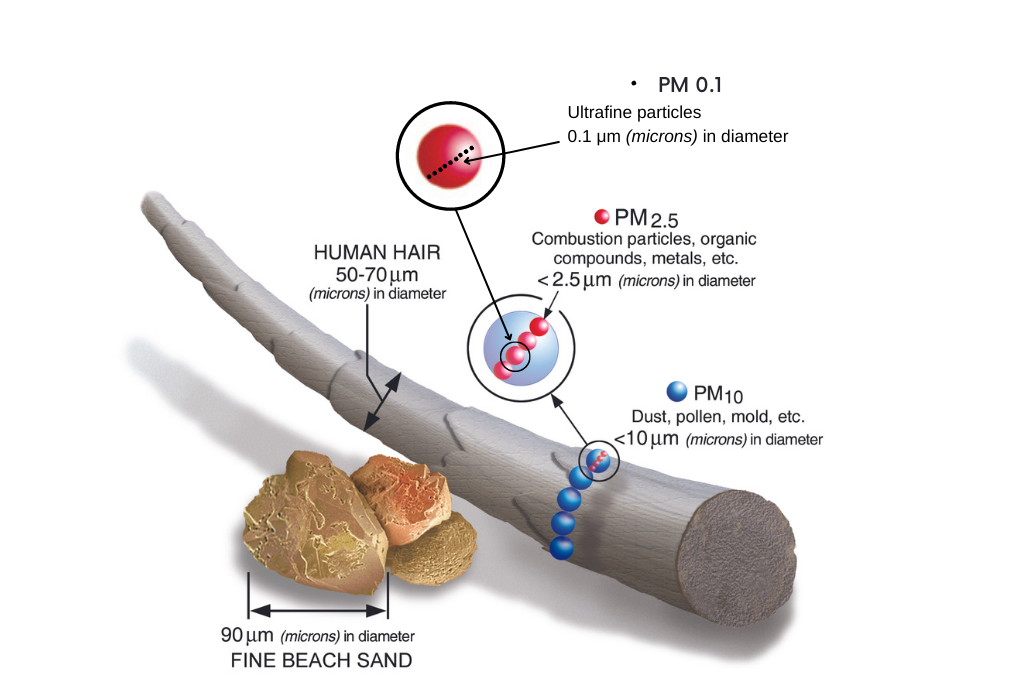
You already know air pollution is bad. But do you know about the tiny particles so small your body can't even detect them — let alone defend against them? Ultrafine particles (UFPs) represent a growing public health concern that most people have never heard of, and the science community hasn't done a great job of explaining why you should care. Unlike larger pollutants your nose and lungs naturally filter out, UFPs — largely produced by jet engines, vehicles, and industrial activity — are so small they slip past every biological defense, entering your bloodstream, lungs, and even your brain. Once they're in, they don't leave. This article breaks down what we know, what we don't, and why the gap between scientific caution and public urgency may be putting lives at risk.
2022-08-13
There is this form of air pollution, which you probably have not heard of, called ultrafine particulates (UFPs). Though they are invisible, they seem to have some particularly nasty effects on human health. UFPs have not been well-studied, they are unregulated, and yet they are prevalent in commercial jet engine emissions. But this is not
2021-09-24
A mini-bio of Clair Patterson, the man who got lead out of (most) of our environment [RADIOLAB INTRO] LATIF NASSER: I’m Latif Nasser. This is Radiolab. Today, a story about how we humans rearrange the elemental stuff all around us, and how one man’s pursuit of a basic truth about the Earth revealed in an extraterrestrial
This letter is in support of a legislative proposal we have made concerning air quality monitors around Sea-Tac Airport. Senator Keiser, Rep. Orwall, Rep. Johnson. I know how busy you all are. I hope you will take 4 minutes to listen to this very good piece of audio. You can start at about 1:40. https://seatacnoise.info/otm111320_cms1067654_pod/
Long-Form: Chronically catastrophic chemist Thomas Midgley accidentally poisons the world with a neurotoxin, and Clair Patterson tries to stop him. Written by Alan Bellows • Non-Fiction • December 2007 Thomas Midgley At the turn of the twentieth century, as the age of automobiles was afoot, the newfangled gasoline-powered internal combustion engine began to reach the limitations of the fuel that fed it. As
 2021-09-24
 2017-02-10