Skip to content
  • STNI
  • Statistics
    • Ops and Passengers
      • King County International Airport (Boeing Field) Annual Operations
    • Financials
    • Aviation fuel uplift in the State of Washington 2018 – 2025
      • Aviation Fuel Tax Revenue in the State of Washington 1983-2025
      • Aviation Fuel Uplift at Sea-Tac Airport
    • Air Quality Monitoring
    • Flight Tracking
      • Flow and Flight Tracks
      • Five Year Comparison
      • Busiest Hours and Days
    • SEL Noise Reports & Graphs
      • About The Permanent Noise Monitors
      • Minutes of Quiet by Noise Monitor
      • Noise Events mapped
      • Noise Events (SEL)
    • Runways
    • Employees
    • Real Estate
      • Port Properties and Trees mapped
    • Parking
  • Events
  • Protest
    • Regular Events
    • Policy
      • Legislative Agenda 2027
      • Airport mitigation for the twenty first century
      • Port Dracula
    • Complain about a particular flight
    • Advocacy Organizations
    • Media Outlets
    • People
    • The Port of Seattle
      • Commission Meetings
      • Public Records Requests
      • StART
      • Highline Forum
    • Contact Your Electeds
  • Resources
    • FAQs
      • FAA Occurrences/Accidents/Indents
    • The SAMP
      • SAMP Public Comment Template
        • Two versions of Appendix K: NEPA/SEPA 2018 vs 2023
      • SAMP NTP: 31 projects by the numbers
      • SEPA Draft EIS (2026)
      • SAMP Record of Decision/FONSI (2025)
      • SAMP Draft EA (October 2024)
      • 2018 Scoping
    • Port Packages
      • Port Package Property Costs
      • Port Packages mapped
      • The Port Package Explainer
      • So you want a (first-time) Port Package? Start here
      • Port Package Looker Upper
      • How do I determine if I have a Port Package or Avigation Easement?
      • Progress on Port Package Update legislation
      • Having a Port Package Problem?
      • Port Package Site Visit Follow-Up
    • Document Library
    • Explainers
      • The Airport Law Cheat Sheet
      • The Grant Explainer
    • External Articles
    • History
      • Timeline
      • The Sea-Tac Communities Plan
        • Sea-Tac Communities Plan – Planning Maps
      • PSRC Third Runway Decision Process
    • Studies
    • Videos
  • Stories
  • Mission
  • Subscribe
  • Contact
Scroll down to content

Get InformedStay Informedx

I understand that you will never share my information with anyone, you will only use it to keep me updated on relevant events and that I may unsubscribe at any time.

STNI

STNISea-Tac Noise.Info

  • Solve for Sea-Tac. Solve for every airport.
  • Since 2016, working to obtain justice for everyone living under the flight path.
  • Less Noise. Cleaner Air. Better Public Health. Compensation.
  • Everything you think you know about the airport is wrong.

TagCouncil on Environmental Quality(8)

Advanced Search Options

  • Dates
  • Media
    • External Articles
    • Images
    • PDFs
    • Video
    • Audio
  • Order By
  • CEQ Scoping for Cumulative Effects

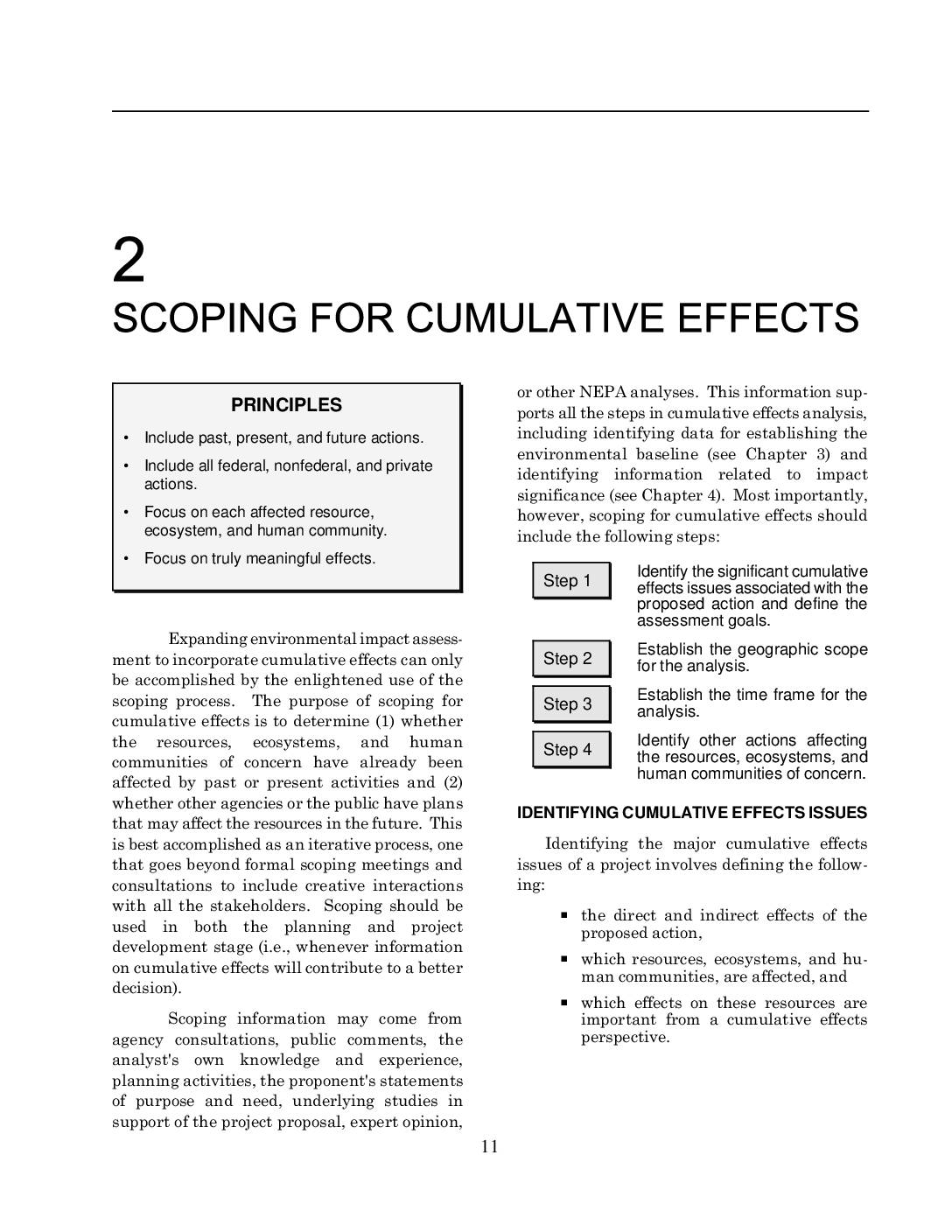
    This document outlines principles and steps for conducting cumulative effects analysis in environmental impact assessments. It covers identifying cumulative effects issues, establishing geographic and temporal boundaries, and determining which effects are important from a cumulative perspective. https://ceq.doe.gov/docs/ceq-publications/ccenepa/sec2.pdf
    TagsCEQ, Council on Environmental Quality, Environmental Impact Statement, NEPAFolderCEQ
  • 2025-10-24

    Permitting Reform in Action: CEQ Updates Roadmap for Agency NEPA Compliance

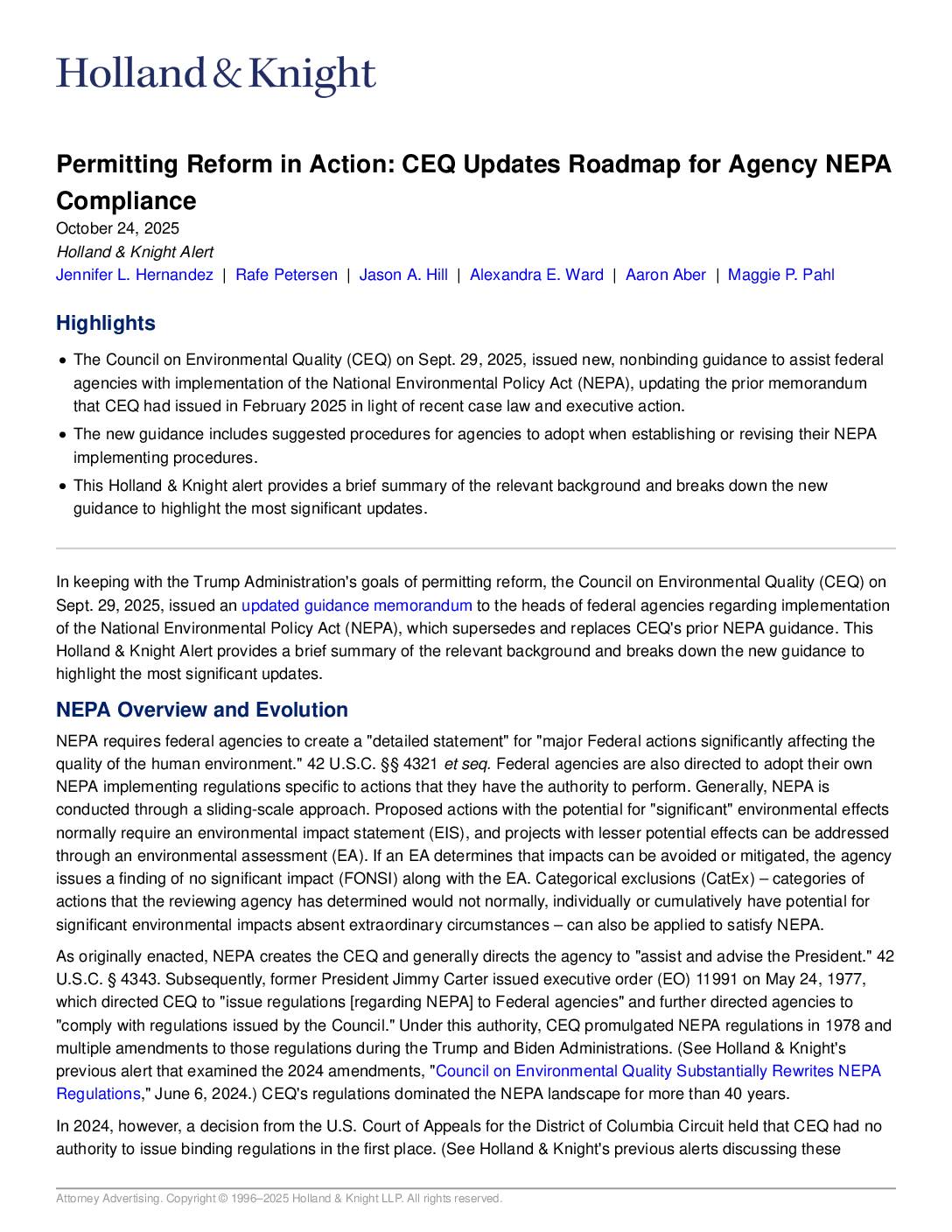
    In September 2025, the Council on Environmental Quality (CEQ) issued updated non-binding guidance to federal agencies on how to conduct environmental reviews under the National Environmental Policy Act (NEPA), replacing earlier guidance from February 2025. The update streamlines the permitting process by incorporating a recent Supreme Court ruling limiting the scope of required environmental analysis, removing climate change and environmental justice considerations, and introducing an optional fee-based program that cuts review timelines in half. Agencies are encouraged to revise their own NEPA procedures using a provided template while continuing existing review processes without delay.
    TagsCEQ, Council on Environmental Quality, Environmental Impact Statement, NEPA, PermittingFolderCEQ
  • 2025-05-30

    U.S. Supreme Court Narrows NEPA Review

    Court removes “indirect effects” requirement The U.S. Supreme Court issued a unanimous decision, on May 29, 2025, narrowing the scope of environmental review under the National Environmental Policy Act (NEPA).  In Seven County Infrastructure Coalition v. Eagle County, Colorado, the Court reversed in part the D.C. Circuit Court of Appeals’ finding that the Surface Transportation
    CategoriesFrom The Web, Litigation, News Stories TagsCouncil on Environmental Quality, Kaplan Kirsch Rockwell, NEPA, Press Release, Supreme Court
  • 2024-06-06

    Council on Environmental Quality Substantially Rewrites NEPA Regulations

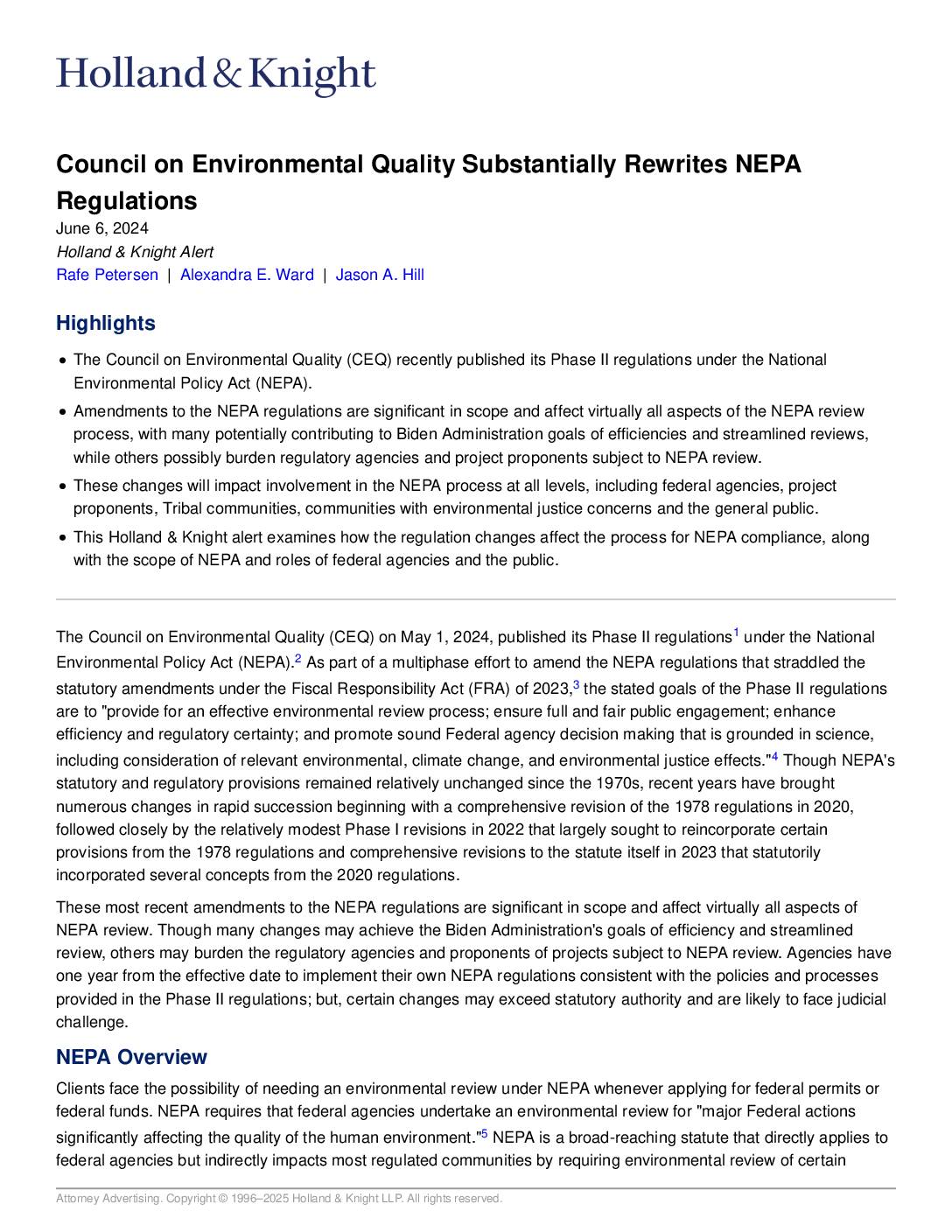
    In May 2024, the Council on Environmental Quality published major updates to the rules governing how federal agencies must review environmental impacts of projects, affecting everything from public participation to project timelines. The changes place new emphasis on environmental justice, requiring agencies to meaningfully engage communities facing disproportionate environmental burdens, and remove previous rules that limited who could challenge agency decisions in court. While some updates are designed to speed up the review process, others may add new requirements for agencies and project sponsors seeking federal permits or funding.
    TagsCEQ, Council on Environmental Quality, Environmental Impact Statement, Environmental Justice, NEPAFolderCEQ
  • 2024-06-01

    Council on Environmental Quality Substantially Rewrites NEPA Regulations

    Highlights The Council on Environmental Quality (CEQ) recently published its Phase II regulations under the National Environmental Policy Act (NEPA). Amendments to the NEPA regulations are significant in scope and affect virtually all aspects of the NEPA review process, with many potentially contributing to Biden Administration goals of efficiencies and streamlined reviews, while others possibly
    CategoriesFrom The Web TagsCouncil on Environmental Quality, Holland & Knight, NEPA
  • 2005-06-24

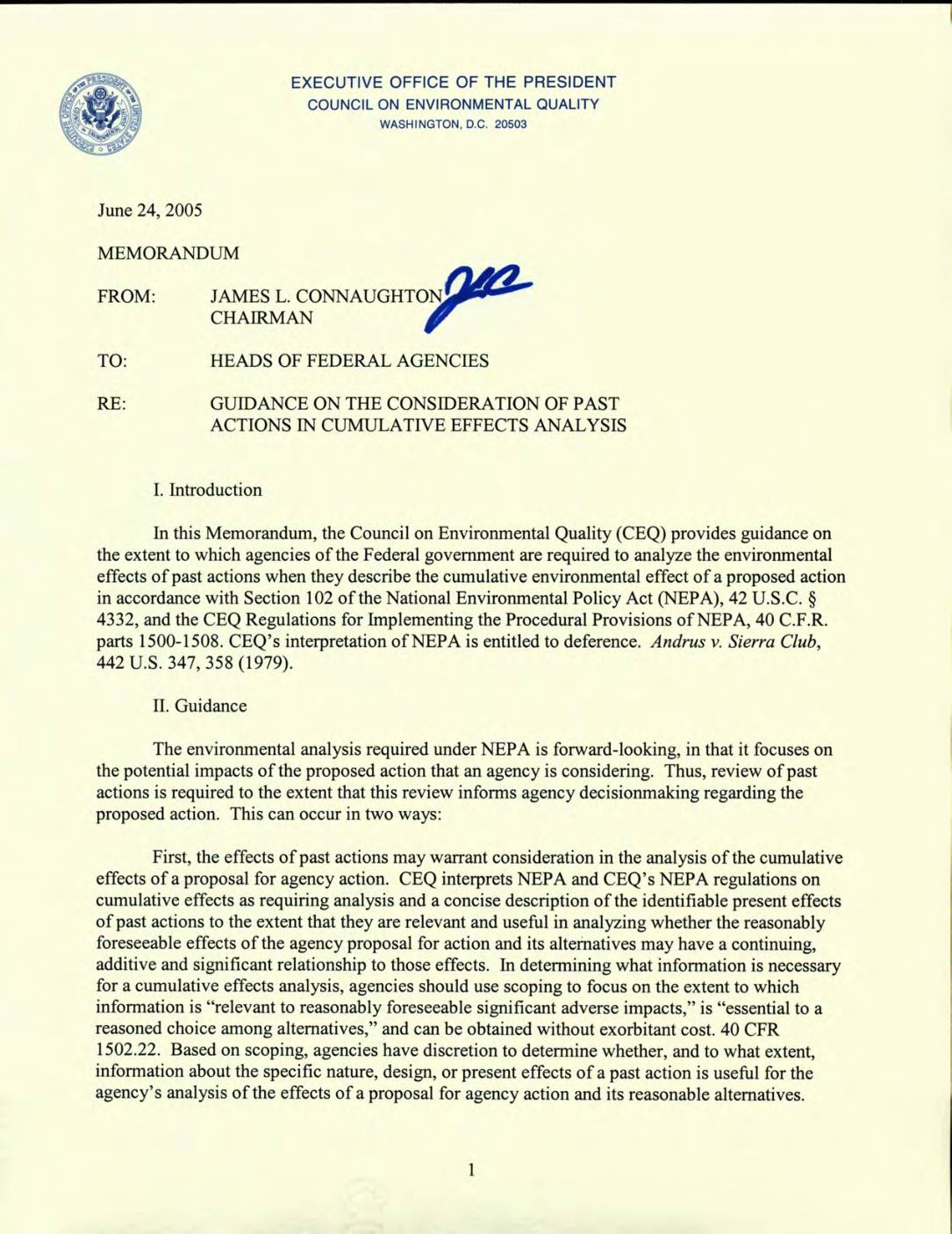
    Guidance on the consideration of past actions in cumulative effects analysis

    This 2005 memo from the White House Council on Environmental Quality instructs federal agencies on how to handle past actions when analyzing cumulative environmental impacts under the National Environmental Policy Act (NEPA). Agencies are not required to exhaustively catalog every past action, but must describe their current combined effects when those effects are relevant to a proposed action's foreseeable environmental impacts. The guidance emphasizes using the scoping process to focus analysis on truly significant cumulative effects rather than accumulating unnecessary background data.
    TagsCEQ, Council on Environmental Quality, Environmental Review, NEPAFolderFAA
  • 1997-01-01

    Considering Cumulative Effects Under NEPA (Executive Summary)

    A handbook by the Council on Environmental Quality providing framework and methods for analyzing cumulative effects in environmental assessments and impact statements under NEPA. The document outlines principles, steps, and data sources for cumulative effects analysis but does not establish new legal requirements.
    TagsCouncil on Environmental Quality, Environmental Impact Statement, NEPAFolderCEQ
  • 1980-06-01

    Guidelines for considering noise in land use planning and control

    Published in June 1980 by the Federal Interagency Committee on Urban Noise, this document provides guidelines for incorporating noise considerations into land use planning and control decisions. It was produced jointly by the U.S. Department of Transportation, Department of Defense, Environmental Protection Agency, and Department of Housing and Urban Development. The guidelines are intended to help planners and policymakers manage the impact of noise—such as that generated by airports like Sea-Tac—on surrounding communities through zoning and land use strategies.
    TagsCEQ, Council on Environmental Quality, Department Of Transportation, Land Use, NoiseFolderFederal
Sidebar On/Off

Upcoming Events

  • Part 150 NCP Workshop — Burien
    Add to CalendarMSaturday Oct 17: 10:00am

    Attend a Port of Seattle open house on the Part 150 Study Noise Compatibility Program (NCP). The Part 150 program determines the noise boundary around the airport and opportunities for noise mitigation such as sound insulation.

    [...]
  • Part 150 NCP Workshop — SeaTac
    Add to CalendarMMonday Oct 19: 6:00pm

    Attend a Port of Seattle open house on the Part 150 Study Noise Compatibility Program (NCP). The Part 150 program determines the noise boundary around the airport and opportunities for noise mitigation such as sound insulation.

    [...]
  • Part 150 NCP Workshop — Des Moines
    Add to CalendarMTuesday Oct 20: 6:00pm

    Attend a Port of Seattle open house on the Part 150 Study Noise Compatibility Program (NCP). The Part 150 program determines the noise boundary around the airport and opportunities for noise mitigation such as sound insulation.

    [...]

[See all...]


Issues

Sea-Tac Airport is currently undergoing the largest and longest expansion in its history, collectively known as the Sustainable Airport Master Plan (SAMP). Some of it you can already hear, but you’re probably not aware of what it all means. Here’s what you need to know.
read more...

Read This!

As the source for federal transportation grants, the Puget Sound Regional Council was charged with developing a system to meet the growing need for commercial aviation. When the search for a second airport failed, they authorized the Port of Seattle to build the Third Runway, with a mandate to develop a noise abatement and mitigation program. In their effort to stop the Third Runway, the ACC argued over every detail of the Port's efforts--including property buyouts and sound insulation. The dispute was meant to be settled by a three member Expert Arbitration Panel. This is their final report. It finds 2-1, that the Port's program was insufficient in several respects. Despite that, funding for the Third Runway was approved by the PSRC, and the 'Port Package' program, proceeded largely unchanged. Expert Arbitration Panel's final decision finding that the Port of Seattle had not shown sufficient reduction in real on-the-ground noise impacts to satisfy noise reduction conditions required for approval of a third runway at Sea-Tac International Airport. The majority decision concluded the Port's noise abatement programs were insufficient despite being impressive in scope.
continue...

  • Sea-Tac Noise.Info
  • Connect with STNI

    • Subscribe
    • Port Package Problem?
    • Donate
    • Podcast
    • Socials
      • Facebook
      • X (Twitter)
      • Bluesky
      • Instagram
  • Learn

    • Frequently Asked Questions
    • Explainers
    • Youtube
    • Research Requests
    • Complain about one flight
  • Goals

    Fulfill the promises of 1976:
    • Compensation
    • Reduced noise
    • Improved air quality
    • Environmental remediation
Login/Register
©2026•Data Privacy

Message

We use cookies to provide basic functionality. We also provide access to search engines in order to provide site analytics. We do not sell or share your data.
V V