TagPort Packages(186)
-
 2026-07-25
Ep #38 Aviation Forum Postgame (Raw!)
What if the solution to decades of airport noise and community impacts has been hiding in plain sight all along? In this open letter to city managers across airport communities, we revisit a landmark yet largely forgotten document: the Sea-Tac Communities Plan of 1976. Built on the Port of Seattle's promise — *"As we do better, you'll do better"* — this collaborative plan was supposed to be the long-term answer for neighborhoods living under the flight path. So why has it been reduced to little more than an expensive property buyout program? The answer reveals a critical gap that neither elected officials nor community advocates can fill alone. Real, lasting solutions require sustained professional commitment to airport community planning — something that should have been established 50 years ago. If you work in city management, this episode speaks directly to you and the unique role only you can play in finally delivering on that broken promise. -
2026-07-08
Ep #37 Dear City Managers
What if the solution to decades of airport noise and community impacts has been hiding in plain sight all along? In this open letter to city managers across airport communities, we revisit a landmark yet largely forgotten document: the Sea-Tac Communities Plan of 1976. Built on the Port of Seattle's promise — *"As we do better, you'll do better"* — this collaborative plan was supposed to be the long-term answer for neighborhoods living under the flight path. So why has it been reduced to little more than an expensive property buyout program? The answer reveals a critical gap that neither elected officials nor community advocates can fill alone. Real, lasting solutions require sustained professional commitment to airport community planning — something that should have been established 50 years ago. If you work in city management, this episode speaks directly to you and the unique role only you can play in finally delivering on that broken promise. -
2026-06-28
Ep #36 Orphans
**Discover why environmental progress stalled for airport communities while cars got cleaner** Ever wonder why your car's emissions have dramatically improved over decades, but aviation seems stuck in the past? In this eye-opening episode of The Airport Communities Podcast, we explore the fascinating tale of two environmental paths that diverged after 1970. While Washington Senator Scoop Jackson spearheaded NEPA—one of the largest expansions of environmental policy in American history—and California secured game-changing carve-outs in the Clean Air Act that led to massive air quality improvements, aviation somehow got left behind. Despite Boeing being headquartered in Washington, aviation environmental standards never caught up. UW Meteorologist Cliff Mass delivers some stark perspective: those two annual flights to Europe generate more greenhouse gases than most people produce in their entire homes over a year. Meanwhile, Boeing's monopoly status has eliminated market incentives for cleaner technology. This wasn't an oversight—it was intentional. Today, every airport community continues paying the price for decisions made decades ago that exempted aviation from automotive-level engineering standards. -
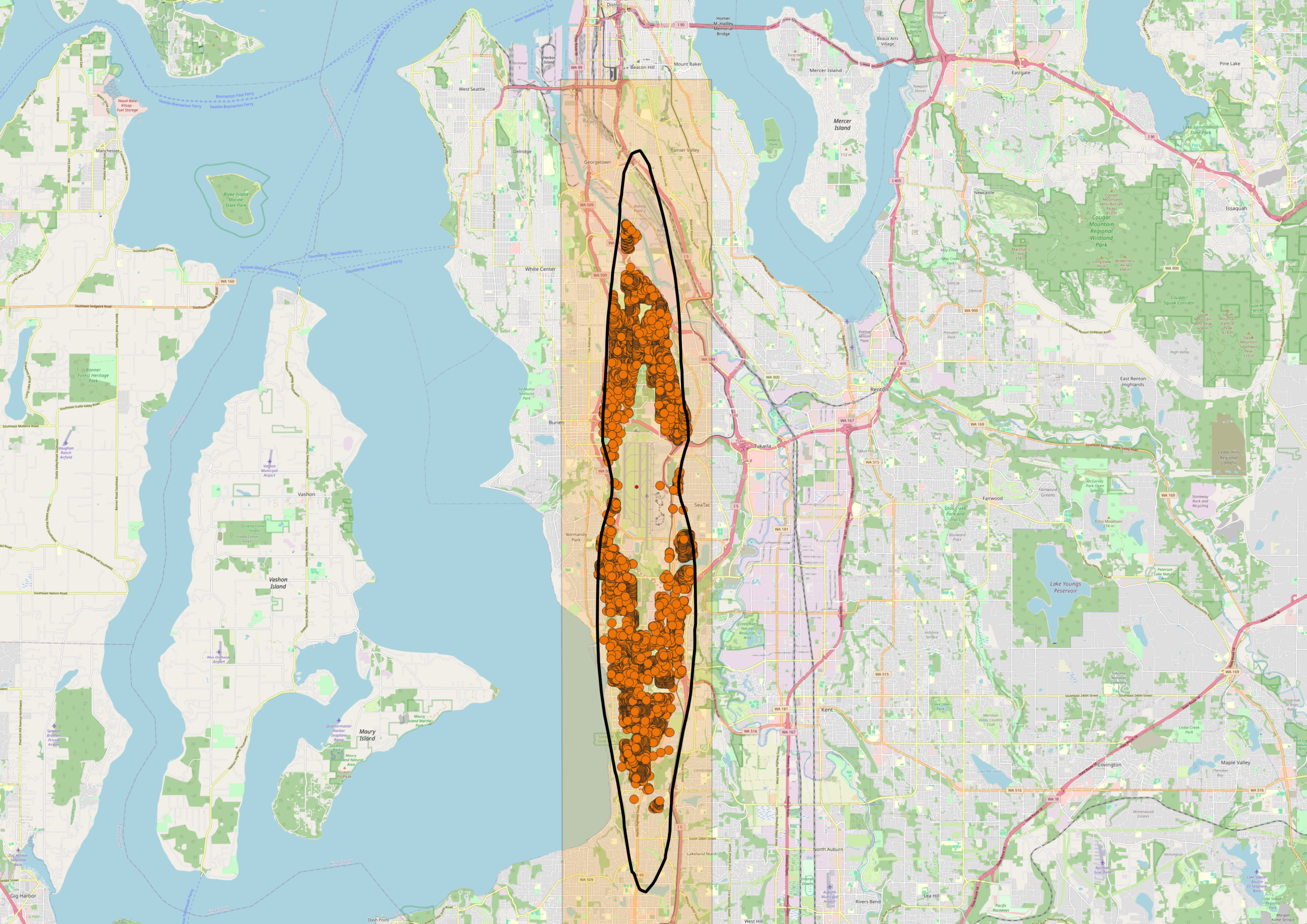
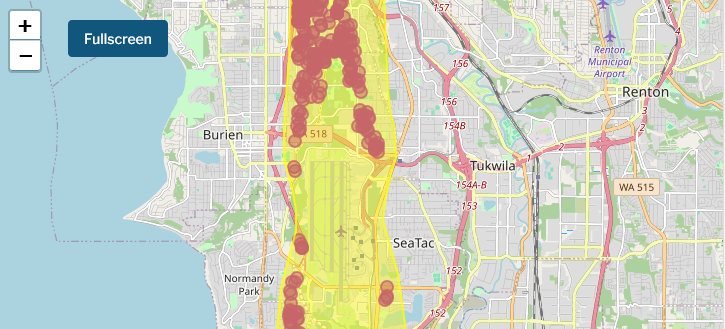
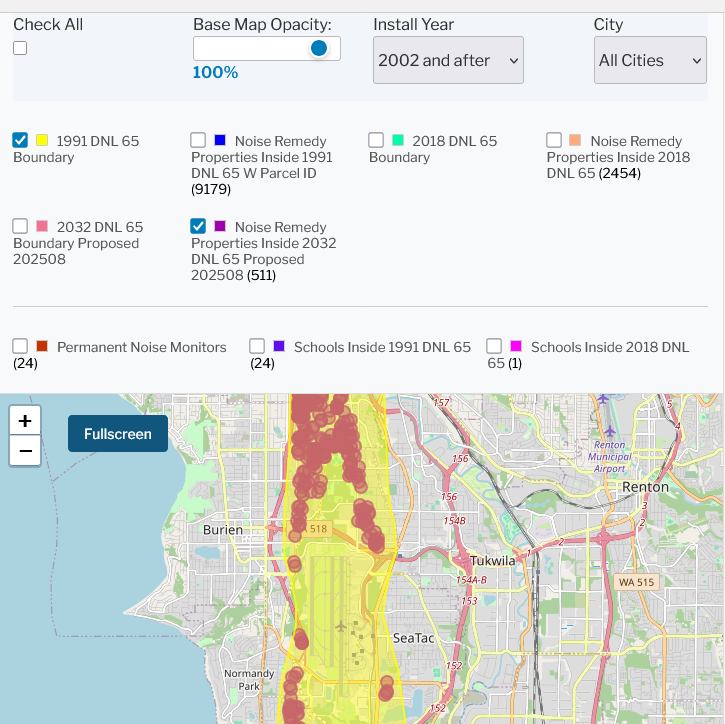
Port Packages mapped: eligibility over time
Changes 1985-2032 The black outline depicts the 1985-2013 Part 150 noise contour. The light orange rectangle is the 92 sq mile area defined under State of Washington law (RCW 53.54.020) that is eligible for funding to mitigate noise impacts–but only those generated by Sea-Tac Airport. All sound insulated homes inside the original DNL65 (1985-2032). Sound -
 2026-01-30
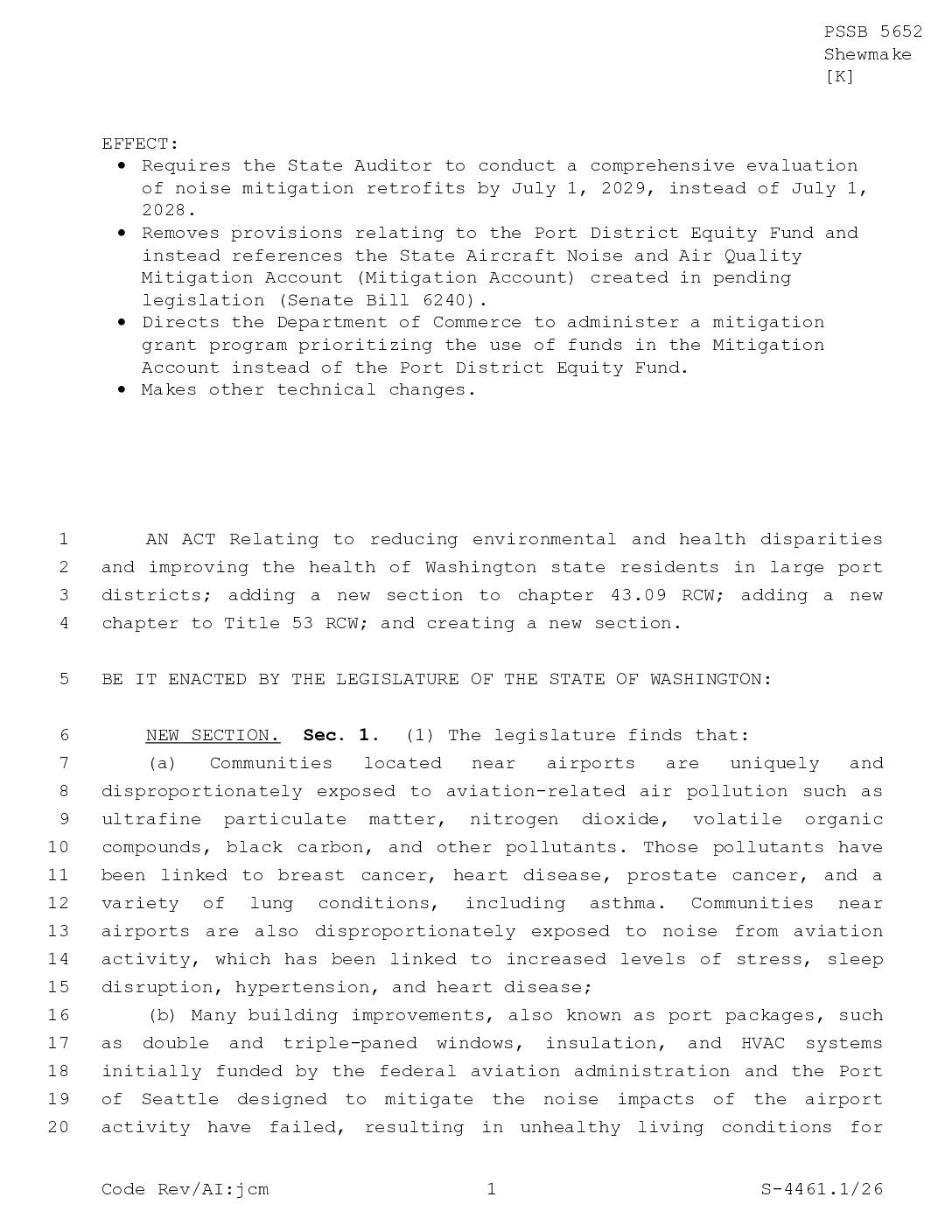
PSSB 5652: An Act Relating to Reducing Environmental and Health Disparities and Improving the Health of Washington State Residents in Large Port Districts
Washington State legislation (PSSB 5652) aimed at reducing health and environmental impacts on communities near Sea-Tac Airport, where residents face disproportionate exposure to aviation-related air pollution and noise linked to serious health conditions. The bill establishes a grant program to fix failed noise-mitigation home improvements (known as 'port packages') and fund new mitigation strategies, while directing the University of Washington to conduct ongoing air quality and noise assessments every two years. It also requires the State Auditor to evaluate the Port of Seattle's noise mitigation efforts and directs the Department of Commerce to administer a mitigation grant program using the State Aircraft Noise and Air Quality Mitigation Account. -
 2025-12-18
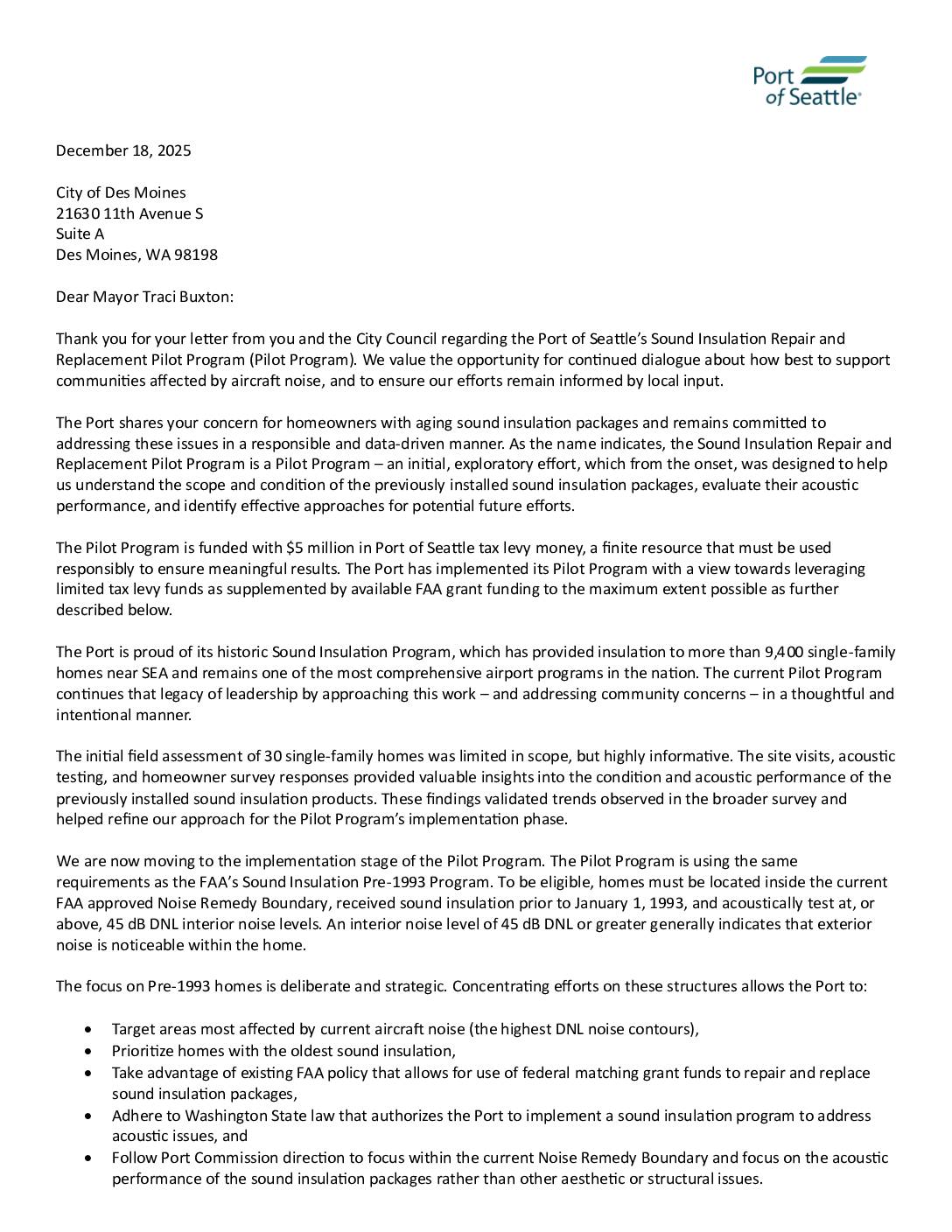
Port Of Seattle Response Letter to Des Moines Mayor Traci Buxton: Sound Insulation Repair and Replacement Pilot Program
The Port of Seattle wrote to Des Moines Mayor Traci Buxton in December 2025 to explain its Sound Insulation Repair and Replacement Pilot Program, a $5 million initiative aimed at helping homeowners near Seattle-Tacoma International Airport whose aging sound insulation packages may no longer be performing adequately. The program focuses on homes that received insulation before 1993 and are located within the FAA-approved Noise Remedy Boundary, with eligibility determined by acoustic testing showing interior noise levels at or above 45 dB DNL. Of the 117 homes tested in the initial phase, five were found eligible, and the Port plans to expand outreach to an additional 209 homes in early 2026 while pursuing FAA grant funding that could cover up to 80% of design and construction costs. -
Port Packages Mapped Year Filter Sea Tac Noise.info Cropped
An interactive web map displaying aircraft noise impact zones around Seattle-Tacoma International Airport (Sea-Tac), with a heat map overlay showing high-intensity noise areas (dark red/maroon) concentrated along the north-south runway corridor. The affected communities visible include Burien, Normandy Park, SeaTac, and Tukwila, with highway routes including WA-518, WA-515, and I-5 corridor visible as reference points. -
Port Packages Mapped Year Filter Sea Tac Noise.info
Interactive GIS map displaying multiple Day-Night Level (DNL) 65 noise boundary layers around Seattle-Tacoma International Airport, including the 1991, 2018, and proposed 2032 boundaries, along with noise remedy properties (9179 parcels under 1991 boundary, 2454 under 2018, 511 under proposed 2032), permanent noise monitors (24), and schools inside noise contours. The map covers the cities of Burien, Tukwila, SeaTac, Normandy Park, and Renton. -
 2025-10-09
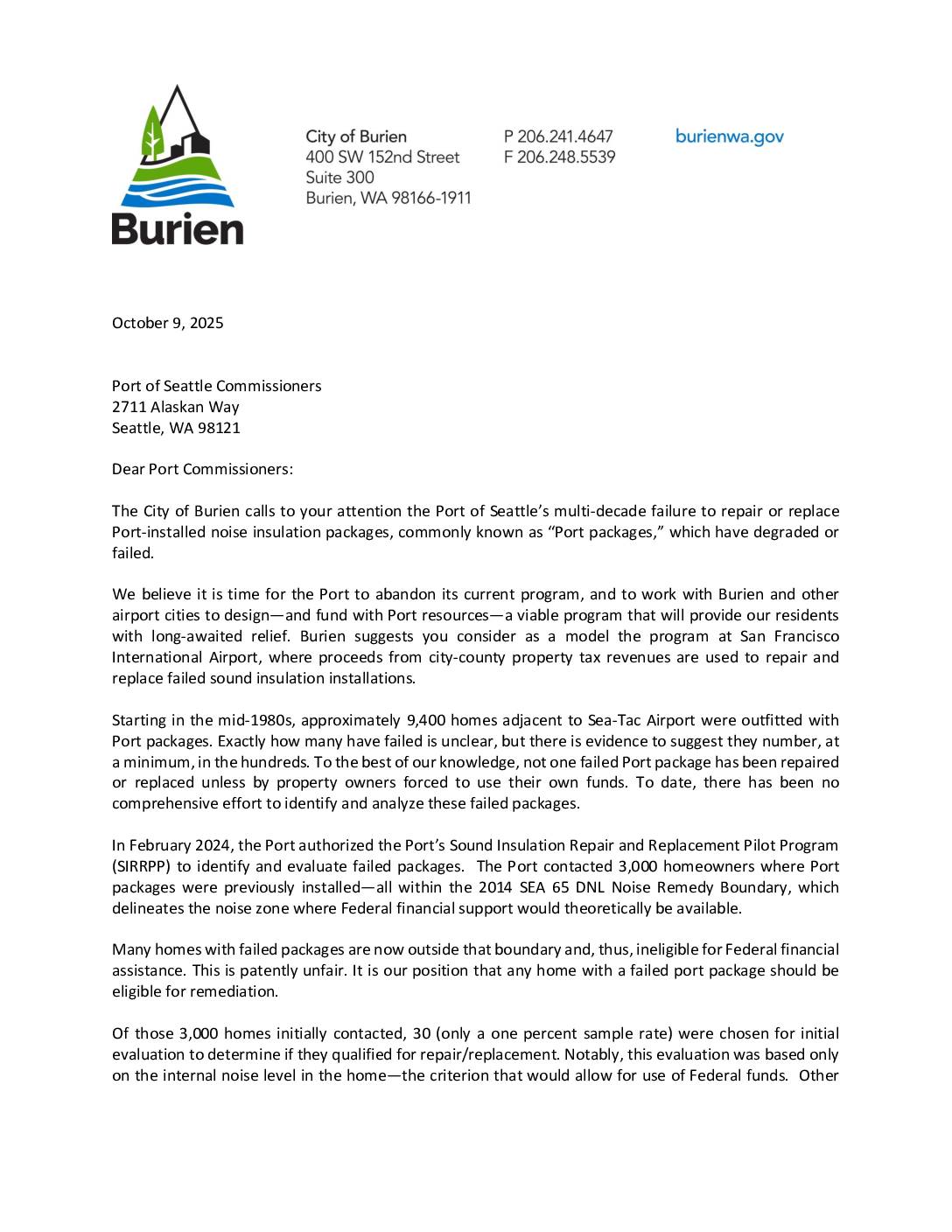
City of Burien letter to Port Of Seattle Commissioners regarding failed noise insulation packages
The City of Burien sent this October 2025 letter to Port of Seattle Commissioners demanding a new, Port-funded program to repair or replace failed noise insulation packages installed in roughly 9,400 homes near Sea-Tac Airport since the mid-1980s. The city criticizes the Port's existing pilot program (SIRRPP) as inadequate, noting that none of the 30 homes evaluated qualified for repair or replacement and that many affected homes fall outside the boundary eligible for federal funding. Burien urges the Port to stop relying on federal or state dollars and instead model a solution after San Francisco International Airport's locally funded approach. -
 2025-10-06
Update from Burien Airport Committee
The City of Burien is calling on Port of Seattle Commissioners to overhaul their decades-old noise insulation program after hundreds of Port-installed soundproofing packages in homes near Sea-Tac Airport have degraded or failed with no repairs made. A 2024 pilot program contacted 3,000 homeowners but evaluated only 30, and none qualified for repair under the Port's narrow federal-funding criteria. Burien is urging the Port to fund a broader replacement program using its own resources, pointing to San Francisco International Airport's locally funded model as a potential template.