TagTimothy Larson(13)
-
 2024-10-24
Assessing exposures to source-specific air pollution through a multi-pollutant mobile monitoring campaign in Seattle, WA
This presentation from the 2024 International Society of Exposure Science annual meeting describes a mobile air quality monitoring study conducted in Seattle, Washington, aimed at measuring exposure to pollutants from specific pollution sources. Researchers from the University of Washington used a multi-pollutant mobile monitoring campaign to assess how residents are exposed to various types of air pollution across different locations in the city. The study covers methods, results, and conclusions related to source-specific air pollution exposure assessment. -
 2021-03-29
Characterizing Ultrafine Particulate Matter and Black Carbon Exposure Levels for a Seattle-Based Cohort From a Mobile Monitoring Campaign
This research presentation describes a mobile air monitoring study conducted in Seattle to measure ultrafine particulate matter and black carbon pollution levels for elderly residents participating in the Adult Changes in Thought (ACT) study, which investigates aging and dementia. Researchers used a vehicle-mounted monitoring system to collect repeated short-term air quality samples across the Seattle area, aiming to estimate long-term pollution exposure for cohort participants aged 65 and older. The study is funded by the National Institute of Environmental Health Sciences and the National Institute on Aging. -
 2020-12-05
The relationship between flight traffic, ultrafine particles and noise from the Seattle Aircraft Air and Noise Study
Researchers from the University of Washington School of Public Health examined how aircraft flight traffic at Seattle-Tacoma International Airport relates to ultrafine particle pollution and noise levels in surrounding communities. The study highlights that neighborhoods such as Beacon Hill and other South King County areas already rank among the most environmentally burdened in Washington State, facing cumulative hazards including both air and noise pollution from aircraft. The findings are intended to inform policy discussions about the health impacts of airport operations on nearby, often disadvantaged, communities. -
 2020-12-01
Community health and airport operations related noise and air pollution: Report to the legislature in response to Washington State House Bill 1109
This December 2020 report, prepared by Public Health Seattle & King County in response to Washington State House Bill 1109, examines how noise and air pollution from airport operations affect the health of communities near Sea-Tac Airport compared to the rest of King County. It reviews evidence on pollutants such as ultrafine particulates, their links to conditions like asthma, heart disease, and reduced life expectancy, and includes findings from a University of Washington study on air quality. The report concludes with recommendations for addressing these public health impacts. -
 2019-05-07
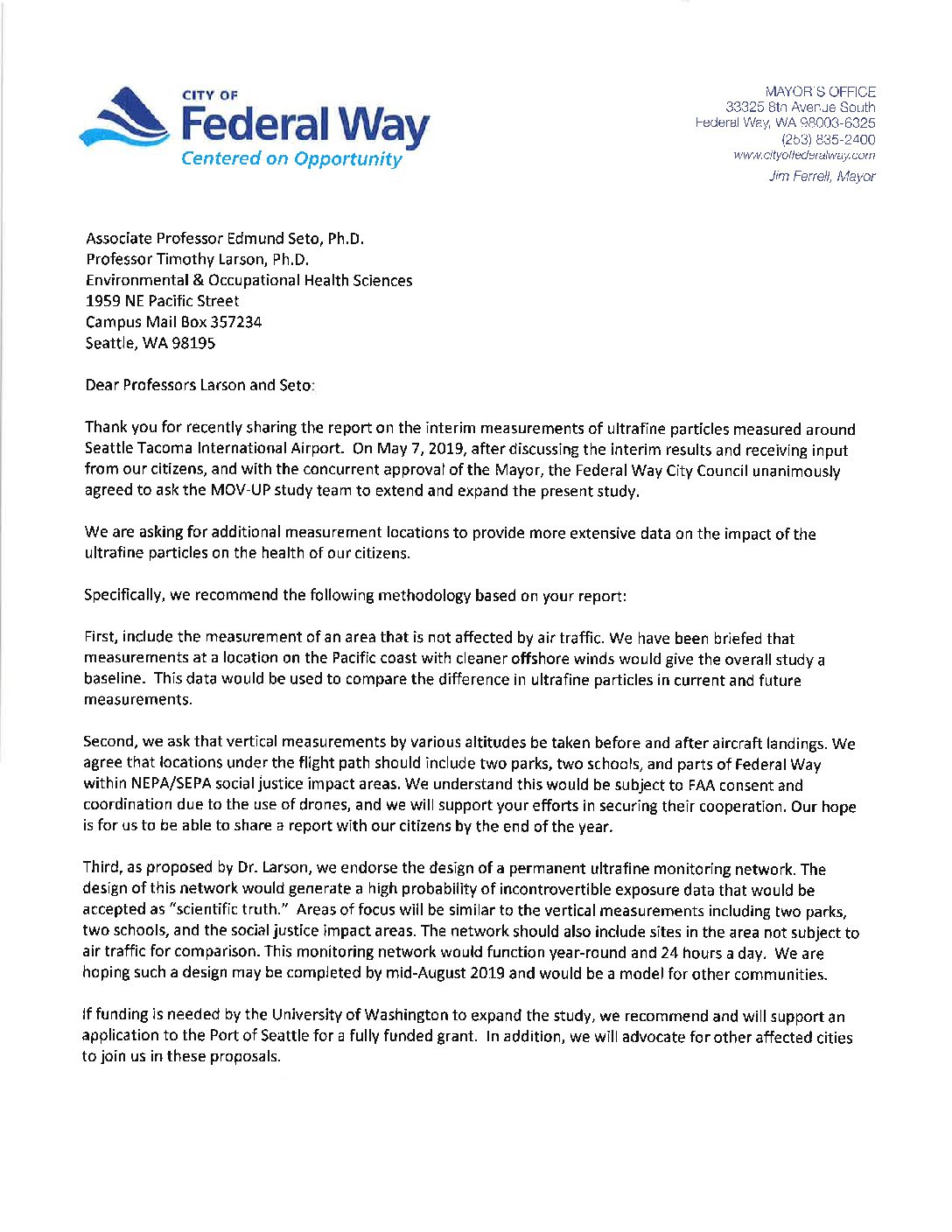
Federal Way Mayor and City Council Letter to UW Professors Larson and Seto Requesting Expansion of MOV-UP Ultrafine Particle Study Near Sea-Tac Airport
In May 2019, Federal Way Mayor Jim Ferrell and the unanimous City Council wrote to University of Washington researchers requesting an expansion of the MOV-UP study measuring ultrafine particle pollution around Seattle-Tacoma International Airport. The letter calls for three key additions: a baseline measurement site unaffected by air traffic, drone-based vertical air sampling before and after aircraft landings at parks, schools, and social justice impact areas, and the design of a permanent 24/7 ultrafine particle monitoring network. The city also offered to support a Port of Seattle grant application to fund the expanded research and pledged to encourage other affected communities to join the effort. -
 2019-04-01
Ambient Ultrafine Particles Near Sea-Tac Airport: Presentation to the Federal Way Transportation & Planning Commission
Researchers from the University of Washington studied ultrafine particles (UFPs) — tiny airborne pollutants less than 100 nanometers in diameter — near Seattle-Tacoma International Airport. Their findings highlight that jet aircraft engines produce exceptionally small particles (under 30 nanometers), while diesel vehicles also contribute elevated UFP levels within about 200 meters of major roads. Although UFPs are currently unregulated, a growing body of scientific evidence suggests they pose significant health risks to nearby communities. -
 2019-01-23
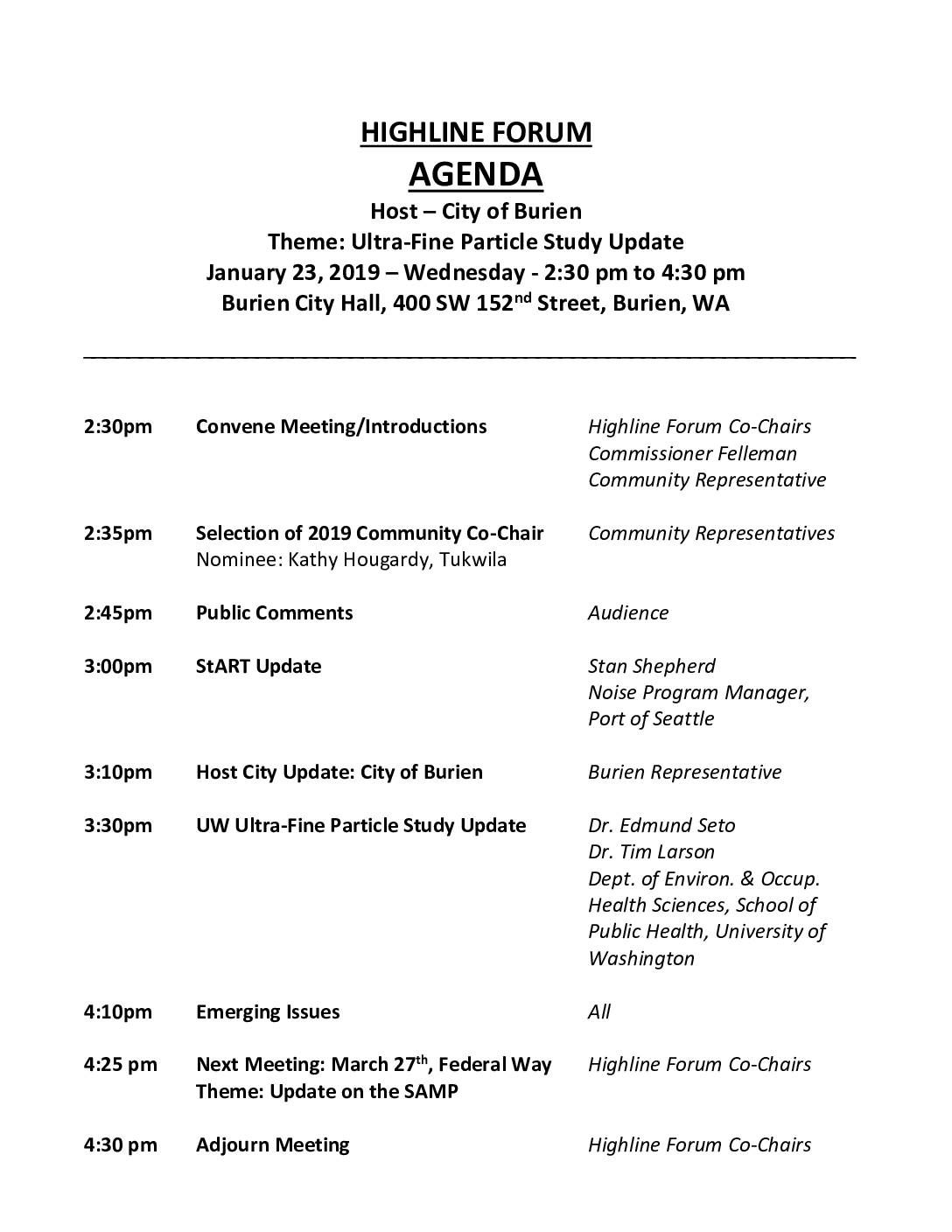
Highline Forum agenda: Ultra-Fine Particle Study Update, January 23, 2019
The Highline Forum held its January 23, 2019 meeting at Burien City Hall, focusing on an update of the University of Washington's Ultra-Fine Particle Study presented by researchers from the UW School of Public Health. The agenda also included a StART program update from the Port of Seattle's Noise Program Manager, selection of a 2019 Community Co-Chair, and a City of Burien host update. The forum scheduled six bimonthly meetings throughout 2019, rotating among cities near Seattle-Tacoma International Airport including Federal Way, SeaTac, Tukwila, and Des Moines. -
 2016-12-27
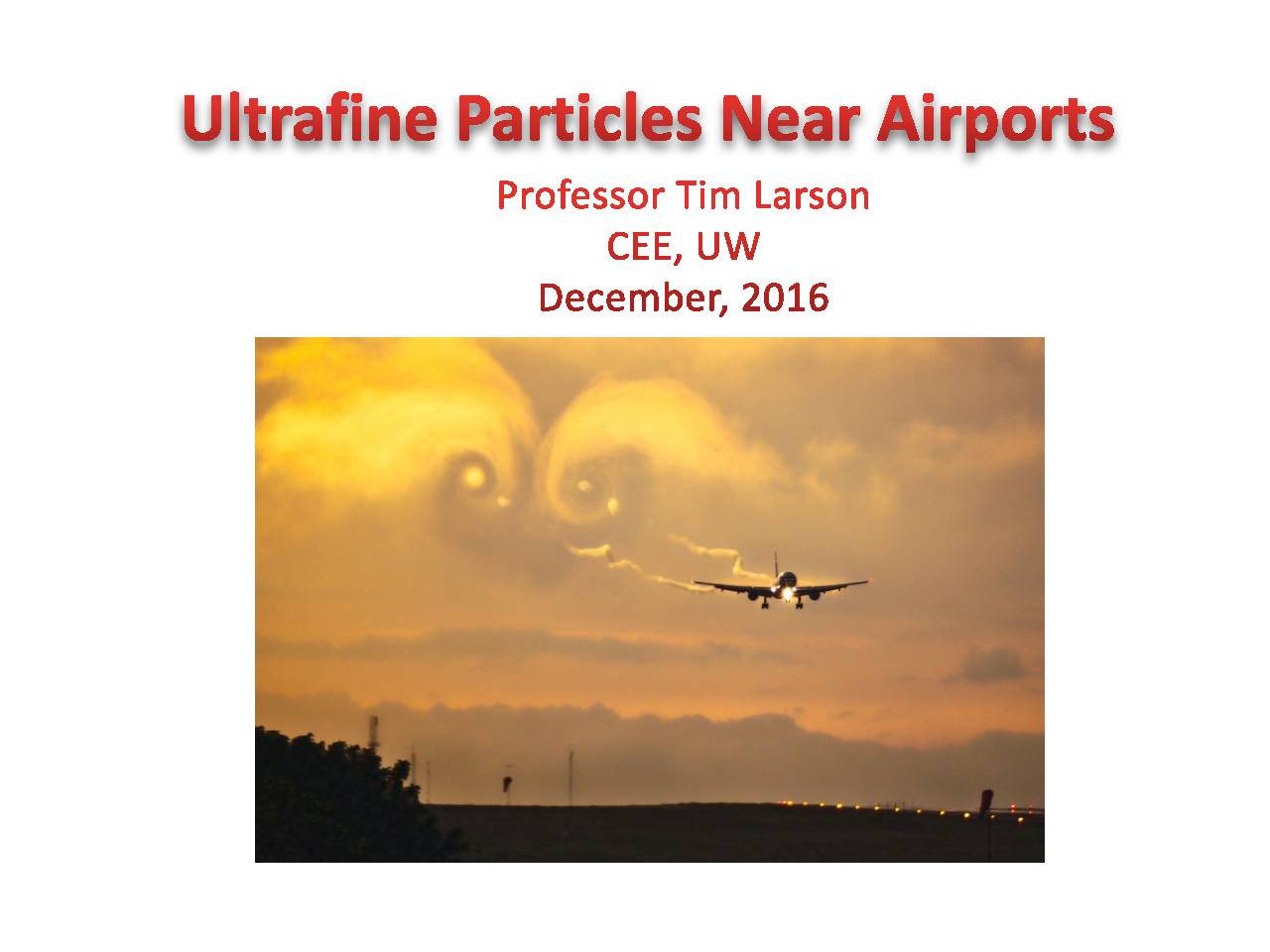
Ultrafine Particles Near Airports
This December 2016 presentation by University of Washington Professor Tim Larson examines ultrafine particles (UFPs) — tiny airborne particles smaller than 0.1 micrometers — found near airports, including sources such as jet engine exhaust and other combustion products. The research, conducted in collaboration with USC scientists, investigates the concentration and spread of these microscopic particles in communities surrounding airports. The findings are relevant to ongoing discussions about air quality and public health impacts near facilities like Sea-Tac Airport. -
 2016-12-01
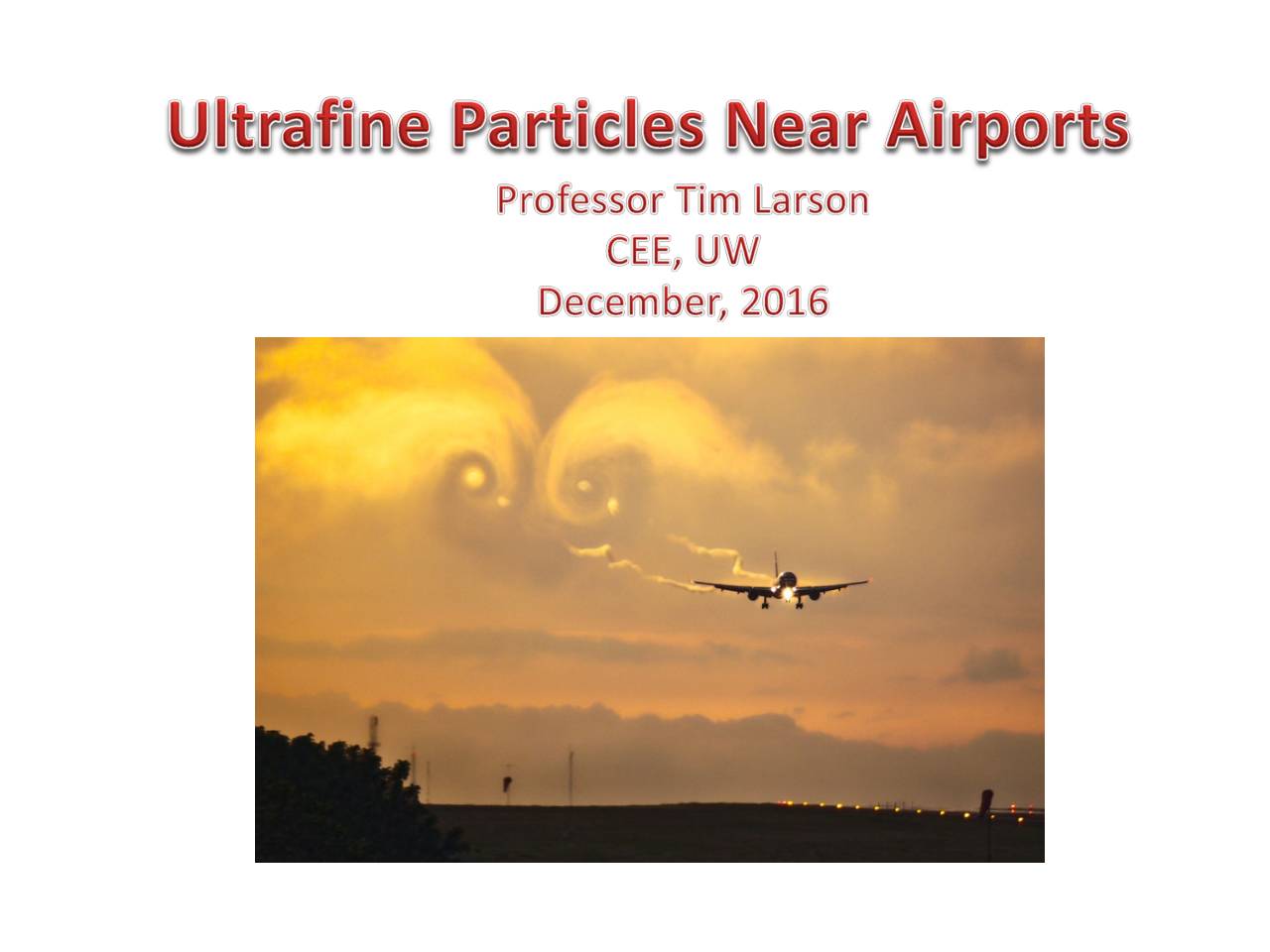
Ultrafine Particles Near Airports
This December 2016 presentation by University of Washington Professor Tim Larson examines ultrafine particles (UFPs) — tiny airborne particles smaller than 0.1 micrometers — found near airports, with a focus on emissions from aircraft and other combustion sources. Conducted in collaboration with researchers from UW and USC, the study explores how these microscopic particles, which are far smaller than diesel smoke or tobacco smoke particles, may pose environmental and health concerns for communities near airports like Sea-Tac. The research provides scientific context for understanding air quality impacts associated with airport operations. -
 2016-11-17
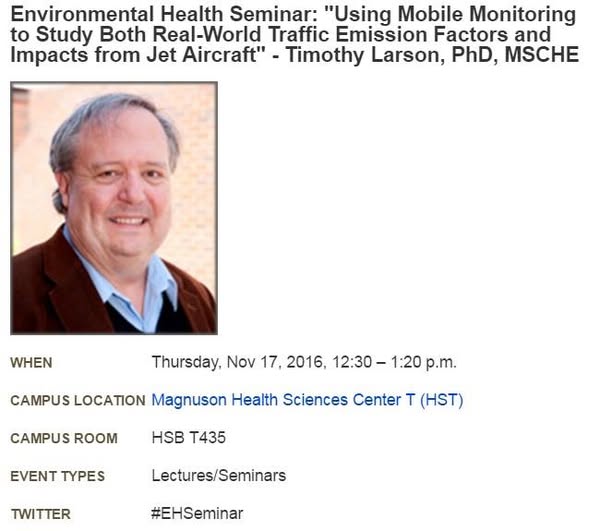
Timothy Larson UW DEOHS seminar flyer — mobile monitoring of traffic emissions and jet aircraft impacts
Flyer for a University of Washington Environmental Health Seminar titled 'Using Mobile Monitoring to Study Both Real-World Traffic Emission Factors and Impacts from Jet Aircraft,' presented by Timothy Larson, PhD, MSCHE. The event was held Thursday, November 17, 2016, 12:30–1:20 p.m. at Magnuson Health Sciences Center T, Room HSB T435.