TagESA(29)
-
 2026-08-30
Appendix C Aircraft Noise
This document explains the fundamentals of aircraft noise at Seattle-Tacoma International Airport, covering how sound is measured in decibels and A-weighted decibels (dBA) to reflect human hearing sensitivity. It describes how outdoor sound levels decrease with distance due to wave spreading and atmospheric absorption, with noise typically dropping 6 dB each time the distance from the source doubles. A comparative chart of common indoor and outdoor noise levels is included to help put aircraft noise levels in everyday context. -
2026-08-30
Appendix C Aircraft Noise
This document explains the fundamentals of aircraft noise at Seattle-Tacoma International Airport, covering how sound is measured in decibels and A-weighted decibels (dBA) to reflect human hearing sensitivity. It describes how outdoor sound levels decrease with distance due to wave spreading and atmospheric absorption, with noise typically dropping 6 dB each time the distance from the source doubles. A comparative chart of common indoor and outdoor noise levels is included to help put aircraft noise levels in everyday context. -
 2026-05-08
What’s heating up for spring – federal permitting policy update
This May 2026 ESA policy briefing provides an update on federal permitting policy, noting that all three branches of government — legislative, executive, and judicial — are actively shaping permitting decisions. A key highlight is that Trump's second term has seen a dramatically higher number of first-year executive orders than any previous administration in recent history, signaling an aggressive pace of executive action on regulatory and permitting matters. While the document focuses broadly on federal permitting trends, its content is relevant to infrastructure and environmental review processes that can affect airport-related noise and land-use decisions. -
 2026-05-01
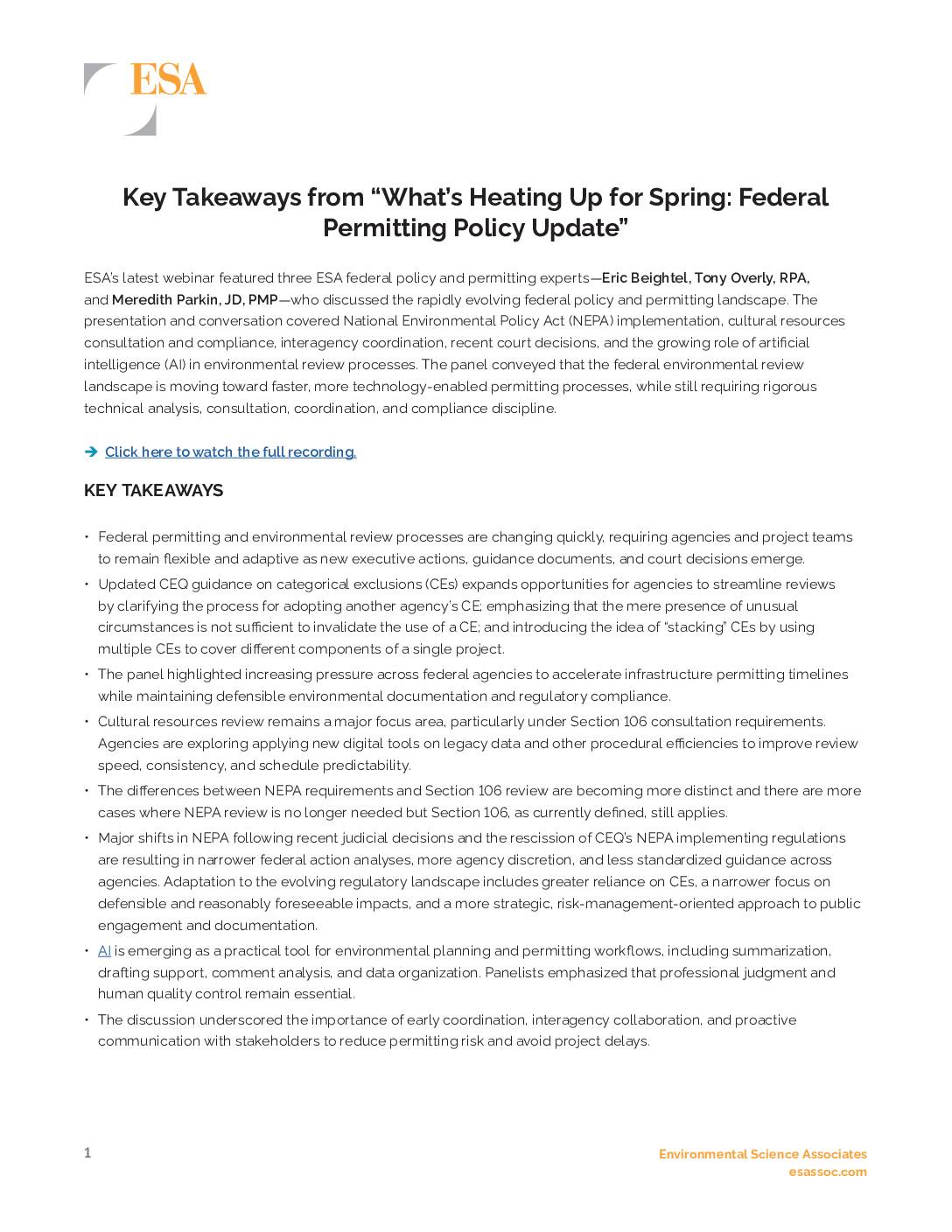
Key takeaways from what’s heating up for spring: federal permitting policy update
Environmental Science Associates hosted a webinar examining rapid changes in federal environmental permitting, covering topics such as streamlined categorical exclusions under NEPA, cultural resources consultation under Section 106, and the growing use of AI tools in environmental review workflows. Experts noted that agencies face increasing pressure to accelerate infrastructure permitting timelines while maintaining legally defensible documentation, particularly as recent court decisions and regulatory rescissions create greater agency discretion and less standardized guidance. Organizations are advised to invest in adaptable workflows and early interagency coordination to manage permitting risk in this shifting landscape. -
2025-11-15
Sea-Tac Airport Part 150 Study Virtual Public Workshop Transcript
Hello and welcome to the virtual public workshop for the Part 150 study for Seattle-Tacoma International Airport. We appreciate you attending this workshop today and your participation and input is a key component of this study. This series of workshops is a continuation of the in-person workshops that were held starting on September 30th. Today -
2025-10-15
Sea-Tac Airport Part 150 Full NEM Virtual Workshop Recording
JENNY THACKER (PRR, Virtual Meeting Facilitator): All right, welcome everybody to the Part 150 study for Seattle Tacoma International Airport virtual public workshop. I’m Jenny Thacker from PRR and I’ll be your virtual meeting facilitator this evening. All participants are automatically muted upon arrival and will remain muted through the entire meeting and those who -
 2025-08-12
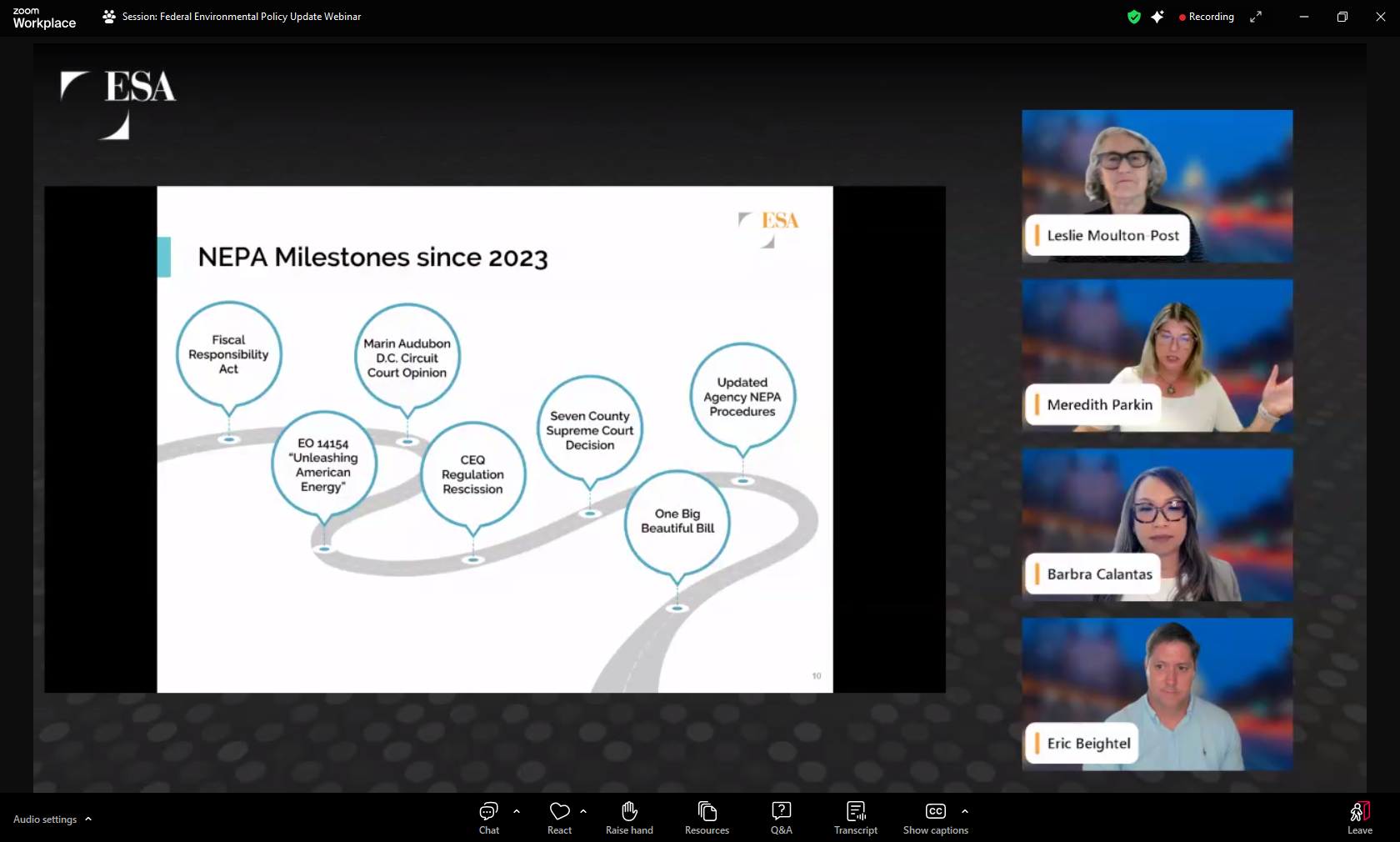
ESA Webinar on recent NEPA policy changes
So many lemons. Maybe some lemonade? Environmental Science Associates (ESA) held a webinar today to provide an overview and meaning to the truly astounding number of policy changes affecting NEPA over the past two years. Although an ‘overview’, the NEPA process is so technical the video may be of interest only to specialists. However, we -
 2025-07-28
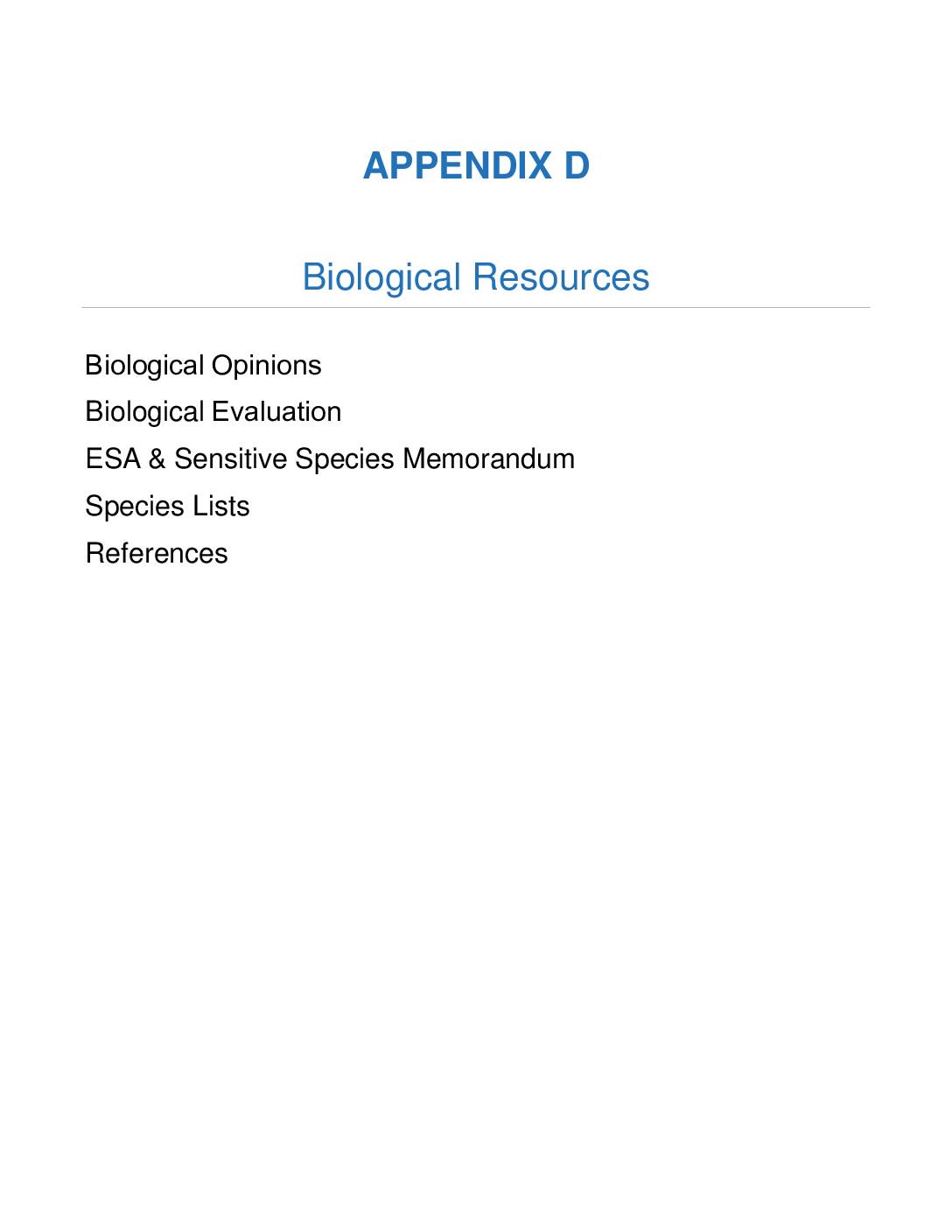
Appendix D: Biological Resources — ESA Section 7(a)(2) Biological Opinion and EFH Response for Sea-Tac Airport Sustainable Airport Master Plan Near-Term Projects
The National Marine Fisheries Service (NMFS) issued a Biological Opinion on July 28, 2025, in response to a Federal Aviation Administration (FAA) consultation request regarding the Seattle-Tacoma International Airport Sustainable Airport Master Plan Near-Term Projects. The opinion evaluates potential effects of the planned airport projects on endangered species and critical fish habitat under the Endangered Species Act and the Magnuson-Stevens Fishery Conservation and Management Act. The review drew on a Final Biological Evaluation prepared by the FAA to assess impacts on species status, critical habitat, and the surrounding environment. -
 2025-07-28
Appendix D: Biological Opinion and Essential Fish Habitat Response for Seattle-Tacoma International Airport Sustainable Airport Master Plan Near-Term Projects
The National Marine Fisheries Service (NMFS) issued a Biological Opinion on July 28, 2025, in response to a Federal Aviation Administration consultation request regarding near-term construction projects outlined in the Seattle-Tacoma International Airport Sustainable Airport Master Plan. The opinion evaluates potential effects of these projects on endangered species and critical fish habitat under the Endangered Species Act and the Magnuson-Stevens Fishery Conservation and Management Act. NMFS reviewed and independently verified analyses from the FAA's Biological Evaluation, incorporating findings related to the proposed action area, species status, and effects on critical habitat. -
 2024-09-24
Appendix D: Biological Resources — Biological Evaluation and Section 7 Consultation Request, SEA SAMP Near-Term Projects
The FAA submitted a Biological Evaluation to support an informal consultation under the Endangered Species Act for near-term construction projects at Seattle-Tacoma International Airport, all expected to be completed by 2032. The projects aim to expand passenger and cargo capacity, upgrade taxiway layouts, and increase fuel storage including sustainable aviation fuel. The evaluation assessed potential impacts on 14 species, determining that several—including Chinook salmon, bull trout, and killer whales—may be affected but not likely adversely, while the remaining species, such as the marbled murrelet and North American wolverine, would face no effect.