TagNAAQS(9)
-
 2026-01-28
EPA Advances Cooperative Federalism to Improve Air Quality by Taking an Important Step to Reconsider Biden-era “Good Neighbor Plan”
Agency Proposes to Approve State Implementation Plans for Eight States January 28, 2026 Contact Information EPA Press Office (press@epa.gov) WASHINGTON – On January 27, 2026, the U.S. Environmental Protection Agency (EPA) proposed phase 1 of its reconsideration of the deeply flawed Biden-era “Good Neighbor Plan.” Under phase 1, the agency is proposing to approve eight -
 2025-11-25
EPA asks court to strike down fine particulate air pollution standard, threatening public health and undermining obligation under Clean Air Act
WASHINGTON – The U.S. Environmental Protection Agency (EPA) filed a motion for vacatur in the Court of Appeals for the D.C. Circuit, asking the court to strike down the health-based fine particulate matter (PM2.5) standard the agency had strengthened last year. Kentucky V EPA Motion Vacatur “EPA’s motion is a blatant attempt to avoid legal -
 2025-11-24
Respondents’ motion for vacatur
This is a legal filing in the U.S. Court of Appeals for the D.C. Circuit in which the U.S. Environmental Protection Agency asks the court to vacate its own previously issued air quality standard, arguing that EPA lacked the statutory authority to revise the standard without completing a full review process. The case centers on National Ambient Air Quality Standards (NAAQS) under the Clean Air Act, not airport noise policy. This document does not contain information relevant to Sea-Tac Airport noise policy. -
 2024-12-13
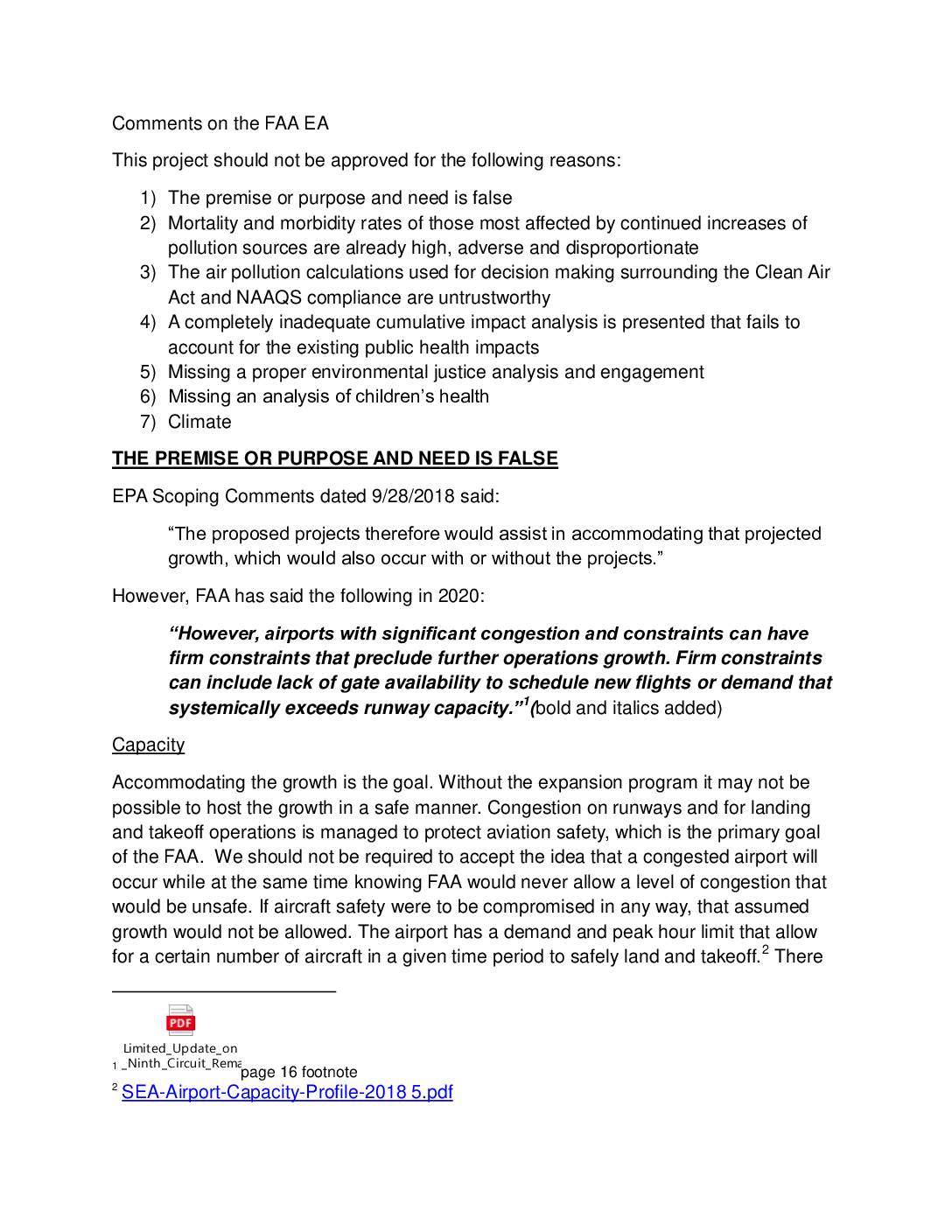
Comments on the FAA EA: SAMP Draft Environmental Assessment (Debi Wagner)
This document presents formal public comments opposing an FAA Environmental Assessment for expansion projects at Seattle-Tacoma International Airport. The author argues that the stated justification for expansion is misleading, contending that airport growth would not automatically occur without new gates and terminals since FAA safety rules already cap the number of aircraft operations. Additional concerns raised include disproportionate health burdens on nearby communities, unreliable air pollution modeling, inadequate environmental justice analysis, and failure to properly assess cumulative public health and climate impacts. -
 2022-09-01
Destination 2030: Air quality conformity
This document outlines the air quality conformity analysis for Destination 2030, the long-range transportation plan for the central Puget Sound region, ensuring that planned transportation projects meet federal and state clean air standards. The region, previously designated as a nonattainment area for carbon monoxide, ozone, and particulate matter, was redesignated as a maintenance area after meeting federal air quality standards, with EPA approvals granted between 1996 and 2001. The conformity process involved consultation with agencies including the EPA, FHWA, and Washington State Department of Ecology to ensure new transportation projects do not cause or worsen air quality violations. -
 2020-08-20
Comments on the FAA EA: SAMP Environmental Assessment
This document presents formal public comments opposing an FAA Environmental Assessment for expansion projects at Seattle-Tacoma International Airport, arguing that the stated justification for growth is misleading because FAA safety regulations would naturally cap operations without new gates. The comments raise concerns about disproportionate air pollution health impacts on nearby residents, flawed emissions modeling dating back to the 1990s, and inadequate environmental justice and cumulative impact analyses. The author contends that adding gates and terminals is the true driver of increased flight operations, not an unavoidable surge in demand that would occur regardless of expansion. -
2020-08-20
Comments on the FAA EA: SAMP Environmental Assessment
Public comments opposing the FAA Environmental Assessment (EA) for the Sea-Tac Airport Sustainable Airport Master Plan (SAMP), arguing the project should not be approved on seven grounds: false premise/purpose and need, disproportionate mortality and morbidity in affected communities, untrustworthy NAAQS air pollution calculations, inadequate cumulative impact analysis, missing environmental justice analysis, missing children’s health analysis, -
 2020-05-29
Sea-Tac Airport Communities Impact Study: Air Quality Analysis (Section 6, Appendix A)
This 2020 study examines how Seattle-Tacoma International Airport affects regional air quality, reviewing data from 1997 to 2018 collected across 13 monitoring stations within a 15-mile radius of the airport. It finds that King County consistently meets federal, state, and regional air quality standards for pollutants such as ozone, carbon monoxide, nitrogen dioxide, and particulate matter. In fact, pollution levels have generally decreased over time, leading authorities to shut down some monitoring stations near SeaTac due to consistently low readings. -
 2020-02-01
Model-extrapolated estimates of airborne lead concentrations at U.S. airports
This EPA technical report estimates airborne lead concentrations near U.S. airports caused by piston-engine aircraft burning leaded aviation gasoline (avgas). Using air quality modeling and extrapolation methods, the study identifies airports where lead levels may exceed national air quality standards, particularly in areas close to aircraft run-up zones. While not specific to Sea-Tac Airport, the findings are relevant to understanding aviation-related air quality impacts at airports nationwide.