Category : Key Documents(99)
The (99) files, images and basic information we refer to constantly from the Document Library and Resources pages.
-
FAA Order JO 7110.65Z – Air Traffic Control
★This order prescribes air traffic control procedures and phraseology for use by personnel providing air traffic control services. Controllers are required to be familiar with the provisions of this order that pertain to their operational responsibilities and to exercise their best judgment if they encounter situations not covered by it. Effective: May 19, 2022 Change: -
2022-07-01
Worldwide Airport Slot Guidelines (WASG), Edition 2
★ The Worldwide Airport Slot Guidelines (WASG), Edition 2, effective July 1, 2022, is a joint publication by Airports Council International (ACI), the International Air Transport Association (IATA), and the Worldwide Airport Coordinators Group (WWACG) that provides global standards and guidance for managing airport slot allocation. The document is intended to help airports, airlines, and coordinators navigate capacity constraints and scheduling processes at busy airports worldwide. Note that while this document covers broad international slot management principles, readers should consult applicable local laws and regulations for specific airport noise or capacity policies.
 -
2021-10-01
Ground Noise Study Progress Update
★ This October 2021 progress update presents findings from a Ground Noise Study conducted at Seattle-Tacoma International Airport (SEA). The presentation covers key acoustic concepts—including Maximum Sound Level (Lmax), Sound Exposure Level (SEL), and Equivalent Sound Level (Leq)—alongside topics such as sound propagation, the study's scope of work, noise monitoring activities, and planned next steps. The study aims to better understand and document ground-level noise impacts in and around the airport.
 -
Annual Operations and Passengers
★Operations Air carrier: Scheduled aircraft operation with over 70 seats Air Taxi: Scheduled aircraft operation with less than 70 seats Source: Federal Aviation Administration (FAA) Passengers *1996 total pax are correct. Domestic and International pax, derived estimates. It’s complicated: a brief analysis Nothing about airports is simple. The Port of Seattle usually focuses on passengers–each -
Common environmental noise levels
★How loud is too loud? Continued exposure to noise above 85 dBA (adjusted decibels) over time will cause hearing loss. The volume (dBA) and the length of exposure to the sound will tell you how harmful the noise is. In general, the louder the noise, the less time required before hearing loss will occur. According -
2020-08-11
Miller Creek Culvert Replacement, Fish Passage and Stream Restoration
★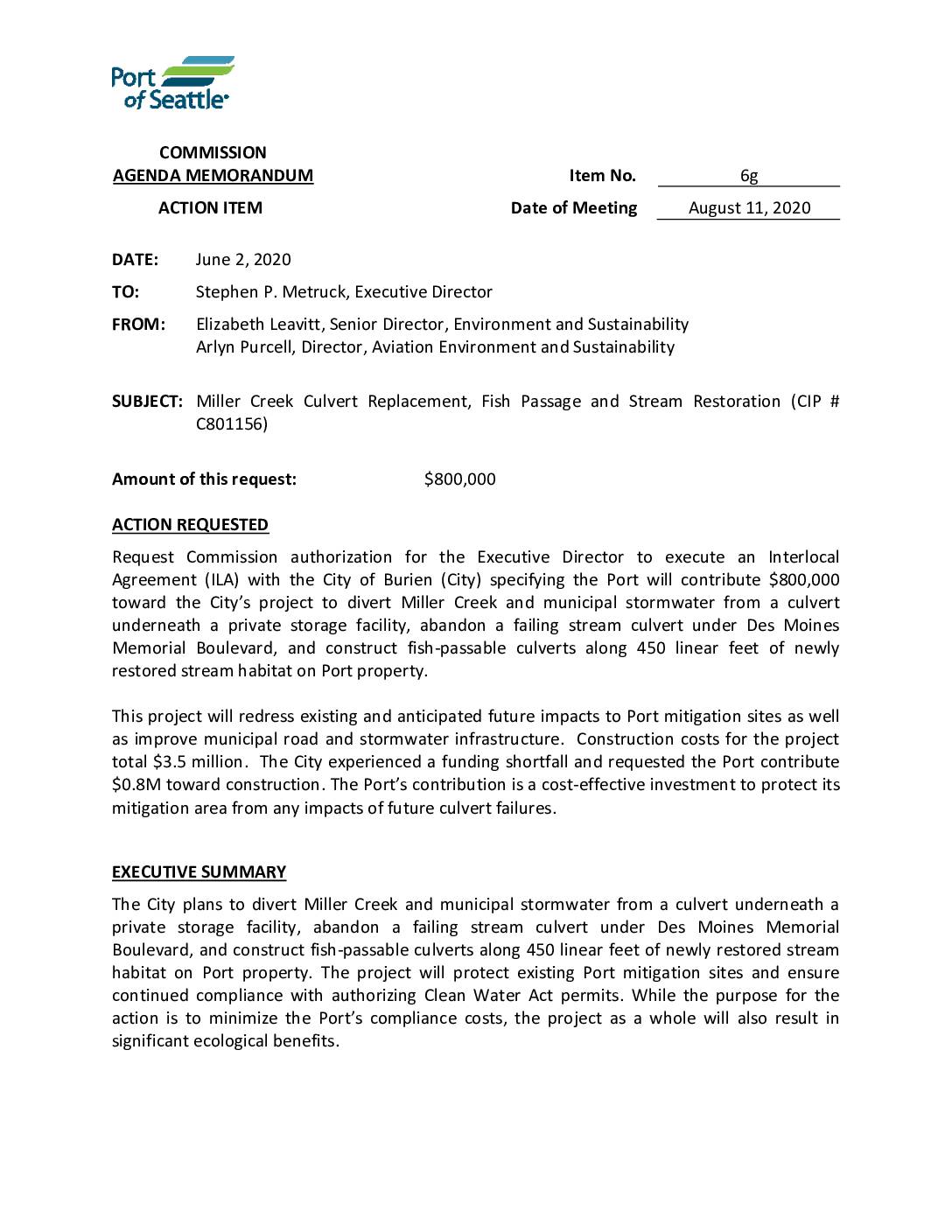 The Port of Seattle Commission is being asked to approve an $800,000 contribution to the City of Burien for the Miller Creek Culvert Replacement and Stream Restoration project, which aims to fix failing culverts near Sea-Tac International Airport that threaten protected wetland mitigation sites. The project will divert Miller Creek, replace a deteriorating culvert under Des Moines Memorial Boulevard, and construct fish-friendly culverts along 450 feet of restored stream habitat on Port property. Beyond protecting the Port's Clean Water Act permit compliance, the project delivers broader environmental benefits by removing the largest fish barrier on Miller Creek and creating a continuous, passable stream corridor through the watershed.
 -
CFR Title 14 Part 161 NOTICE AND APPROVAL OF AIRPORT NOISE AND ACCESS RESTRICTIONS
★Title 14: Aeronautics and Space PART 161—NOTICE AND APPROVAL OF AIRPORT NOISE AND ACCESS RESTRICTIONS Contents Subpart A—General Provisions §161.1 Purpose. §161.3 Applicability. §161.5 Definitions. §161.7 Limitations. §161.9 Designation of noise description methods. §161.11 Identification of land uses in airport noise study area. Subpart B—Agreements §161.101 Scope. §161.103 Notice of the proposed restriction. §161.105 Requirements for new entrants. §161.107 Implementation of the restriction. §161.109 Notice of -
2020-01-28
Commission Agenda Memorandum – Flight Corridor Safety Program 2019 contracts, agreements, and real property interests
★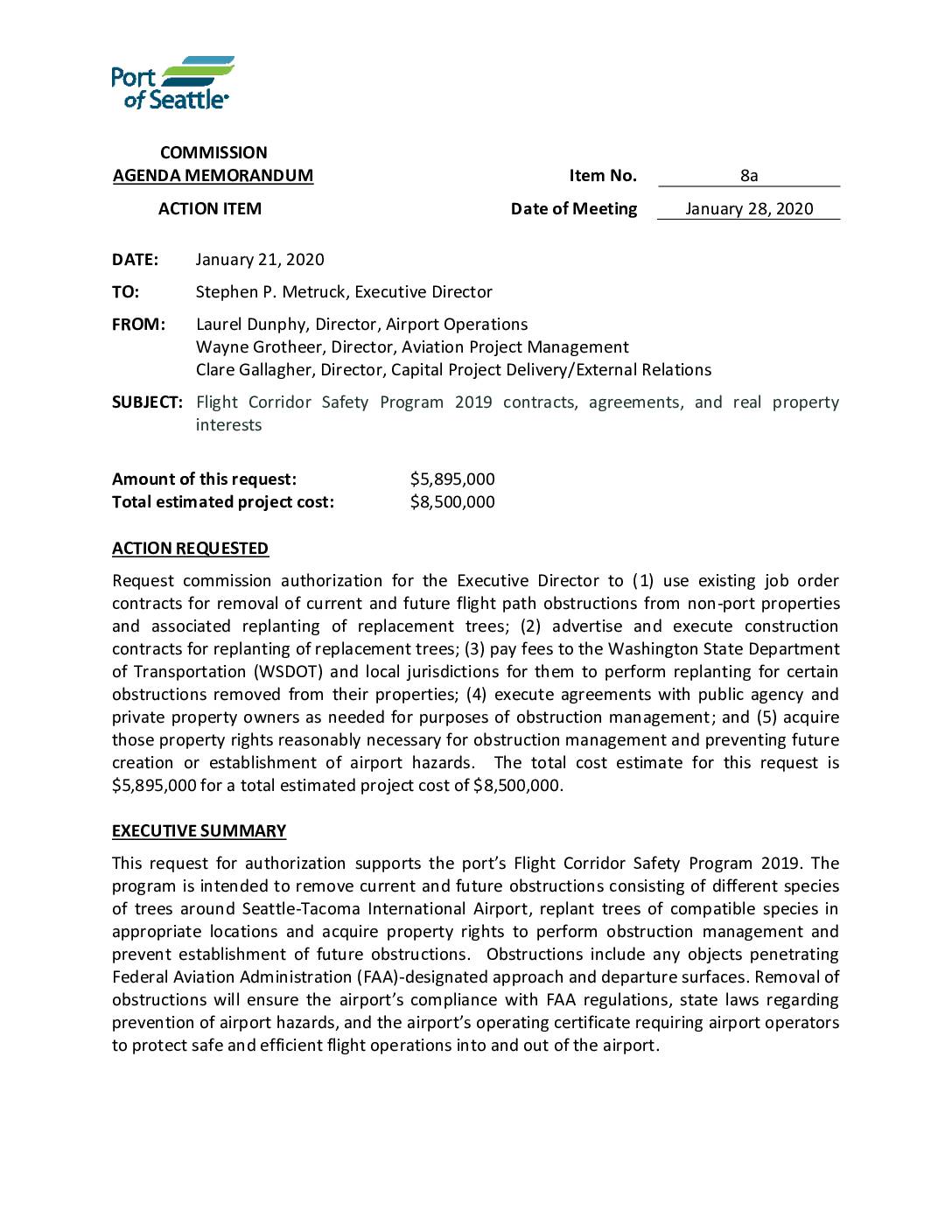 Port of Seattle commission agenda item requesting authorization for the Executive Director to execute contracts and agreements related to the Flight Corridor Safety Program 2019, including removal of flight path obstructions, tree replanting, and property rights acquisition. The total cost estimate is $5,895,000 for a total project cost of $8,500,000.
 -
2020-01-01
Air filters, pollution and student achievement
★ A study by NYU economist Michael Gilraine found that installing air filters in classrooms led to a 0.20 standard deviation improvement in math and English test scores, using a natural experiment from the 2015-2016 Aliso Canyon gas leak in Los Angeles. The gas company installed air filters in all schools within five miles of the leak, allowing researchers to compare student achievement between schools that received filters and those that did not. The findings suggest that air filtration is a cost-effective way to boost student achievement by reducing exposure to common indoor air pollutants.
 -
2019-06-06
Des Moines City Council Study Session SAMP Consultants Vianair, abcx2
★Joint Meeting with Aviation Advisory Committee and Aviation Consultants Consultants present: James (Jim) Allardice, Jason Schwarz, Emily Tranter, and [Airport-side consultant — Larry?] Aviation Advisory Committee members present: David, Sheila Brush, Steve Edmiston, Wendy Ghiora, Mark Proulx Mayor Pina: Please let the record show that all council members are present. Council, we have consultants here