TagUltrafine(9)
-
 2025-01-07
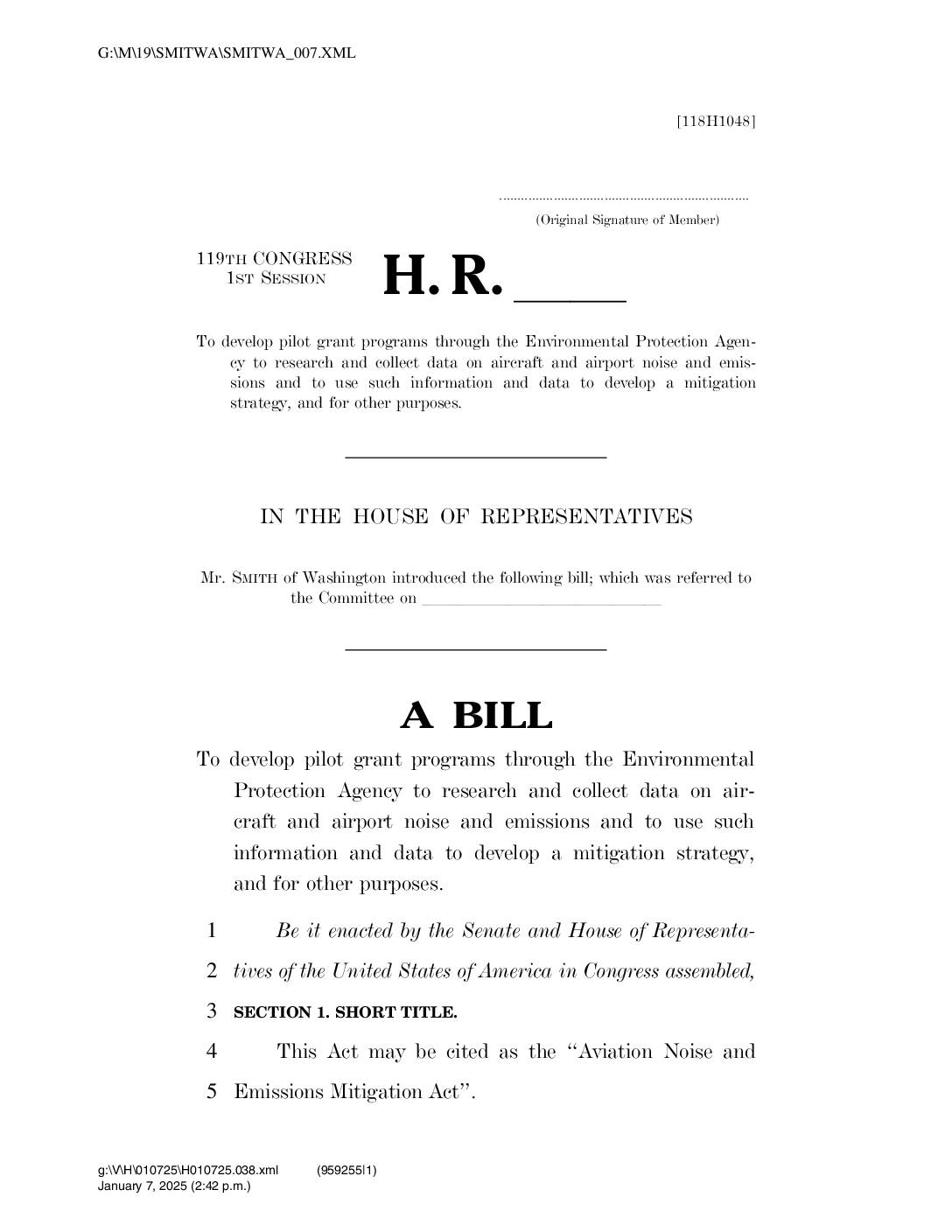
Aviation Noise and Emissions Mitigation Act (H.R. __, 119th Congress, 1st Session)
The Aviation Noise and Emissions Mitigation Act, introduced in the 119th Congress by Rep. Smith of Washington, would direct the EPA to establish a 3-year pilot grant program to measure aircraft and airport noise and emissions—including greenhouse gases, particulate matter, and ultrafine particles—in communities near airports and flight paths. Grant recipients would use advanced monitoring technology to trace pollution to specific sources, produce neighborhood- and ZIP Code-level data, and work with local agencies and community organizations to develop mitigation strategies. The program is designed to be replicable nationwide, with a focus on identifying and protecting frontline and disproportionately impacted communities. -
2025-01-07
Aviation Noise and Emissions Mitigation Act (H.R. __, 119th Congress, 1st Session)
H.R. bill introduced by Rep. Adam Smith of Washington in the 119th Congress, 1st Session, dated January 7, 2025, titled the ‘Aviation Noise and Emissions Mitigation Act.’ Establishes a 3-year pilot grant program through the Environmental Protection Agency (EPA), in consultation with the Secretary of Transportation, to measure and collect data on aircraft and airport -
 2024-10-01
Update on Our Ongoing Ultrafine Monitoring
The Puget Sound Clean Air Agency's Monitoring Team provides an October 2024 update on their ongoing ultrafine particle (UFP) monitoring program, explaining that UFPs are extremely tiny particles smaller than 0.1 microns that are not currently regulated under air quality standards. The presentation covers key concepts such as particle number concentration (PNC), monitoring instrumentation, and WHO good practice recommendations for UFP measurement. While not specific to noise policy, this monitoring effort is relevant to understanding air quality impacts near high-traffic areas such as airports. -
2024-10-01
Update on Our Ongoing Ultrafine Monitoring
Puget Sound Clean Air Agency (PSCAA) Monitoring Team October 2024 presentation on ongoing ultrafine particle (UFP) monitoring. Covers key acronyms and facts: UFP defined as particles less than 100 nm or 0.1 microns, particle number concentration (PNC), SMPS (Scanning Mobility Particle Size Spectrometer), and the fact that UFPs account for more than 80% of PNC. -
 2023-08-23
SeaTac International Airport: Trifecta for change
This presentation addresses environmental and health concerns surrounding Seattle-Tacoma International Airport, framing the issue as more than a mere noise nuisance by highlighting the health impacts of Jet A fuel pollution, specifically ultrafine particles. It outlines a 'Trifecta for Change' strategy that includes shifting public dialogue, engaging the University of Washington to study pollution prevalence, and building local, state, and federal partnerships to advance mitigation efforts. -
 2022-08-15
State of the art ambient ultrafine particle monitoring: the blind spot of current methods
This 2022 conference presentation from TSI Incorporated examines the limitations of current methods for monitoring ultrafine particles (UFP) in ambient air. It highlights the critical role that air quality monitoring plays in both identifying known pollution hazards and building research datasets to uncover new ones, with UFP listed alongside pollutants such as CO, ozone, lead, and particulate matter as a causative constituent of air pollution health effects. -
 2022-07-14
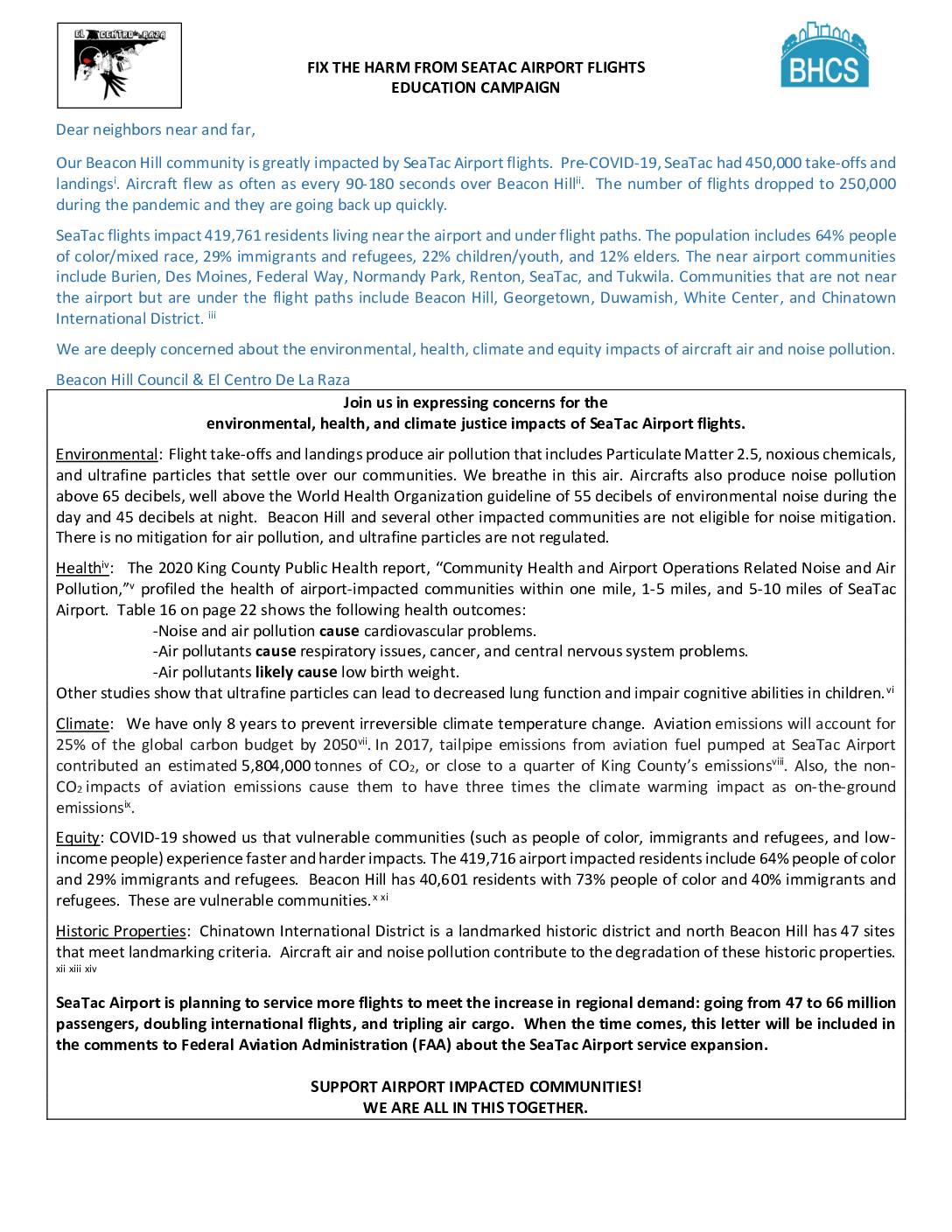
Fix the Harm from Sea-Tac Airport Flights: Education Campaign Fact Sheet
The Beacon Hill Council and El Centro De La Raza are calling on community members to take action against the environmental, health, and equity harms caused by SeaTac Airport flight operations, which affect nearly 420,000 residents — including large proportions of people of color, immigrants, and refugees. Aircraft noise regularly exceeds World Health Organization safe limits, while air pollution from flights contributes to cardiovascular disease, respiratory illness, and developmental harm in children, with no current mitigation available for many impacted neighborhoods. The campaign also warns that SeaTac's planned expansion — from 47 to 66 million passengers, doubled international flights, and tripled air cargo — will worsen these impacts, and pledges to submit community concerns to the FAA during the expansion review process. -
 2020-01-01
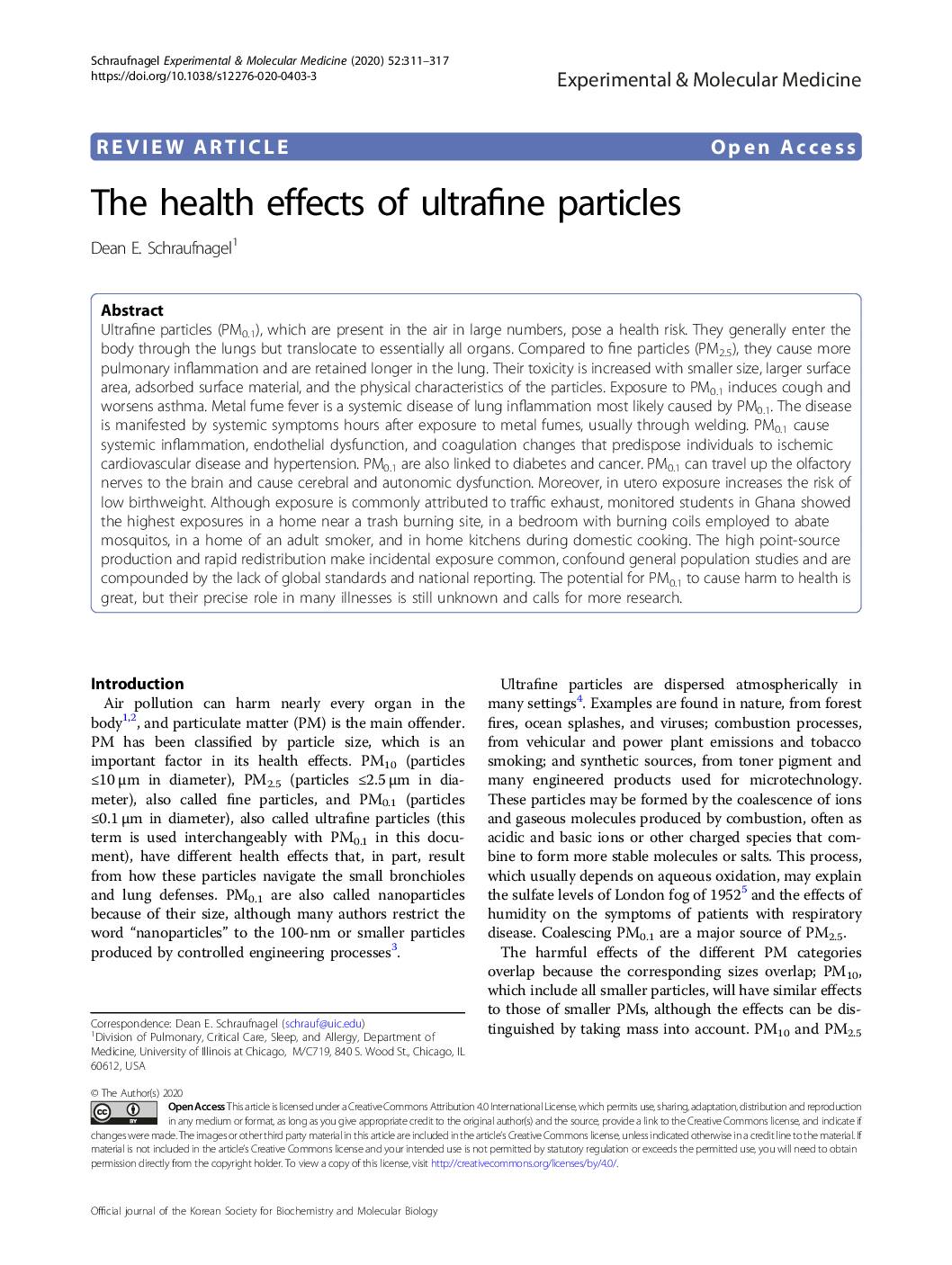
The health effects of ultrafine particles
Review article by Dean E. Schraufnagel published in Experimental & Molecular Medicine (2020) 52:311–317, DOI 10.1038/s12276-020-0403-3, examining the health effects of ultrafine particles (PM0.1, also called nanoparticles). Covers PM0.1 sources (traffic exhaust, welding, forest fires, cooking, tobacco smoke), absorption and retention in the lung, translocation to distal organs, pulmonary inflammation, metal fume fever, cardiovascular disease, -
2020-01-01
The health effects of ultrafine particles
Review article by Dean E. Schraufnagel published in Experimental & Molecular Medicine (2020) 52:311–317, DOI 10.1038/s12276-020-0403-3, examining the health effects of ultrafine particles (PM0.1, also called nanoparticles). Covers PM0.1 sources (traffic exhaust, welding, forest fires, cooking, tobacco smoke), absorption and retention in the lung, translocation to distal organs, pulmonary inflammation, metal fume fever, cardiovascular disease,