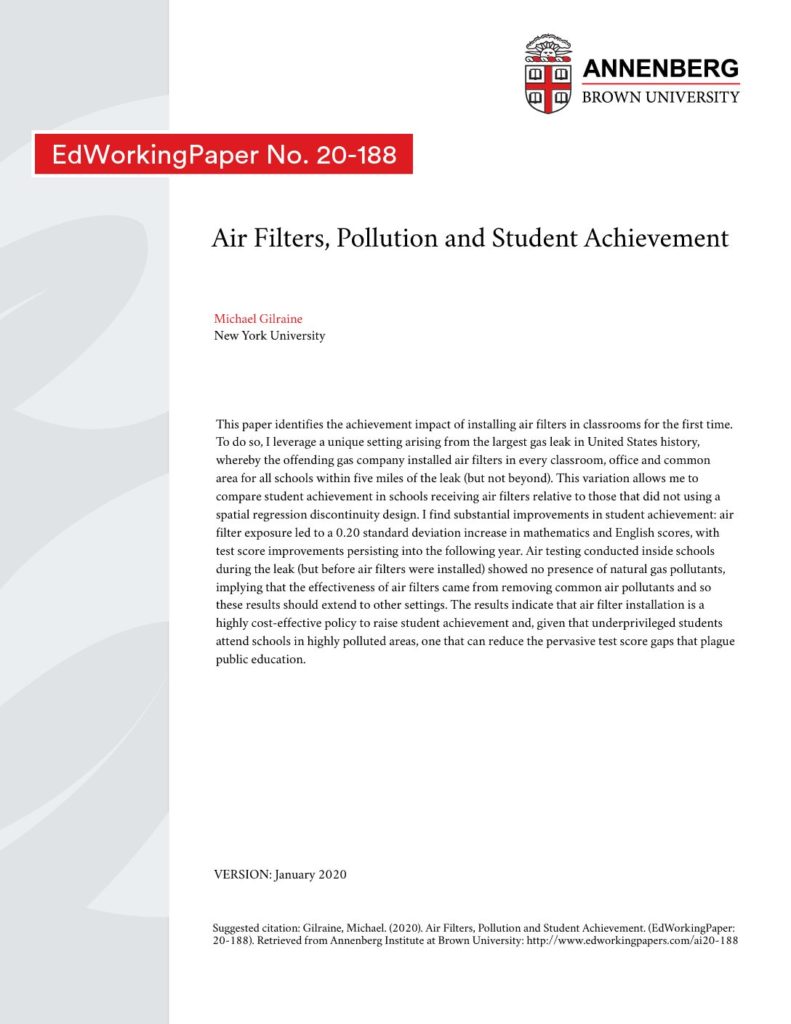
A study by NYU economist Michael Gilraine found that installing air filters in classrooms led to a 0.20 standard deviation improvement in math and English test scores, using a natural experiment from the 2015-2016 Aliso Canyon gas leak in Los Angeles. The gas company installed air filters in all schools within five miles of the leak, allowing researchers to compare student achievement between schools that received filters and those that did not. The findings suggest that air filtration is a cost-effective way to boost student achievement by reducing exposure to common indoor air pollutants.Open full document
Notes
This paper investigates the impact of air filter installation on student achievement using a natural experiment from the Aliso Canyon gas leak, the largest in US history. Using a spatial regression discontinuity design, the author finds that air filter exposure led to a 0.20 standard deviation increase in mathematics and English test scores. The results suggest air filter installation is a cost-effective policy to raise student achievement, particularly for underprivileged students in highly polluted areas.