Category : Key Documents(99)
The (99) files, images and basic information we refer to constantly from the Document Library and Resources pages.
-
1984-01-16
Final Evaluation of Noise Abatement and Noise Remedy Measures – Acoustical Treatment of Existing Structures
★ 32 This draft report from Peat Marwick, consultants to the Port of Seattle, evaluates noise remedy measures for neighborhoods surrounding Seattle-Tacoma International Airport. It outlines eligibility criteria for a sound insulation program, targeting approximately 5,529 existing residential structures exposed to noise levels of Ldn 70 or higher in 1980, or Ldn 65 or higher projected for the year 2000. The recommendations build on the 1976 Sea-Tac/Communities Plan, reflecting updated noise exposure data, airline deregulation impacts, and residential growth in the area.
 -
1982-06-01
Sea-Tac International Airport noise exposure update
★ 32 This June 1982 report, produced by the Port of Seattle, provides an update on noise exposure levels at Seattle-Tacoma (Sea-Tac) International Airport. It documents the extent of aircraft noise affecting surrounding communities, serving as an official record to inform airport noise management and land-use planning policies. The report was part of ongoing efforts by the Port of Seattle to monitor and address the impact of airport operations on nearby residents.
 -
1981-12-10
Boeing Headquarters Memo of Understanding – Port of Seattle Letter
★ 32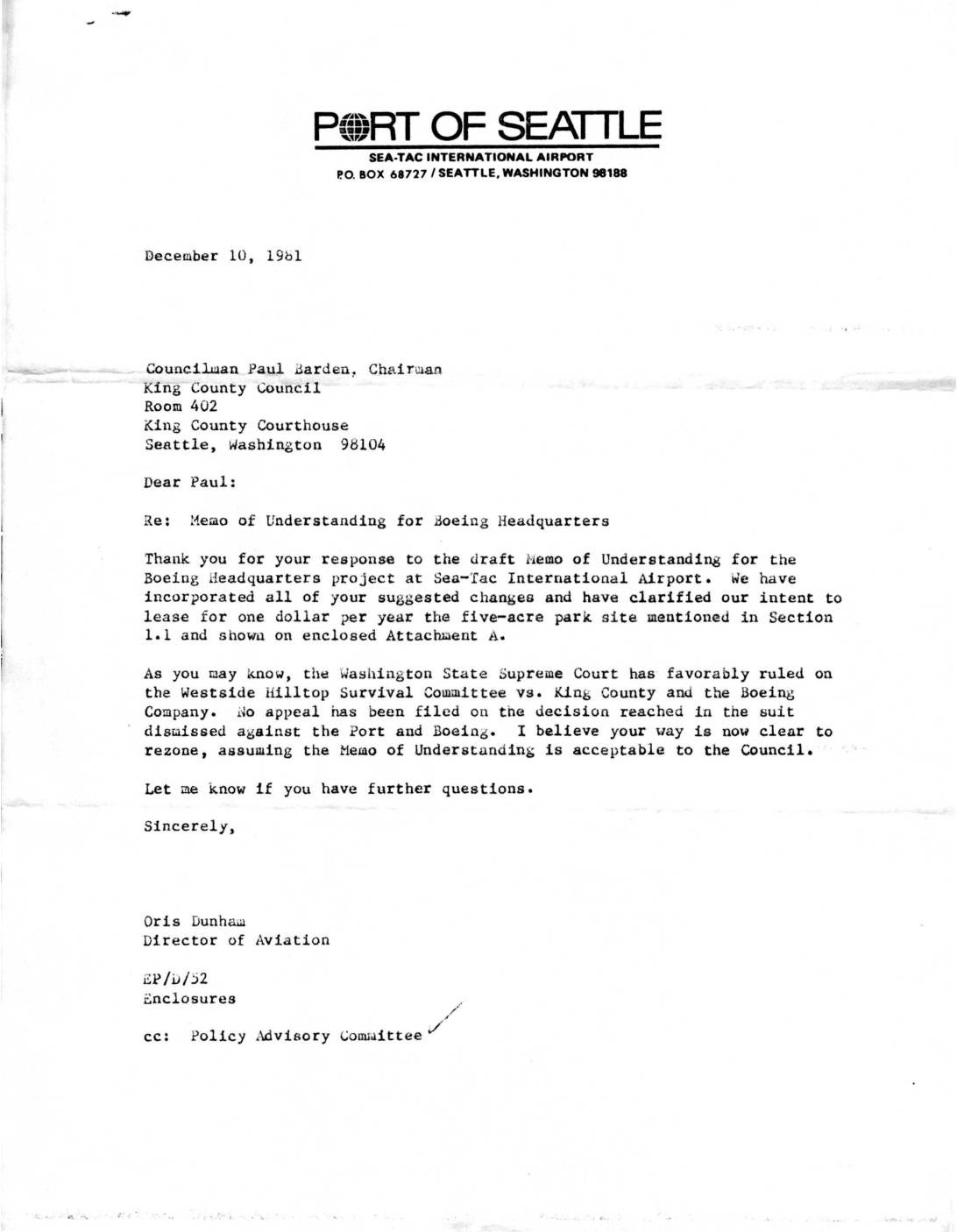 Letter from Port of Seattle Director of Aviation Oris Dunham to King County Council Chairman Paul Barden regarding a Memo of Understanding for Boeing Headquarters project at Sea-Tac International Airport. Includes discussion of rezoning approval following favorable Washington State Supreme Court ruling.
 -
1981-10-28
Airspace Study: Sea-Tac International Airport and King County International Airport
★ 32 This 1981 airspace study, prepared by Peat, Marwick, Mitchell & Co., examines how the shared use of airspace between Seattle-Tacoma International Airport (Sea-Tac) and King County International Airport (Boeing Field) affects the capacity of both airports. The two-phase study analyzes projected congestion and delays through the year 2000 and evaluates operational and policy alternatives to reduce airspace conflicts. A public information program was also included to keep the community informed of the study's findings and implications.
 -
1981-05-13
King County Council Notice: Proposed Motion 81-322 Rescinding Motion 4668, Building and Land Development File 224-78-R (Port Of Seattle Reclassification)
★ 32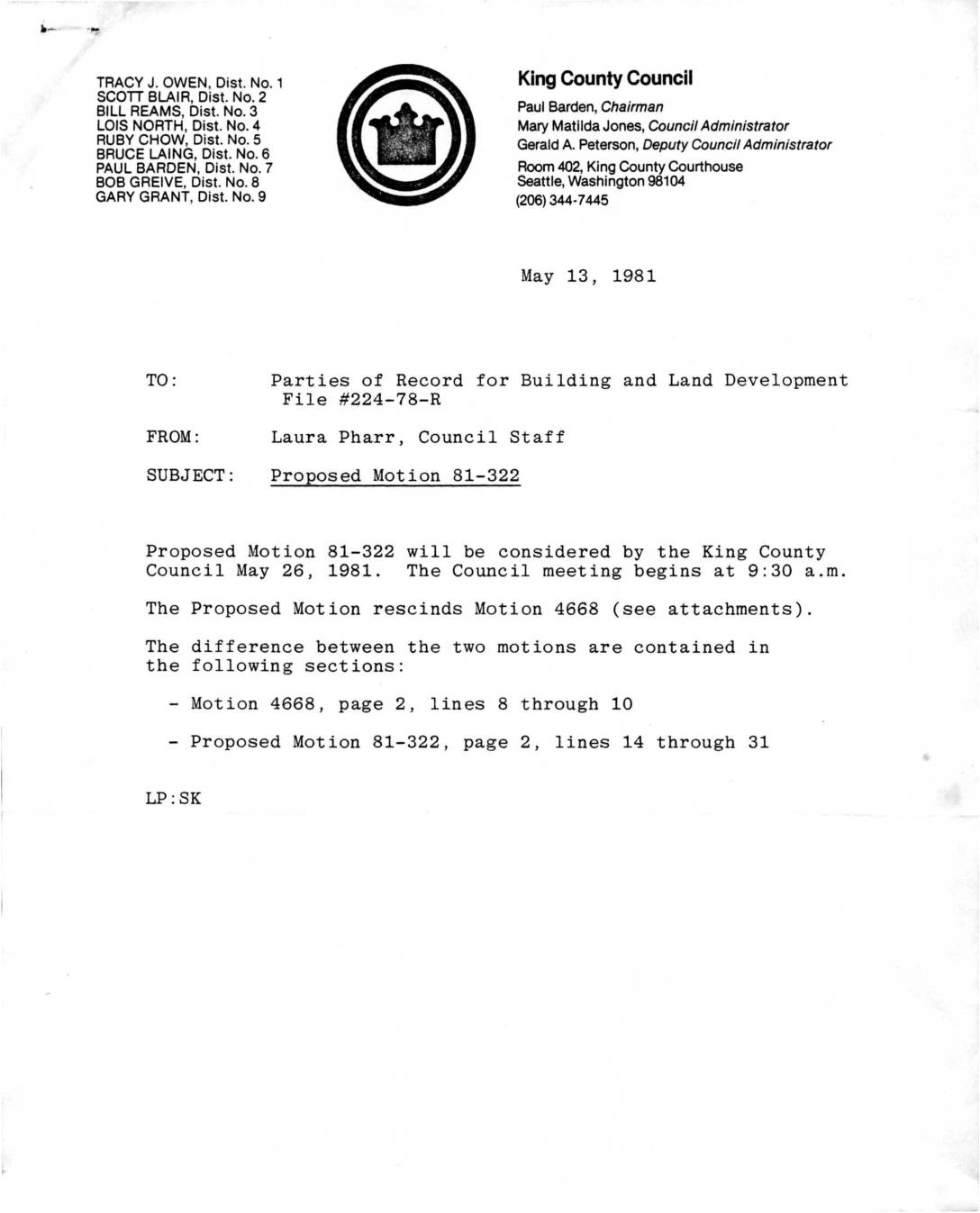 In December 1979, the King County Council passed Motion 4668 approving a rezone request by the Port of Seattle (Building and Land Development File No. 224-78-R), subject to conditions including the Port providing 5 acres for a neighborhood park and agreeing not to develop a 55-acre Westside Greenbelt buffer area for ten years. In May 1981, the Council proposed Motion 81-322 to rescind and replace Motion 4668, with key differences in the conditions outlined on page 2 of each motion. The matter, which had been appealed by both the applicant and neighboring property owners, required a separate public hearing in affected communities as part of the site plan approval process.
 -
1980-11-19
Regional Airport System Plan, 1980-2000, Central Puget Sound region
★ 32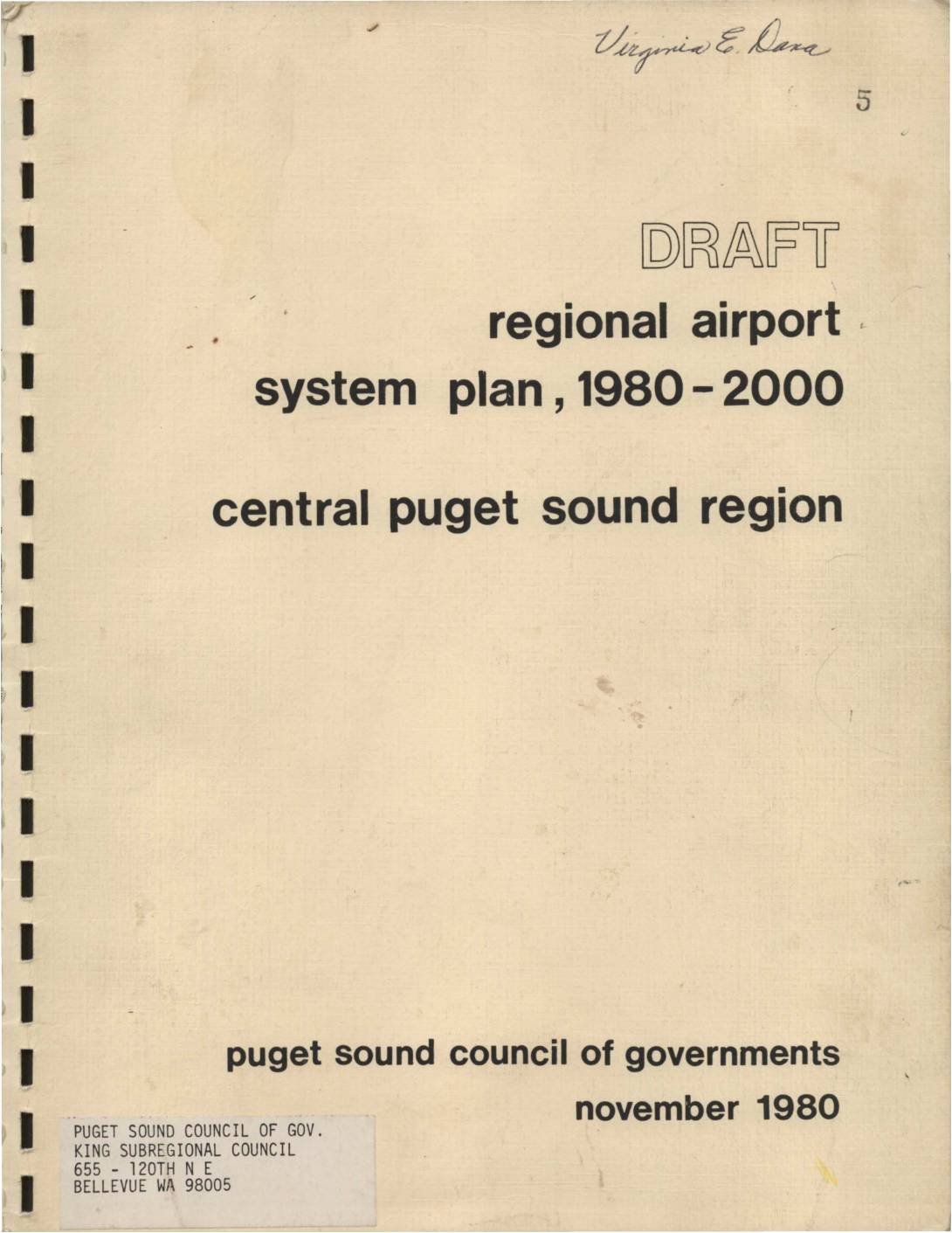 This 1980 draft report, produced by the Puget Sound Council of Governments, outlines a Regional Airport System Plan for the Central Puget Sound area covering the years 1980 to 2000. Funded by the Port of Seattle, the Washington State Department of Transportation, and the Federal Aviation Administration, the plan was developed to guide regional aviation policy and infrastructure decisions across King, Pierce, Snohomish, and Kitsap counties. It was prepared for review by the Standing Committee on Transportation and represents an early framework for managing air travel demand and airport development in the greater Seattle region.
 -
1980-02-18
Aviation Safety and Noise Abatement Act of 1979, Public Law 96-193
★ 32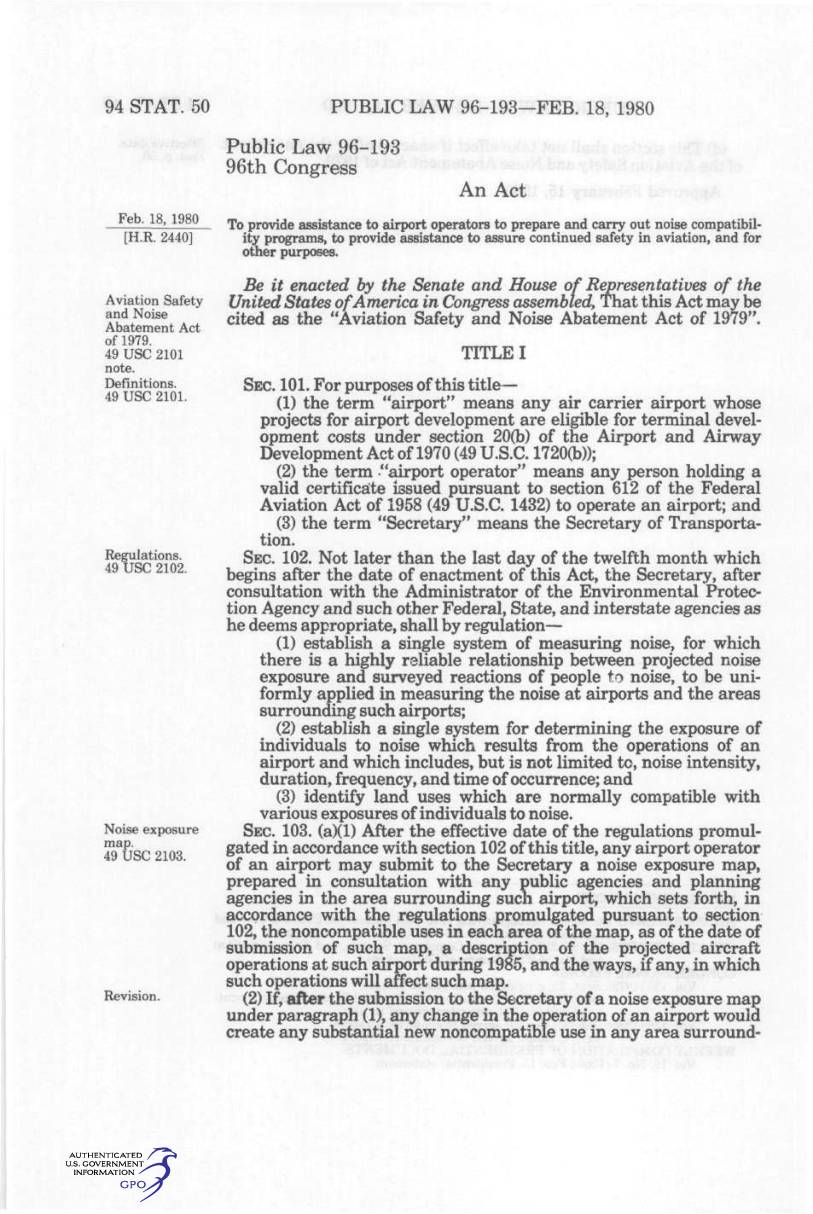 The Aviation Safety and Noise Abatement Act of 1979 (Public Law 96-193) requires the U.S. Secretary of Transportation to establish uniform standards for measuring airport noise and its impact on surrounding communities. Airport operators may voluntarily submit noise exposure maps and noise compatibility programs outlining steps to reduce incompatible land uses near airports, such as soundproofing buildings, adjusting flight procedures, or acquiring nearby land. The federal government can fund up to 80% of approved noise compatibility projects, with grants available to airport operators and local government units in affected areas.
 -
1978-10-24
Airline Deregulation Act of 1978
★ 32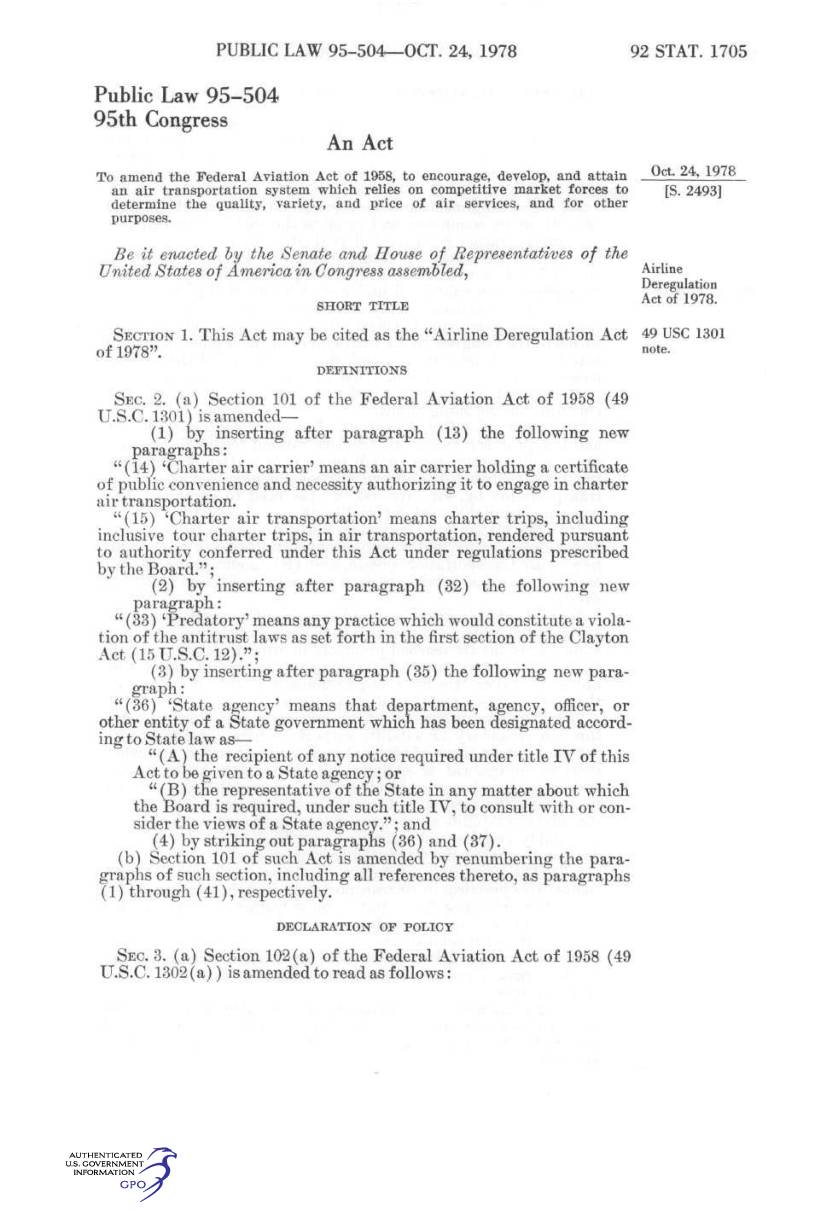 The Airline Deregulation Act of 1978 (Public Law 95-504) amended the Federal Aviation Act of 1958 to shift the U.S. air transportation system away from heavy government regulation toward open market competition, allowing competitive forces to determine airline prices, routes, and service quality. The law established key policy priorities including maintaining safety as the highest concern, preventing monopolistic practices, encouraging new carriers to enter the market, and preserving scheduled service to small communities. While focused on economic deregulation rather than noise policy directly, the resulting surge in air traffic growth it enabled has significant implications for airport noise management planning.
 -
1976-09-20
Ordinance No. 2883: An ordinance adopting the Sea-Tac Communities Plan
★ 32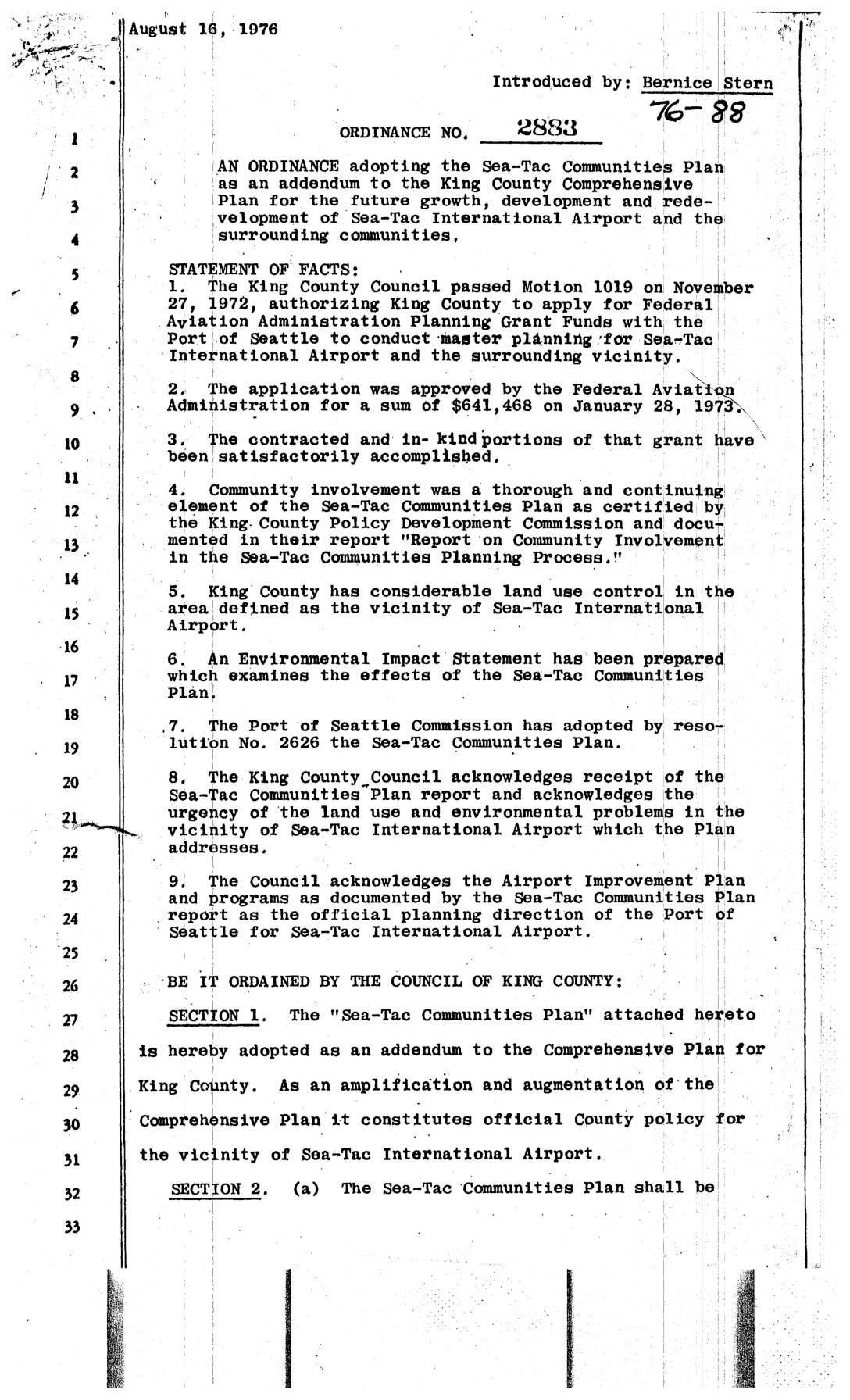 King County Ordinance No. 2883, passed in September 1976, officially adopted the Sea-Tac Communities Plan as an addendum to the King County Comprehensive Plan, establishing it as the guiding policy for land use, development, and redevelopment around Sea-Tac International Airport. The plan, developed with Federal Aviation Administration grant funding and extensive community involvement, addresses noise programs, open space acquisition areas, and compatible land use in the airport's vicinity. It required coordination between King County and the Port of Seattle on any future changes, with the Highline Communities Plan designated as the official zoning guideline for implementing its land use concepts.
 -
City of Burbank v. Lockheed Air Terminal
★ 32In one of the most maddening examples of airport law, the United States argued for reversal (ie. allowing for local airport control) of curfews. The FAA, which had previously supported the ban, adopted a neutral position when the The Department of Transportation, filed a Friend of the Court brief arguing for reversal. Summary Holding that