Category : Key Documents(99)
The (99) files, images and basic information we refer to constantly from the Document Library and Resources pages.
-
2020-02-28
Study of the current and ongoing effects of the operation of the Seattle-Tacoma International Airport
★ 32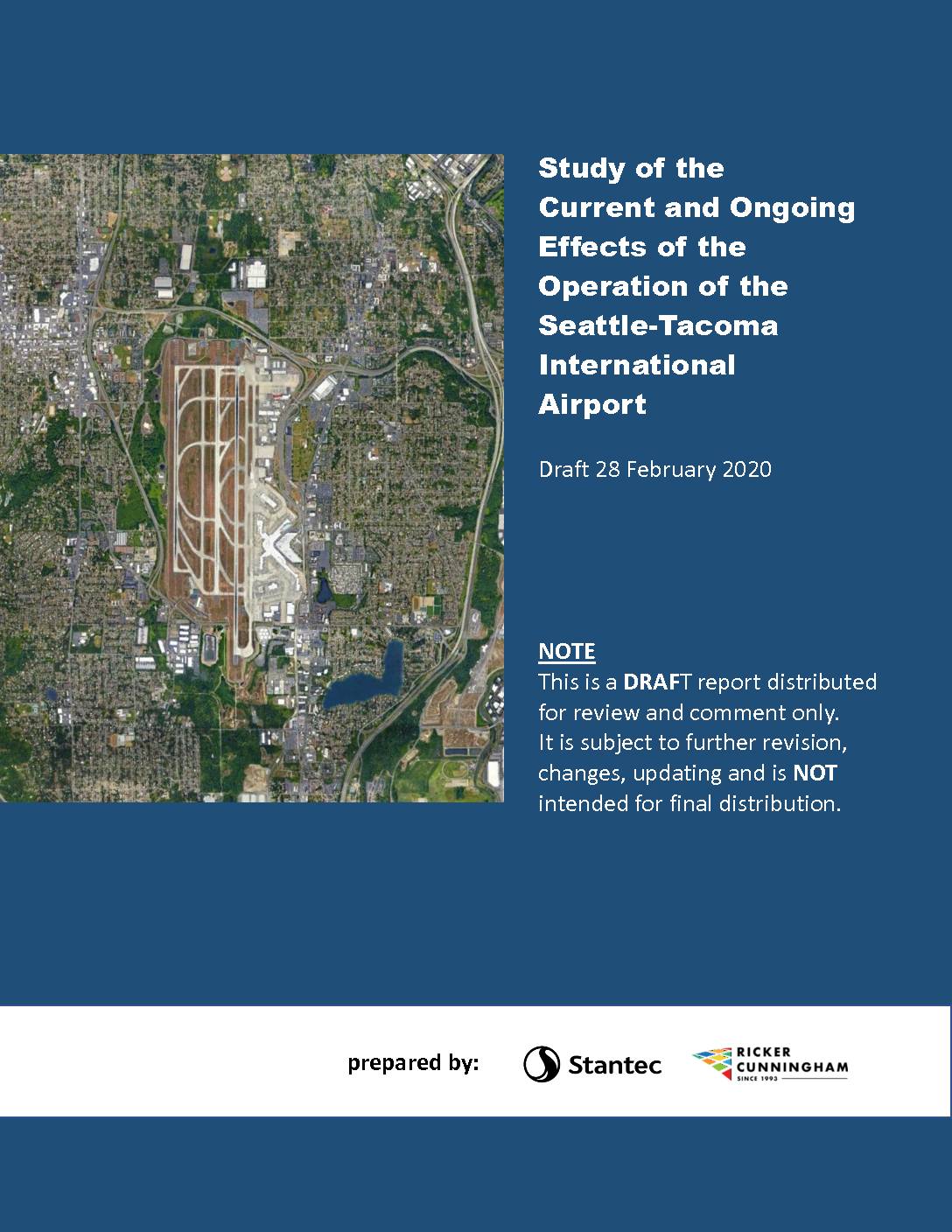 This draft report, prepared by Stantec and Ricker Cunningham for the Washington State Department of Commerce under ESSB 6032, examines the current and ongoing effects of operating Seattle-Tacoma International Airport (Sea-Tac). It covers the airport's broader impacts on surrounding communities, likely including noise, land use, and environmental concerns. The report was released in draft form on February 28, 2020, for review and comment only, and was not intended for final distribution at that time.
 -
2020-02-01
Cumulative impacts: 1050.1F desk reference (v2)
★ 32 This FAA guidance document explains how to analyze cumulative environmental impacts for aviation projects, meaning the combined effect of an airport action together with other past, present, and foreseeable future actions by any agency or party. It outlines how to define the study area, determine significance, and consider mitigation, noting that even individually minor impacts can together become significant. While focused on FAA projects broadly, it is relevant to noise and environmental planning at airports like Sea-Tac, where surrounding development and multiple simultaneous projects can compound environmental effects.
 -
2019-12-01
Mobile ObserVations of Ultrafine Particles: The MOV-UP study report
★ 32 The MOV-UP (Mobile ObserVations of Ultrafine Particles) study was a two-year University of Washington research project, funded by the State of Washington, that measured air quality impacts from aircraft traffic on communities living near and beneath the flight paths of Seattle-Tacoma International Airport. Researchers used mobile monitoring methods to collect ultrafine particle data across the affected neighborhoods, working alongside local governments, community members, and an advisory group of agency and city representatives. The findings are intended to inform policymakers and the public about the air pollution risks associated with airport operations in the Seattle-Tacoma region.
 -
Environmental Impact Statement EIS-1996
★ 32The 1996 Environmental Impact Statement (EIS) by Landrum & Brown. This will give you an idea of what to expect from the upcoming EIS (if it is determined to be necessary.) Sea-Tac Airport Final EIS, Feb. 1996, Vol. 1 of 7 Sea-Tac Airport Final EIS, Feb. 1996, Vol. 2 of 7 Sea-Tac Airport Final EIS, -
2018-05-22
Aircraft Noise 101
★ 32 This presentation, sponsored by the Port of Seattle and delivered by ESA Senior Vice President Steve Alverson on May 22, 2018, provides an introductory overview of aircraft noise for community members and stakeholders. It covers the evolution and quantification of aviation noise, how it is regulated, and draws on Alverson's 37 years of experience conducting over 200 aviation noise studies. The session concluded with a question-and-answer period for attendees.
 -
2018-01-01
Sea-Tac International Airport economic impacts
★ 32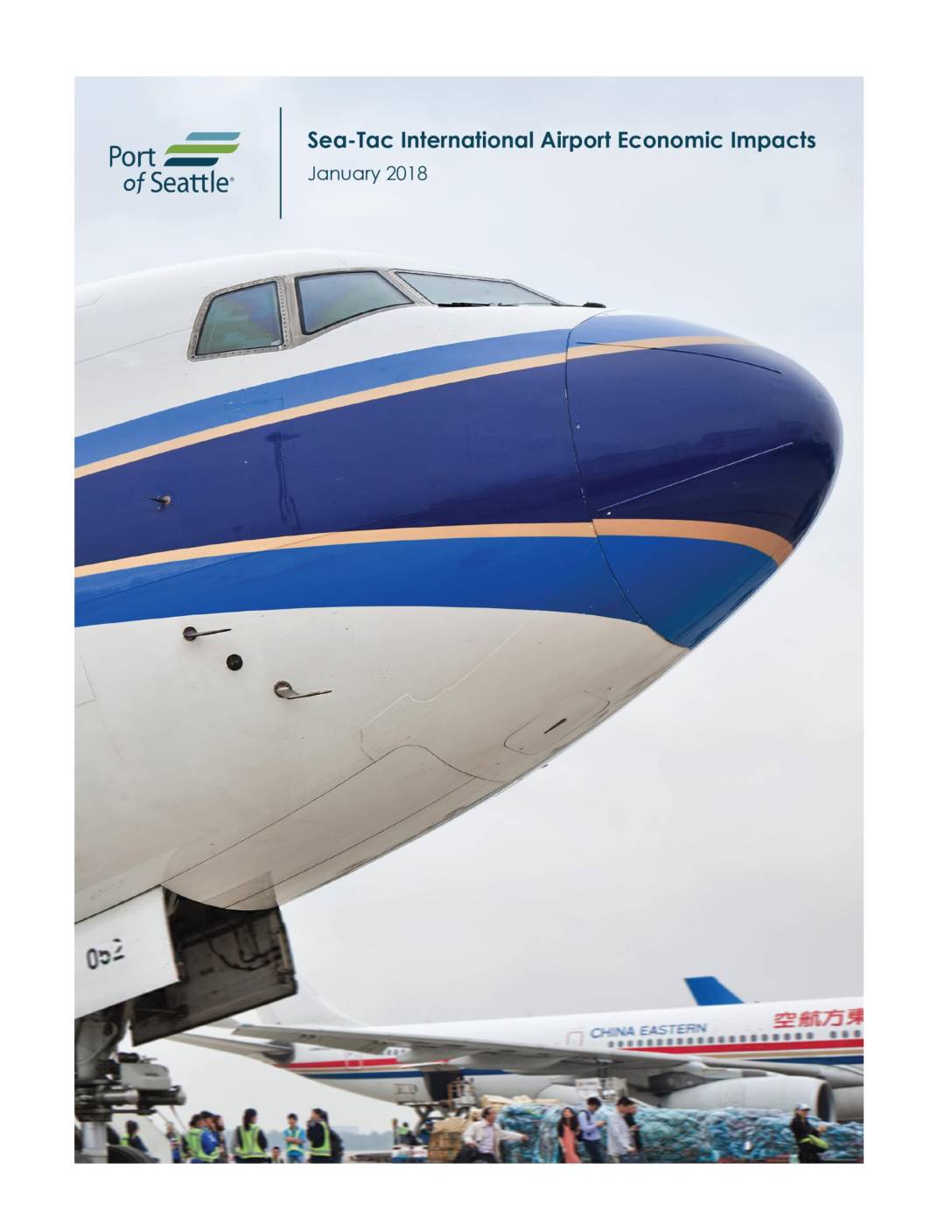 This January 2018 report from the Port of Seattle examines the economic impact of Seattle-Tacoma International Airport, which handled an estimated 46.8 million passengers and roughly 425,860 metric tons of air cargo in 2017. The airport directly supported 19,100 on-site jobs and $5.6 billion in economic activity, while generating nearly $22.5 billion in total economic output and 151,400 jobs across Washington state when multiplier effects are included. The report also highlights the airport's role as a critical trade gateway, including the export of Washington-grown cherries to international markets.
 -
2017-12-01
King County Greenhouse Gas Emissions Inventory: A 2015 Update
★ 32 This December 2017 report inventories greenhouse gas emissions across King County, Washington, providing a comprehensive 2015 update that examines emissions by sector using geographic-based and consumption-based methodologies. It was prepared by Cascadia Consulting Group and Hammerschlag & Co. LLC, covering sources such as transportation, buildings, waste, and energy use. The report tracks changes in emissions over time and analyzes key data sources to help inform county-level climate and environmental policy decisions.
 -
2016-06-01
NextGen implementation plan 2016
★ 32 The FAA's 2016 NextGen Implementation Plan outlines progress on six major air traffic modernization programs, including ADS-B surveillance, Data Communications, and automation upgrades, which are reshaping operations across the National Airspace System. Key milestones include Data Comm departure clearance services being rolled out to over 56 airports by end of 2016, three years ahead of schedule, and a doubling of ADS-B-equipped aircraft since 2014. While this plan focuses on nationwide airspace modernization rather than Sea-Tac-specific noise policy, the technologies described—such as more precise flight routing—can have implications for aircraft flight paths and noise impacts at airports like Sea-Tac.
 -
2014-06-15
Airport Key Map: Sea-Tac Airport Property Zones
★ 32 This Airport Key Map, published by the Port of Seattle on June 15, 2014, provides a general reference overview of property zones surrounding Seattle-Tacoma International Airport. It identifies distinct areas including the Airfield, Terminal, Commercial, South of Airfield, South of 200th, and North of Airfield zones, and distinguishes between Port of Seattle property, lease boundaries, non-Port property, land available for redevelopment, and the proposed SR 509 corridor. The aerial photo, taken in Spring 2012, is intended for general reference only and is not approved for navigation use.
 -
2013-10-15
Informal Runway Use Agreement (Appendix I 2013 Part 150 Study)
★ 32Appendix I from the 2013 Part 150 Study by Landrum & Brown. A Letter Of Agreement (LOA) where the Port Of Seattle agrees to using the Third Runway primarily for overflows and bad weather. Note the very official looking signature of the Port CEO, Tay Yoshitani. Also note that it is described as an ‘informal