Skip to content
  • STNI
  • Statistics
    • Ops and Passengers
      • King County International Airport (Boeing Field) Annual Operations
    • Financials
    • Aviation fuel uplift in the State of Washington 2018 – 2025
      • Aviation Fuel Tax Revenue in the State of Washington 1983-2025
      • Aviation Fuel Uplift at Sea-Tac Airport
    • Air Quality Monitoring
    • Flight Tracking
      • Flow and Flight Tracks
      • Five Year Comparison
      • Busiest Hours and Days
    • SEL Noise Reports & Graphs
      • About The Permanent Noise Monitors
      • Minutes of Quiet by Noise Monitor
      • Noise Events mapped
      • Noise Events (SEL)
    • Runways
    • Employees
    • Real Estate
      • Port Properties and Trees mapped
    • Parking
  • Events
  • Protest
    • Regular Events
    • Policy
      • Legislative Agenda 2027
      • Airport mitigation for the twenty first century
      • Port Dracula
    • Complain about a particular flight
    • Advocacy Organizations
    • Media Outlets
    • People
    • The Port of Seattle
      • Commission Meetings
      • Public Records Requests
      • StART
      • Highline Forum
    • Contact Your Electeds
  • Resources
    • FAQs
      • FAA Occurrences/Accidents/Indents
    • The SAMP
      • SAMP Public Comment Template
        • Two versions of Appendix K: NEPA/SEPA 2018 vs 2023
      • SAMP NTP: 31 projects by the numbers
      • SEPA Draft EIS (2026)
      • SAMP Record of Decision/FONSI (2025)
      • SAMP Draft EA (October 2024)
      • 2018 Scoping
    • Port Packages
      • Port Package Property Costs
      • Port Packages mapped
      • The Port Package Explainer
      • So you want a (first-time) Port Package? Start here
      • Port Package Looker Upper
      • How do I determine if I have a Port Package or Avigation Easement?
      • Progress on Port Package Update legislation
      • Having a Port Package Problem?
      • Port Package Site Visit Follow-Up
    • Document Library
    • Explainers
      • The Airport Law Cheat Sheet
      • The Grant Explainer
    • External Articles
    • History
      • Timeline
      • The Sea-Tac Communities Plan
        • Sea-Tac Communities Plan – Planning Maps
      • PSRC Third Runway Decision Process
    • Studies
    • Videos
  • Stories
  • Mission
  • Subscribe
  • Contact
Scroll down to content

Get InformedStay Informedx

I understand that you will never share my information with anyone, you will only use it to keep me updated on relevant events and that I may unsubscribe at any time.

STNI

STNISea-Tac Noise.Info

  • Solve for Sea-Tac. Solve for every airport.
  • Since 2016, working to obtain justice for everyone living under the flight path.
  • Less Noise. Cleaner Air. Better Public Health. Compensation.
  • Everything you think you know about the airport is wrong.

Category : Correspondence(303)

Advanced Search Options

  • Tags
  • Dates
  • Media
    • PDFs
    • Video
    • Audio
  • Order By
  • 1983-12-09

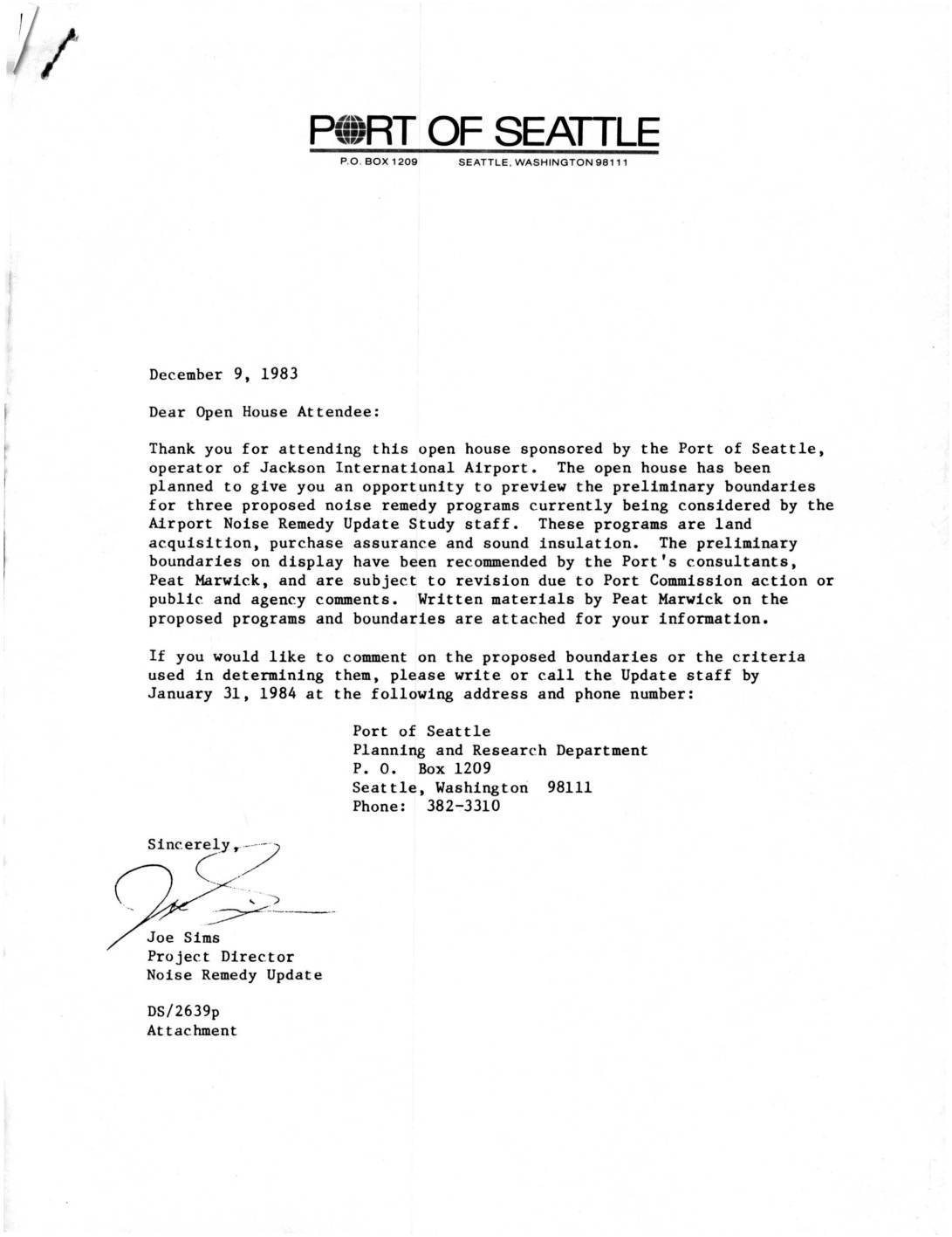
    Port of Seattle Open House Letter – Noise Remedy Programs

    In December 1983, the Port of Seattle invited community members to review preliminary boundaries for three proposed noise remedy programs near Seattle-Tacoma (Jackson) International Airport: land acquisition, purchase assurance, and sound insulation. Consultant firm Peat Marwick recommended eligibility criteria for sound insulation, targeting single-family homes exposed to noise levels of Ldn 70 or above in 1980, or Ldn 65 or above projected for the year 2000. Residents were encouraged to submit comments on the proposed boundaries and criteria by January 31, 1984.
    CategoriesCorrespondence Tagscommunity engagement, Noise Mitigation, Noise Remedy Update, Peat Marwick Mitchell, Port Of SeattleFolderNoise Remedy Update
  • 1983-05-18

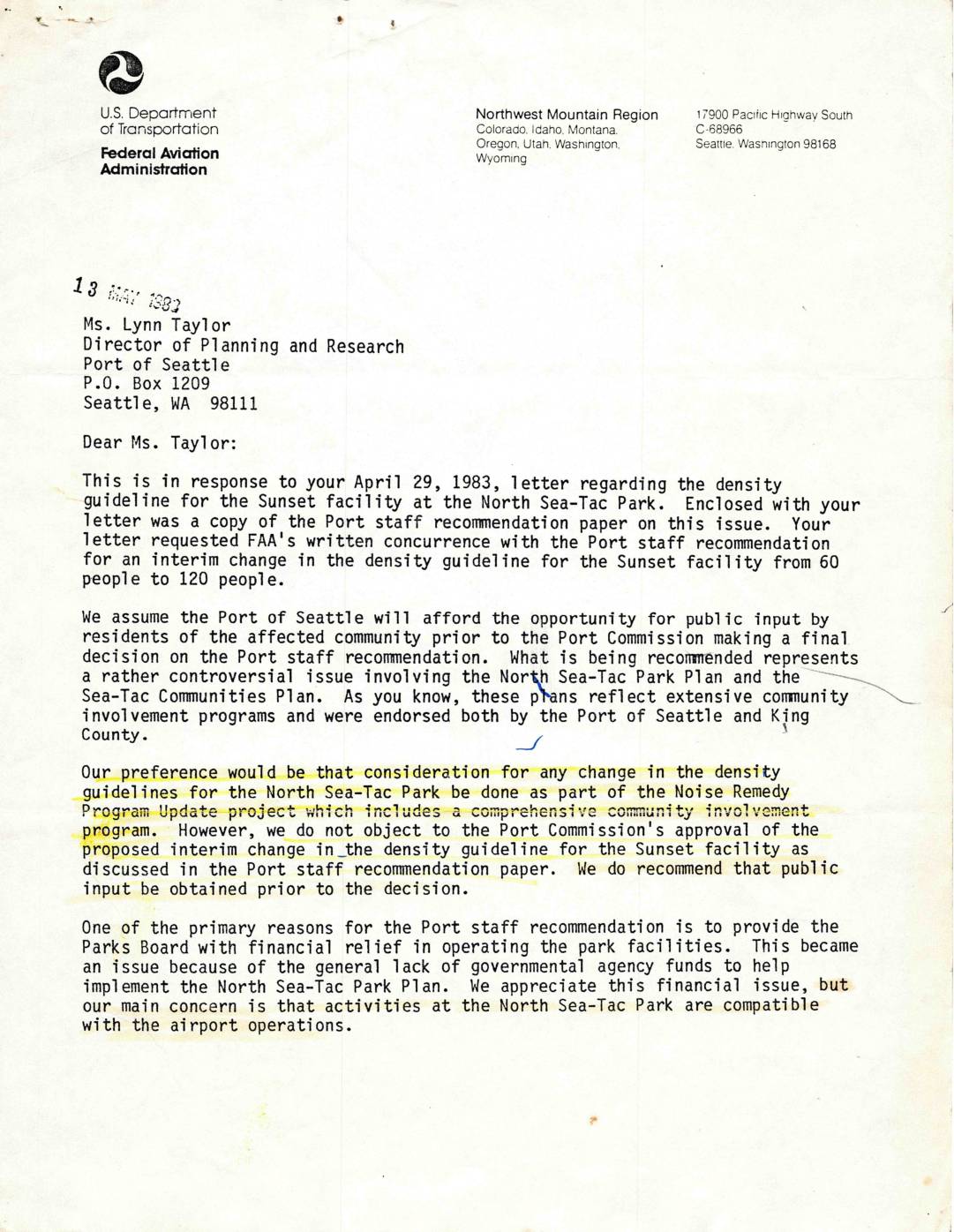
    FAA Response letter regarding North Sea-Tac Park Density Guideline change

    In this May 1983 letter, the FAA's Acting Manager of Airports Division responds to the Port of Seattle's request for federal concurrence on a proposed interim change to the density guideline at the Sunset facility in North Sea-Tac Park, doubling the allowed occupancy from 60 to 120 people. The FAA does not object to the Port Commission approving the change, but strongly recommends that public input be gathered from affected community residents before any final decision is made. The agency also expresses a preference that broader density guideline changes be addressed through the ongoing Noise Remedy Program Update, which includes a comprehensive community involvement process.
    CategoriesCorrespondence TagsNorth Sea-Tac Park, NSTPFolderNSTP
  • 1983-04-26

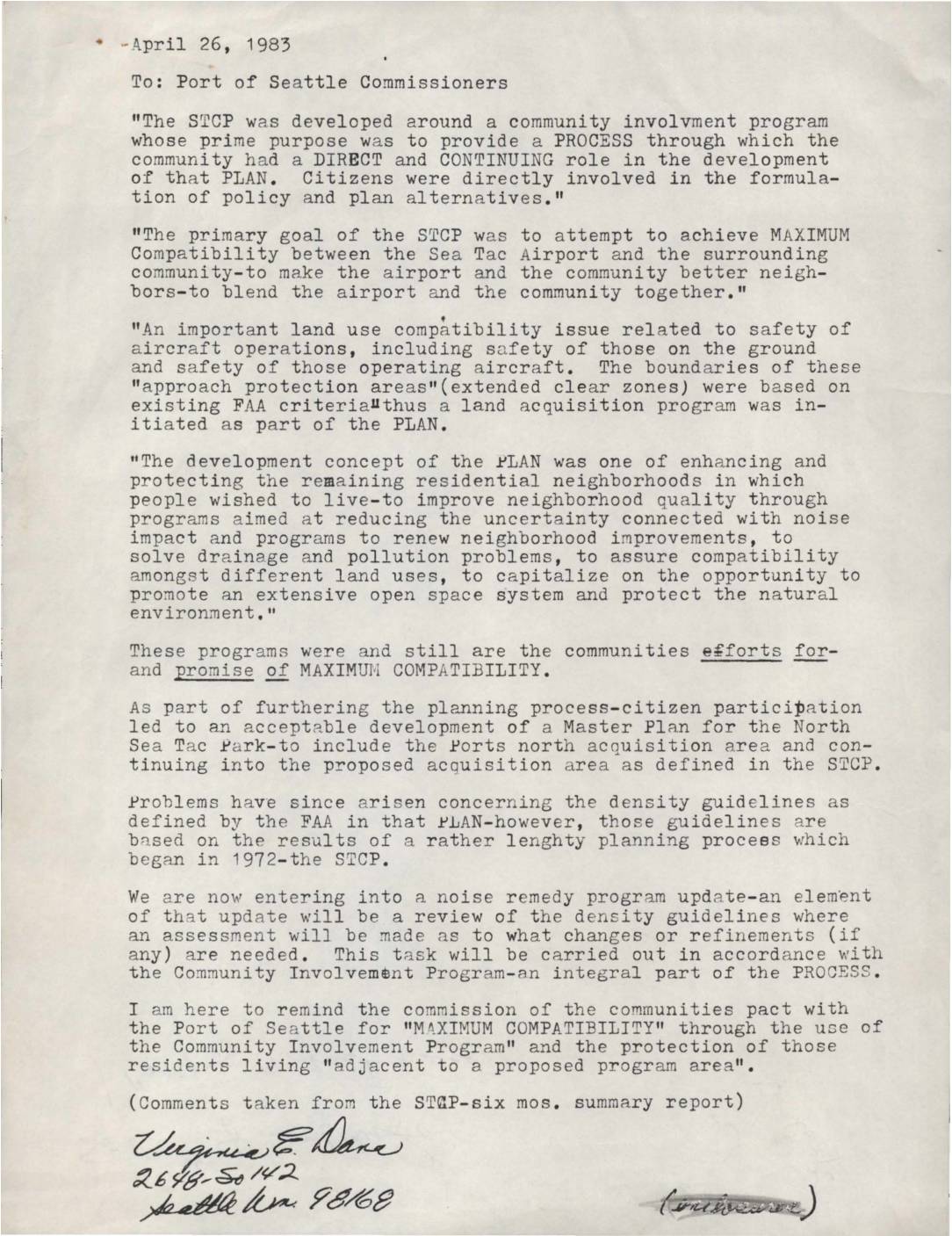
    Letter to Port Of Seattle Commissioners regarding STCP and maximum compatibility

    In this April 26, 1983 letter to the Port of Seattle Commissioners, resident Virginia E. Dare urges the commission to honor its commitment to 'maximum compatibility' between Sea-Tac Airport and surrounding neighborhoods, as originally promised under the Sea-Tac Community Plan (STCP) launched in 1972. The letter emphasizes that community members were guaranteed a direct, ongoing role in planning decisions—including noise mitigation, land acquisition, and density guidelines—through a formal Community Involvement Program. The author calls on commissioners to uphold that process as they enter a new noise remedy program update that will reassess FAA density guidelines affecting nearby residents.
    CategoriesCorrespondence TagsAirport Committees, Port Of Seattle, Sea-Tac Airport, STCPFoldermisc
  • 1983-04-26

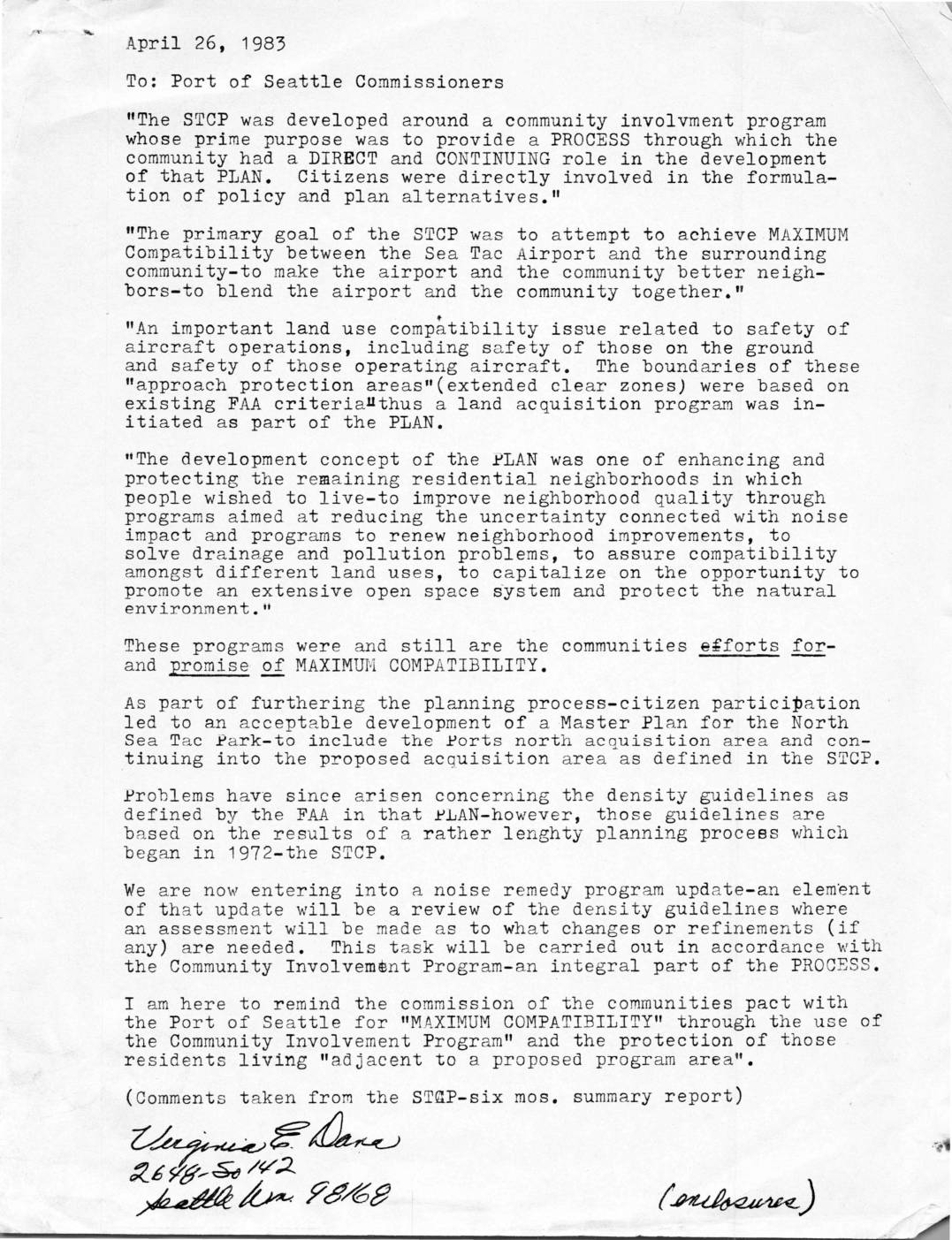
    Letter to Port Of Seattle Commissioners regarding STCP and community compatibility

    In this April 1983 letter to Port of Seattle Commissioners, a community representative reminds officials of their commitment to 'Maximum Compatibility' between Sea-Tac Airport and surrounding neighborhoods, as established through the Sea-Tac Communities Plan (STCP) begun in 1972. The letter emphasizes that citizens were promised a direct, continuing role in planning decisions—including land acquisition for safety zones and noise reduction programs—through a formal Community Involvement Process. The author calls on the commission to honor that commitment as they enter a new noise remedy program update that will reassess density guidelines near the airport.
    CategoriesCorrespondence TagsLand Use, Noise Mitigation, Noise Remedy Update, North Sea-Tac Park, Sea-Tac Communities PlanFolderNoise Remedy Update
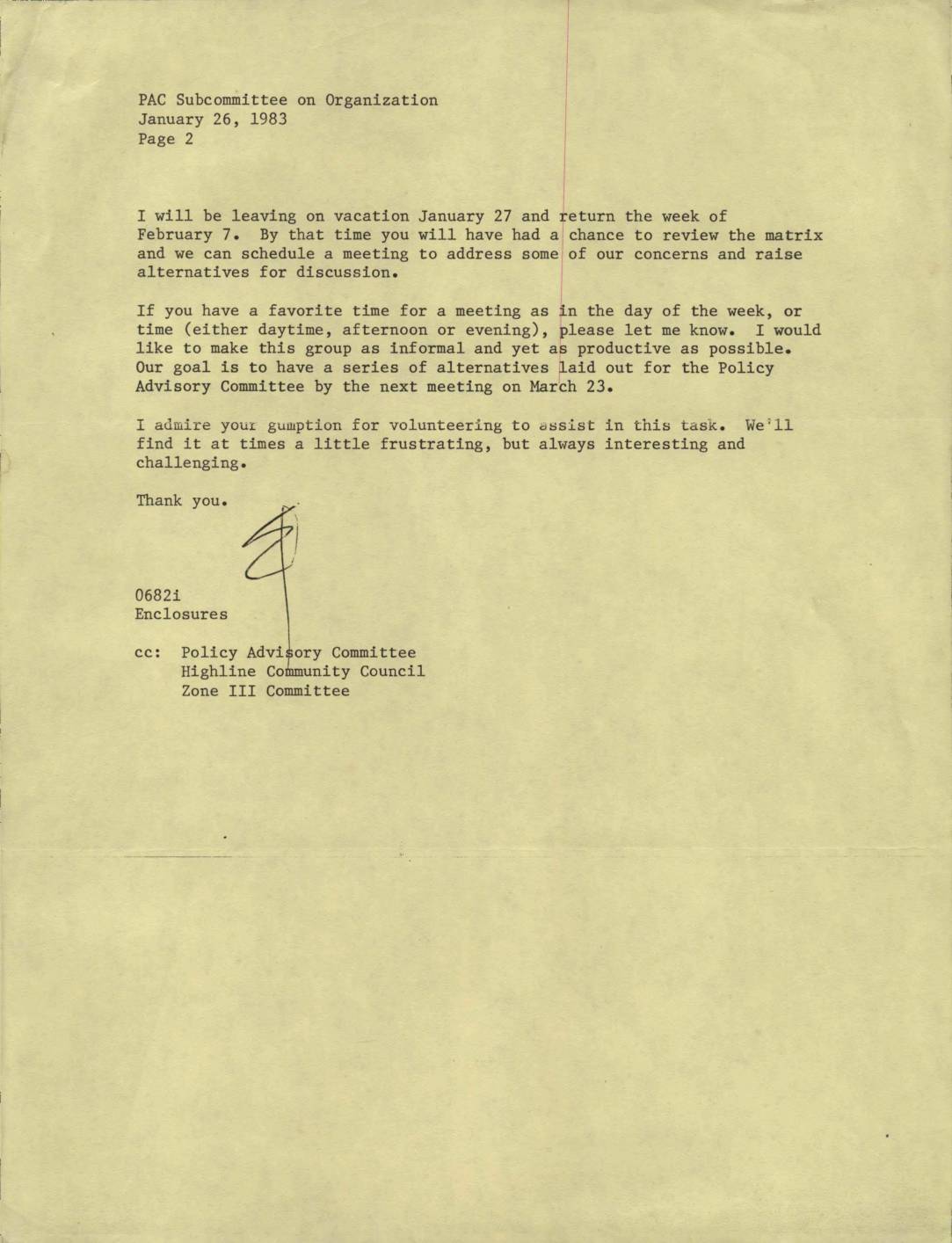
  • 1983-01-26

    PAC Subcommittee on Organization letter, January 26, 1983

    This document collection includes correspondence from 1981–1983 related to noise policy around Seattle-Tacoma (Sea-Tac) Airport. A February 1981 letter from PAC Chairman Oris Dunham to King County's Director of Planning urges the county to adopt and enforce building code sound insulation requirements — as called for in the Sea-Tac/Communities Plan adopted in 1976 — to protect nearby residents from aircraft noise. A January 1983 letter to the PAC Subcommittee on Organization outlines plans to develop a series of organizational alternatives for review at the March 23 Policy Advisory Committee meeting.
    CategoriesCorrespondence TagsKing County, Oris Dunham, Policy Advisory Committee, Sea-Tac Communities PlanFolderSea-Tac Airport
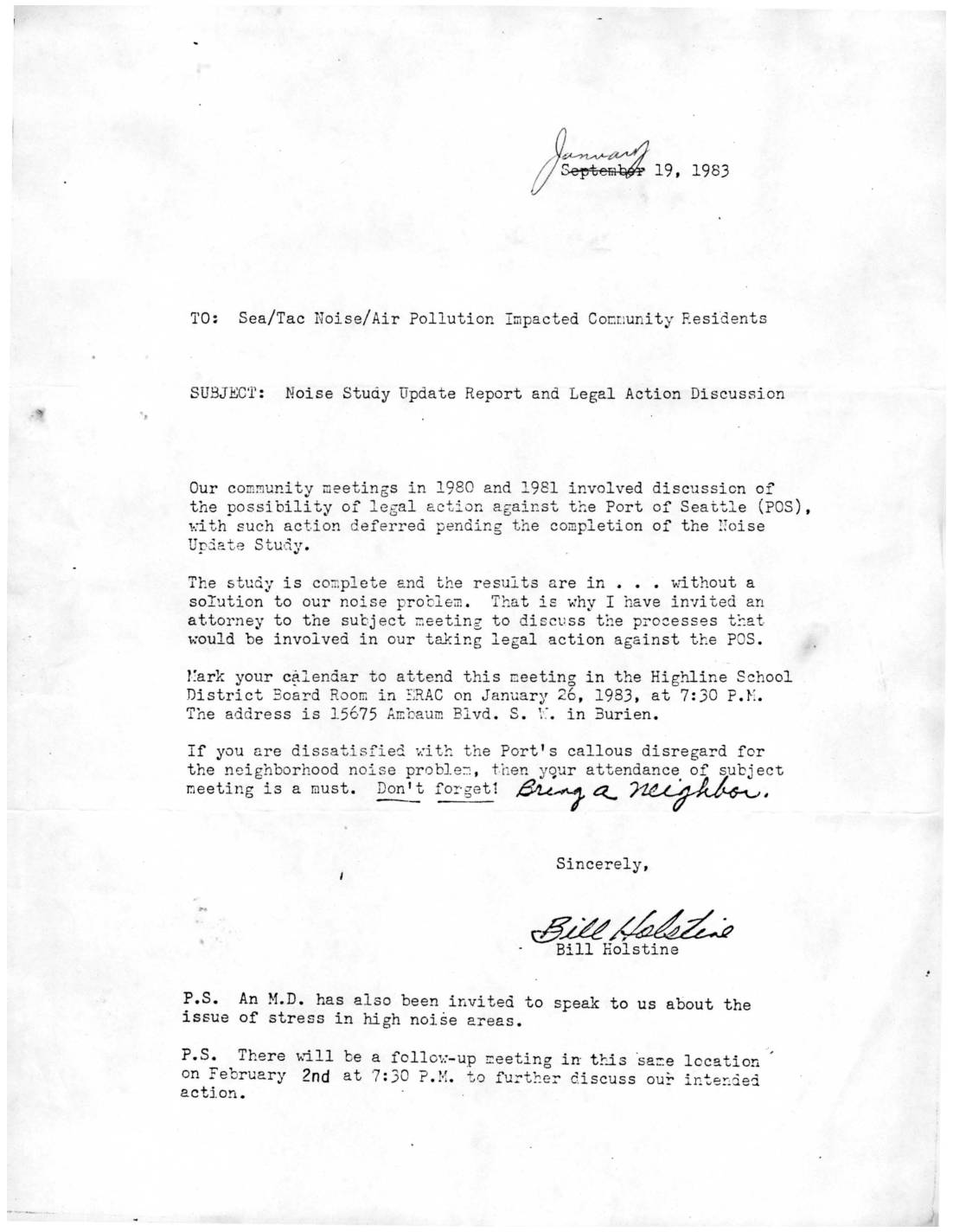
  • 1983-01-26

    Community Meeting Notice for Noise Study Update and Legal Action Discussion

    A letter from Bill Holstine to Sea/Tac noise and air pollution impacted community residents announcing a meeting to discuss the completed Noise Update Study results and potential legal action against the Port of Seattle. The meeting was scheduled for January 26, 1983, and would include an attorney to discuss legal processes and an M.D. to
    CategoriesCorrespondence, Meetings Tagscommunity engagement, Port Of SeattleFolderNoise Mitigation
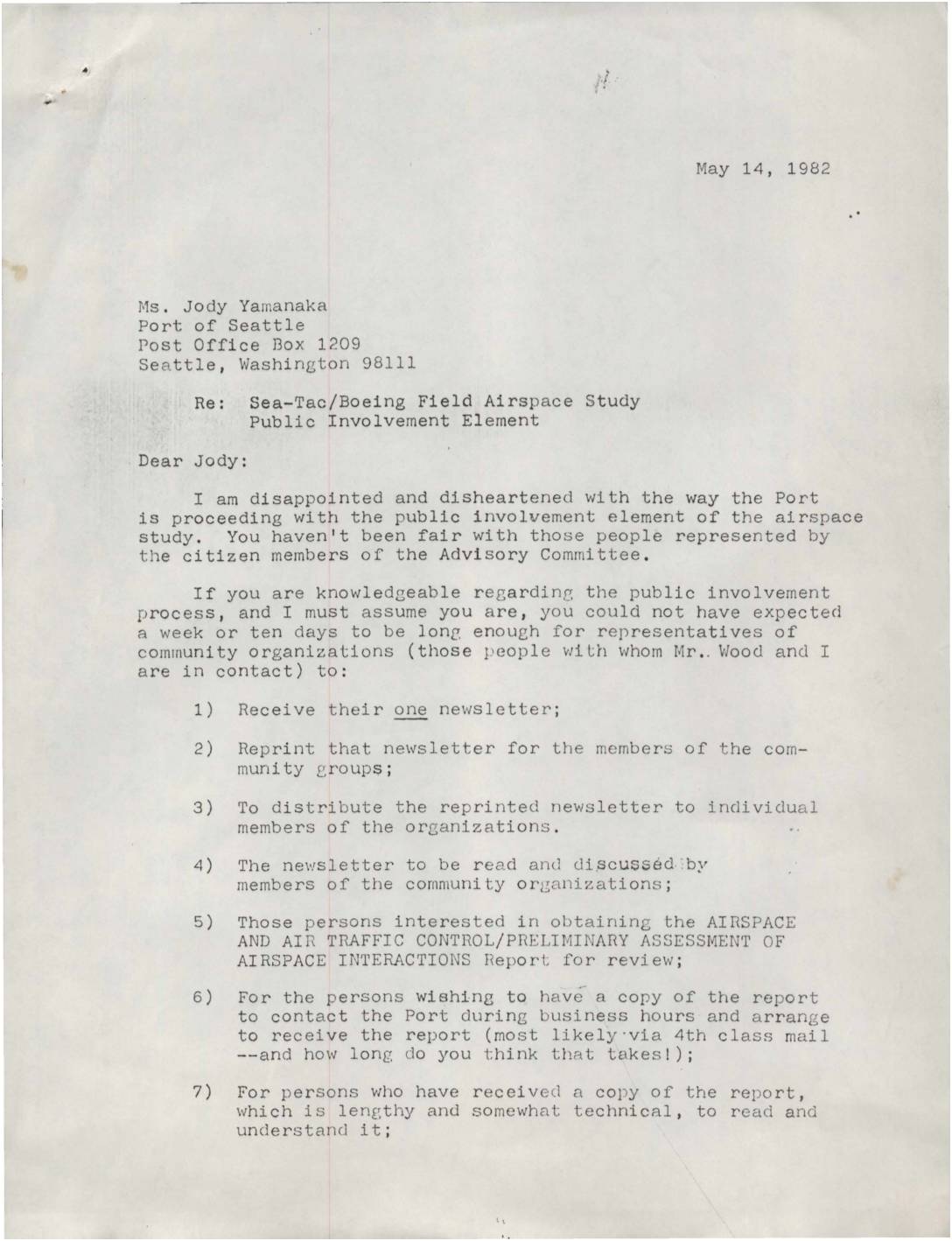
  • 1982-05-14

    Letter to Port of Seattle Regarding Sea-Tac/Boeing Field Airspace Study Public Involvement

    Letter from Rosemary Zeutschel criticizing the Port of Seattle’s inadequate public involvement process for the Sea-Tac/Boeing Field Airspace Study, arguing that insufficient time was provided for community organizations to review technical documents and provide meaningful input.
    CategoriesCorrespondence TagsAirspace Study, community engagement, Port Of SeattleFolderShared Airspace Study
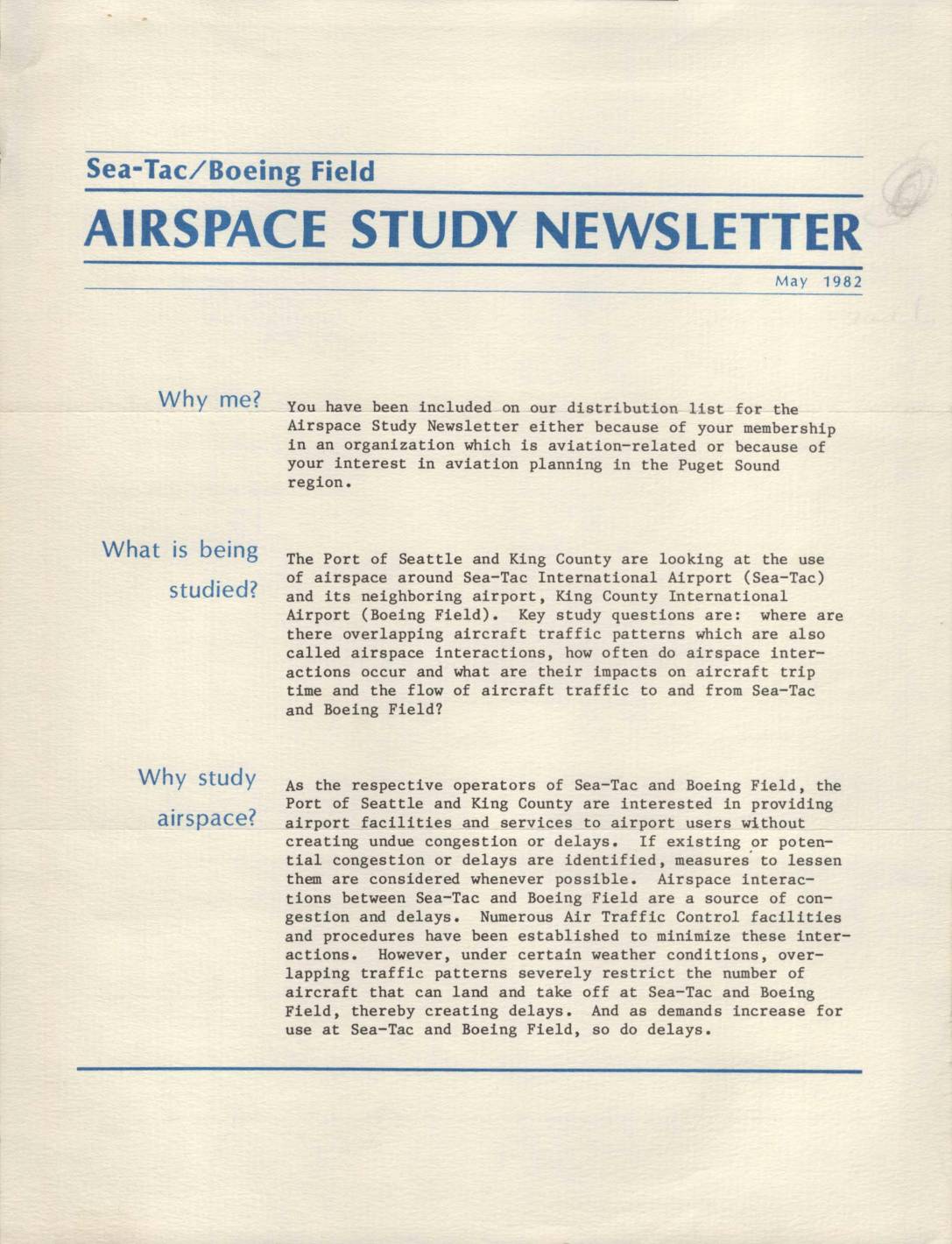
  • 1982-05-01

    Sea-Tac/Boeing Field Airspace Study Newsletter, May 1982

    A May 1982 newsletter from the Port of Seattle and King County describing an airspace study examining overlapping flight patterns between Sea-Tac International Airport and Boeing Field. The study found that delays caused by these overlapping traffic patterns were expected to grow gradually through 1990 and accelerate through 2000, particularly at Sea-Tac. The public was invited to a May 18, 1982 meeting to review preliminary findings and provide input on whether to proceed with identifying solutions to reduce aircraft delays.
    CategoriesCorrespondence, History TagsAirspace Study, Boeing Field, KCIA, King County, Newsletter, Port Of Seattle, Sea-Tac AirportFolderFlyers
  • 1982-03-26

    Letter from Senator Phil Talmadge regarding FAA density guidelines and Sea-Tac Communities Plan

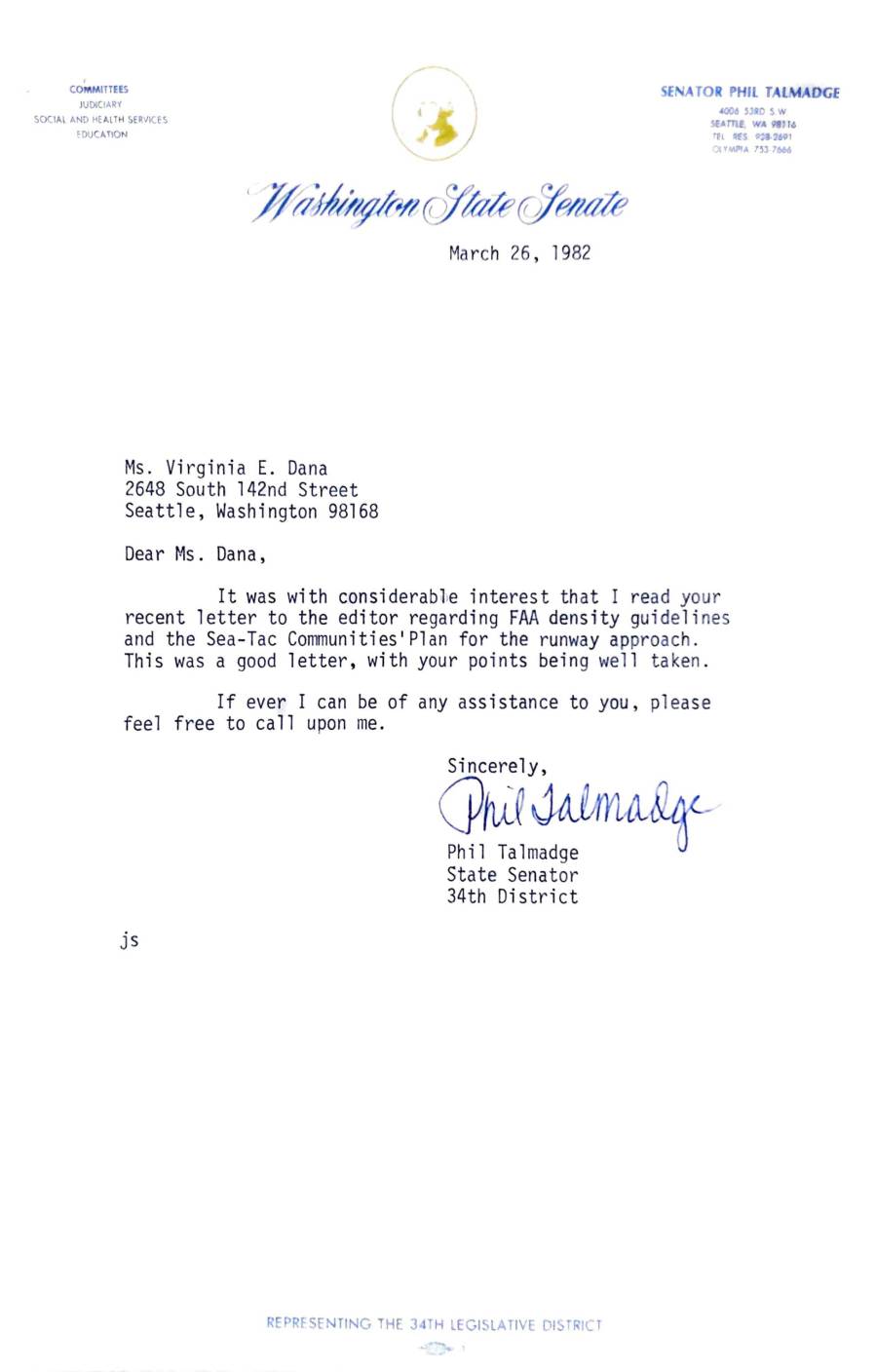
    In a 1982 letter to the editor titled 'Clear Zone Rules Have a Purpose,' Seattle resident Virginia E. Dana defended FAA density guidelines restricting how many people could gather on land north of Sea-Tac Airport, arguing the area was acquired to serve as a safety zone for aircraft, not a public park without limitations. She noted that the Port of Seattle purchased the land partly with federal funds to address severe noise impacts on residents, and that the FAA's people-per-acre restrictions had already been approved by community organizations, Port commissioners, and King County Council. State Senator Phil Talmadge responded with a letter commending Dana's well-reasoned position on the FAA guidelines and the Sea-Tac Communities Plan for the runway approach area.
    CategoriesCorrespondence TagsFAA Density Guidelines, Sea-Tac Communities PlanFoldermisc
  • 1982-02-11

    Port Of Seattle Memorandum: Forecast of Aviation Demand for King County International Airport (Boeing Field) and Sea-Tac International Airport — Airspace Study

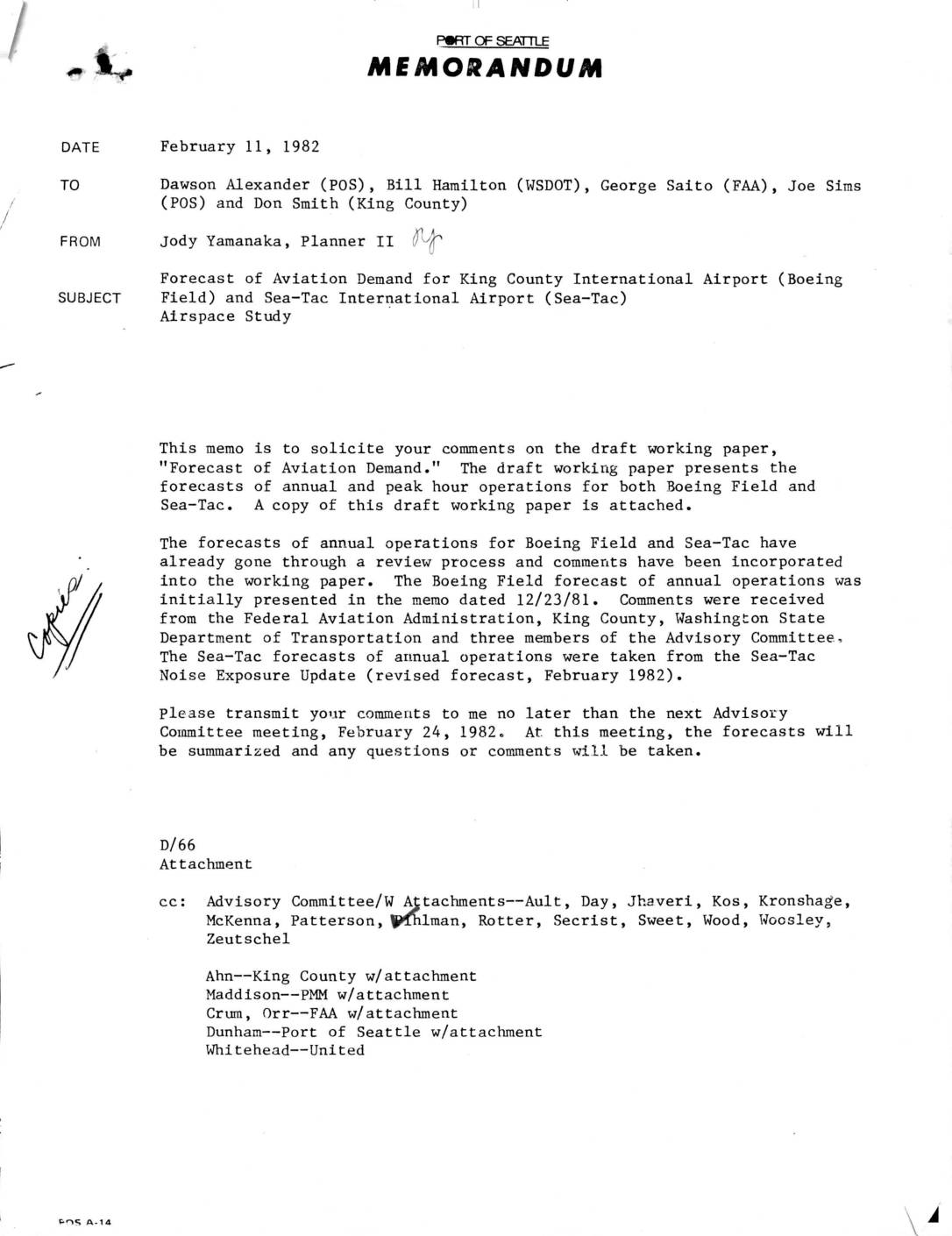
    A 1982 Port of Seattle memorandum presents draft forecasts of aviation demand for Sea-Tac International Airport and Boeing Field, projecting aircraft operations through the year 2000. The forecasts cover annual take-offs and landings as well as peak-hour traffic under both visual and instrument flight conditions, with Sea-Tac's total annual operations expected to grow from roughly 214,000 in 1980 to over 261,000 by 2000. The document was circulated to FAA, King County, and Washington State DOT representatives for review as part of an airspace capacity and noise planning study.
    CategoriesCorrespondence TagsAirspace Study, Boeing Field, FAA, Forecast, Jody Yamanaka, Joe Sims, KCIA, Port Of SeattleFolderShared Airspace Study

Posts pagination

Page 1 … Page 23 Page 24 Page 25 Page 26 Page 27 … Page 31
Sidebar On/Off

Upcoming Events

  • Part 150 NCP Workshop — Burien
    Add to CalendarMSaturday Oct 17: 10:00am

    Attend a Port of Seattle open house on the Part 150 Study Noise Compatibility Program (NCP). The Part 150 program determines the noise boundary around the airport and opportunities for noise mitigation such as sound insulation.

    [...]
  • Part 150 NCP Workshop — SeaTac
    Add to CalendarMMonday Oct 19: 6:00pm

    Attend a Port of Seattle open house on the Part 150 Study Noise Compatibility Program (NCP). The Part 150 program determines the noise boundary around the airport and opportunities for noise mitigation such as sound insulation.

    [...]
  • Part 150 NCP Workshop — Des Moines
    Add to CalendarMTuesday Oct 20: 6:00pm

    Attend a Port of Seattle open house on the Part 150 Study Noise Compatibility Program (NCP). The Part 150 program determines the noise boundary around the airport and opportunities for noise mitigation such as sound insulation.

    [...]

[See all...]


Issues

Sea-Tac Airport is currently undergoing the largest and longest expansion in its history, collectively known as the Sustainable Airport Master Plan (SAMP). Some of it you can already hear, but you’re probably not aware of what it all means. Here’s what you need to know.
read more...

Read This!

As the source for federal transportation grants, the Puget Sound Regional Council was charged with developing a system to meet the growing need for commercial aviation. When the search for a second airport failed, they authorized the Port of Seattle to build the Third Runway, with a mandate to develop a noise abatement and mitigation program. In their effort to stop the Third Runway, the ACC argued over every detail of the Port's efforts--including property buyouts and sound insulation. The dispute was meant to be settled by a three member Expert Arbitration Panel. This is their final report. It finds 2-1, that the Port's program was insufficient in several respects. Despite that, funding for the Third Runway was approved by the PSRC, and the 'Port Package' program, proceeded largely unchanged. Expert Arbitration Panel's final decision finding that the Port of Seattle had not shown sufficient reduction in real on-the-ground noise impacts to satisfy noise reduction conditions required for approval of a third runway at Sea-Tac International Airport. The majority decision concluded the Port's noise abatement programs were insufficient despite being impressive in scope.
continue...

The Podcast!

Subscribe to the only podcast devoted to helping people under the flight path everywhere. It’s definitely not just about noise!

Most Recent: Ep #43 Air Quality Monitoring Update (Raw!)

  • Sea-Tac Noise.Info
  • Connect with STNI

    • Subscribe
    • Port Package Problem?
    • Donate
    • Podcast
    • Socials
      • Facebook
      • X (Twitter)
      • Bluesky
      • Instagram
  • Learn

    • Frequently Asked Questions
    • Explainers
    • Youtube
    • Research Requests
    • Complain about one flight
  • Goals

    Fulfill the promises of 1976:
    • Compensation
    • Reduced noise
    • Improved air quality
    • Environmental remediation
Login/Register
©2026•Data Privacy

Message

We use cookies to provide basic functionality. We also provide access to search engines in order to provide site analytics. We do not sell or share your data.
V V