Category : Correspondence(303)
-
 1992-03-06
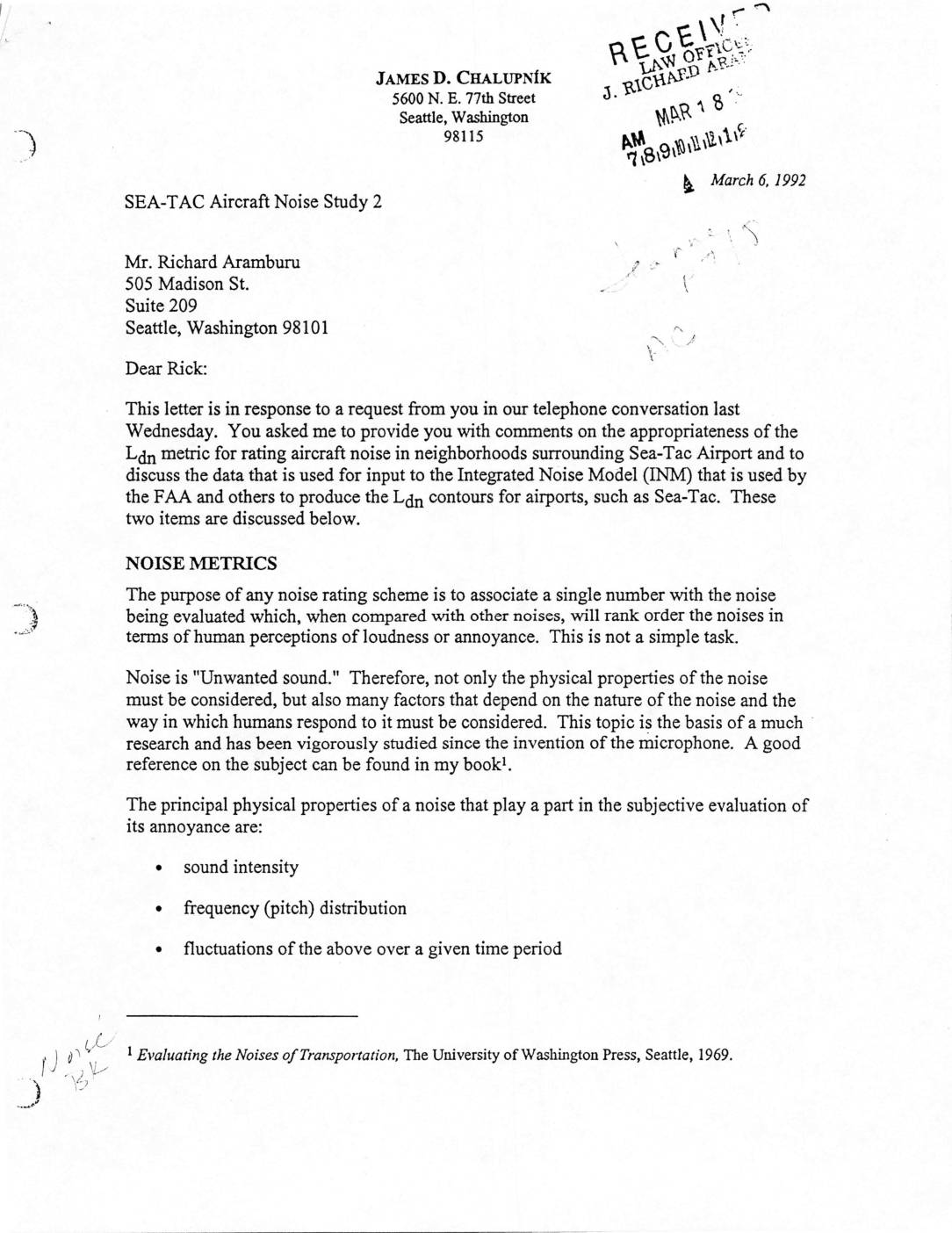
Letter from James D. Chalupník to Richard Aramburu Regarding Sea-Tac Aircraft Noise Study 2: Ldн Metric and Integrated Noise Model
In this 1992 letter, acoustics expert James D. Chalupník explains to attorney Richard Aramburu how aircraft noise near Seattle's Sea-Tac Airport is measured and rated, focusing on the appropriateness of the Ldn metric and the data used in the FAA's Integrated Noise Model (INM). He outlines the key physical properties of noise—intensity, frequency distribution, and fluctuation over time—and describes how various weighting schemes, particularly the A-weighting (dBA) scale, are used to approximate human perception of loudness and annoyance. The letter also notes the limitations of simpler metrics and introduces more sophisticated rating methods such as Stevens' Loudness Level and Perceived Noise Level for evaluating aircraft noise. -
 1992-03-02
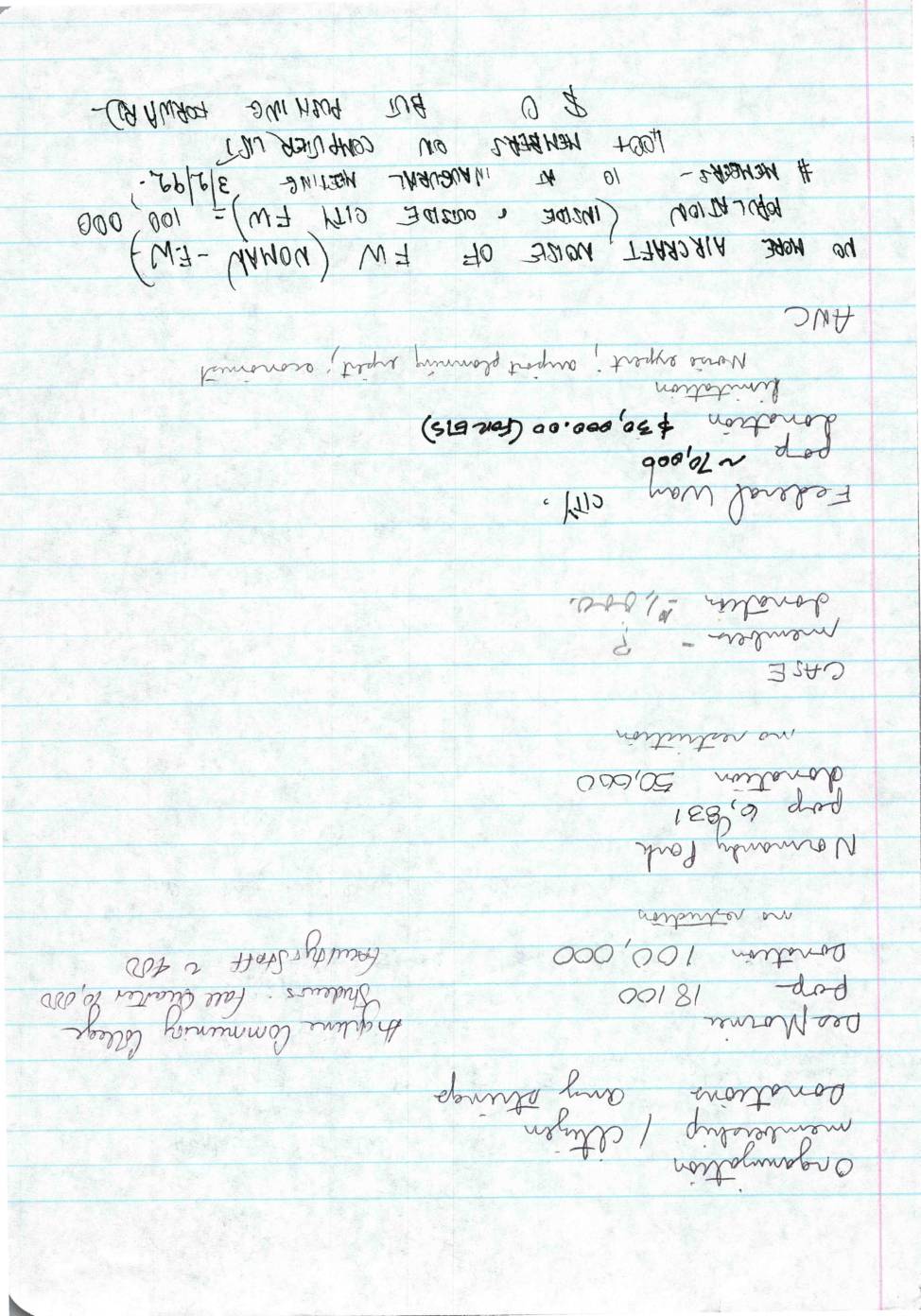
Handwritten notes on community organizations and airport noise
This handwritten document appears to be notes from an early 1992 meeting (dated 3/2/92) concerning aircraft noise policy near Sea-Tac Airport, referencing a group opposed to further aircraft noise and seeking members from both inside and outside city limits, with a target population of 100,000. The notes outline several case studies of organizations and community colleges receiving donations ranging from $50,000 to $100,000, apparently as part of noise mitigation or community foundation funding efforts. Key concerns include growing a membership list beyond those already on a computer list and organizing inaugural meetings to advance the no-more-aircraft-noise agenda. -
 1984-07-19
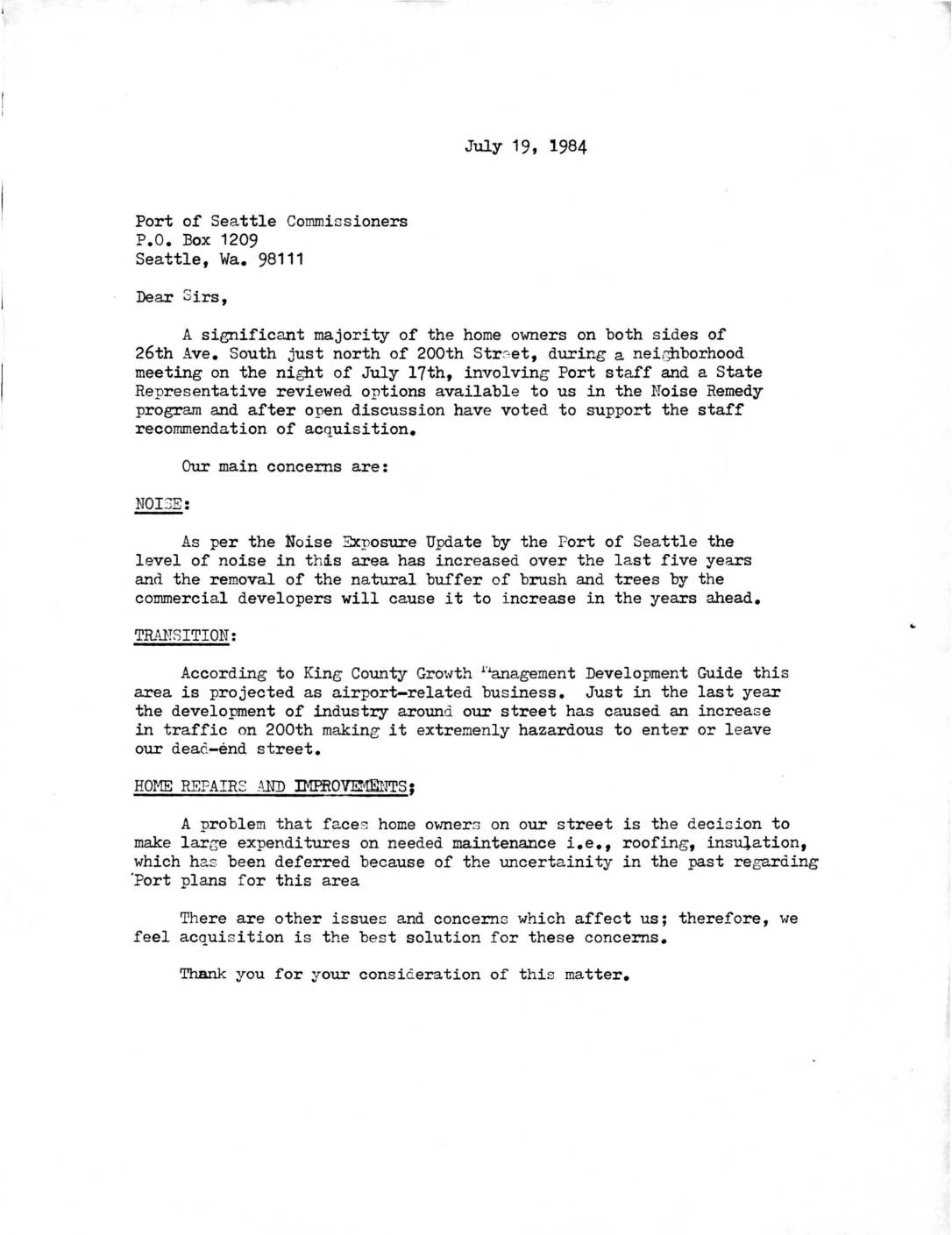
Letter to Port Of Seattle Commissioners supporting acquisition on 26th Ave. South
In July 1984, homeowners on 26th Ave. South near Seattle-Tacoma International Airport wrote to Port of Seattle Commissioners supporting the acquisition of their properties under the Noise Remedy program, citing increasing aircraft noise, growing industrial traffic hazards, and uncertainty that had delayed home maintenance. A separate letter from the Port's Director of Aviation to an airline captain acknowledged that non-compliance with existing noise abatement procedures — such as aircraft flying lower or turning sooner than prescribed — was a significant community concern, and noted that the Port was developing computer software using FAA radar data to automatically detect and report such violations. -
 1984-07-09
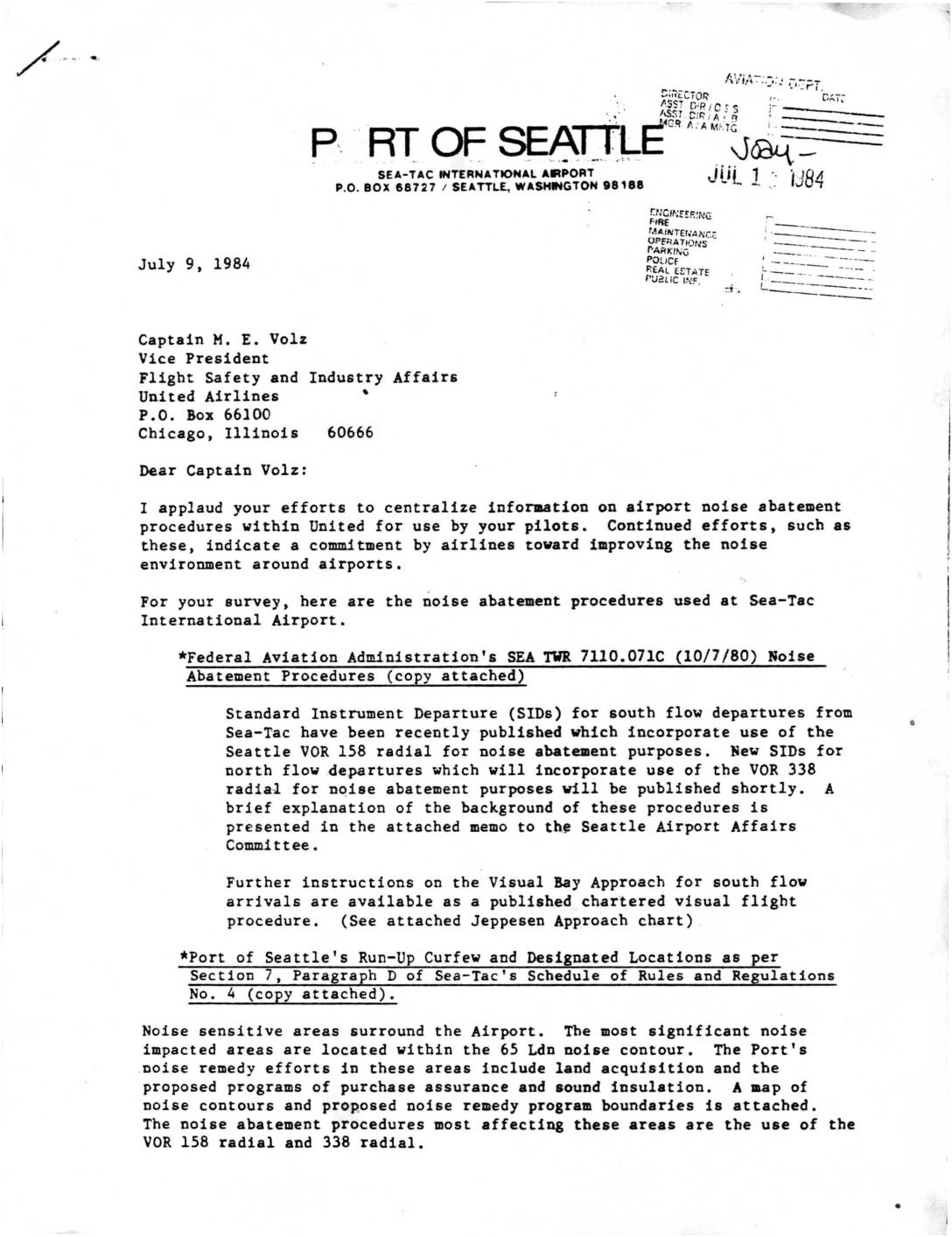
Port Of Seattle Letter to United Airlines on Sea-Tac Airport Noise Abatement Procedures
July 9, 1984 letter from Port Of Seattle to Captain M. E. Volz, Vice President of Flight Safety and Industry Affairs at United Airlines, summarizing noise abatement procedures at Sea-Tac International Airport. Covers FAA SEA TWR 7110.071C (10/7/80) noise abatement procedures, Standard Instrument Departure (SIDs) using Seattle VOR 158 radial for south flow and VOR -
1984-07-09
Port Of Seattle Letter to United Airlines on Sea-Tac Airport Noise Abatement Procedures
A July 9, 1984 letter from Port of Seattle to United Airlines Vice President Captain M. E. Volz outlines the noise abatement procedures in use at Seattle-Tacoma International Airport. The procedures include FAA-established Standard Instrument Departure (SID) routes using the Seattle VOR 158 and 338 radials to minimize noise over surrounding communities, a Visual Bay Approach for south flow arrivals, and a Run-Up Curfew with designated engine run-up locations. The letter also notes that the most noise-impacted areas fall within the 65 Ldn noise contour, where the Port was pursuing land acquisition, purchase assurance, and sound insulation programs as remedies. -
 1984-06-22
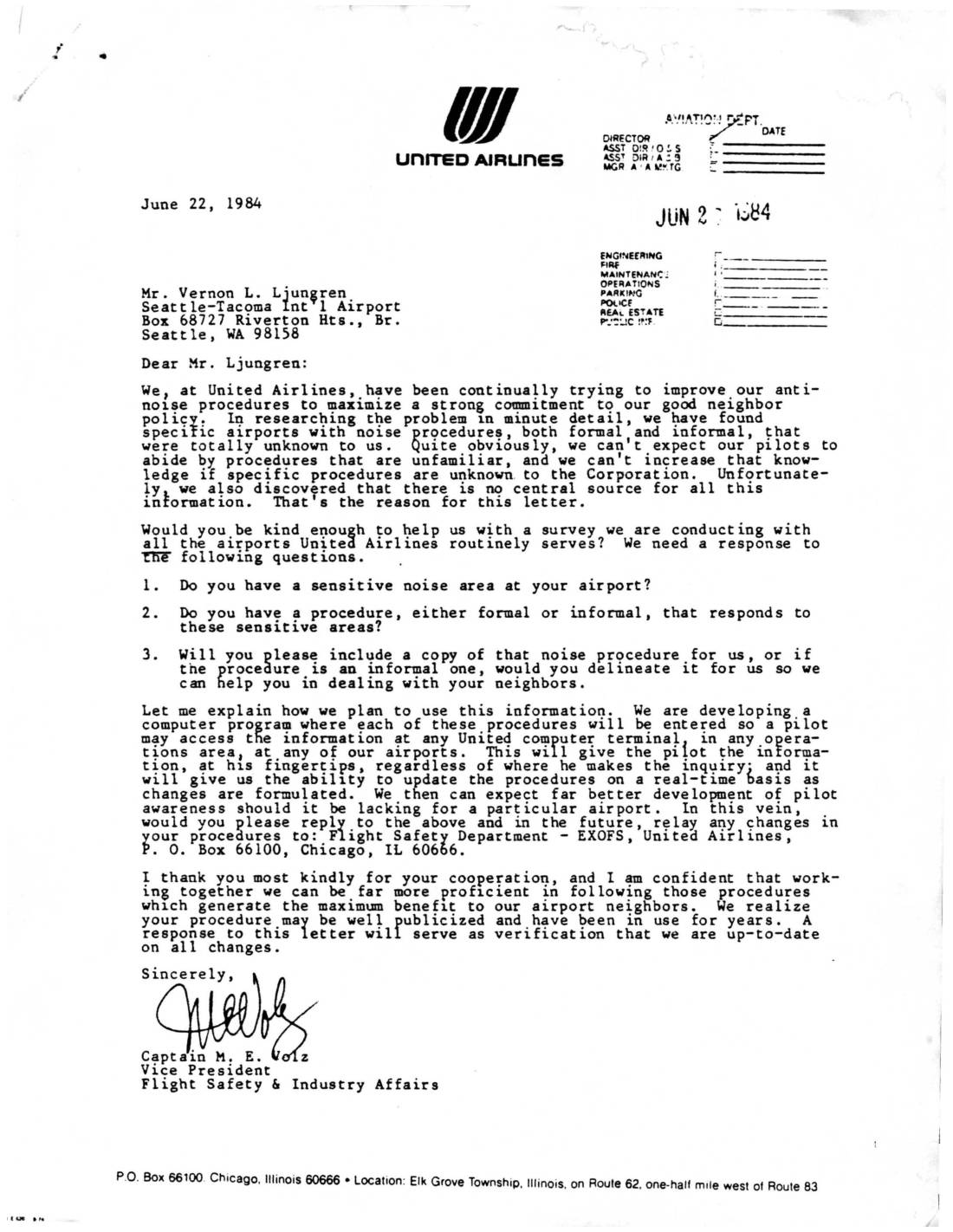
Letter from United Airlines to Mr. Vernon L. Ljungren, Seattle-Tacoma Int’l Airport, Regarding Noise Abatement Procedures Survey
Letter dated June 22, 1984 from Captain M. E. Volz, Vice President of Flight Safety & Industry Affairs at United Airlines (P.O. Box 66100, Chicago, IL 60666), to Mr. Vernon L. Ljungren at Seattle-Tacoma International Airport (Box 68727, Seattle, WA 98158). United Airlines surveys airports it serves regarding sensitive noise areas and formal or informal -
1984-06-22
Letter from United Airlines to Mr. Vernon L. Ljungren, Seattle-Tacoma Int’l Airport, Regarding Noise Abatement Procedures Survey
In a June 22, 1984 letter to Seattle-Tacoma International Airport, United Airlines Vice President Captain M. E. Volz requested information about the airport's noise-sensitive areas and any formal or informal noise abatement procedures in place. The airline was conducting a survey of all airports it served in order to build a computer database of noise procedures accessible to pilots at any United Airlines terminal. United Airlines asked Sea-Tac to provide copies or descriptions of its noise procedures and to send future updates to the Flight Safety Department in Chicago. -
 1984-02-28
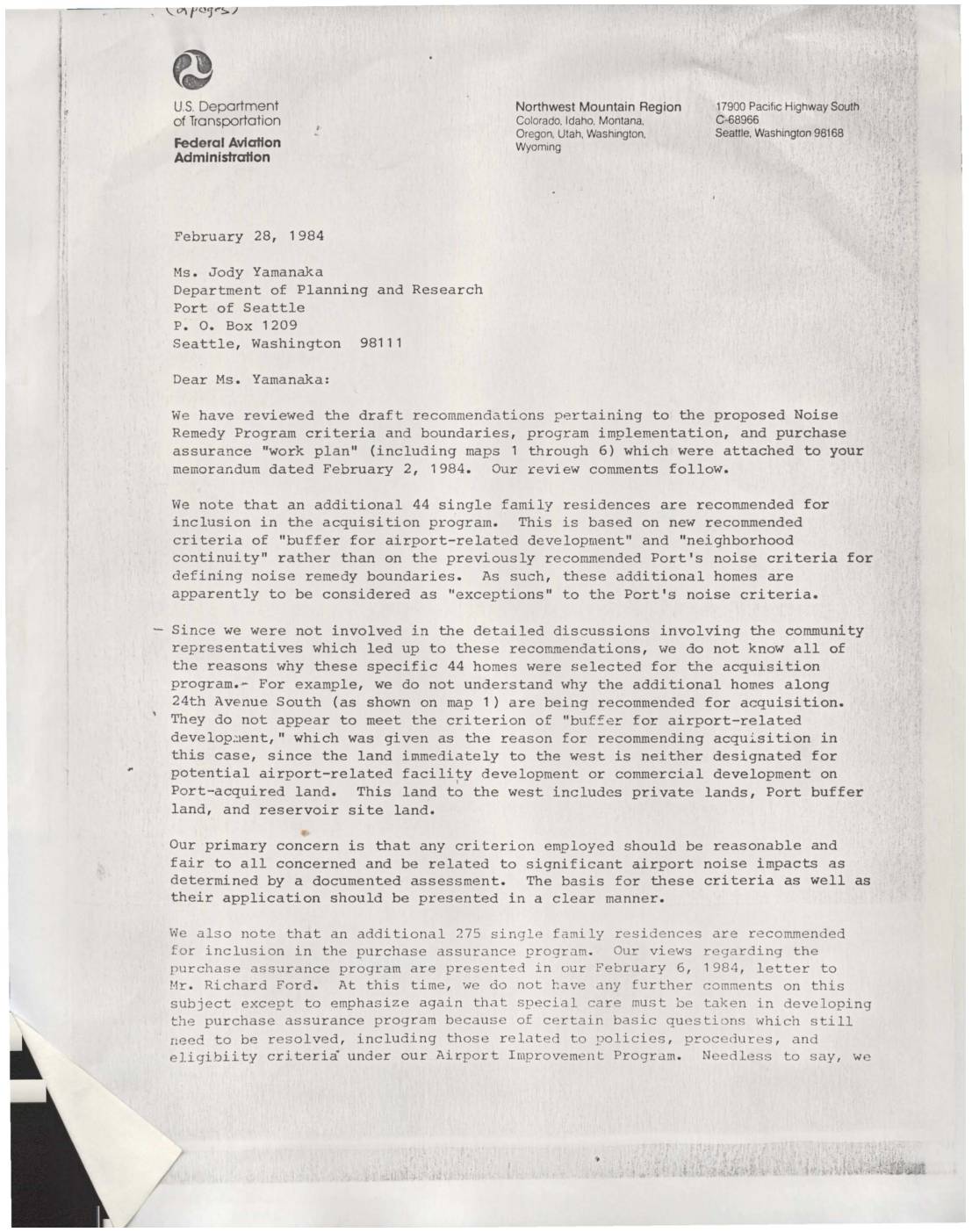
FAA review letter on proposed Noise Remedy Program criteria and boundaries
In this February 28, 1984 letter, the FAA's Northwest Mountain Region reviewed the Port of Seattle's proposed Noise Remedy Program for Sea-Tac Airport, raising concerns about the criteria used to add 44 homes to an acquisition program and 275 homes to a purchase assurance program. The FAA questioned whether the new criteria of 'buffer for airport-related development' and 'neighborhood continuity' were sufficiently justified, particularly for homes along 24th Avenue South. The agency urged that all criteria be reasonable, clearly documented, and tied to measured noise impacts, and cautioned against finalizing the purchase assurance plan before key federal policy questions were resolved. -
 1984-01-23
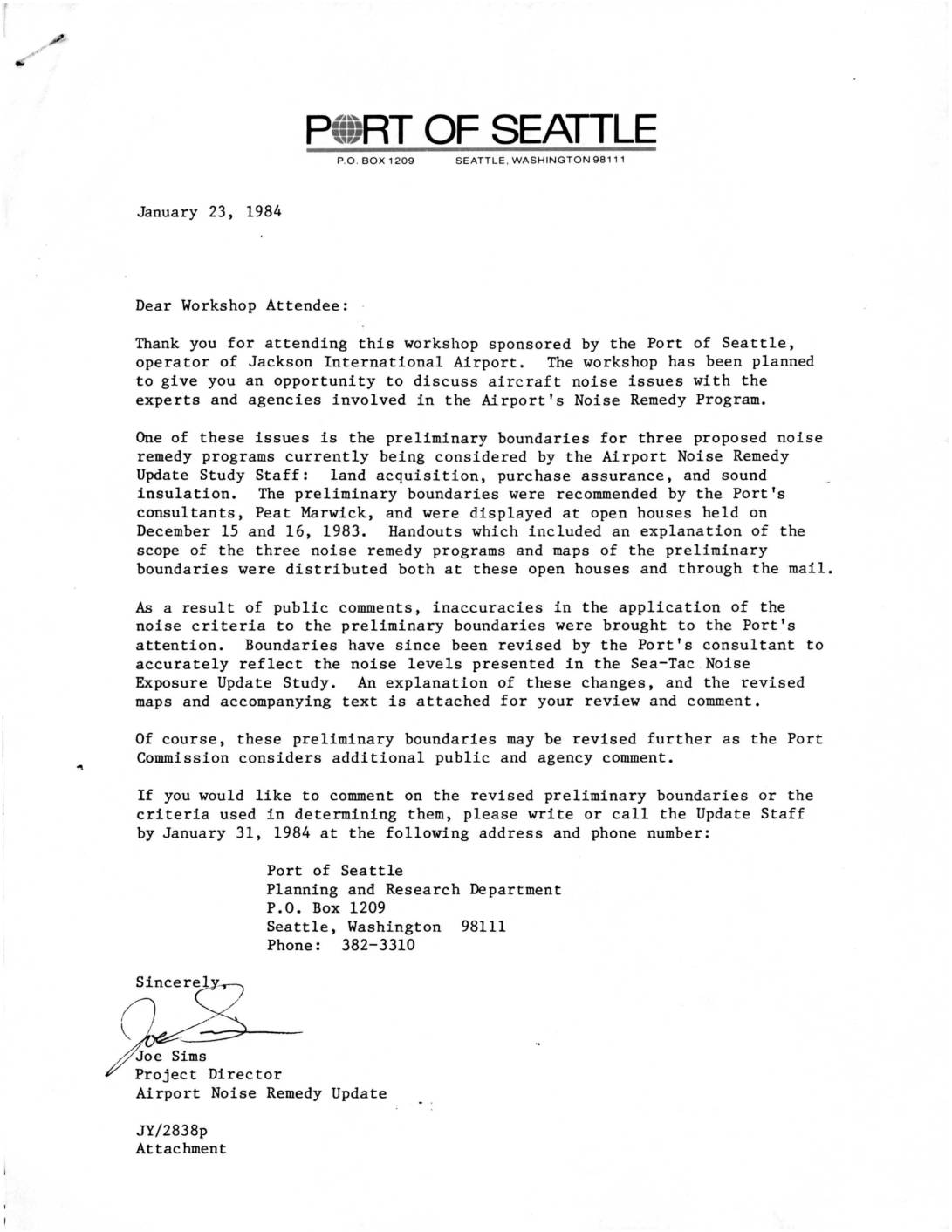
List of modifications to off-airport portion of draft Chapter 5 – Final evaluation of noise abatement and noise remedy measures, Jackson International Airport Noise Remedy Update Study
In January 1984, the Port of Seattle sent workshop attendees an update on proposed noise remedy programs for Jackson International Airport (Sea-Tac), outlining three options: land acquisition, purchase assurance, and sound insulation. Following public feedback that revealed inaccuracies in the original boundary maps, the Port's consultant revised the preliminary geographic boundaries to more accurately reflect noise levels from the Sea-Tac Noise Exposure Update Study. The accompanying modifications document details specific additions and deletions to affected areas surrounding the airport for each of the three programs. -
 1984-01-09
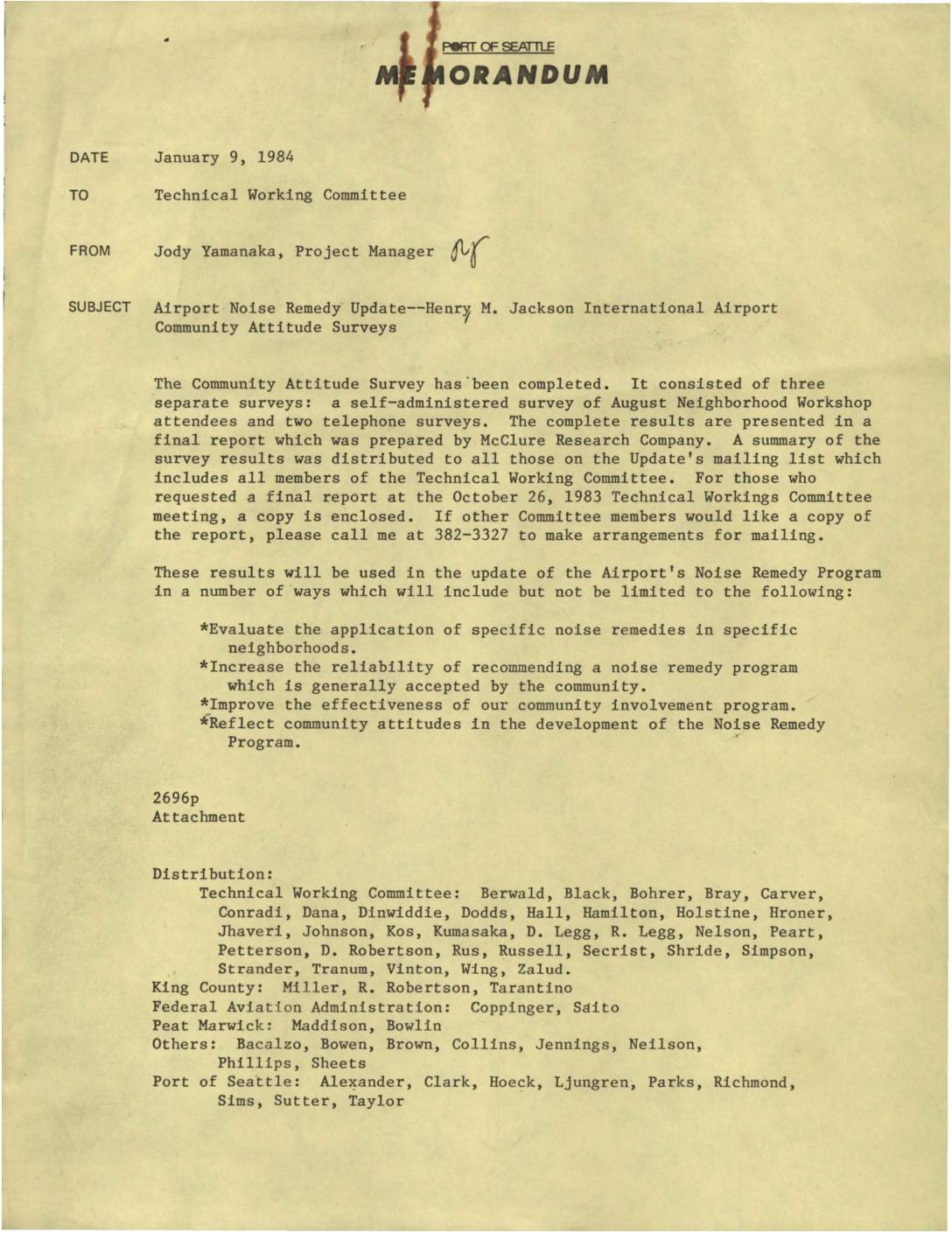
Letter to TRC Airport Noise Remedy Community Attitude Survey
A January 1984 Port of Seattle memo from Project Manager Jody Yamanaka to the Technical Working Committee announces the completion of a Community Attitude Survey related to the Airport Noise Remedy Program at Henry M. Jackson International Airport. The survey, conducted by McClure Research Company, included a self-administered survey of neighborhood workshop attendees and two telephone surveys. The findings were to be used to evaluate specific noise remedies, improve community involvement, and ensure the Noise Remedy Program reflected local community attitudes.