Category : Correspondence(303)
-
 1993-03-03
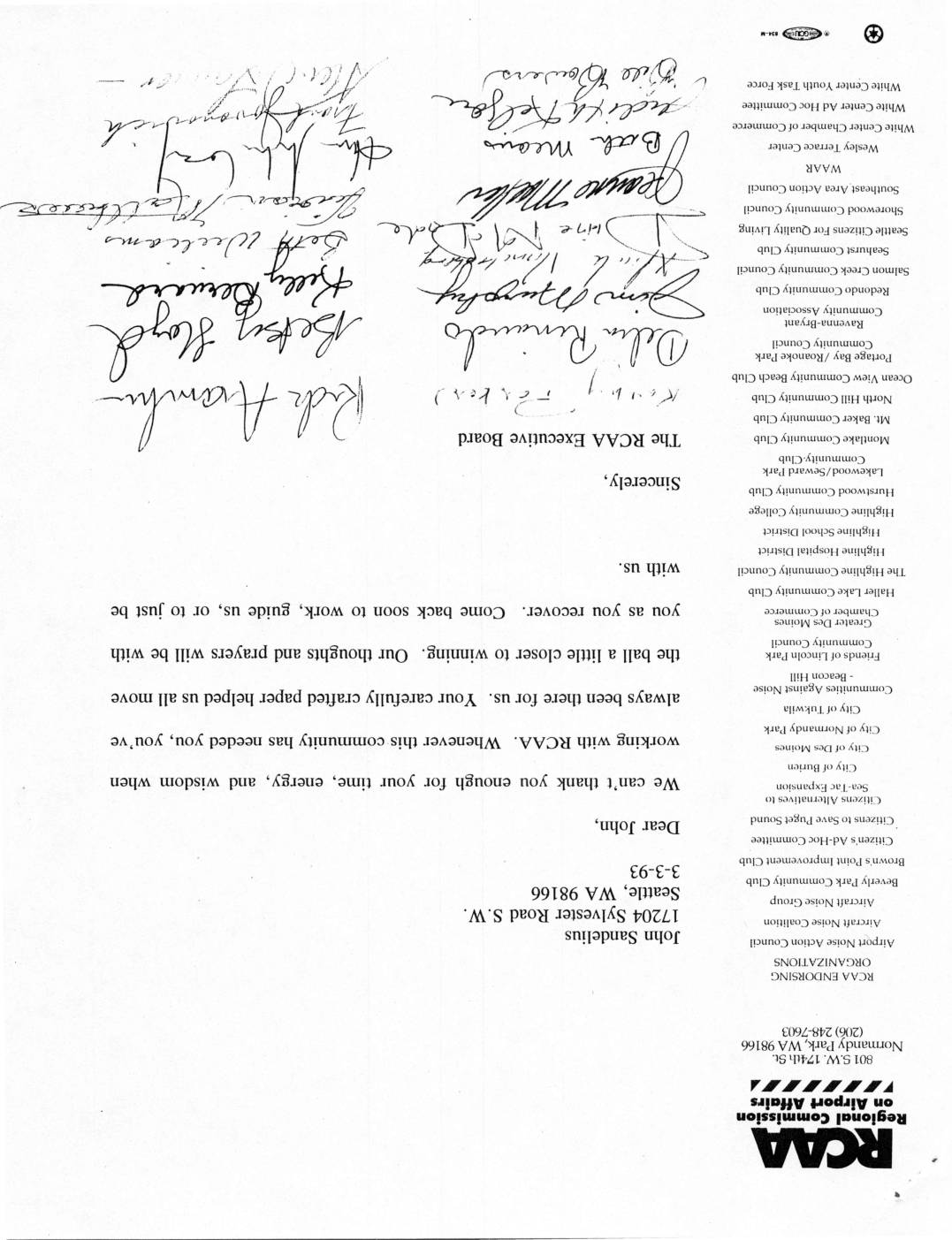
RCAA letter to John Sandelius
A March 1993 letter from the RCAA (Regional Commission on Airport Affairs) Executive Board addressed to John Sandelius of Seattle, thanking him for his time, energy, and wisdom contributed to the organization's efforts regarding Sea-Tac Airport noise issues. The letter expresses well-wishes for his recovery and notes that his work was valued whenever the community needed him. The document is endorsed by a wide coalition of over 50 community organizations, city governments, and civic groups from the greater Seattle and South King County area opposing airport noise expansion. -
 1993-01-28
RCAA letter to Transportation Policy and Executive Board
A January 28, 1993 letter from James T. Murphy of the Regional Commission on Airport Affairs (RCAA) to the Transportation Policy and Executive Board, presenting independent consultant research on air capacity options for the Puget Sound region. The letter notes that RCAA had delivered three volumes of material over three weeks, with a final compilation to follow, aimed at helping the Board make informed decisions about managing airport capacity. The RCAA, backed by dozens of community organizations and cities including Burien, Des Moines, Normandy Park, and Tukwila, framed its work as an alternative voice on Sea-Tac Airport expansion and noise policy. -
 1993-01-13
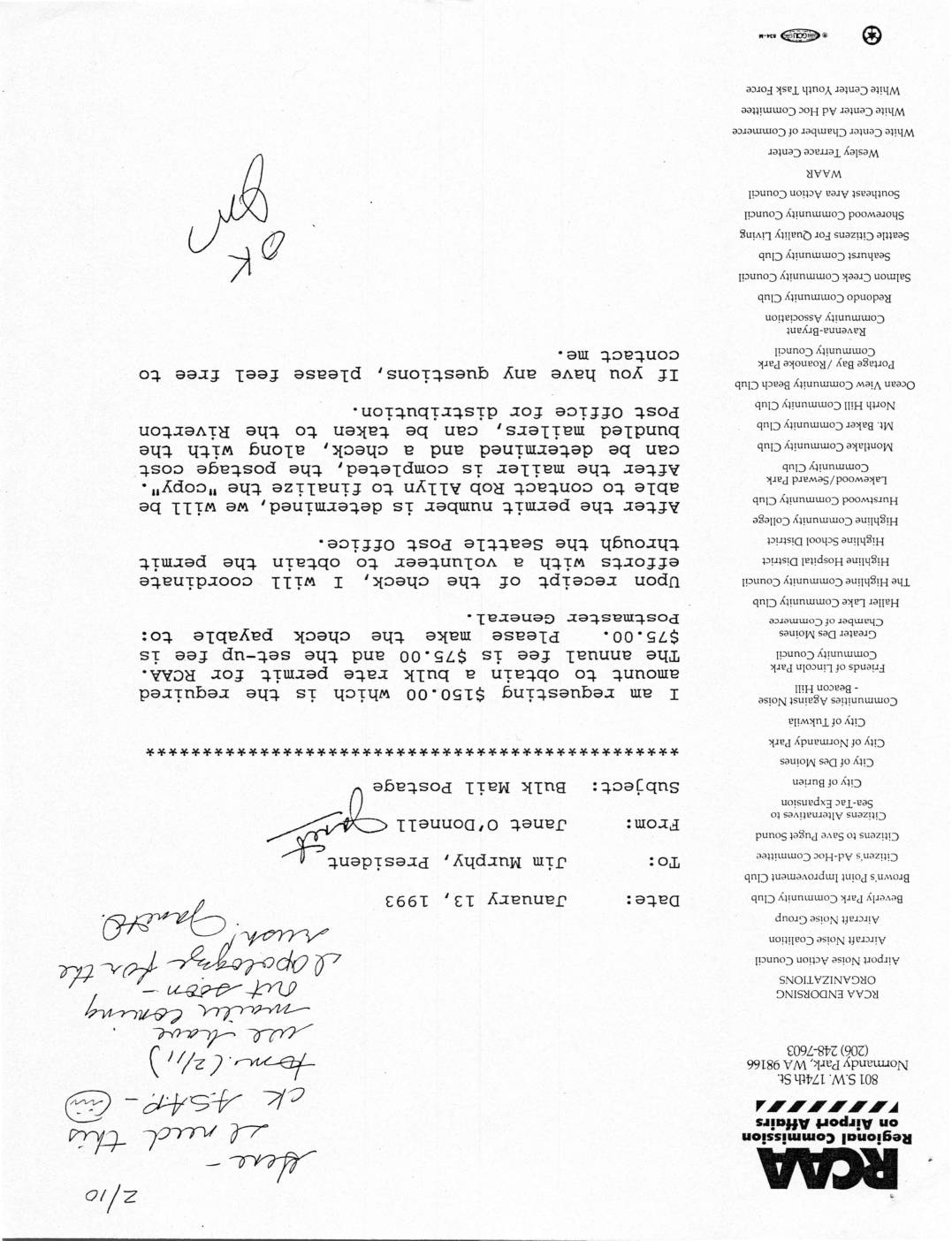
Bulk mail postage memo to Jim Murphy, President
A January 13, 1993 memo from Janet O'Donnell to Jim Murphy, President of the Regional Commission on Airport Affairs (RCAA), requests $150.00 to obtain a bulk mail postal permit — $75.00 for the annual fee and $75.00 for the setup fee — to support distribution of materials related to Sea-Tac Airport noise issues. The memo outlines the process for obtaining the permit through the Seattle Post Office and coordinating with a volunteer to finalize mailing logistics. The document is endorsed by a broad coalition of community organizations, city governments, and civic groups opposed to Sea-Tac Airport expansion and aircraft noise. -
 1992-11-20
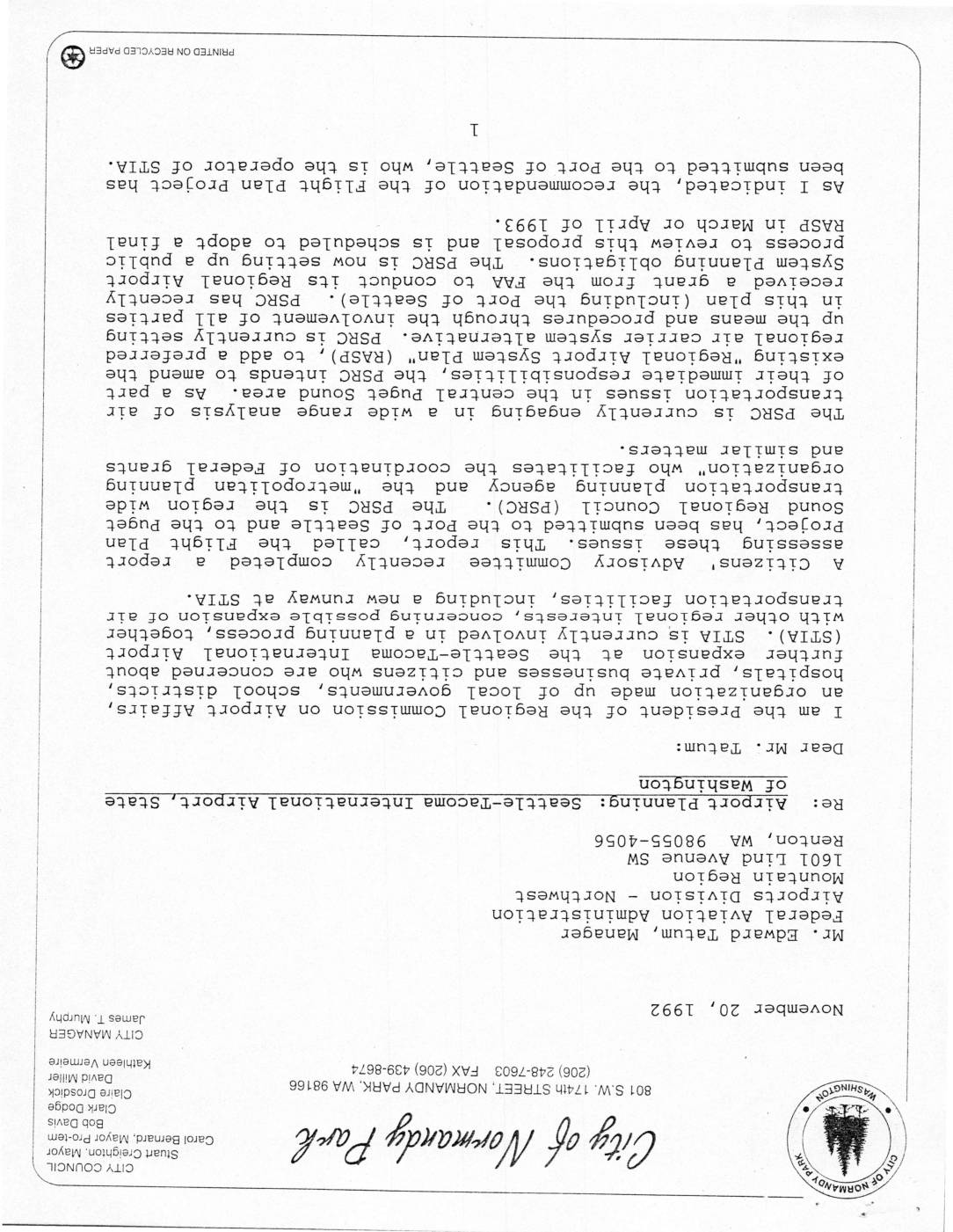
Airport planning: Seattle-Tacoma International Airport, State of Washington
In a November 1992 letter to the FAA's Northwest Mountain Region manager, the President of the Regional Commission on Airport Affairs urges the federal government to defer funding and detailed planning for a proposed third runway at Seattle-Tacoma International Airport (Sea-Tac). The letter argues that the Puget Sound Regional Council's ongoing regional airport system planning process must be allowed to fully evaluate all alternatives before any single project receives federal financial commitment. The author warns that proceeding prematurely with site-specific plans and an Environmental Impact Statement risks wasting federal money if the regional plan ultimately selects an alternative other than a third runway at Sea-Tac. -
 1992-10-05
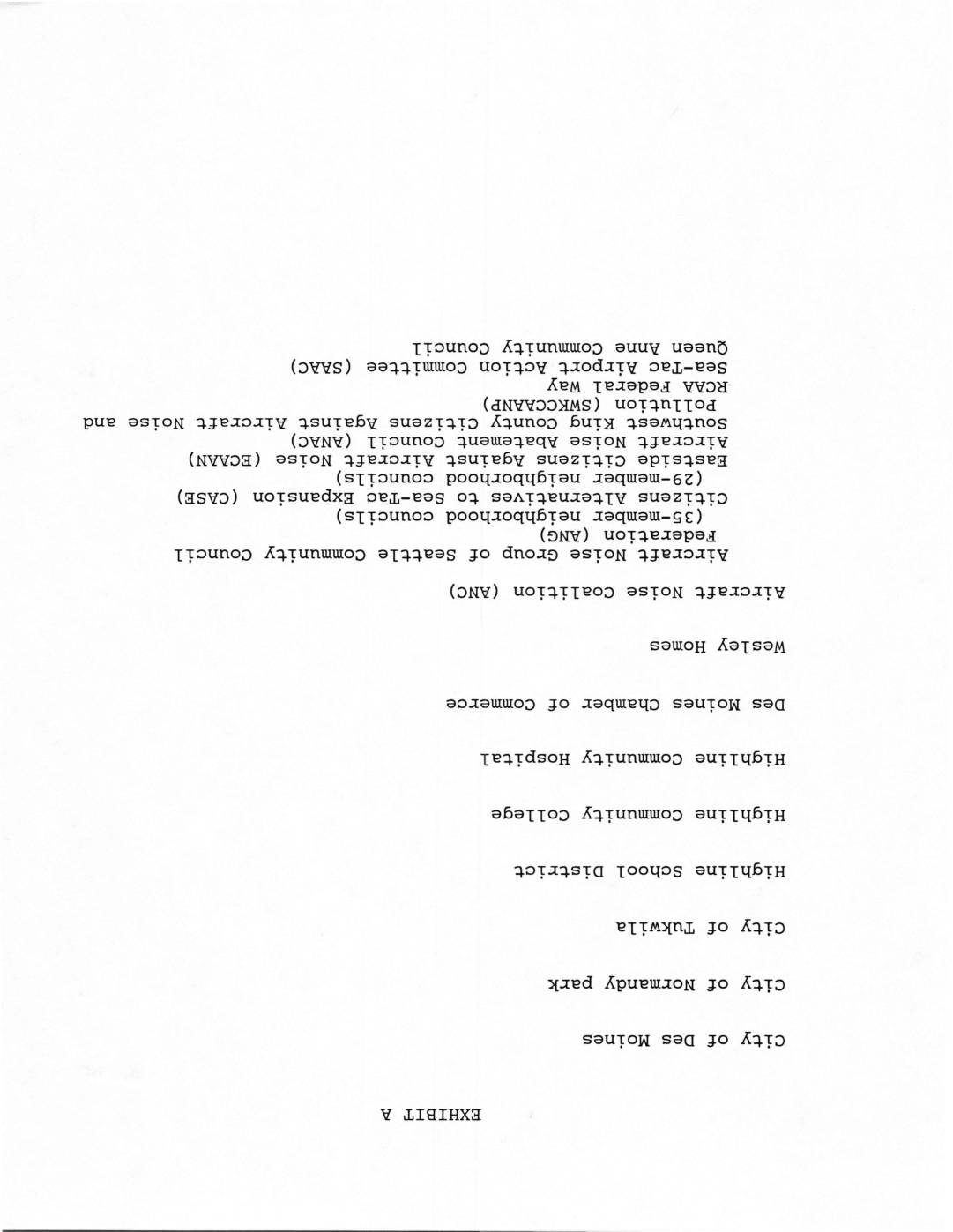
Airport Alternative Committee October 5, 1992 meeting notes
These documents relate to the Airport Alternative Committee's October 1992 meeting, which brought together cities, community organizations, and citizen groups concerned about aircraft noise around Seattle-Tacoma (Sea-Tac) Airport. The committee evaluated criteria and requirements for addressing airport expansion, including minimizing noise impact on the largest number of people, maximizing aircraft and ground safety, and providing 750 operations capacity by the year 2020. Alternative airport sites such as Vancouver, Black Lake, Fort Lewis, Portland, McCord, Arlington, and SeaTac were also discussed. -
 1992-09-28
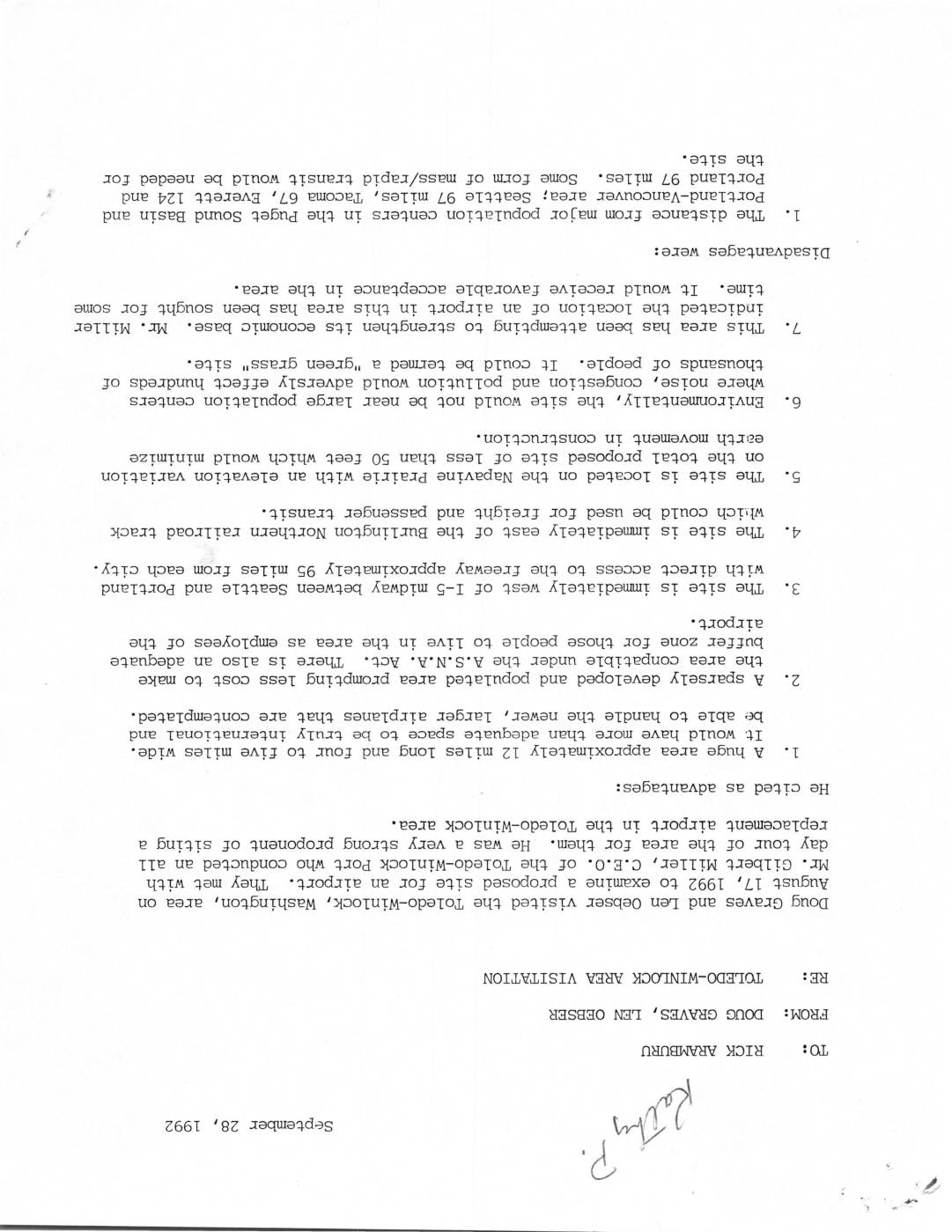
Toledo-Winlock area visitation
A September 1992 internal memo from Doug Graves and Len Oebser to Rick Aramburu summarizes a site visit to the Toledo-Winlock area of Washington State as a potential location for a new replacement airport. The site was praised for its large size, proximity to the I-5 freeway midway between Seattle and Portland, access to Burlington Northern rail lines, and its sparsely populated surroundings, which would minimize noise and environmental impacts. However, drawbacks noted included its distance from major population centers such as Seattle, Tacoma, Everett, and Portland, which would require some form of mass rapid transit to serve the airport effectively. -
 1992-09-01
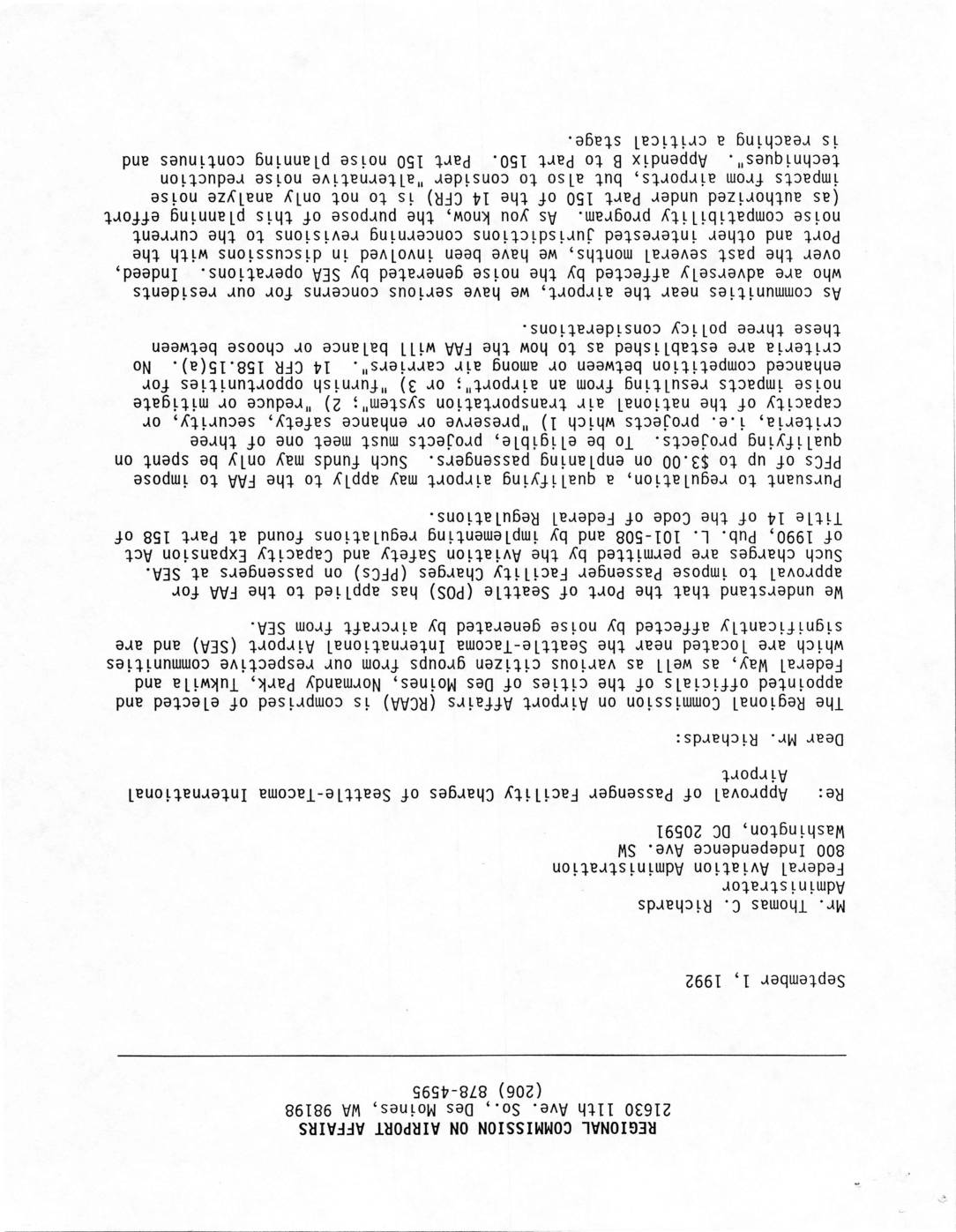
Approval of passenger facility charges of Seattle-Tacoma International Airport
In a September 1, 1992 letter to the FAA Administrator, the Regional Commission on Airport Affairs formally requests reconsideration of the FAA's August 14, 1992 decision approving Passenger Facility Charges (PFCs) at Seattle-Tacoma International Airport. The Commission, representing communities near Sea-Tac severely impacted by aircraft noise, argues that PFC funds should be redirected toward noise mitigation efforts rather than security improvements and preliminary studies, and that local governments were not properly notified or consulted during the PFC application process. The letter calls for increased funding levels for noise mitigation, cancellation of certain approved expenditures deemed inappropriate or excessive, and greater consideration of local government views in future PFC allocation decisions. -
 1992-06-27
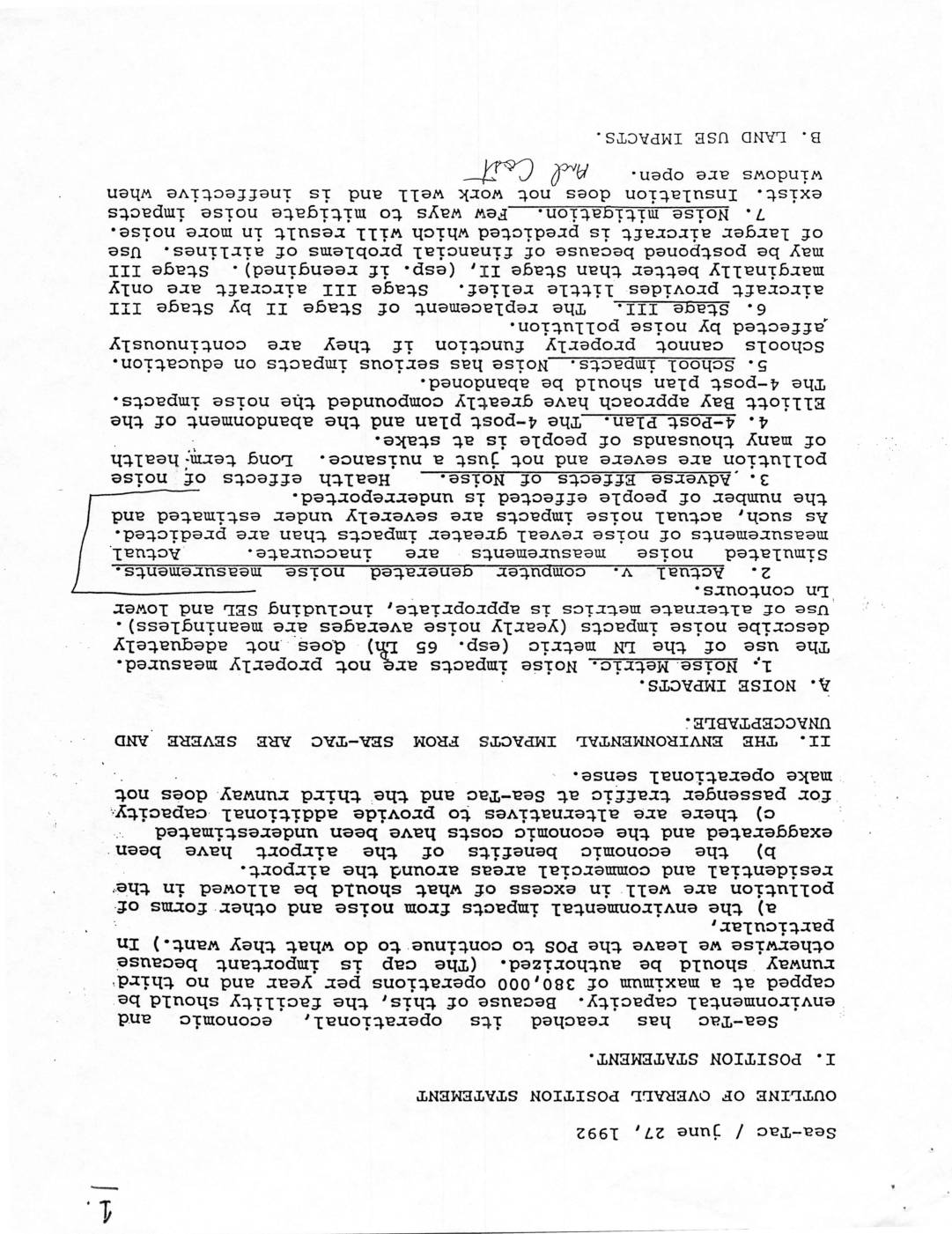
Outline of overall position statement: Sea-Tac, June 27, 1992
A 1992 position statement argues that Seattle-Tacoma International Airport (Sea-Tac) has reached its operational, economic, and environmental capacity and should be capped at a maximum of 380,000 operations per year with no third runway authorized. The document contends that noise impacts on surrounding communities are severely underestimated, that a third runway would make no operational or economic sense, and that alternatives such as demand management, use of existing regional airports, and improved transportation systems should be pursued instead. -
1992-06-12
Flight Patterns – FAA’s ‘Four Post’ traffic plan for planes is illogical, insulting
June 12, 1992 Publication: THE SEATTLE TIMES Page: A9 Word Count: 354 The Ninth Circuit in San Francisco recently voted that since the noise level was not above 65 decibels (recently raised from 55 decibels) the Federal Aviation Administration did not have to be subject to any environmental impact requirements. Therefore, the FAA’s brilliant “four post” plan remains -
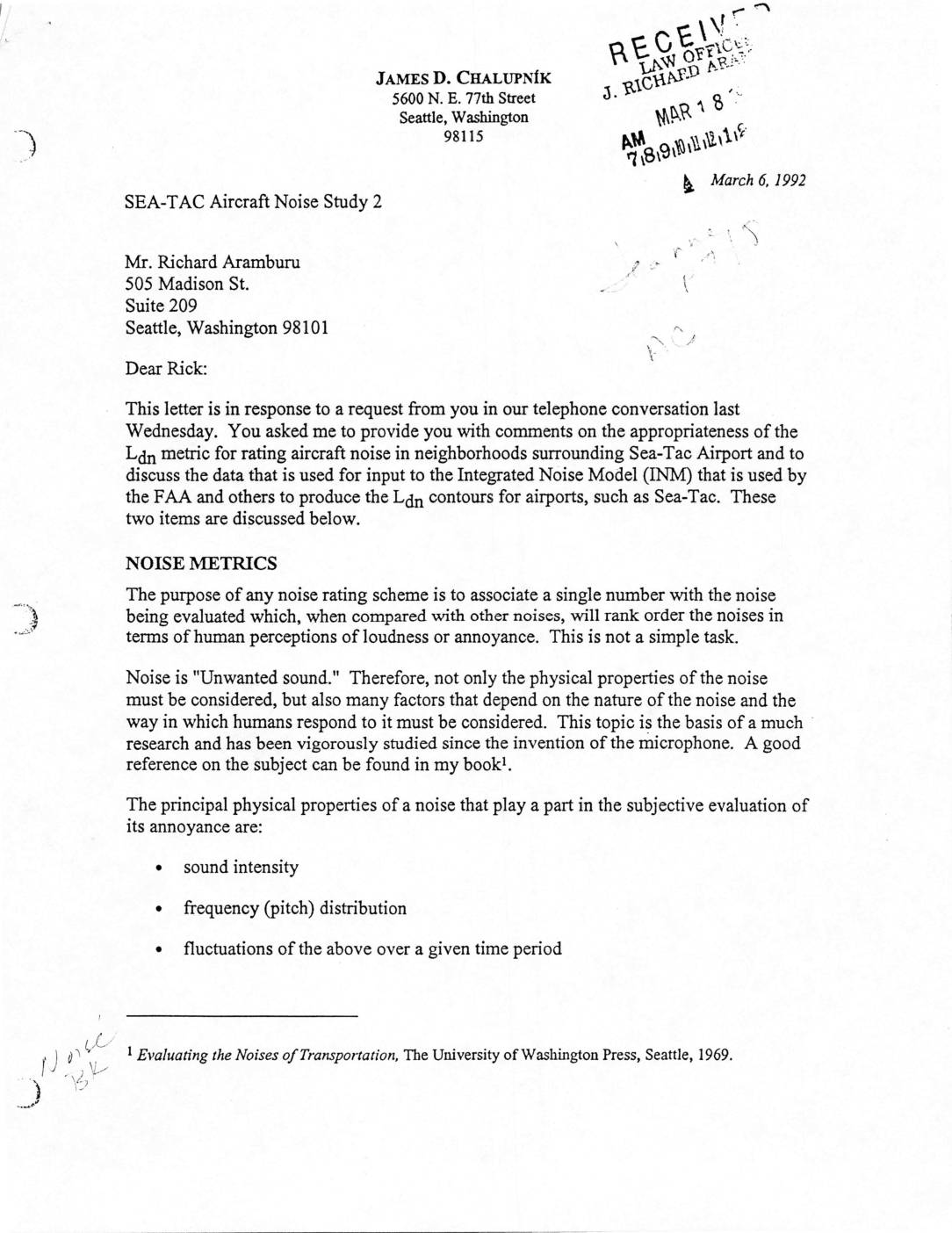 1992-03-06
Letter from James D. Chalupník to Richard Aramburu Regarding Sea-Tac Aircraft Noise Study 2: Ldн Metric and Integrated Noise Model
March 6, 1992 letter from acoustician James D. Chalupník (Seattle, WA) to attorney Richard Aramburu discussing the appropriateness of the Ldn (Day-Night Level) metric for rating aircraft noise around Sea-Tac Airport and the data inputs to the FAA’s Integrated Noise Model (INM). Covers noise metrics including dBA, A-weighting, B-weighting, C-weighting, Fletcher-Munsen equal loudness curves, Stevens’