Category : Correspondence(303)
-
 1998-06-10
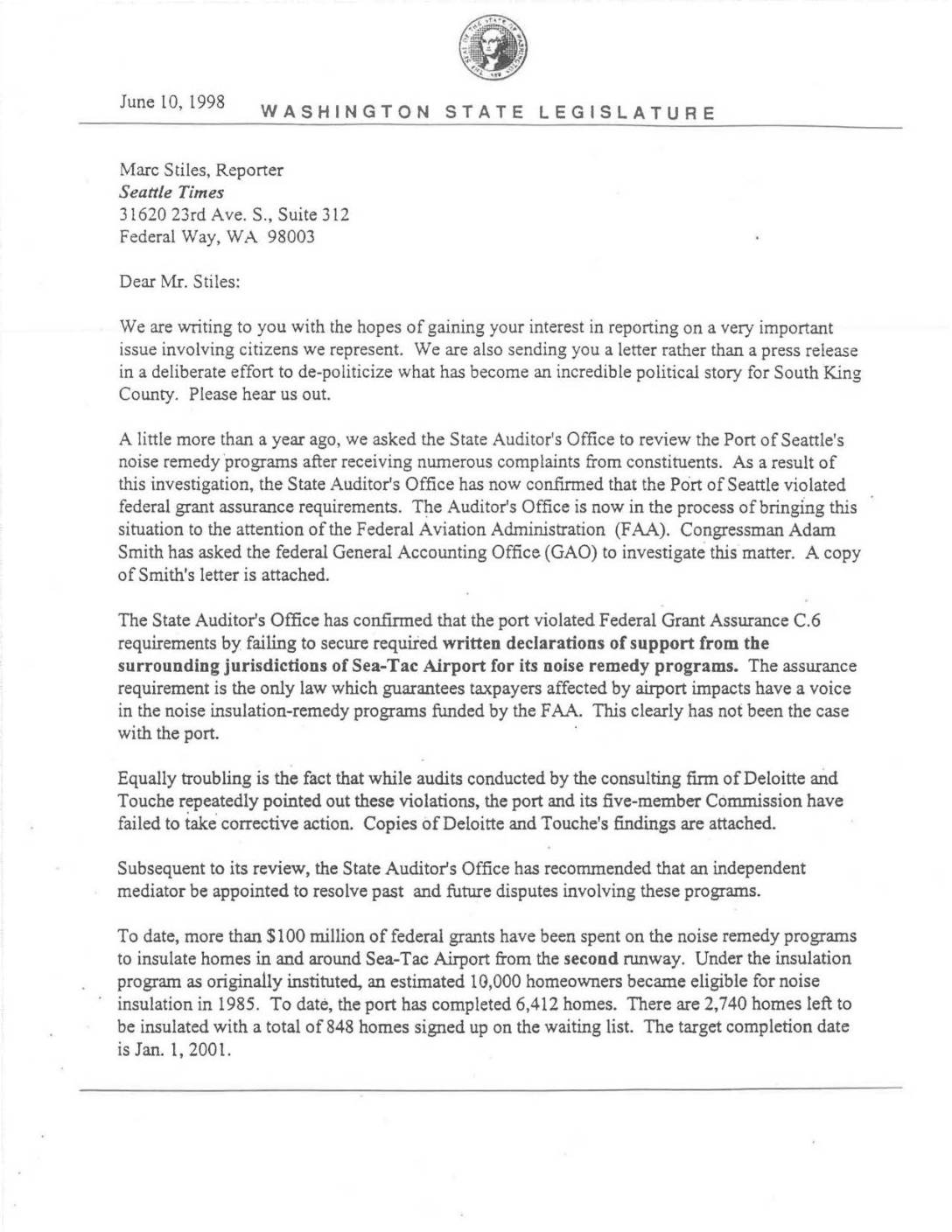
Letter from Karen Keiser and Julia Patterson to Seattle Times Regarding Port Of Seattle Violation of Federal Grant Assurance C.6
In a June 1998 letter to a Seattle Times reporter, Washington State legislators Karen Keiser and Julia Patterson urged media coverage of the Port of Seattle's violations of federal grant rules governing its noise remedy programs near Sea-Tac Airport. The State Auditor's Office confirmed the Port failed to obtain required written support from surrounding local jurisdictions, while auditors at Deloitte and Touche had repeatedly flagged the same violations without the Port taking corrective action. Over $130 million in federal funds had already been spent insulating and assisting homeowners, with an additional $11 million needed to redo 1,141 homes due to building-code violations that local consultation might have prevented. -
 1998-06-01
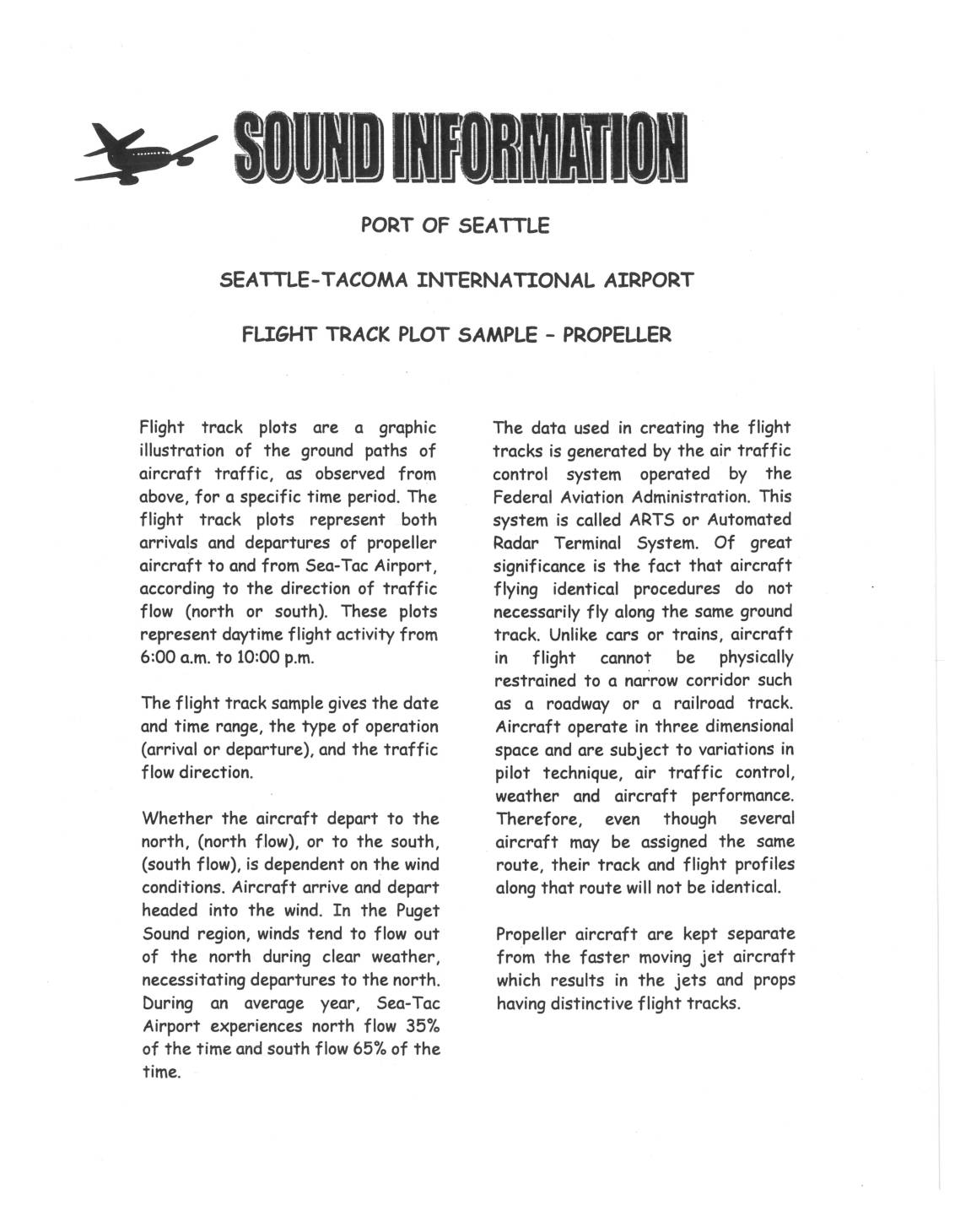
Port Of Seattle Sea-Tac Propeller Aircraft Flight Track Patterns
This Port of Seattle document explains flight track plots for propeller aircraft at Seattle-Tacoma International Airport, showing the ground paths of arrivals and departures during daytime hours (6 a.m. to 10 p.m.) for both north and south traffic flows. Aircraft flight paths vary due to pilot technique, weather, and air traffic control, meaning planes assigned the same route will not follow identical tracks. On average, Sea-Tac experiences south flow conditions 65% of the year and north flow 35%, with propeller aircraft kept on separate tracks from faster jet aircraft. -
 1998-06-01
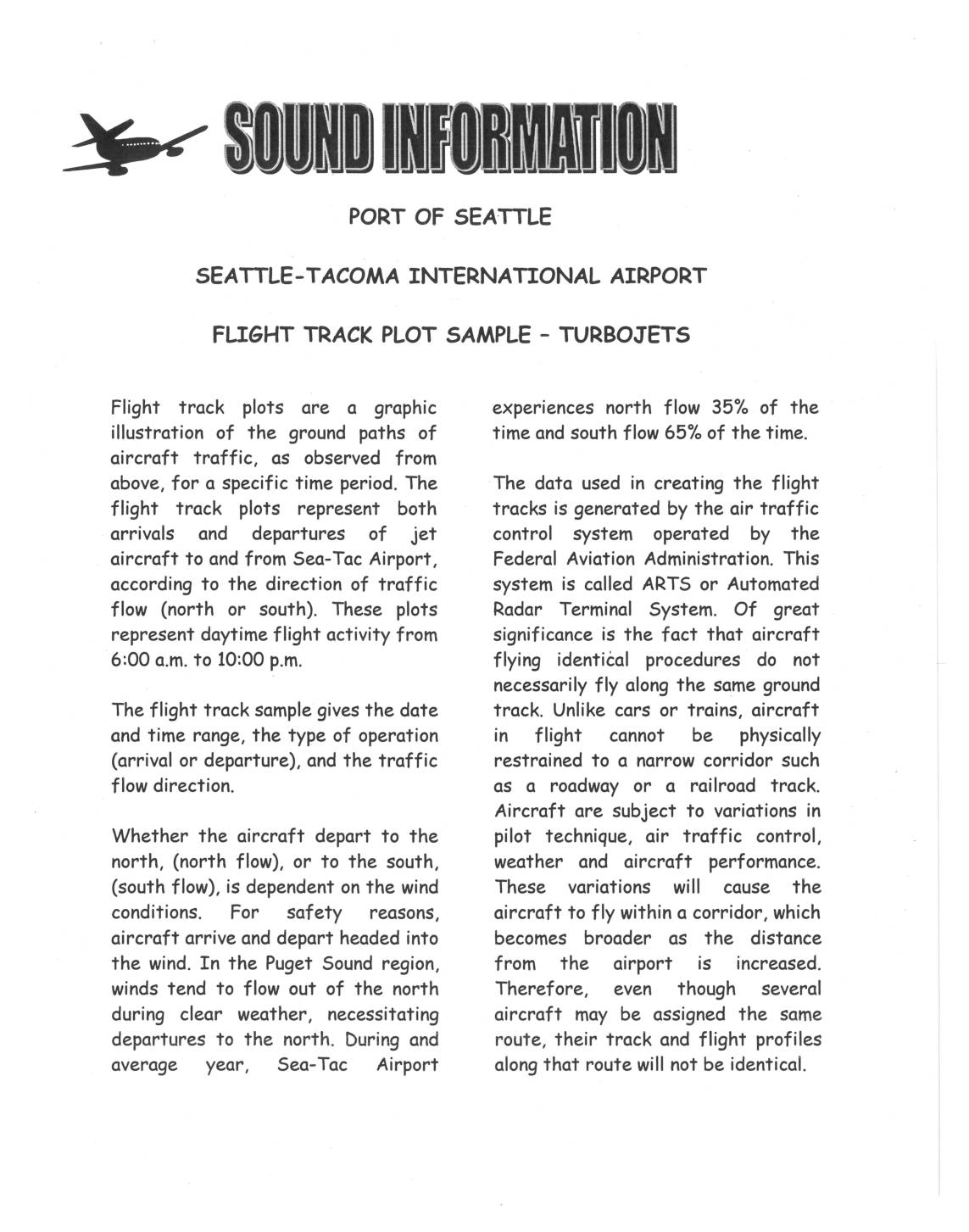
Port Of Seattle Sea-Tac Jet Aircraft Flight Track Patterns: North Flow and South Flow, Summer 1998
This Port of Seattle document explains flight track plots for Seattle-Tacoma International Airport, which map the ground paths of jet aircraft arrivals and departures during daytime hours (6am–10pm). It describes how wind conditions determine whether aircraft fly in a north or south flow pattern, with south flow occurring about 65% of the year. The document also notes that even aircraft following identical routes will not fly the exact same path, due to variations in pilot technique, weather, air traffic control, and aircraft performance. -
 1996-10-21
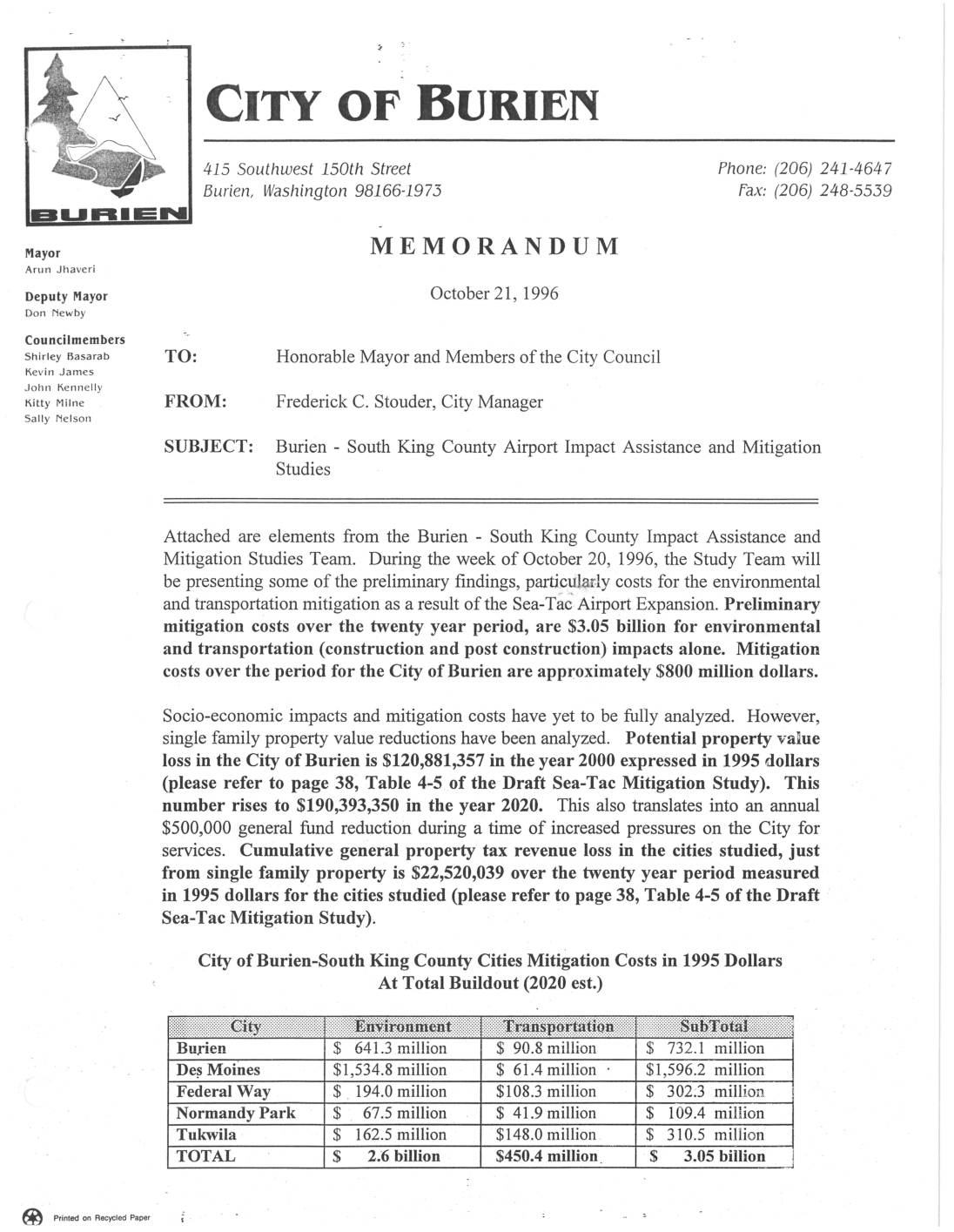
City of Burien Memorandum: South King County Airport Impact Assistance and Mitigation Studies
A 1996 City of Burien memorandum outlines preliminary findings from a regional study on the socio-economic and environmental impacts of Sea-Tac Airport's proposed expansion and third runway. Estimated mitigation costs for five South King County cities totaled $3.05 billion over twenty years, with Burien alone facing roughly $800 million in costs and over $190 million in single-family property value losses by 2020. The study argues that because the airport's benefits are spread across the broader Puget Sound region while its costs—including noise, traffic, and a reduced tax base—fall disproportionately on a handful of nearby communities, targeted mitigation funding is both an equity issue and a necessity. -
 1996-08-23
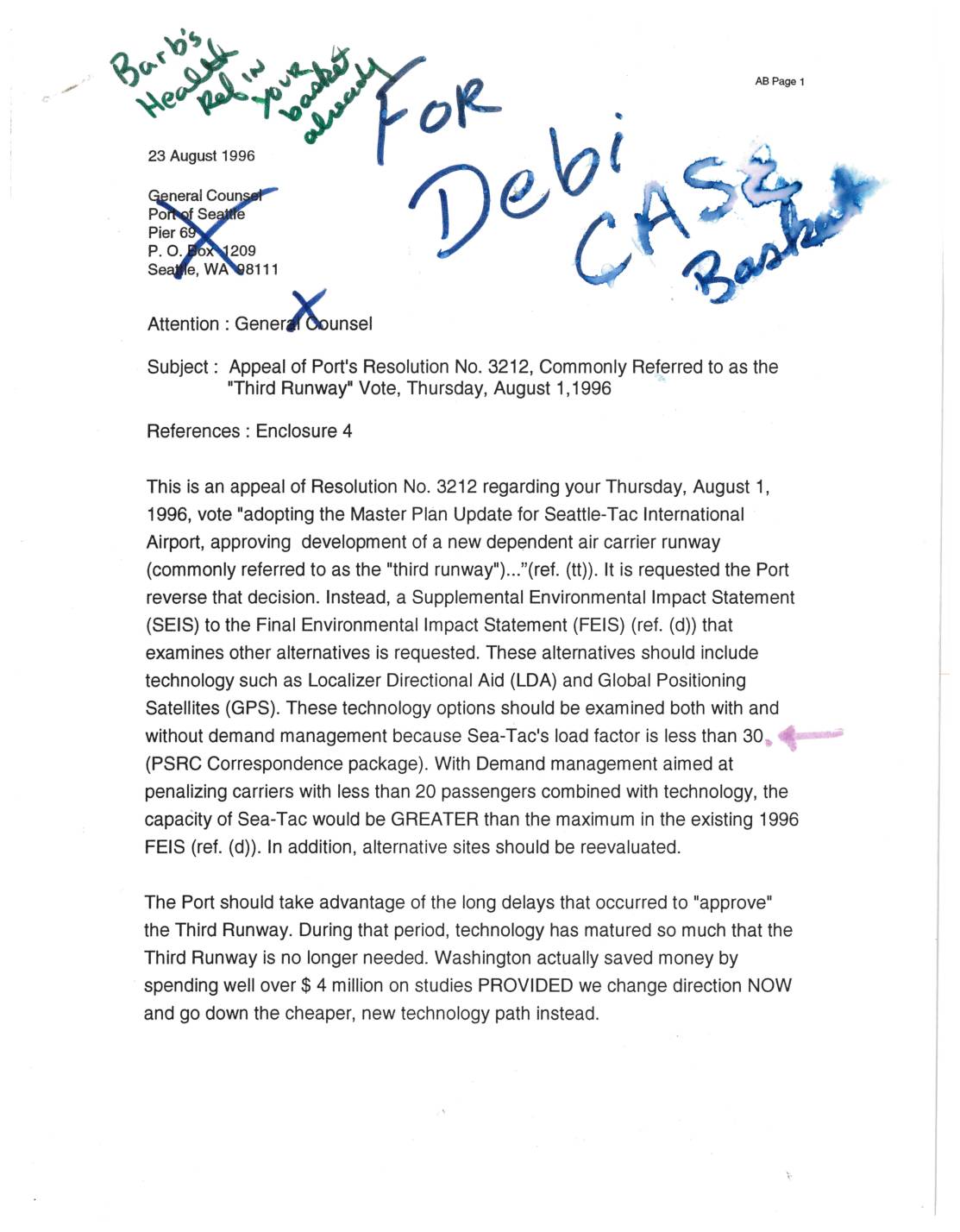
CASE & RCAA Appeal of Port Of Seattle Resolution No. 3212 (Third Runway Vote)
In August 1996, community groups CASE and RCAA formally appealed the Port of Seattle's Resolution No. 3212, which approved construction of a third runway at Seattle-Tacoma International Airport. The appeal argued that newer navigation technologies such as Localizer Directional Aid (LDA) and GPS, combined with demand management strategies, could provide equivalent airport capacity at far lower cost and with less environmental harm. The groups requested a Supplemental Environmental Impact Statement to evaluate these technology-based alternatives and reconsider the third runway decision. -
 1996-03-18
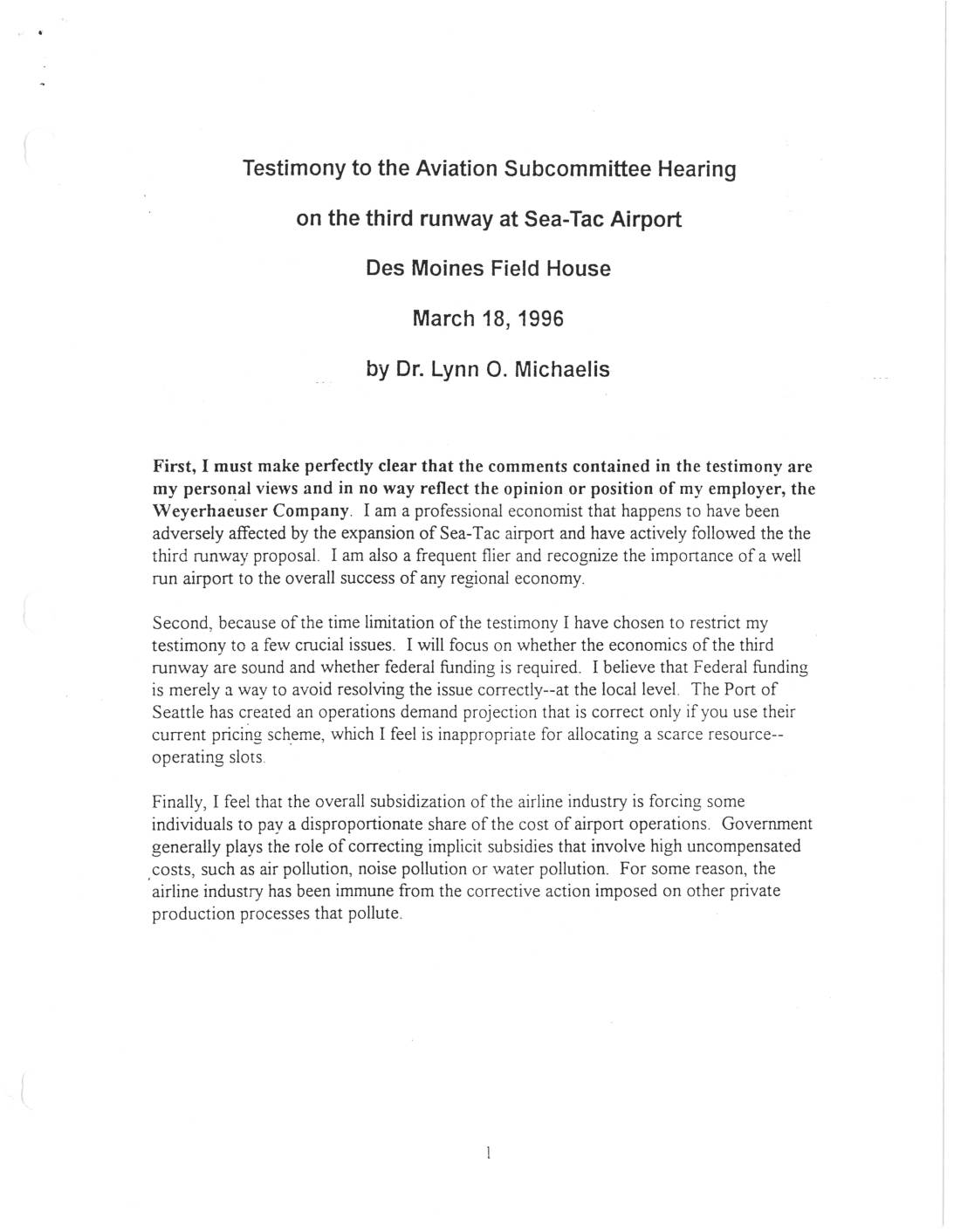
Testimony of Dr. Lynn O. Michaelis on the Third Runway at Sea-Tac Airport, Aviation Subcommittee Hearing, Des Moines Field House, March 18, 1996
Testimony by Dr. Lynn O. Michaelis, economist at Weyerhaeuser Company, to the Aviation Subcommittee hearing on the proposed third runway at Sea-Tac Airport, delivered at Des Moines Field House on March 18, 1996. Michaelis argues that the Port of Seattle’s demand projections are based on a faulty per-pound landing pricing scheme that fails to allocate -
1996-03-18
Testimony of Dr. Lynn O. Michaelis on the Third Runway at Sea-Tac Airport, Aviation Subcommittee Hearing, Des Moines Field House, March 18, 1996
In this 1996 testimony to the Aviation Subcommittee, economist Dr. Lynn O. Michaelis argues that the proposed third runway at Seattle-Tacoma International Airport is economically unjustified, citing flawed pricing schemes that fail to account for peak-hour demand and encourage inefficient small-plane operations. He contends that federal funding is being used to bypass local accountability, masking the project's poor return on investment — estimated at less than 1% on a $500 million expenditure. Michaelis also criticizes the airline industry's exemption from pollution-related cost corrections that apply to other industries, arguing that nearby residents bear a disproportionate share of the environmental costs. -
 1995-08-16
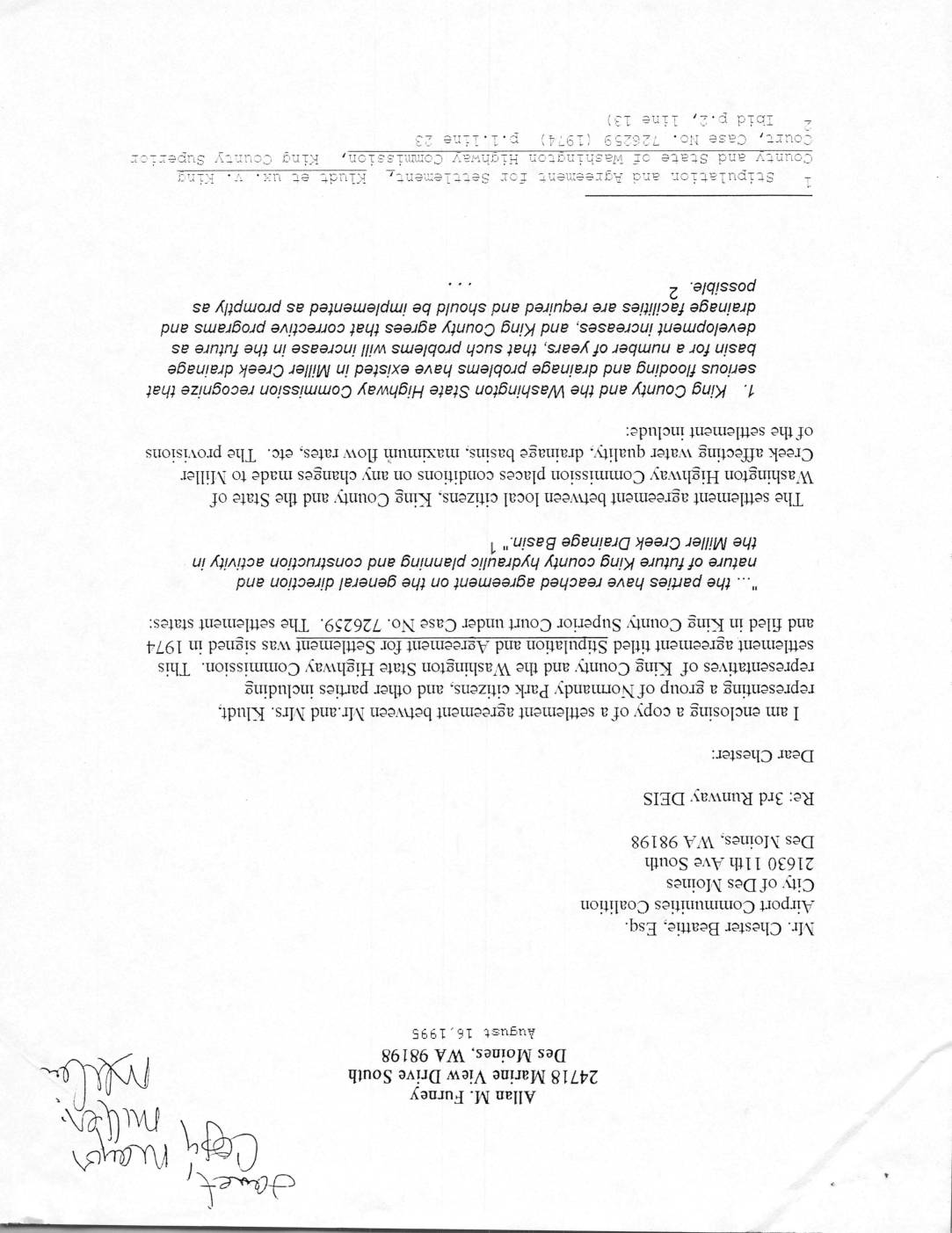
Letter regarding 3rd Runway DEIS and Miller Creek drainage settlement agreement
A 1995 letter from Allan M. Furney to Chester Beattie of the Airport Communities Coalition summarizes a 1974 settlement agreement between King County, the Washington State Highway Commission, and local citizens regarding flooding and drainage problems in the Miller Creek watershed. The settlement requires King County to improve water quality, prevent excess stormwater runoff into Miller Creek, and construct appropriate drainage facilities, while prohibiting full channelization of the creek. The letter raises concerns that proposed SeaTac Airport third-runway expansion plans, as outlined in the Draft EIS, would violate these settlement provisions by significantly increasing impervious surface area and stormwater flows into the Miller Creek drainage basin. -
 1993-12-22
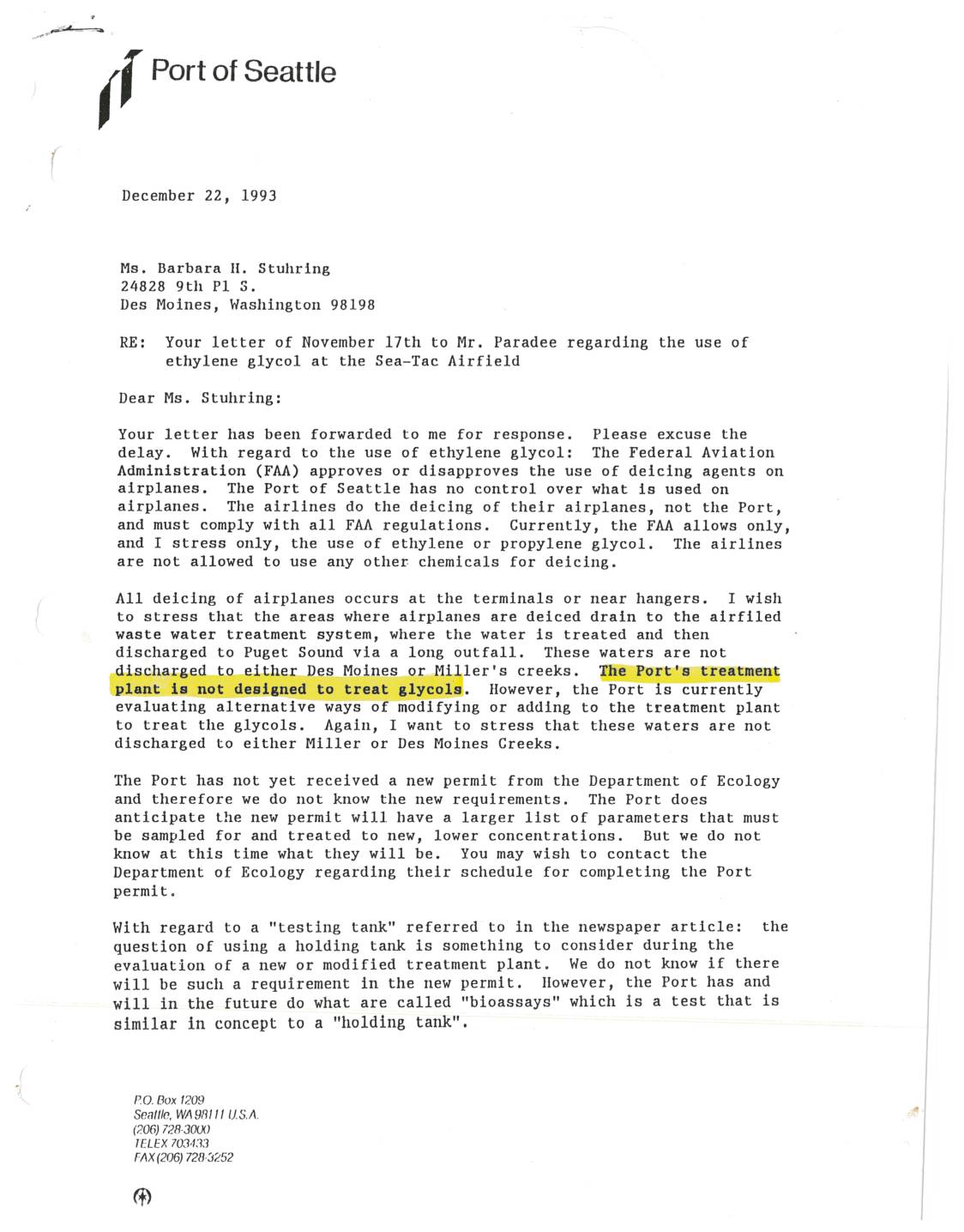
Port Of Seattle Letter to Barbara Stuhring: Ethylene Glycol Deicing at Sea-Tac Airport and Wastewater Treatment
December 22, 1993 letter from Port of Seattle to Barbara H. Stuhring of Des Moines, WA responding to her November 17 inquiry about ethylene glycol and propylene glycol deicing fluid use at Sea-Tac Airport. Letter states FAA requires only ethylene or propylene glycol for aircraft deicing, that deicing areas drain to the airfield wastewater treatment -
1993-12-22
Port Of Seattle Letter to Barbara Stuhring: Ethylene Glycol Deicing at Sea-Tac Airport and Wastewater Treatment
A 1993 letter from the Port of Seattle to a Des Moines resident explains that airline deicing at Sea-Tac Airport uses only FAA-approved ethylene or propylene glycol, and that wastewater from deicing drains to the airport's treatment system before being discharged to Puget Sound — not to Miller or Des Moines Creeks. The Port acknowledged its treatment plant was not designed to handle glycols and was evaluating upgrades. A follow-up 1996 letter challenges a contradictory statement in the airport's Final Environmental Impact Statement, which claimed most deicing fluids were contained and treated by the Port's Industrial Wastewater System.