Notes
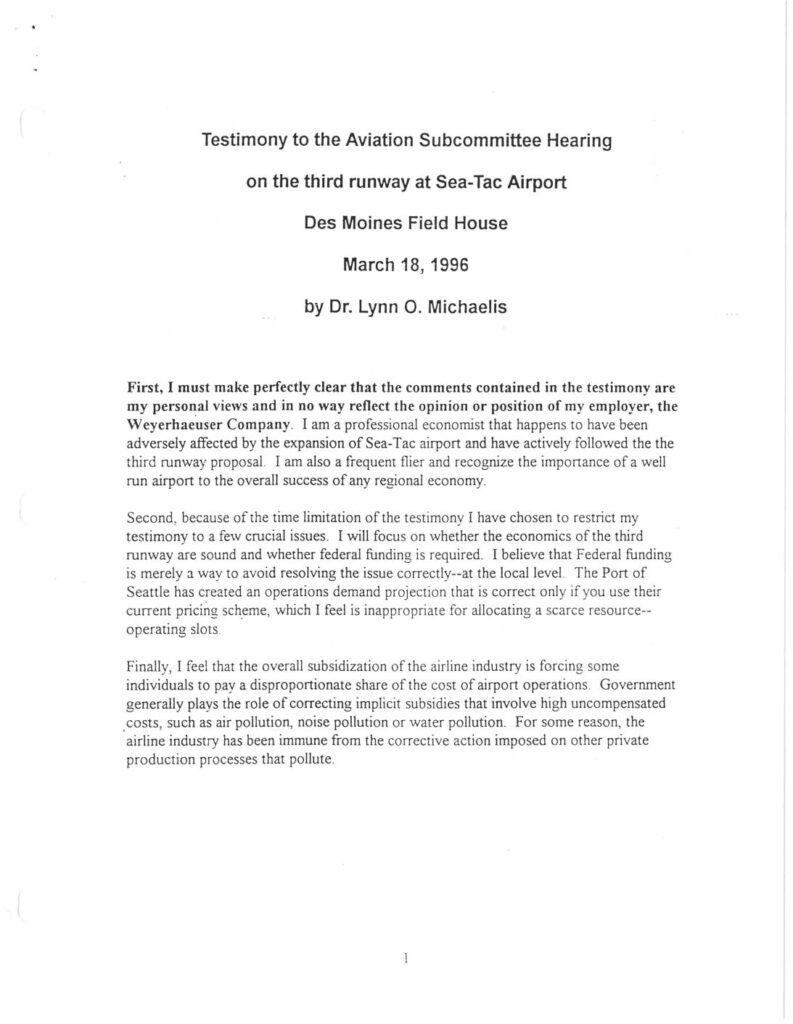
Testimony by Dr. Lynn O. Michaelis, economist at Weyerhaeuser Company, to the Aviation Subcommittee hearing on the proposed third runway at Sea-Tac Airport, delivered at Des Moines Field House on March 18, 1996. Michaelis argues that the Port of Seattle’s demand projections are based on a faulty per-pound landing pricing scheme that fails to allocate scarce operating slots efficiently, encourages small inefficient commuter aircraft (United Express and Horizon accounted for 35% of operations but only 8.7% of passengers in 1990), and that the projected capacity shortage mirrors the WPPS nuclear power fiasco driven by artificially low pricing. He contends that federal funding allows the Port to avoid local scrutiny and that the $500 million third runway capital cost would generate less than 1% return on investment, serving approximately 100,000 commuter aircraft carrying only 1 million passengers generating under $4 million in revenue. Michaelis advocates for peak-hour pricing, market-based slot allocation, and local bond financing rather than federal subsidy.