Category : Legislation(149)
-
 2025-02-21
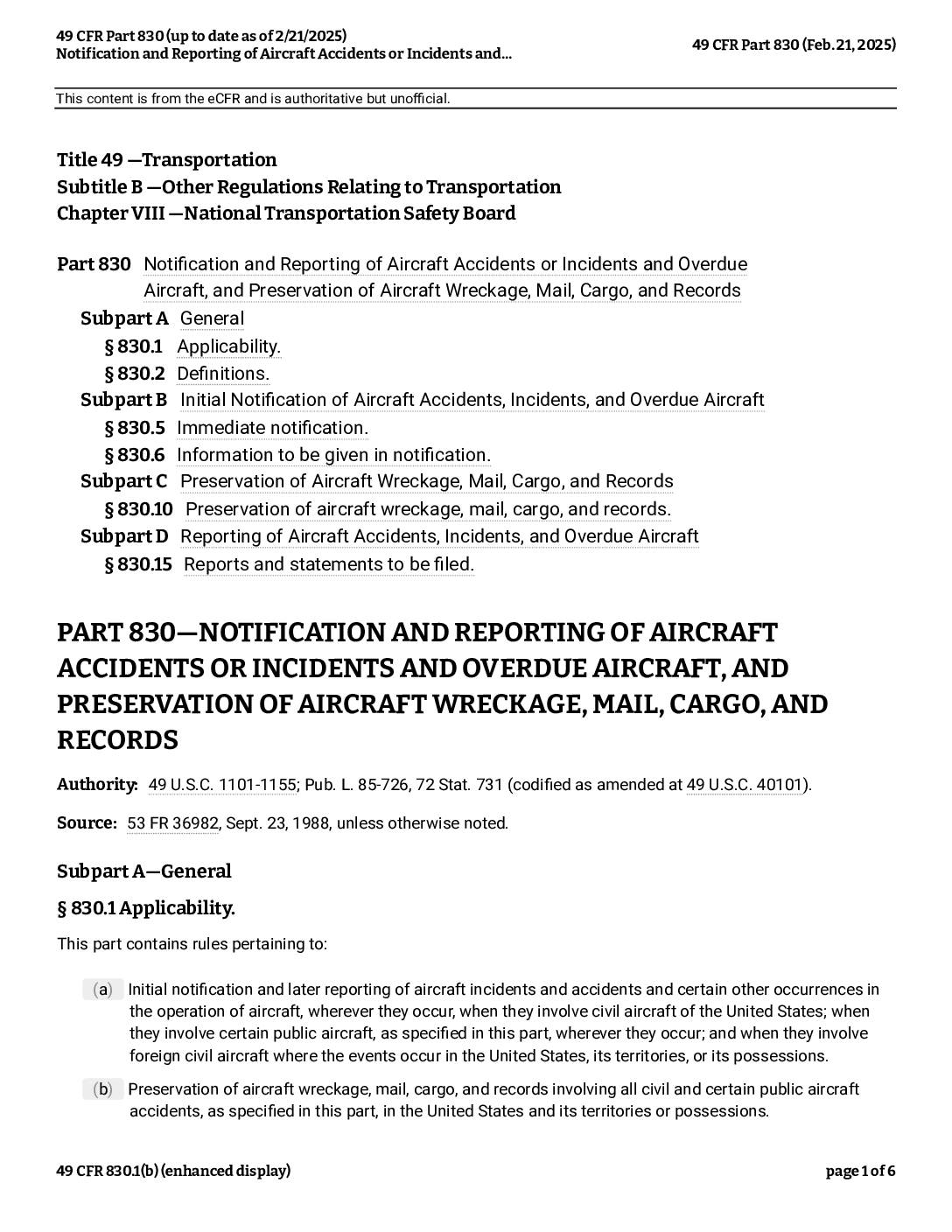
Notification and reporting of aircraft accidents or incidents and overdue aircraft, and preservation of aircraft wreckage, mail, cargo, and records (49 CFR Part 830)
This federal regulation (49 CFR Part 830) sets out the rules for reporting aircraft accidents and incidents to the National Transportation Safety Board (NTSB). It defines key terms such as 'aircraft accident,' 'serious injury,' and 'substantial damage,' and requires aircraft operators to immediately notify the nearest NTSB office when accidents or serious incidents occur. Covered events include flight control failures, in-flight fires, mid-air collisions, and property damage exceeding $25,000. -
 2025-02-17
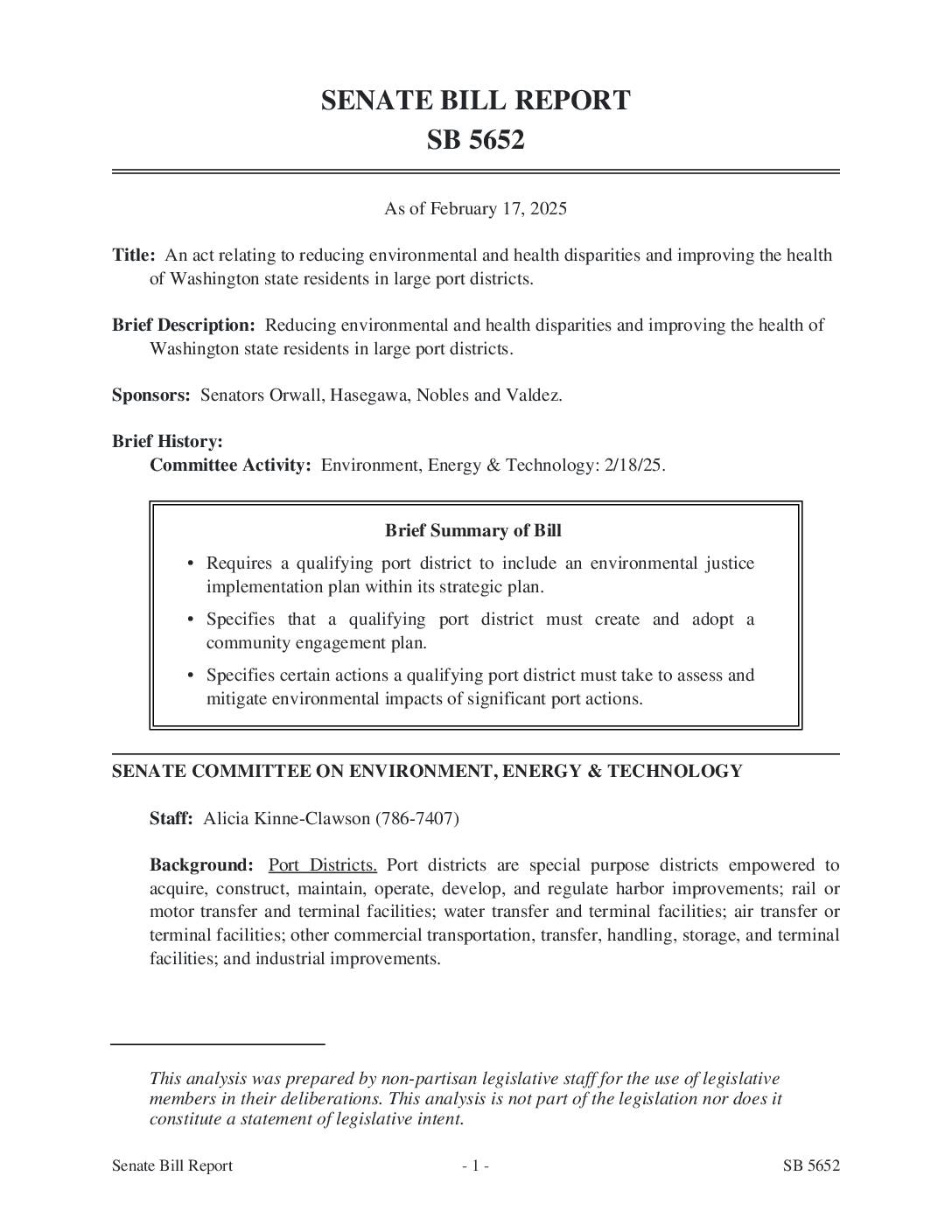
Senate Bill Report SB 5652: Reducing Environmental and Health Disparities in Large Port Districts
Washington State Senate Bill Report for SB 5652, dated February 17, 2025, sponsored by Senators Orwall, Hasegawa, Nobles, and Valdez. Referred to the Senate Committee on Environment, Energy & Technology. Requires qualifying port districts (defined as those authorized to undertake Aircraft Noise Abatement Programs, currently only Port Of Seattle operating Seattle-Tacoma International Airport) to include -
 2025-02-11
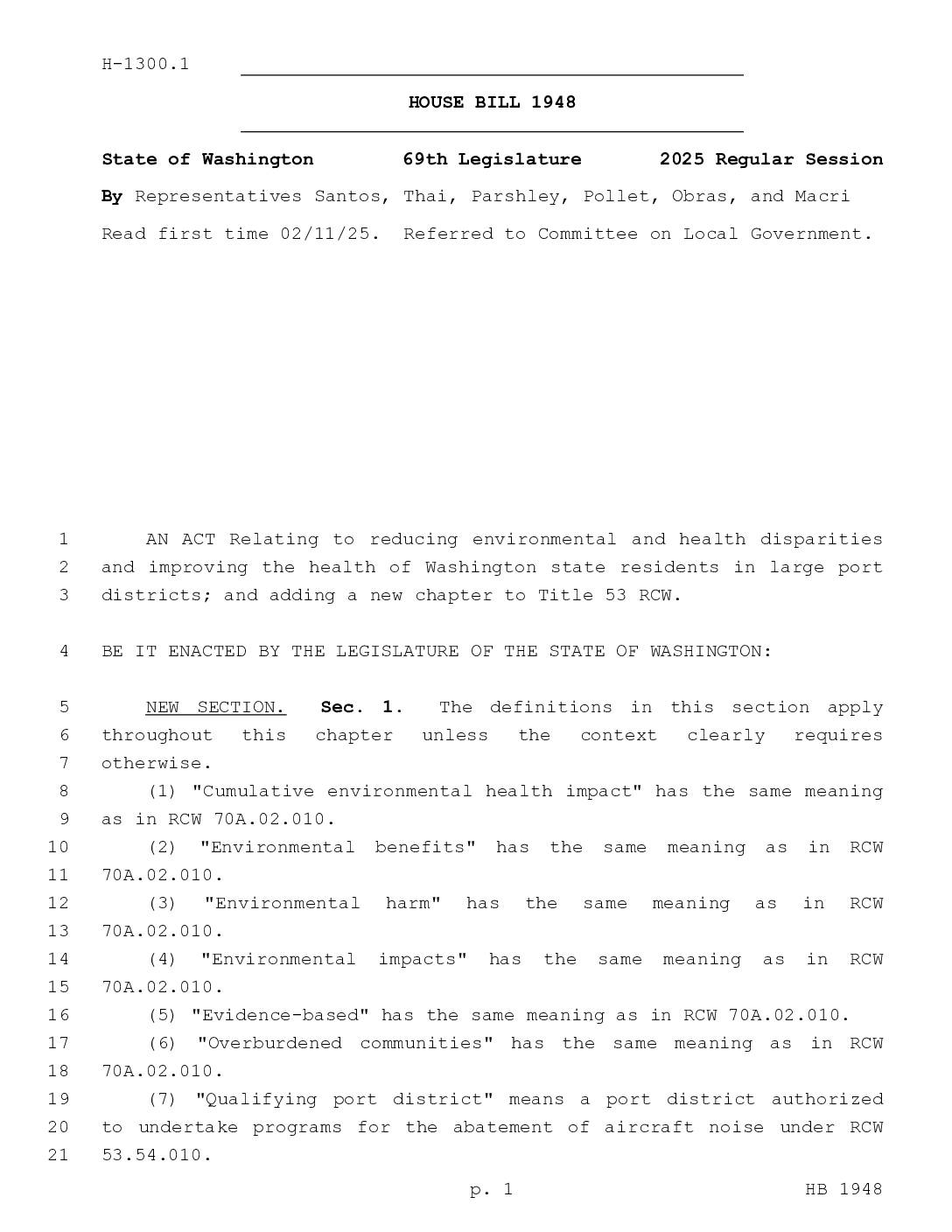
House Bill 1948 – Environmental Justice for Large Port Districts
Washington House Bill 1948 (2025) would require large port districts — such as the Port of Seattle, which operates Sea-Tac Airport — to develop environmental justice implementation plans and community engagement plans aimed at reducing health and environmental disparities for overburdened communities affected by airport noise and other port activities. The bill mandates that these plans include specific goals, measurable metrics, and outreach strategies to ensure meaningful participation from vulnerable populations, including people with limited English proficiency. Port districts would also be required to conduct environmental justice reviews for major capital projects valued at $8 million or more, or any action that increases the number of airport gates. -
 2025-01-23
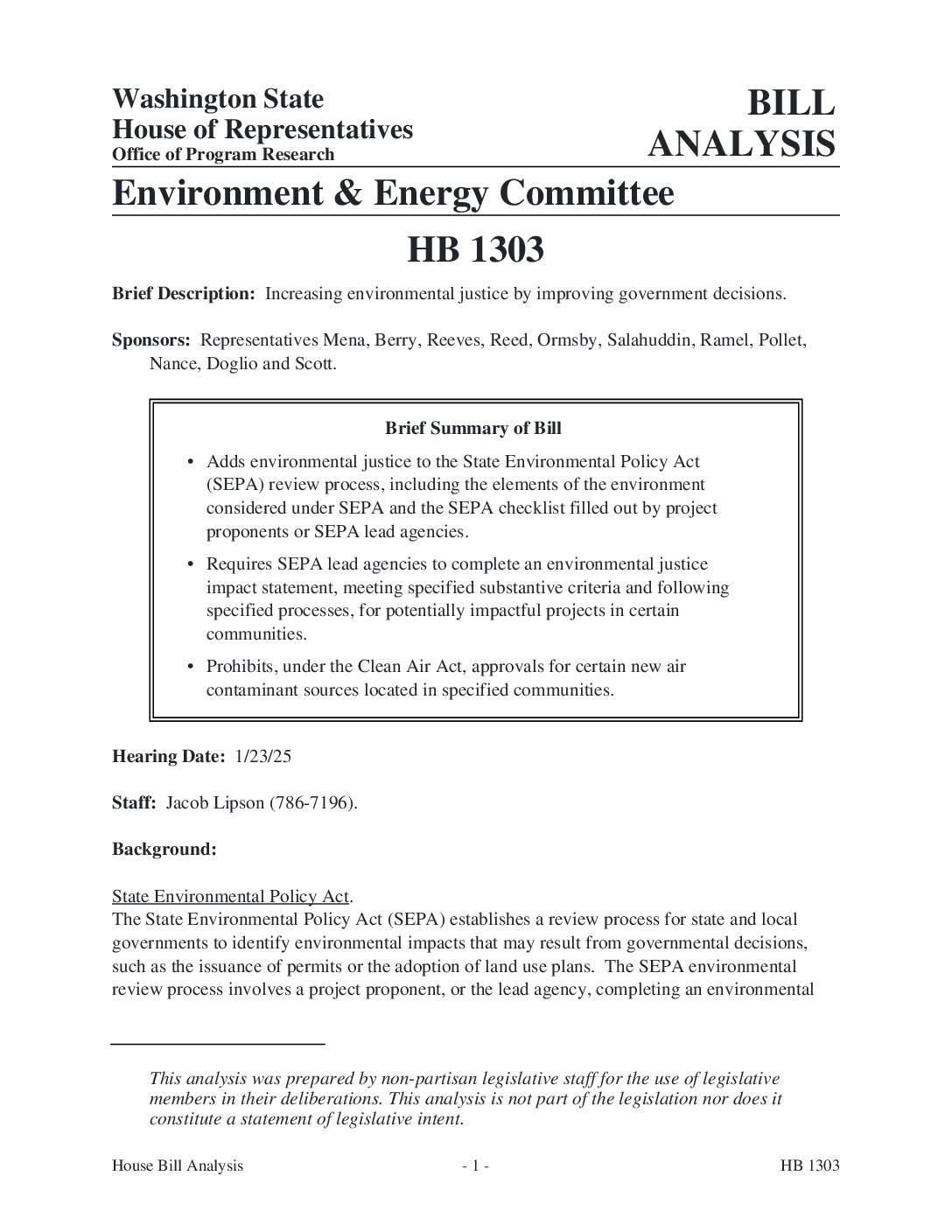
HB 1303 Bill Analysis – Increasing environmental justice by improving government decisions
Washington State House Bill 1303 proposes strengthening environmental justice by adding new requirements to the State Environmental Policy Act (SEPA) review process, requiring environmental justice impact statements for projects in vulnerable or overburdened communities. The bill also prohibits state and local air authorities from issuing certain construction approvals for new air pollution sources in those same communities. Note: This bill focuses on statewide environmental permitting and community health protections, and does not directly address Sea-Tac Airport noise policy. -
 2025-01-22
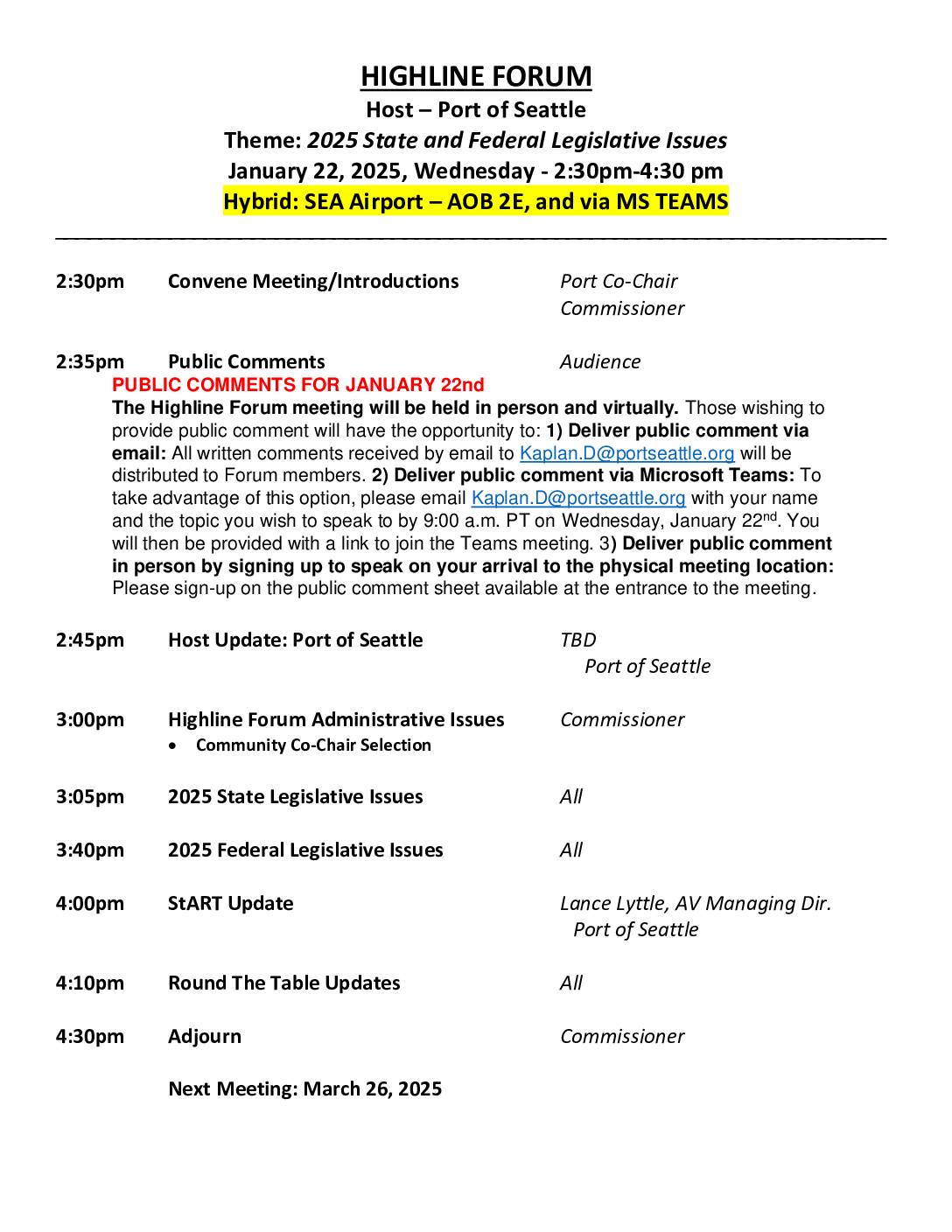
Highline Forum Meeting Agenda – 2025 State and Federal Legislative Issues
Agenda for the Highline Forum meeting hosted by the Port of Seattle on January 22, 2025, 2:30–4:30 pm, held hybrid at SEA Airport AOB 2E and via Microsoft Teams. The meeting theme is '2025 State and Federal Legislative Issues' and includes items on public comments, state and federal legislative issues, a StART Update by Lance Lyttle (AV Managing Director, Port of Seattle), and Community Co-Chair Selection. -
 2025-01-21
Senate Bill 5380 – Environmental Justice Act
Senate Bill 5380, introduced in the Washington State 69th Legislature's 2025 Regular Session by Senators Lovelett, Trudeau, Hasegawa, Nobles, Saldaña, Stanford, and Valdez, aims to increase environmental justice by improving government decisions. The bill directs the Department of Ecology to add environmental justice as an element of the environment within state environmental review rules (WAC 197-11-444 and WAC 197-11-960), amending RCW 70A.15.2210 and adding new sections to chapter 43.21C RCW. -
2025-01-21
Senate Bill 5380 – Environmental Justice in Government Decisions
Senate Bill 5380, introduced in Washington State's 69th Legislature during the 2025 Regular Session by Senators Lovelett, Trudeau, Hasegawa, Nobles, Saldaña, Stanford, and Valdez, aims to increase environmental justice by improving government decisions. The bill amends RCW 70A.15.2210 and adds new sections to chapter 43.21C RCW, requiring the Department of Ecology to add environmental justice as an element within SEPA environmental review rules (WAC 197-11-444 and WAC 197-11-960). -
 2025-01-15
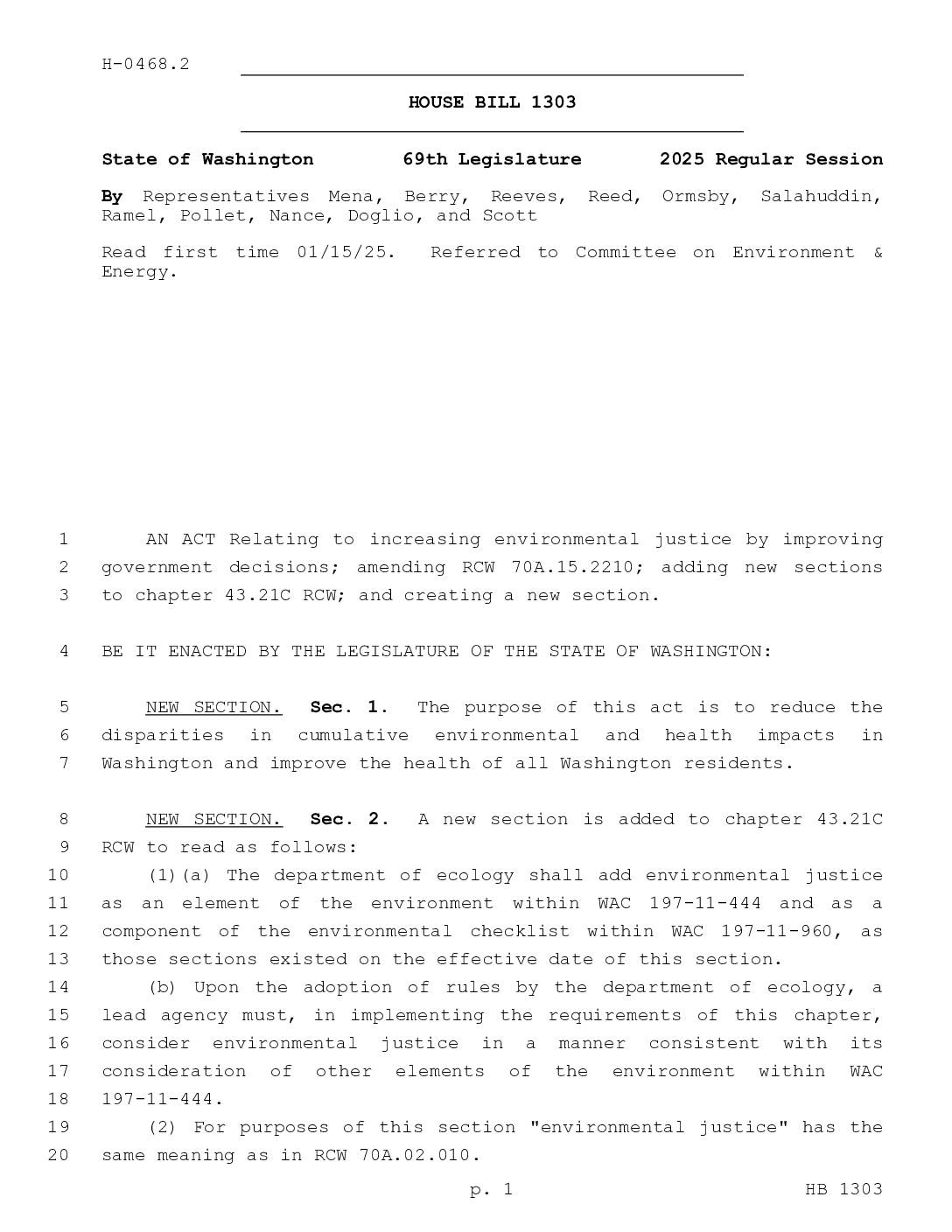
House Bill 1303 – Environmental Justice in Government Decisions
House Bill 1303 (H-0468.2), introduced in the Washington State 69th Legislature's 2025 Regular Session by Representatives Mena, Berry, Reeves, Reed, Ormsby, Salahuddin, Ramel, Pollet, Nance, Doglio, and Scott, proposes to increase environmental justice by improving government decisions, amending RCW 70A.15.2210, and adding new sections to chapter 43.21C RCW. The bill directs the Department of Ecology to add environmental justice as an element within SEPA environmental review rules (WAC 197-11-444 and WAC 197-11-960), and was referred to the Committee on Environment & Energy on January 15, 2025. -
 2025-01-01
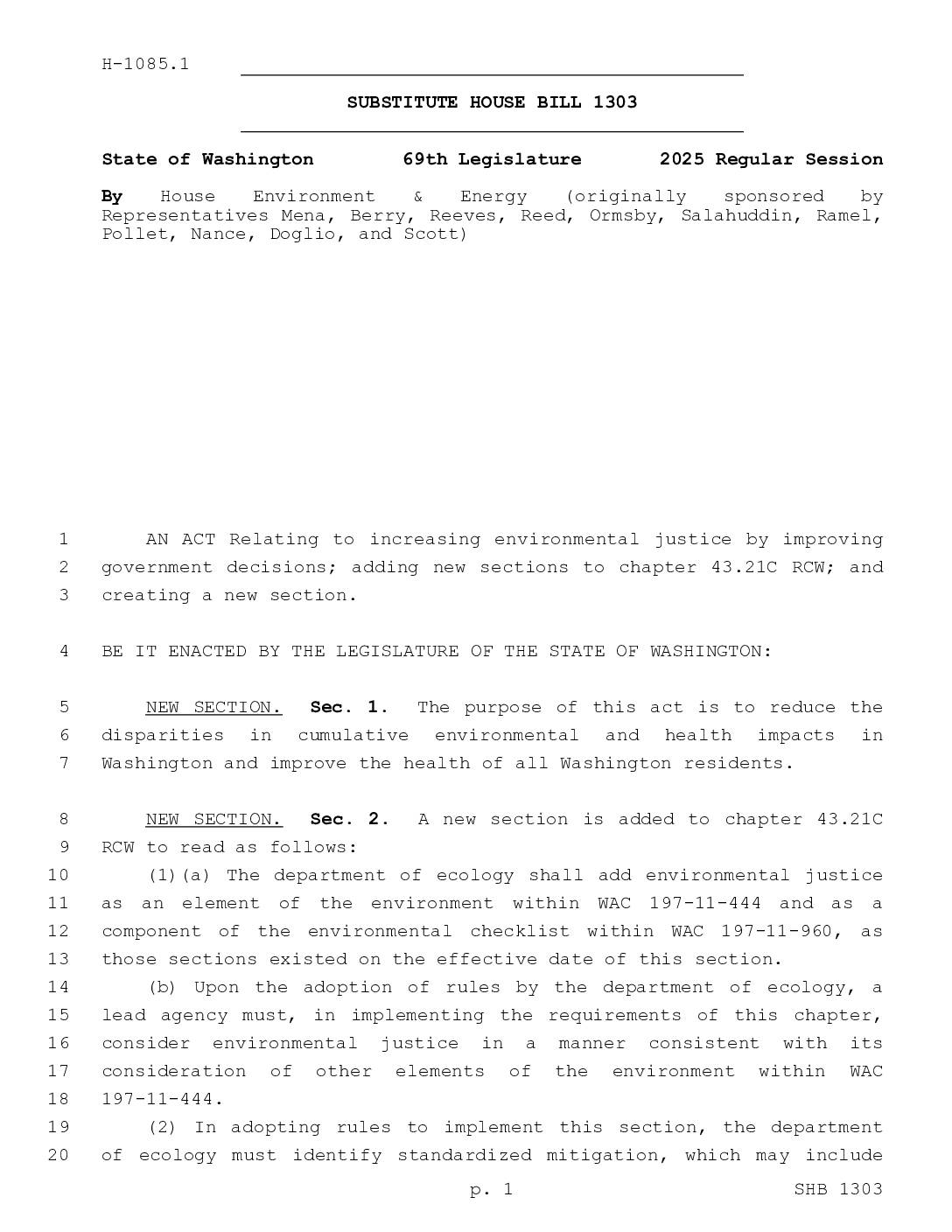
Substitute House Bill 1303 – Environmental Justice in Government Decisions
Substitute House Bill 1303, introduced during Washington State's 69th Legislature 2025 Regular Session, directs the Department of Ecology to add environmental justice as an element of the environment under SEPA regulations (WAC 197-11-444 and WAC 197-11-960). The bill was sponsored by Representatives Mena, Berry, Reeves, Reed, Ormsby, Salahuddin, Ramel, Pollet, Nance, Doglio, and Scott, with the stated purpose of reducing disparities in cumulative environmental and health impacts across Washington. -
 2024-10-08
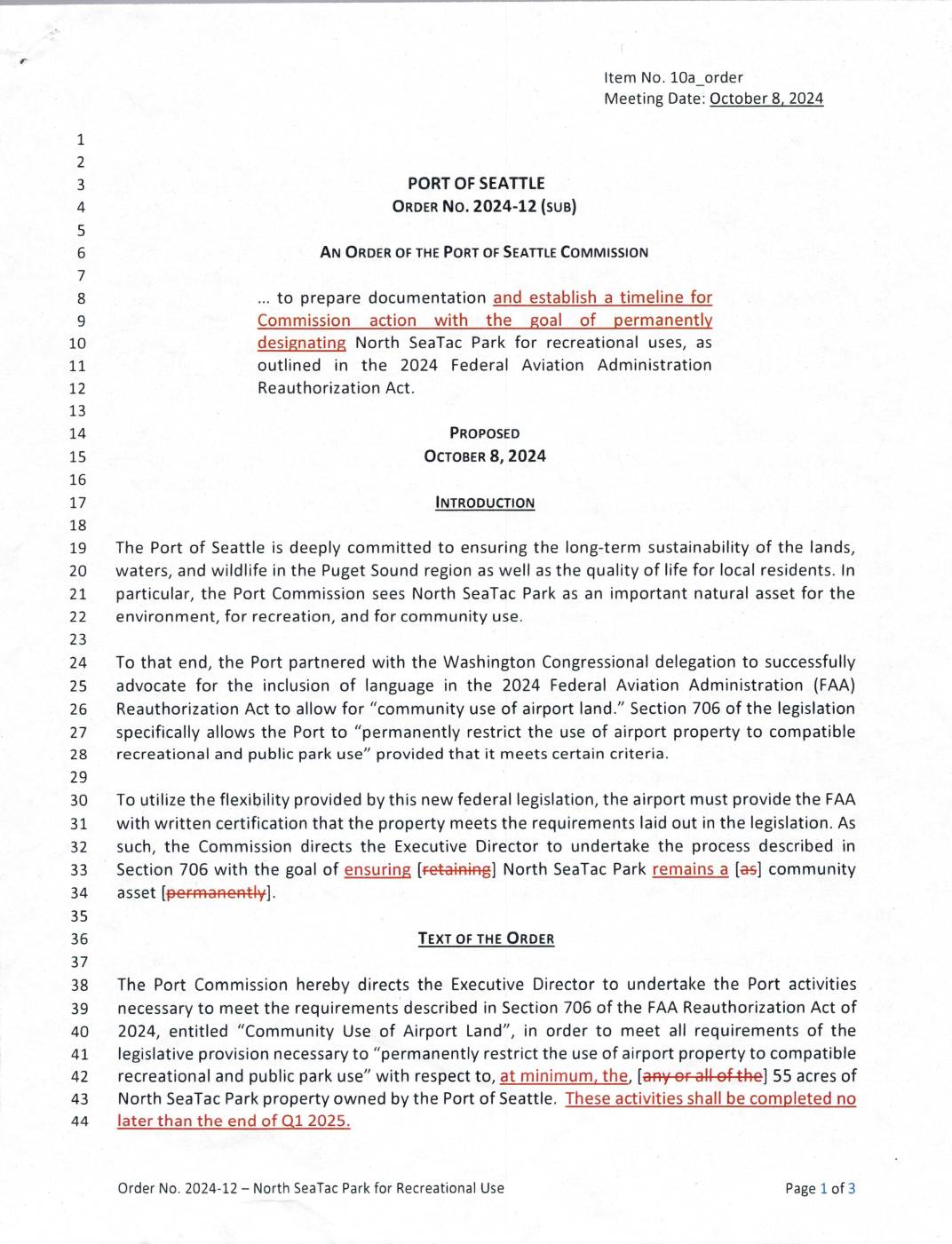
Port of Seattle Order No. 2024-12 – North SeaTac Park for Recreational Use
The Port of Seattle Commission issued Order No. 2024-12 in October 2024, directing its Executive Director to take the steps necessary under Section 706 of the 2024 FAA Reauthorization Act to permanently designate the 55-acre North SeaTac Park for recreational and public park use. The order requires the development of legally binding frameworks, a preferred protection methodology reported to the Commission by Q2 2025, and at least $150,000 in the 2025 budget for park improvements in partnership with the City of SeaTac. This action aims to ensure the park remains a permanent community and ecological asset, shielded from future aeronautical or commercial redevelopment.