Category : History(256)
-
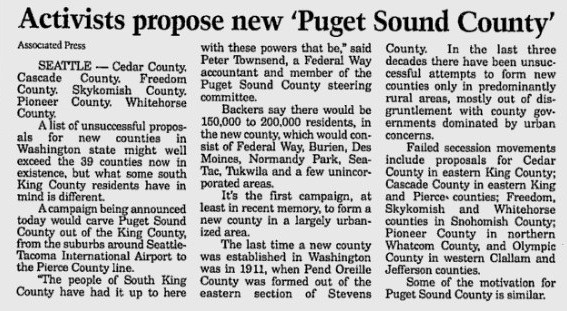
Moscow-Pullman Daily News July, 11 1996: Activists propose new ‘Puget Sound County’
An Associated Press article reports on a campaign to carve 'Puget Sound County' out of King County, stretching from suburbs around Seattle-Tacoma International Airport to the Pierce County line. The proposed county would include Federal Way, Burien, Des Moines, Normandy Park, Sea-Tac, Tukwila, and nearby unincorporated areas, with a projected population of 150,000 to 200,000 residents. -
 1996-07-11
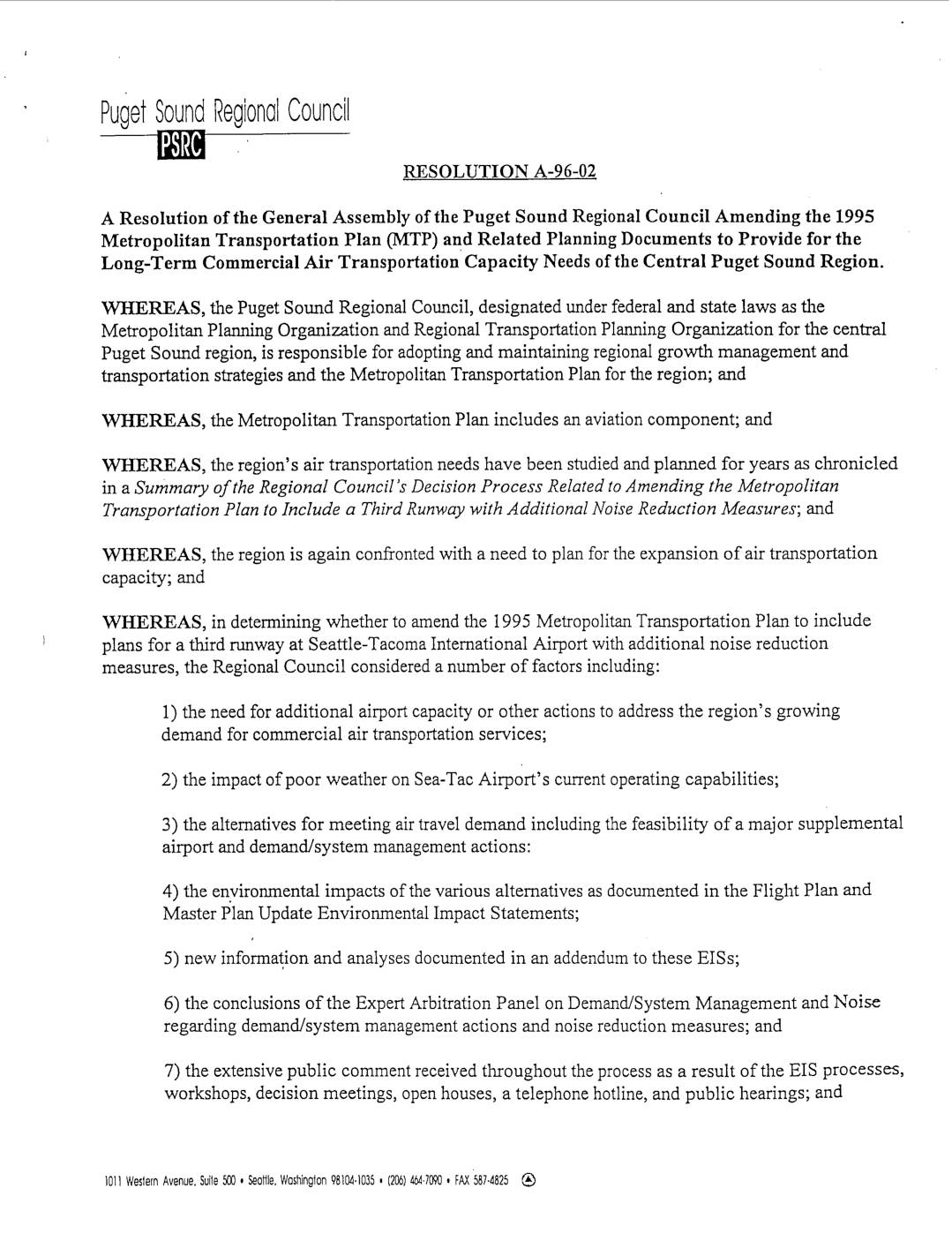
PSRC Resolution A-96-02: amending the 1995 MTP and related planning documents to provide for the long-term commercial air transportation capacity needs of the Central Puget Sound Region
In July 1996, the Puget Sound Regional Council adopted Resolution A-96-02, amending the region's Metropolitan Transportation Plan to include plans for a third runway at Seattle-Tacoma International Airport, paired with additional noise reduction measures. The decision followed years of study, including an Expert Panel finding that neither demand management strategies nor high-speed rail could eliminate the need for expanded capacity. Final approval of the runway remained contingent on environmental review by the Port of Seattle, Federal Aviation Administration permitting, and completion of required noise mitigation steps. -
 1996-03-27
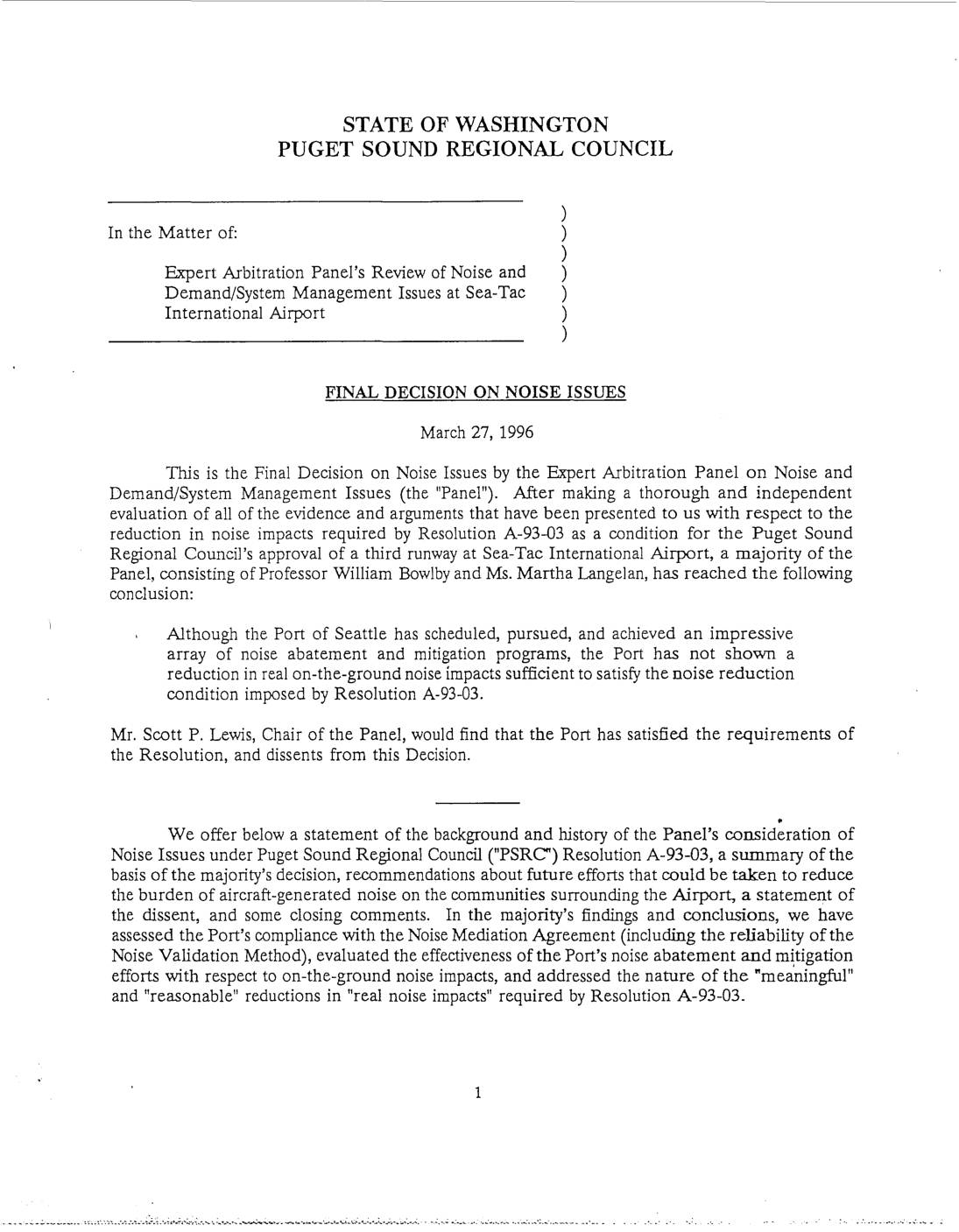
PSRC Expert Arbitration Panel Final decision on noise issues
The Expert Arbitration Panel on Noise and Demand/System Management Issues issued its final decision on noise issues related to Resolution A-93-03, which set noise reduction conditions for PSRC authorization of a third runway at Sea-Tac International Airport. A majority of the Panel found that the Port of Seattle had not demonstrated a sufficient reduction in -
 1995-01-20
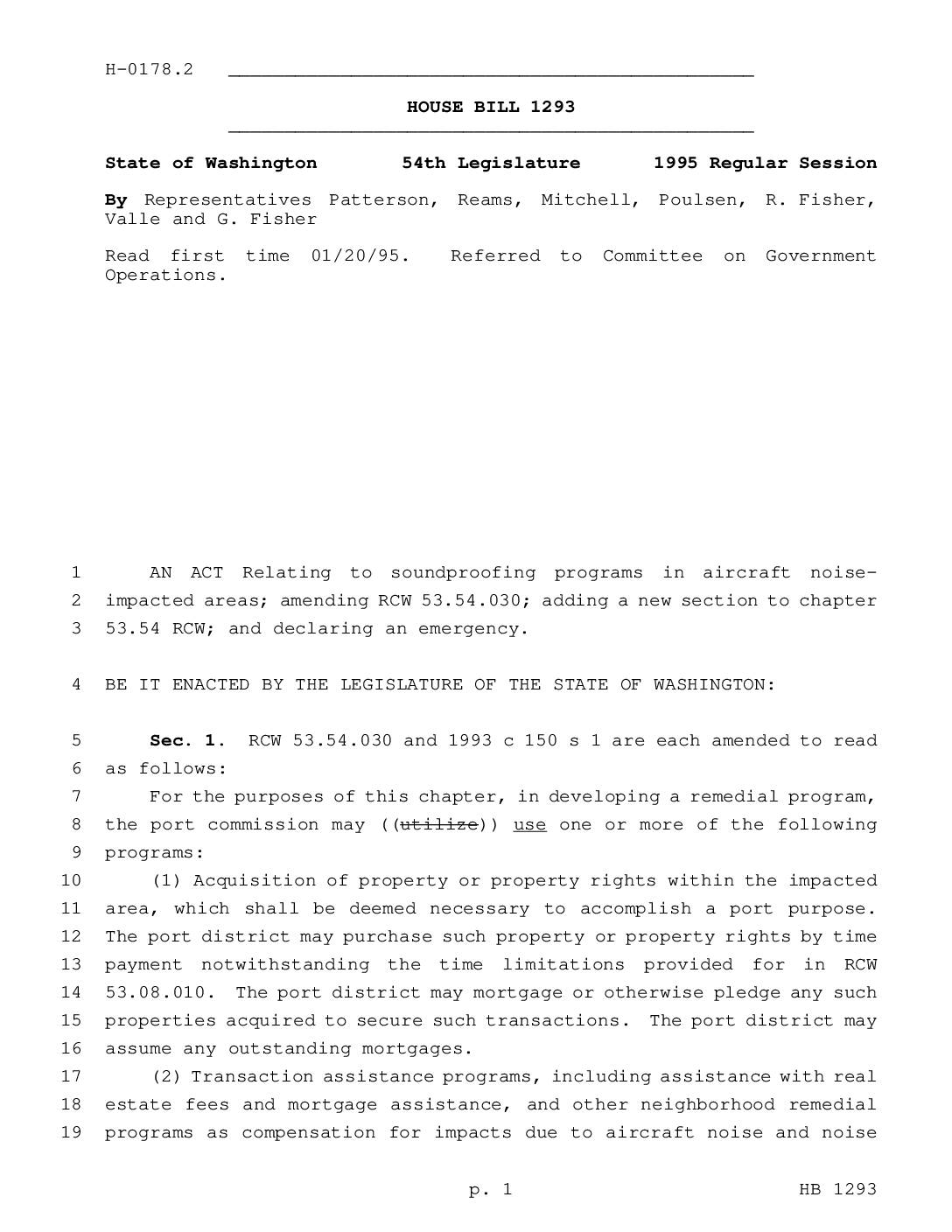
House Bill 1293: Soundproofing programs in aircraft noise-impacted areas
Washington House Bill 1293 (1995) amended state law governing how port districts can address aircraft noise impacts on nearby properties, expanding soundproofing programs and removing a prior requirement that property owners waive damages and convey easements in exchange for noise mitigation. The bill declared such damage-waiver agreements void as against public policy, meaning residents near airports like Sea-Tac could receive soundproofing benefits without giving up their legal rights. The act was designated an emergency measure, intended to take effect immediately upon passage. -
1994-12-11
Sea-Tac’s Turbulent History
Stephen Clutter, Paul J. Lim The latest controversy at Sea-Tac, over a possible third runway, is one more chapter in a long, turbulent history of airport expansion. Planes started using the site in 1944 and in five decades, it has become the 16th-busiest airport in the nation. ———————————- If you’re upset about the possibility of -
 1993-12-22
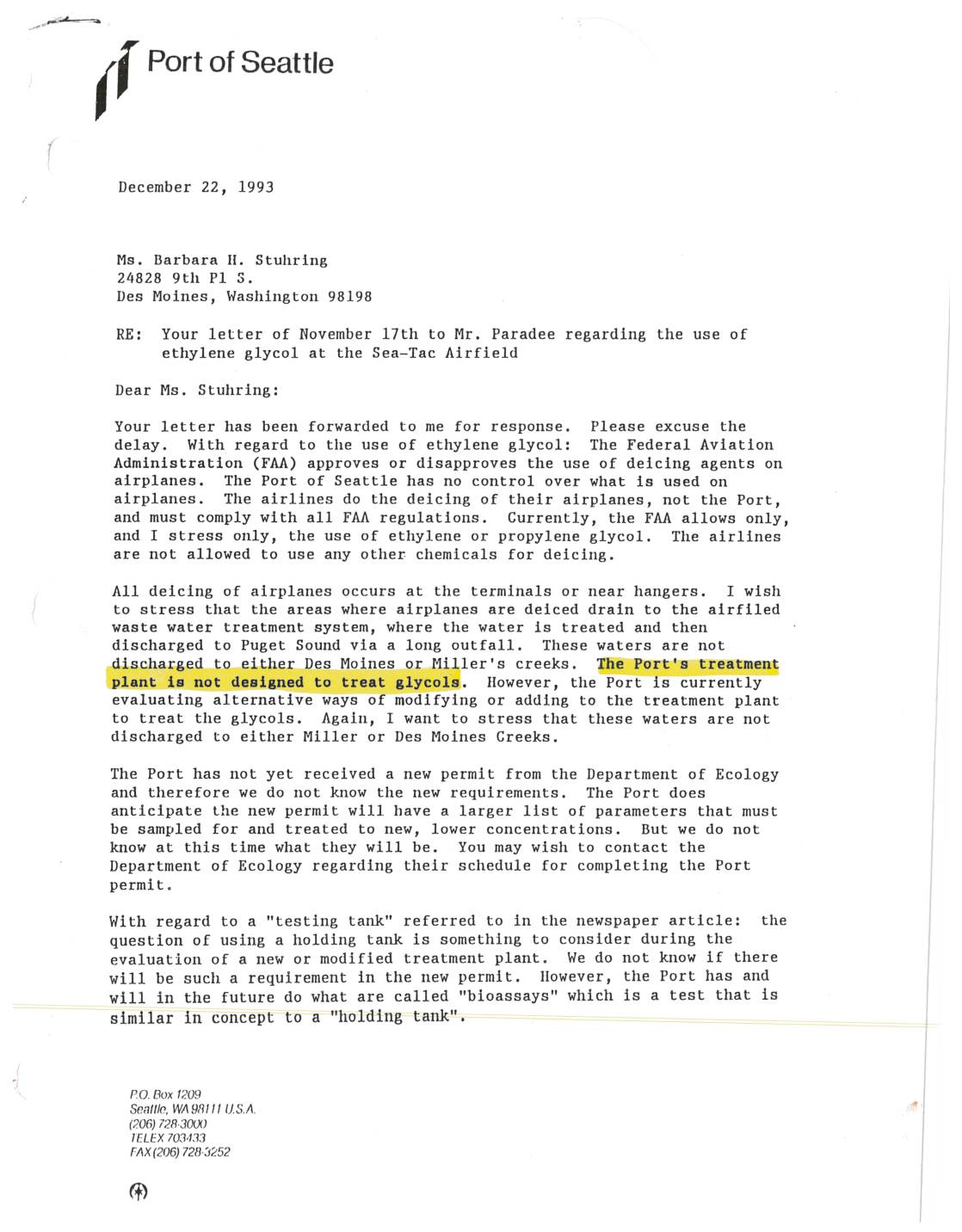
Port Of Seattle letter to Barbara H. Stuhring regarding ethylene glycol use at Sea-Tac Airfield
A 1993 Port of Seattle letter to Des Moines resident Barbara Stuhring explains that airplane deicing at Sea-Tac uses only FAA-approved ethylene or propylene glycol, and that wastewater from deicing drains to the airport's treatment system before being discharged to Puget Sound — not to Miller or Des Moines Creeks. A 1996 Final Environmental Impact Statement (EIS) later addressed public concerns about deicing fluid effects on local waterways, concluding that glycol quantities in stormwater runoff were too small and too diluted to cause lethal impacts on aquatic life in those creeks. Stuhring subsequently wrote to the Port challenging what she saw as a contradictory response in the Final EIS compared to the original 1993 letter. -
 1993-07-25
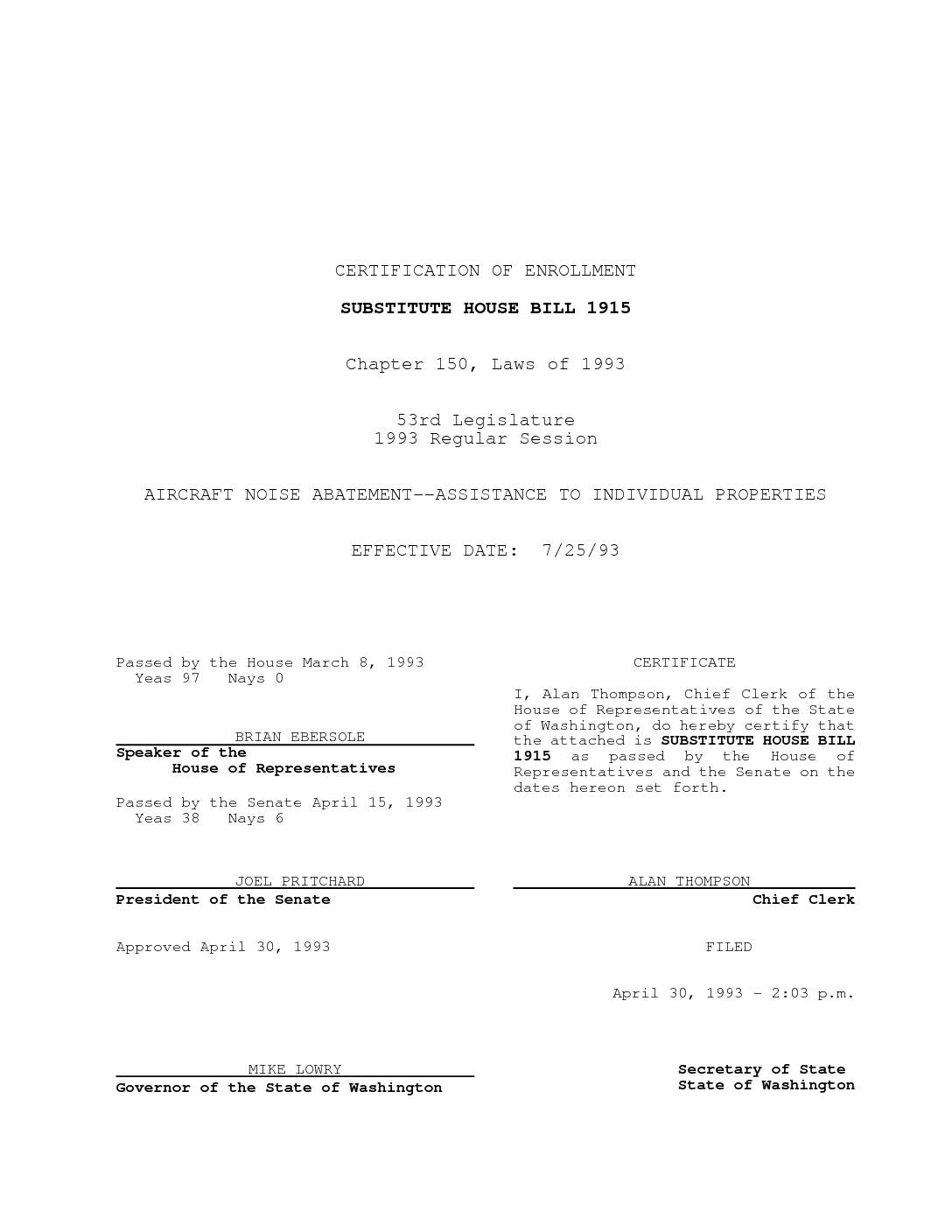
Substitute House Bill 1915: Aircraft noise abatement–assistance to individual properties
Washington State's Substitute House Bill 1915, signed into law on April 30, 1993, expanded the tools available to port districts for addressing aircraft noise impacts on nearby properties. The law allows ports to offer affected property owners a range of remedies, including property acquisition, transaction assistance, soundproofing programs, and mortgage insurance. A key update permits individual properties to receive benefits more than once if they experience increased or changed aircraft noise levels that would have warranted a different level of mitigation. -
 1993-01-01
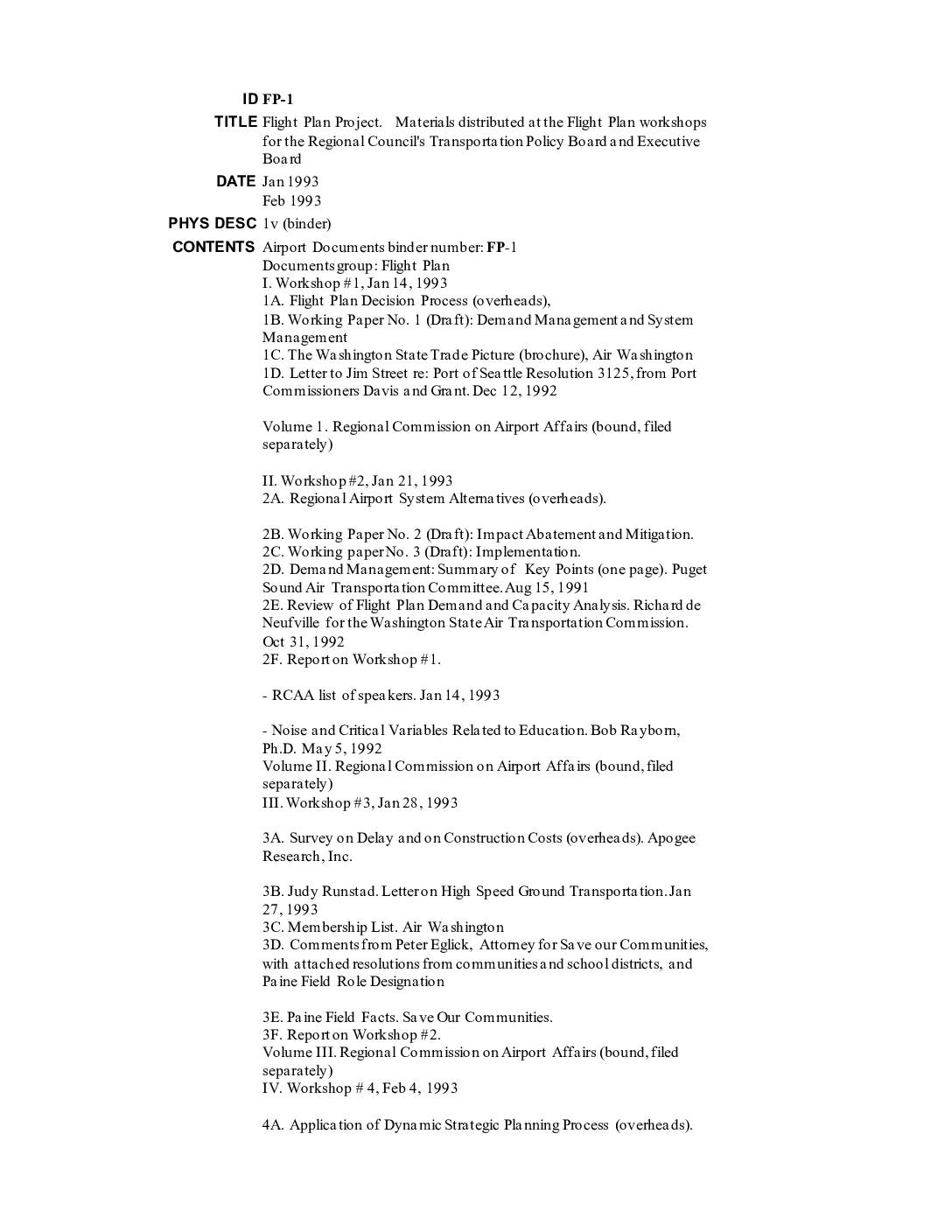
Flight Plan Project: Materials distributed at the Flight Plan workshops for the Regional Council’s Transportation Policy Board and Executive Board
This collection contains materials from the Flight Plan Project workshops held in January and February 1993, organized for the Regional Council's Transportation Policy Board and Executive Board to address airport planning and capacity needs in the Puget Sound region. The binders include working papers, overhead presentations, environmental impact statement documents, public hearing records, and correspondence from stakeholders ranging from the FAA and Port of Seattle to community groups opposing airport expansion. Key topics covered include demand management, noise abatement, regional airport system alternatives, and the evaluation of sites such as Sea-Tac and Paine Field. -
 1992-04-02
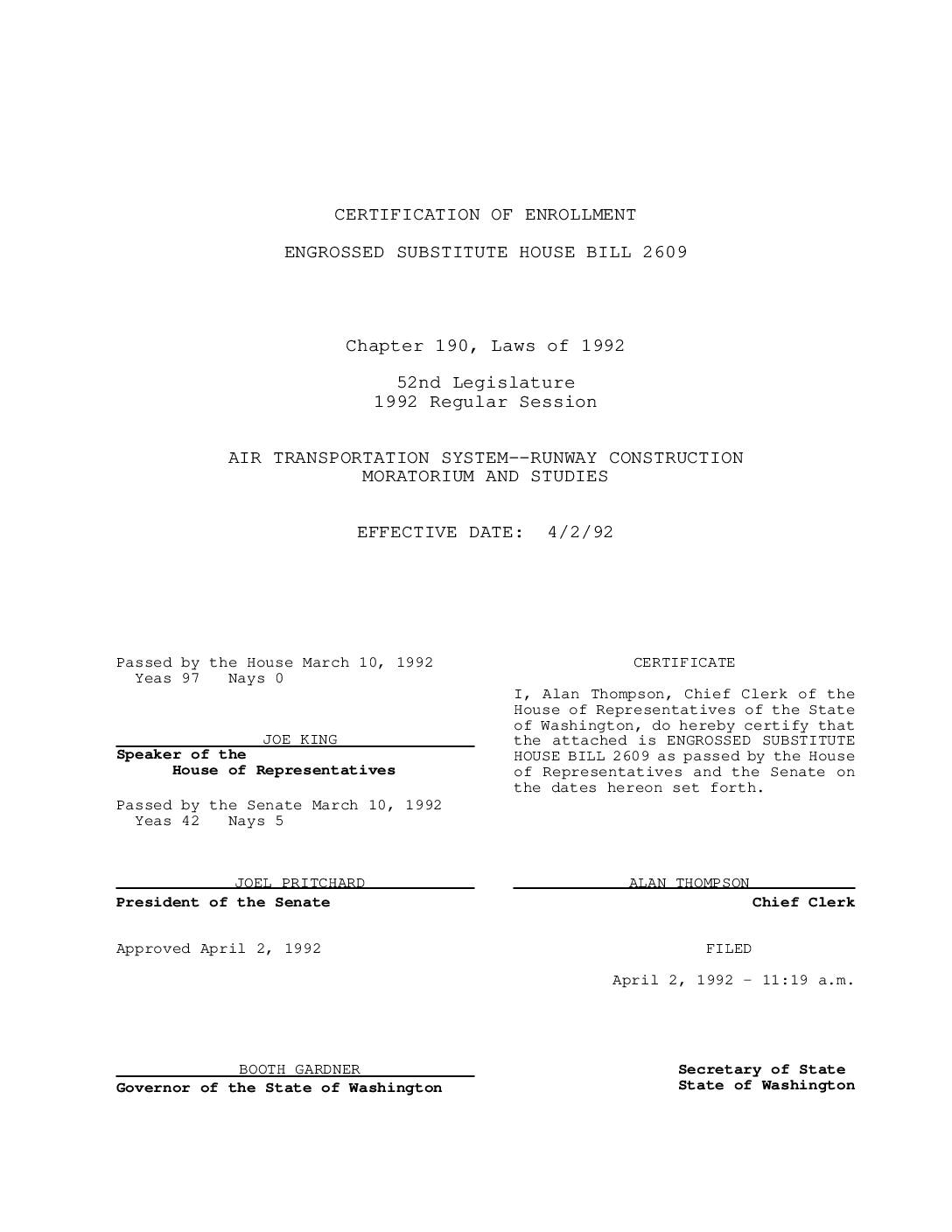
Engrossed Substitute House Bill 2609: Air transportation system–runway construction moratorium and studies
Washington State's Engrossed Substitute House Bill 2609, passed in March 1992 and effective April 2, 1992, placed a moratorium on the construction or extension of runways of 1,000 feet or more by cities, counties, or port districts in heavily populated western Washington counties. The bill was designed to allow the state's Air Transportation Commission time to complete a comprehensive statewide air transportation strategy, with an interim report due December 1, 1992, and a final report due December 1, 1994. The legislation aimed to balance regional aviation capacity needs with environmental and growth management policies before any major new runway infrastructure was approved. -
ESHB 2609 Air Transportation Commission AIRTRAC 1992
ESHB 2609 As Passed House February 18, 1992 Title: An act relating to air transportation. Brief Description: Making airport expansions consistent with the state air transportation policy plan. Sponsor(s): By House Committee on Transportation (originally sponsored by Representatives Hine, G. Fisher, R. Fisher, Brough, Heavey, Locke, Chandler, Leonard, Valle, Wood, Prentice, Hochstatter, Mitchell, Horn,