Category : History(256)
-
 2001-05-01
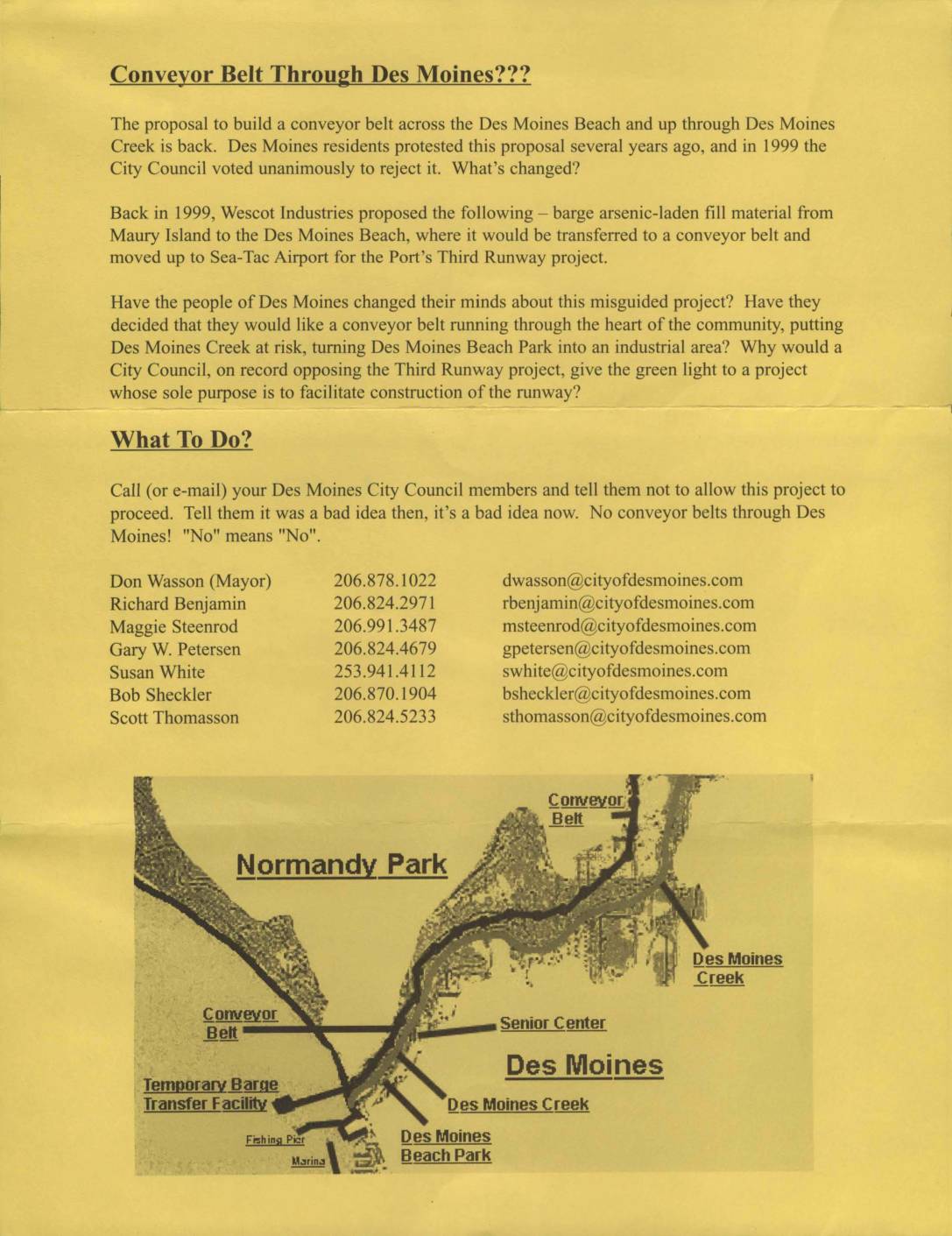
Conveyor belt through Des Moines???
A community flyer opposing a proposed conveyor belt system through Des Moines, Washington, that would transport arsenic-laden fill material from Maury Island to Sea-Tac Airport in support of the Port's Third Runway construction project. The Des Moines City Council had unanimously rejected the same proposal in 1999, and residents were urged to contact their council members to block the revived plan. Opponents argued the project would industrialize Des Moines Beach Park and put Des Moines Creek at environmental risk. -
 2001-04-30
EXH AR050083: Response to Comments — Master Plan Update Improvements at Seattle-Tacoma International Airport, Permit 1996-4-02325
Port of Seattle response to agency and public comments on Section 404 Clean Water Act permit application (JARPA, reference 1996-4-02325) for Master Plan Update improvements at Seattle-Tacoma International Airport. Covers U.S. Army Corps of Engineers public notice history (December 19, 1997; September 30, 1999; December 27, 2000), wetland fill acreages, Miller Creek channel relocation, Highline -
 2001-03-01
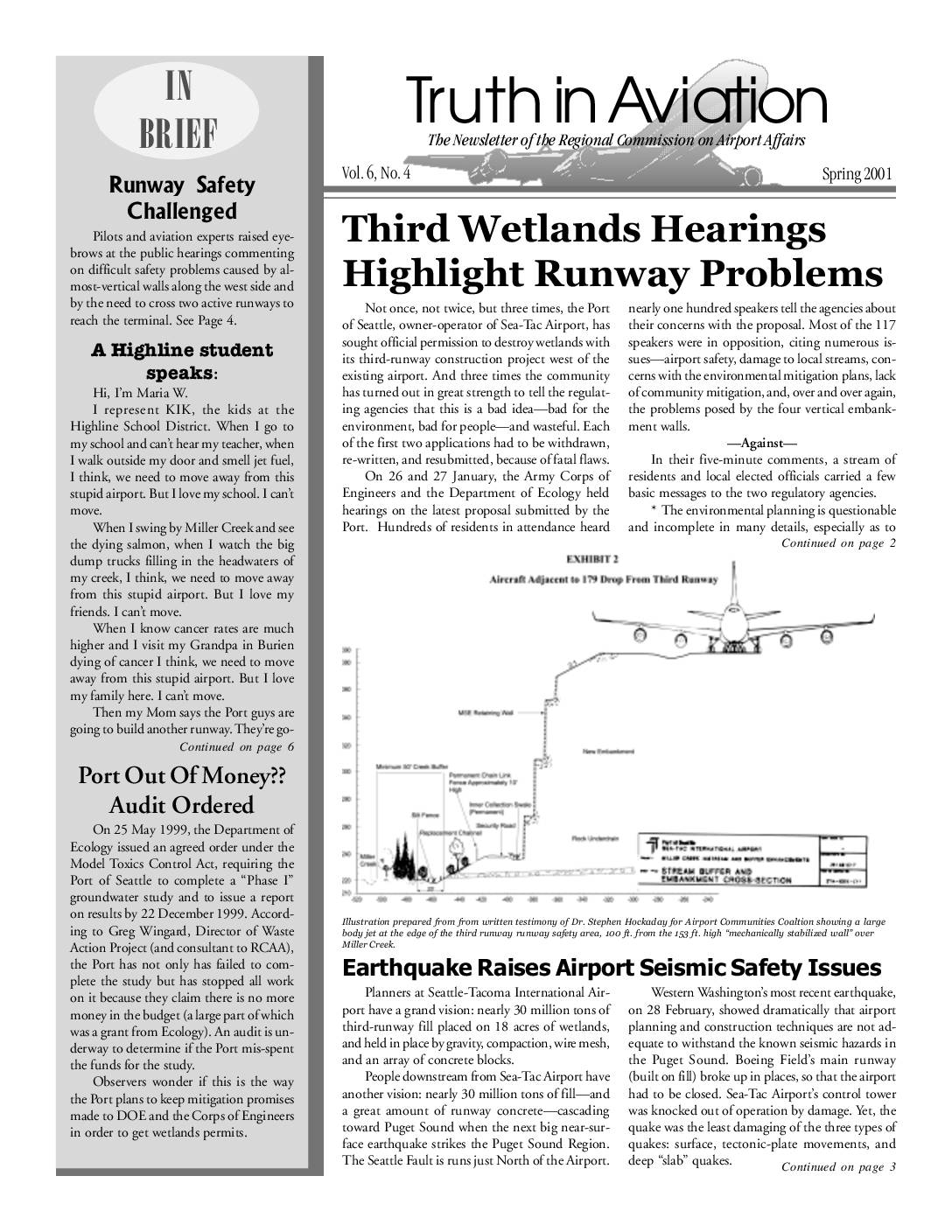
Truth in Aviation: The newsletter of the Regional Commission on Airport Affairs, Vol. 6, No. 4, Spring 2001
A 2001 community newsletter documenting widespread opposition to Sea-Tac Airport's proposed third runway construction, which required destroying 18 acres of wetlands. Residents, local elected officials, and independent experts raised serious concerns about earthquake safety, environmental damage to local streams and salmon habitat, and the structural integrity of four unprecedented earthen retaining walls planned for the project. The Port of Seattle's applications were repeatedly challenged and withdrawn due to fatal flaws in environmental planning and seismic risk analysis. -
1999-09-08
ACC: Letter to the Editor: It’s never too late to save over a billion dollars in public funds
City of Burien City of Tukwila City of Des Moines City of Federal Way City of Normandy Park Highline School District AIRPORT COMMUNITIES COALITION September 8, 1999 To the Editor: It’s never too late to save over a billion dollars in public funds. It’s not too late to ease freeway gridlock. And it’s not -
Des Moines Memorial Way South, Women’s Memorial
By Mildred Andrews Posted 1/14/1999 HistoryLink.org Essay 679 On Armistice Day, November 11, 1921, members of the Seattle Garden Club, led by President Lillian Gustin McEwan, planted the first 25 elm trees along Des Moines Way S (later renamed Des Moine Memorial Drive) — the beginning of a living memorial to “American men who gave -
Des Moines — Thumbnail History
The City of Des Moines, located 15 miles south of Seattle along the shores of Puget Sound, has never been a large center of industry like other Seattle suburbs. Although it incorporated as recently as 1959, it has been a Northwest community for more than 100 years. Europeans first saw the high bluffs of Des -
 1998-08-01
The Health of King County: Highlights, August 1998
A 1998 public health report from the Seattle-King County Department of Public Health summarizing key health trends among King County residents. The report highlights both improvements, such as declining infant mortality, increased prenatal care access, falling teen birth rates, and reduced AIDS cases and sexually transmitted diseases, as well as ongoing challenges including chronic illnesses, drug-related deaths, smoking, obesity, and persistent health inequities across racial and socioeconomic groups. -
 1997-11-01
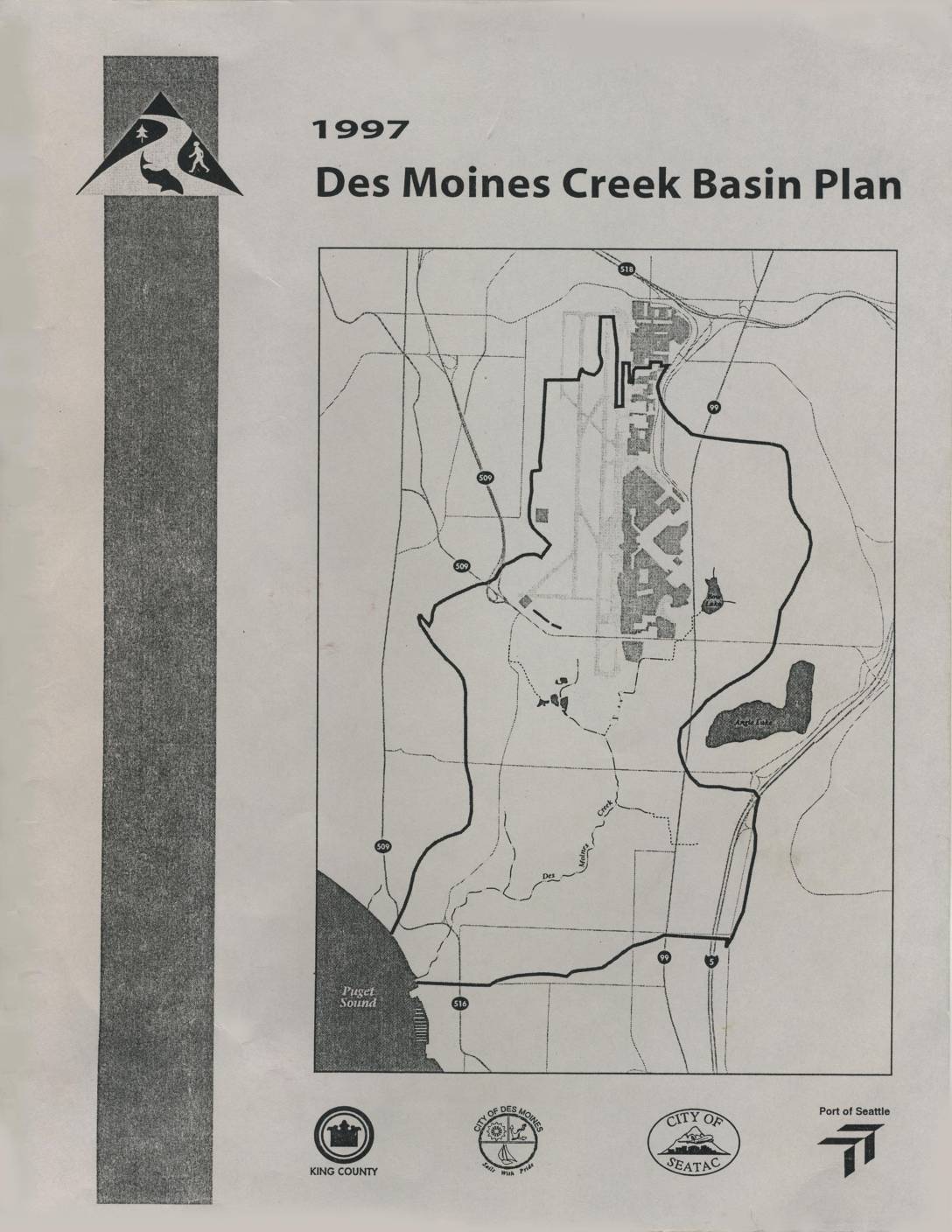
Des Moines Creek Basin Plan
The 1997 Des Moines Creek Basin Plan is a collaborative watershed management document produced by the City of SeaTac, City of Des Moines, Port of Seattle, and King County. It addresses stormwater, drainage, and environmental conditions within the Des Moines Creek basin, an area significantly influenced by Sea-Tac Airport and surrounding urban development. The plan establishes coordinated strategies among the four jurisdictions to manage water quality and flooding in this shared watershed. -
1997-02-07
HOK Executive Summary
an excerpt from the 1997 Sea-Tac International Airport Impact Mitigation Study Overview There is no doubt that the expansion of Sea-Tac International Airport will have a positive economic benefit for the region and the State. However, the costs associated with these improvements are disproportionately borne by those communities immediately surrounding the Airport. Communities such as -
Down-To-Earth Job — Sea-Tac’s Third Runway To Get Its Fill Of Dirt
Jack Broom Seattle Times Staff Reporter Let’s say you’ve been looking for a better view, but you don’t want to leave the neighborhood. Instead, you bring in fill dirt to raise your property so you can see over all your neighbors. Somehow you get the dirt to form a nice column straight up from your