Tagpos_rm_2017_10_24(9)
Port of Seattle Regular Meeting Oct 24, 2017
-
 2017-10-24
Sea-Tac cargo growth
A 2017 Port of Seattle report outlines strong cargo growth at Seattle-Tacoma International Airport, driven primarily by new freighter services from DHL (relocated from Boeing Field) and Amazon Prime Air, both launched in 2016. The surge in freighter activity shifted the cargo mix to roughly 65% freighter and 35% belly cargo, with year-end 2017 totals conservatively forecast at 420,000 metric tons — a 14.6% annual increase. On-airfield cargo facilities reached full capacity, prompting discussions about expanding the cargo footprint at up to three on-airfield locations as well as off-airport development north and south of the airport. -
 2017-10-24
Briefing on the tax levy and a preliminary capital funding plan discussion for 2018-2022
In October 2017, Port of Seattle staff briefed the Commission on the proposed 2018 tax levy and a five-year Capital Improvement Plan (CIP) funding strategy for 2018-2022. Staff recommended holding the tax levy steady at $72 million, while noting that the full CIP exceeds available funding resources for the non-Airport operations covering Maritime, Economic Development, and the Northwest Seaport Alliance. A prioritization process was underway to balance near-term needs with long-term financial flexibility, with a revised CIP and updated financing plan to follow. -
 2017-10-24
Tax levy and preliminary funding discussion 2018-2022
This October 2017 Port of Seattle presentation outlines the tax levy and preliminary funding plan for 2018–2022, covering how capital projects at Seattle-Tacoma International Airport and non-airport divisions are financed. The Airport is self-funding through its own free cash flow, while Maritime, Economic Development, and the Northwest Seaport Alliance rely on a combination of operating free cash flow and tax levy revenue after General Obligation bond debt service payments. The discussion also addresses the Airport's Plan of Finance, non-airport project prioritization, and upcoming 2018 finance initiatives. -
 2017-10-24
Adoption of 2018-2022 Long Range Plan
The Port of Seattle Commission considered approval of its 2018-2022 Long Range Plan (LRP) at its October 24, 2017 meeting, outlining a five-year strategy to achieve the Port's Century Agenda goals, including growing seaport container volume and increasing spending with small, women-owned, and minority-owned businesses. The plan incorporates cross-departmental efforts across aviation, maritime, environmental, and workforce development areas, and is designed to support the creation of 100,000 new jobs in the Puget Sound region. Note: this document addresses broad Port strategic planning and does not specifically cover Sea-Tac Airport noise policy. -
 2017-10-24
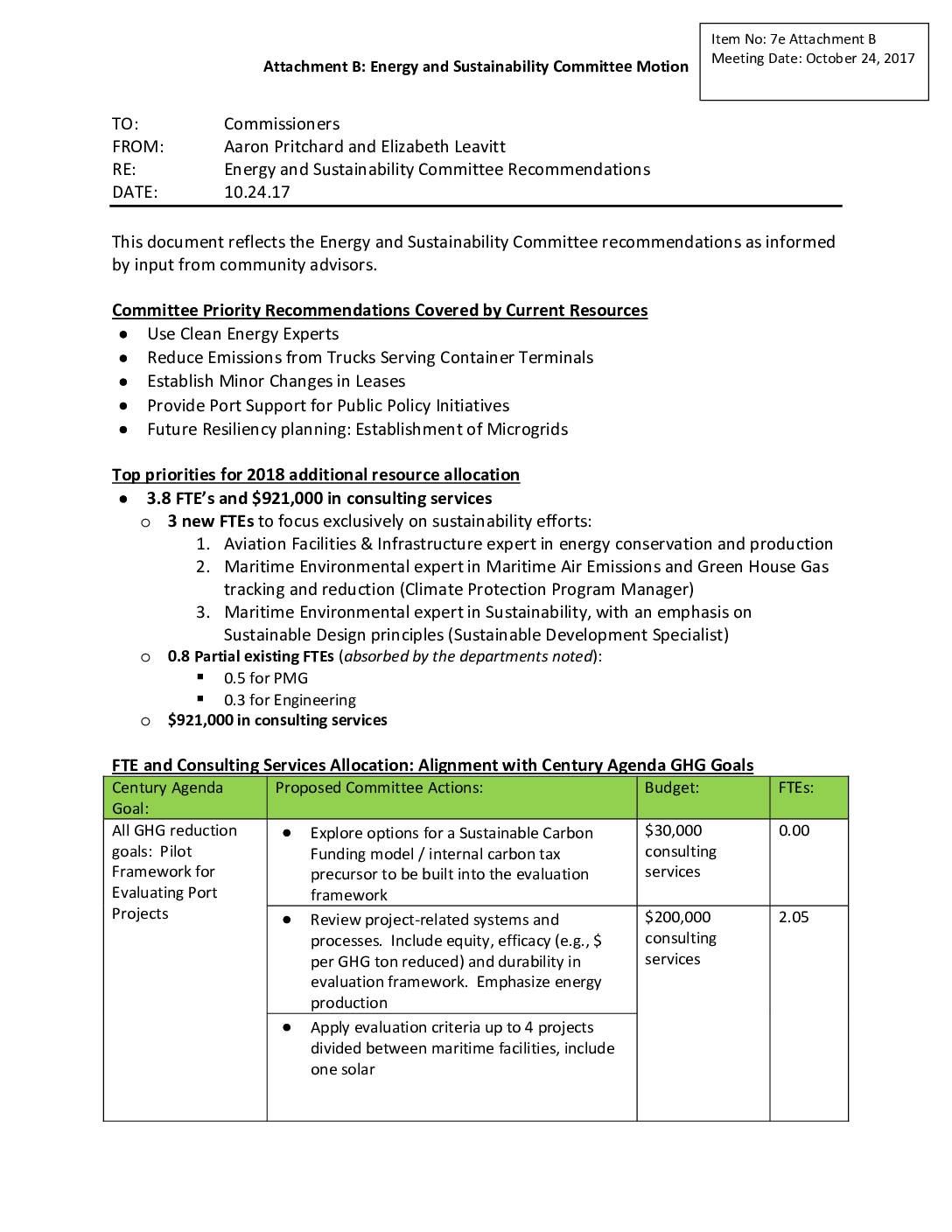
Energy and Sustainability Committee motion: recommendations for 2018 resource allocation
In October 2017, the Port of Seattle's Energy and Sustainability Committee recommended allocating 3.8 new staff positions and $921,000 in consulting services to advance greenhouse gas reduction goals for both aviation and maritime operations. Key initiatives included reducing natural gas use at airport terminals, improving energy efficiency at maritime facilities, and developing programs to cut ground transportation emissions. These efforts were designed to meet Century Agenda targets of 15% Scope 1 and 2 GHG reductions by 2020 and 50–80% Scope 3 reductions by 2030–2050. -
 2017-10-24
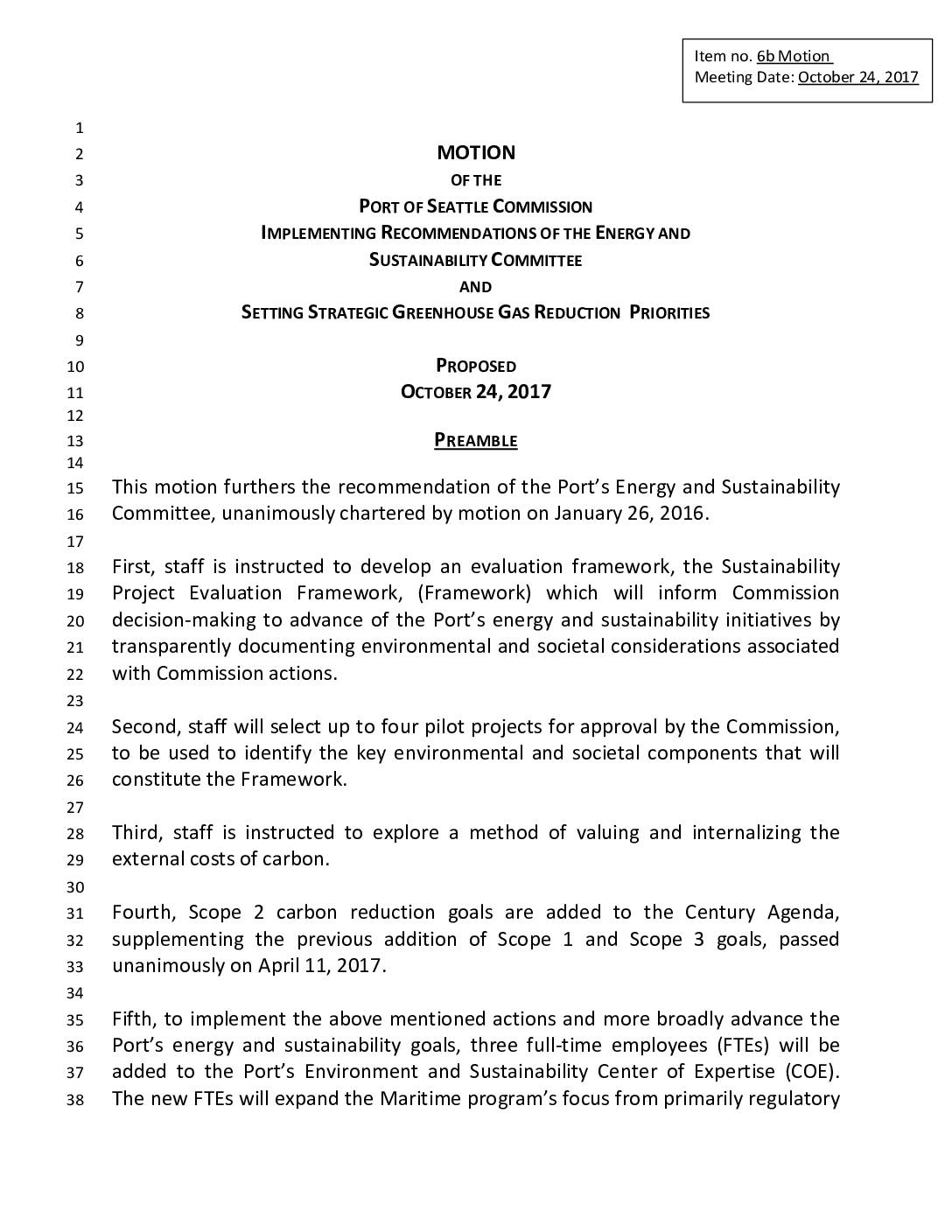
Motion of the Port Of Seattle Commission implementing recommendations of the Energy and Sustainability Committee and setting strategic greenhouse gas reduction priorities
In October 2017, the Port of Seattle Commission adopted a motion setting greenhouse gas reduction priorities and implementing recommendations from its Energy and Sustainability Committee. The motion established targets to reduce Scope 1, 2, and 3 emissions — aiming for 15% below 2005 levels by 2020, 50% below 2005 levels by 2030, and carbon neutrality by 2050. It also directed staff to develop a Sustainability Project Evaluation Framework, select pilot projects, and add three full-time employees to advance the Port's energy and sustainability goals. -
 2017-10-24
Draft 2018 state legislative agenda presentation to Port Of Seattle Commission
This October 2017 presentation outlines the Port of Seattle's draft state legislative priorities for 2018, including support for a study of State Route 518 to address transportation congestion and safety challenges caused by the growth of Seattle-Tacoma International Airport. The agenda also includes workforce development initiatives focused on the maritime, manufacturing, and industrial sectors. The Commission was asked to formally adopt the agenda at the October 24, 2017 meeting. -
 2017-10-24
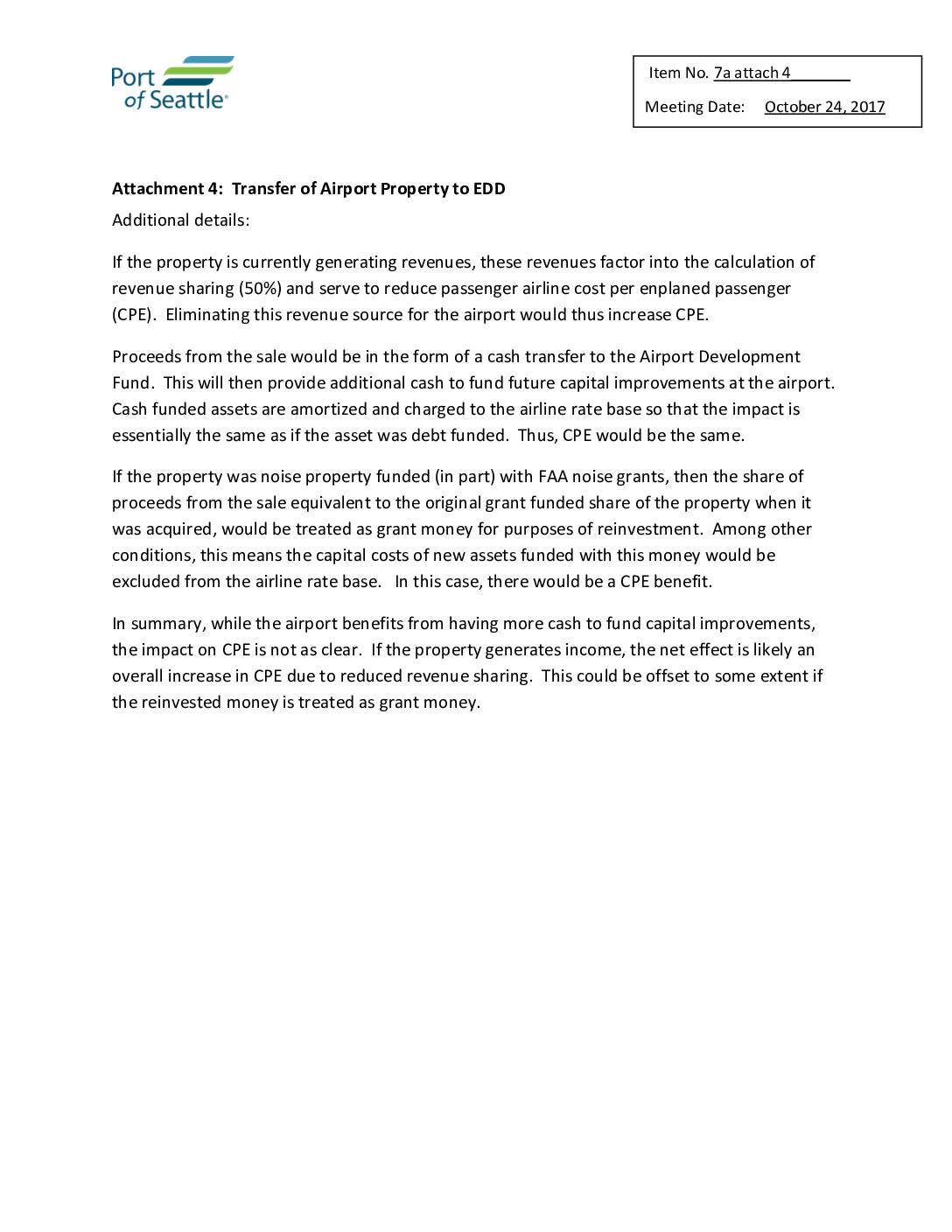
Transfer of airport property to EDD
This Port of Seattle document examines the financial implications of transferring airport property to the Economic Development Division (EDD). It explains that if the transferred property currently generates revenue, losing that income would likely raise the cost per passenger (CPE) for airlines, since those revenues normally offset airline fees. However, if the property was originally purchased using FAA noise grants, a portion of the sale proceeds could be reinvested as grant money, potentially reducing costs and partially offsetting the CPE increase. -
 2017-10-17
Follow-up discussion of operating division budget requests
This October 2017 Port of Seattle memorandum provides follow-up responses to Commissioner questions raised during operational budget briefings for the Aviation, Maritime, and Economic Development divisions. Key topics include passenger and cargo growth trends at Seattle-Tacoma International Airport, street pricing compliance by airport dining and retail tenants, and a $750,000 roof replacement project at Pier 66. The document also outlines the budget approval timetable leading to a December 4, 2017 filing deadline with King County.