Tagpos_rm_2024_12_10(4)
Port of Seattle Regular Meeting Dec 10, 2024
-
 2024-12-10
Item 8j Des Moines Creek Basin Plan V5
Commission misses opportunity to protect and maintain Des Moines Creek Trail Our comments on Item 8j ( Memo , Presentation ) where the Port Commission voted to renew the Des Moines Creek Basin Plan V5. The original 1997 plan came out of two practical concerns: hydrology and environmental. The airport plateau is the source of most -
 2024-12-10
Authorization of Interlocal Agreement V, Des Moines Creek Basin Plan
The Port of Seattle is seeking authorization to enter into a fifth Interlocal Agreement (ILA V) with the Cities of Des Moines and SeaTac to continue restoration projects along Des Moines Creek, contributing $89,304 per year over a 20-year period. This agreement is the latest in a series dating back to 1995, through which the Port, neighboring cities, King County, and the Washington Department of Transportation have collaborated on stormwater management and environmental restoration in the creek basin near Sea-Tac Airport. The ongoing work addresses the airport's environmental impact on local waterways and reflects a long-term regional commitment to creek basin planning and habitat restoration. -
 2024-11-01
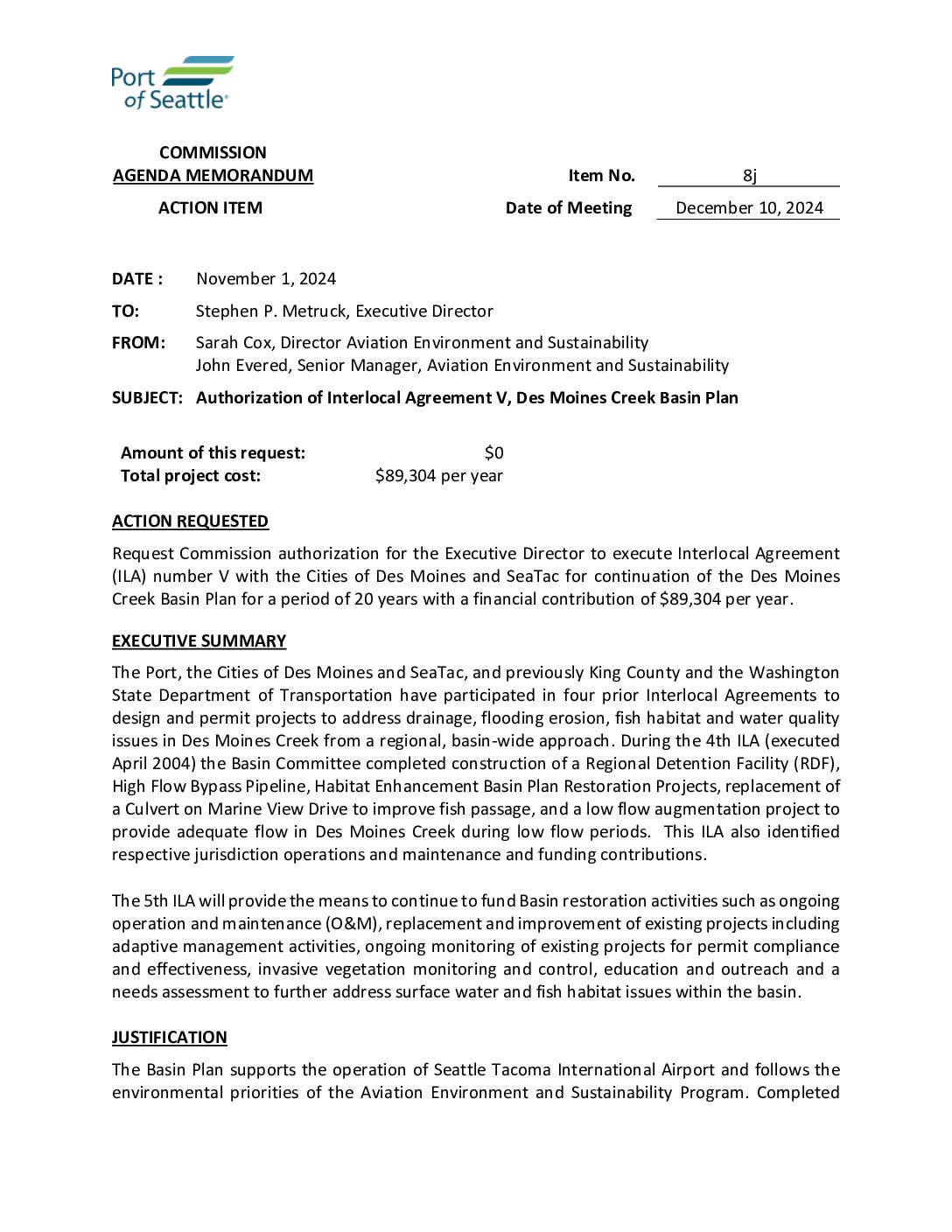
Authorization of Interlocal Agreement V, Des Moines Creek Basin Plan
The Port of Seattle is seeking authorization to enter into a 20-year Interlocal Agreement with the Cities of Des Moines and SeaTac to continue the Des Moines Creek Basin Plan, which manages drainage, flooding, erosion, fish habitat, and water quality issues near Seattle-Tacoma International Airport. The Port would contribute $89,304 per year, covering ongoing operation and maintenance, habitat monitoring, and infrastructure improvements for facilities such as the Regional Detention Facility and High Flow Bypass Pipeline. This cooperative regional effort reduces costs for all parties and supports the airport's stormwater management and environmental compliance obligations.