Tagpos_rm_2016_06_28(6)
Port of Seattle Regular Meeting Jun 28, 2016
-
 2016-06-28
Meeting our green goals
In June 2016, the Port of Seattle Commission presented its 'Meeting Our Green Goals' report for Seattle-Tacoma International Airport, outlining a long-range Strategic Airport Master Plan (SAMP) to guide facility development over 20 years. The plan includes a comprehensive environmental review under both federal (NEPA) and state (SEPA) requirements, with 24 environmental categories to be assessed by the end of 2017. Firm Landrum & Brown was selected to lead the environmental review, which encompasses evaluating baseline conditions and developing a community outreach strategy. -
 2016-06-28
Aviation biofuels – Critical to aviation’s attainment of environmental sustainability
A June 2016 presentation to the Port of Seattle Commission by Washington State University's Ralph Cavalieri, director of the FAA's Aviation Sustainability Center (ASCENT), outlines the critical role of aviation biofuels in reducing the environmental impact of air travel. ASCENT, funded by the FAA's Office of Environment and Energy, conducts research across ten focus areas including alternative jet fuel development, aircraft noise and emissions, and energy-efficient flight operations. The presentation emphasizes that sustainable alternative fuels are essential for the aviation industry to meet its long-term environmental goals. -
 2016-06-28
Auburn Wetland Mitigation Site enhancements construction authorization request
This June 2016 document from the Port of Seattle presents a Construction Authorization Request for enhancements to the Auburn Wetland Mitigation Site, a wetland area located south of Seattle near Auburn, Washington. The site, originally constructed in 2006, serves as a mitigation site likely associated with environmental impacts from Sea-Tac Airport operations or related Port of Seattle projects. The request seeks approval to carry out site improvement work at the approximately 80-acre wetland property situated near the Green River. -
 2016-06-28
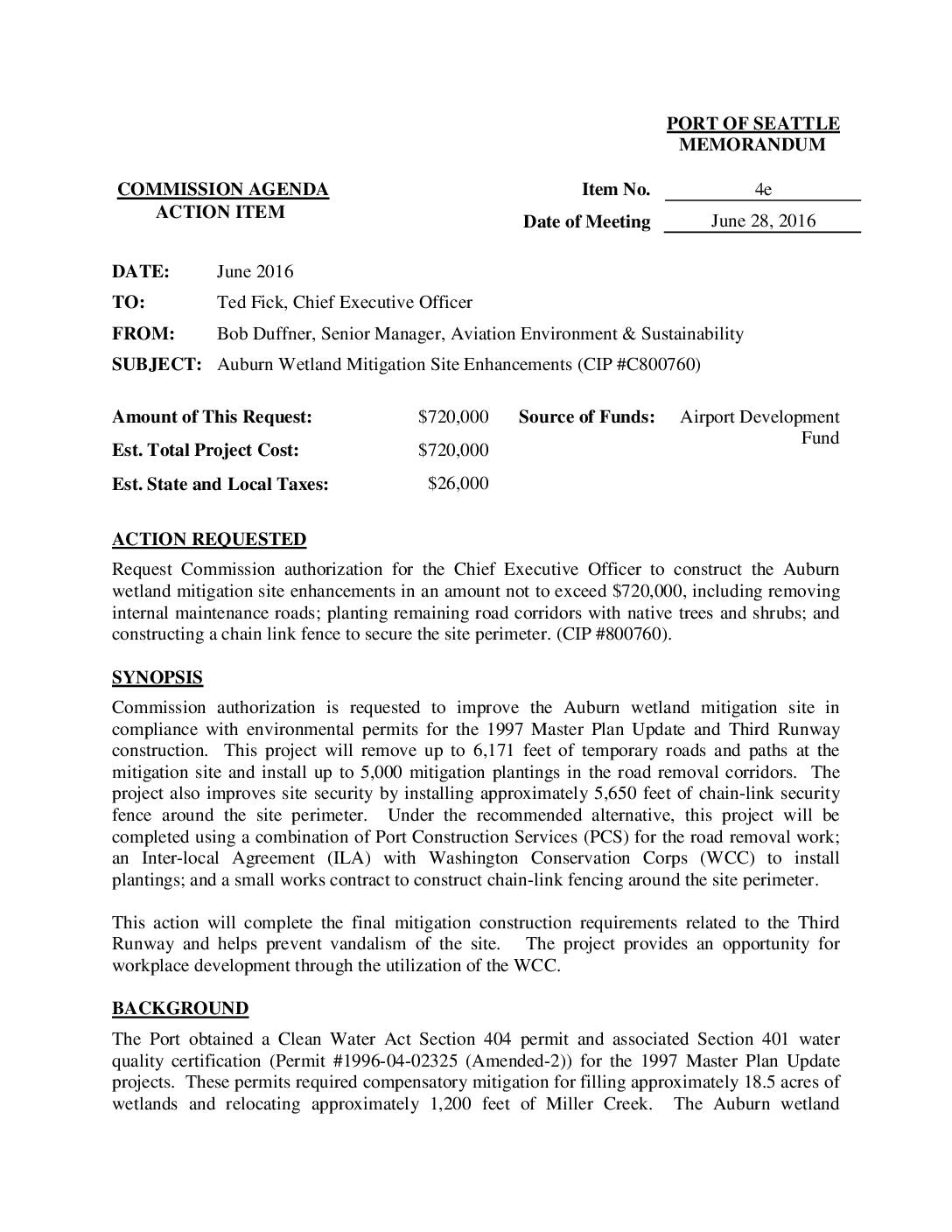
Auburn Wetland Mitigation Site Enhancements Memo (CIP #C800760)
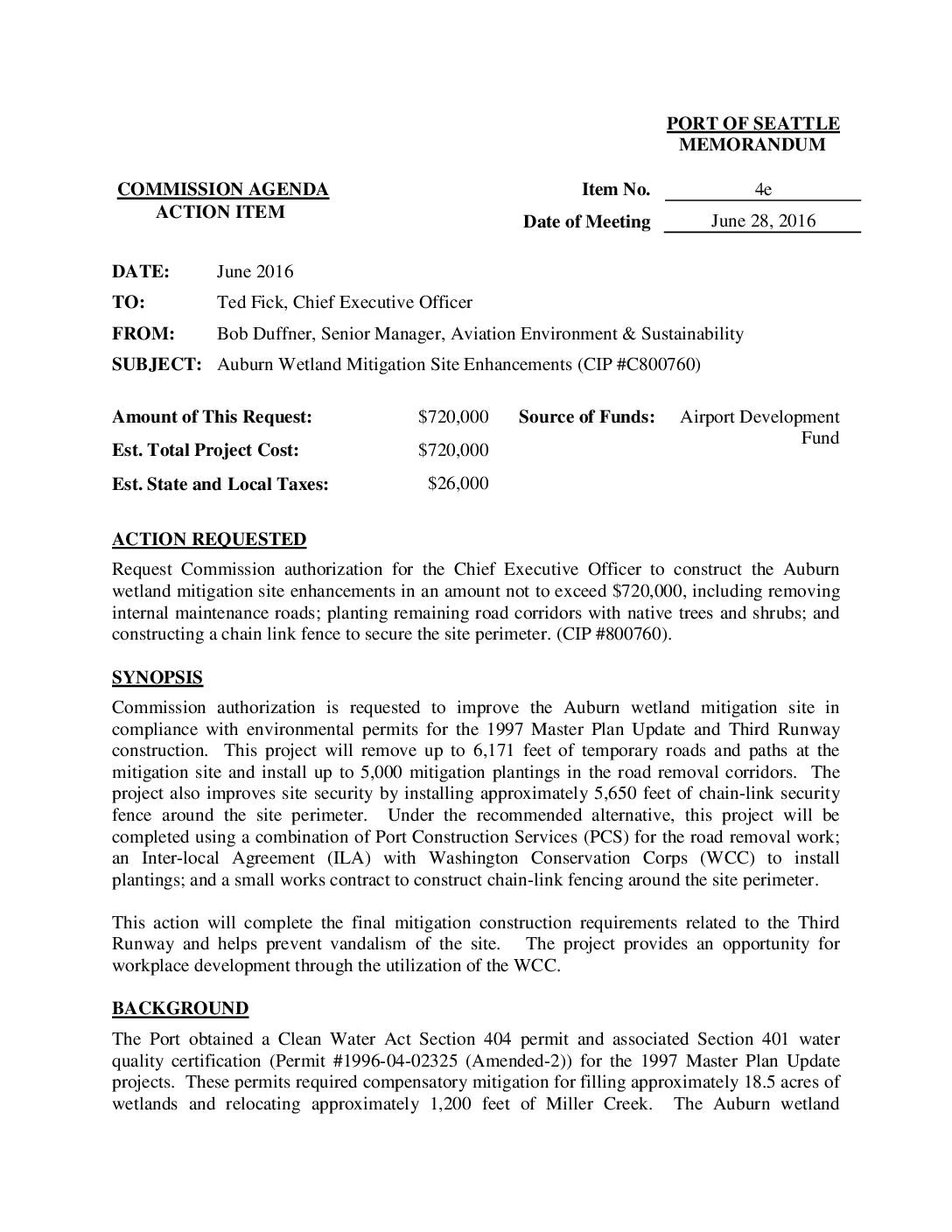
The Port of Seattle requested $720,000 in Commission authorization to improve the Auburn wetland mitigation site, a nature area created to offset environmental impacts from Sea-Tac Airport's Third Runway construction. The project involves removing roughly 6,171 feet of temporary internal roads, planting approximately 5,000 native trees and shrubs in their place, and installing a new chain-link security fence to stop ongoing trespassing, vandalism, and illegal dumping. These enhancements are required to comply with Clean Water Act permits tied to the 1997 Master Plan Update and are intended to reduce long-term maintenance costs. -
 2016-06-28
Auburn Wetland Mitigation Site Enhancements Memo (CIP #C800760)
The Port of Seattle requested $720,000 in Commission authorization to improve the Auburn wetland mitigation site, a nature area created to offset environmental impacts from Sea-Tac Airport's Third Runway construction. The project involves removing roughly 6,171 feet of temporary internal roads, planting approximately 5,000 native trees and shrubs in their place, and installing a new chain-link security fence to stop ongoing trespassing, vandalism, and illegal dumping. These enhancements are required to comply with Clean Water Act permits tied to the 1997 Master Plan Update and are intended to reduce long-term maintenance costs. -
 2016-06-10
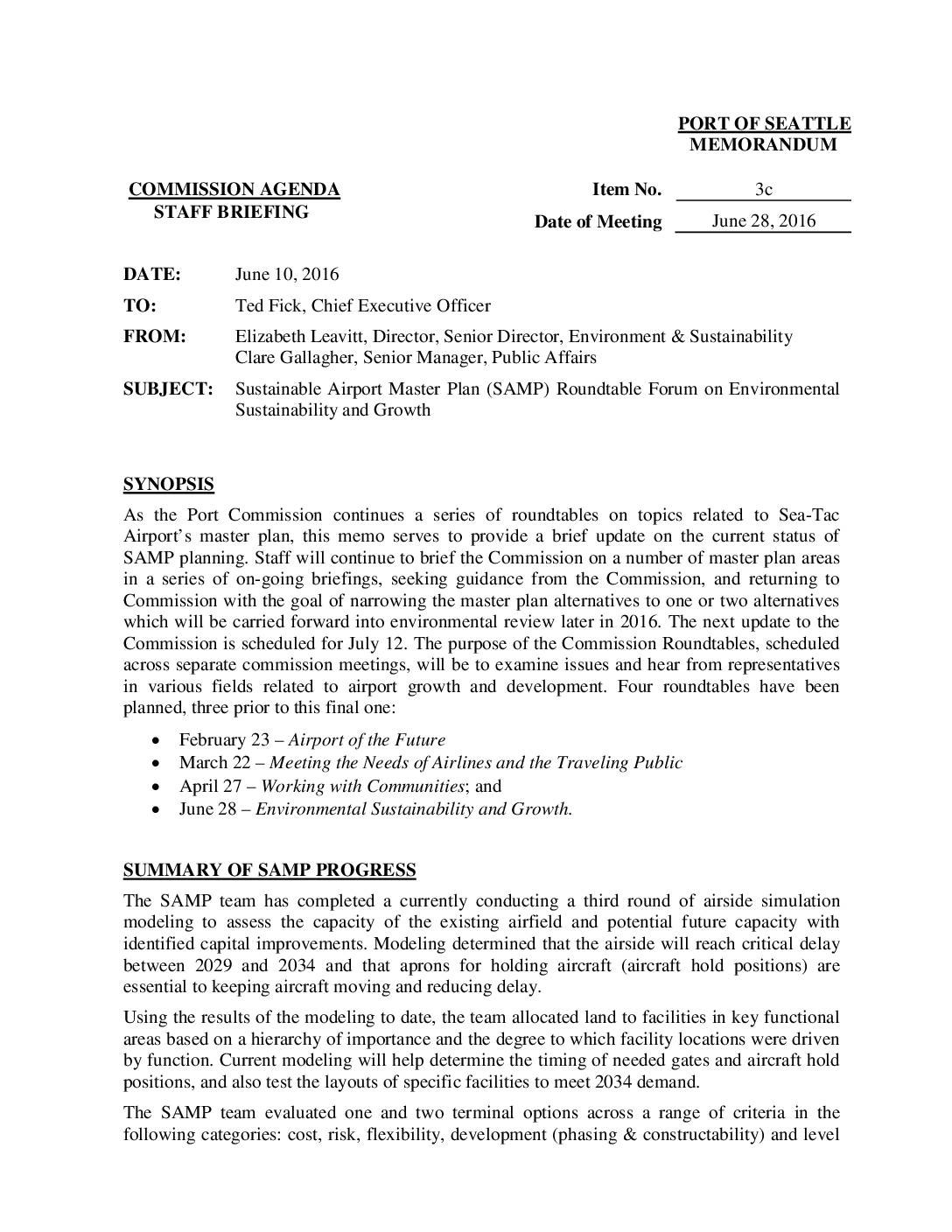
Sustainable Airport Master Plan (SAMP) roundtable forum on environmental sustainability and growth
This June 2016 Port of Seattle staff memo updates the Commission on the Sustainable Airport Master Plan (SAMP) for Sea-Tac Airport, summarizing progress on airside capacity modeling, terminal expansion options, and a series of public roundtable forums on topics such as environmental sustainability, community impacts, and airline needs. Modeling indicates the airfield will reach critical delay levels between 2029 and 2034, making infrastructure improvements such as aircraft hold positions essential. The memo outlines next steps toward narrowing master plan alternatives to one or two options for formal environmental review later in 2016.