Category : Key Documents(137)
The (137) files, images and basic information we refer to constantly from the Document Library and Resources pages.
-
1980-10-22
Letter from Oris Dunham Airport Open Use (AOU) Classification Status Update
★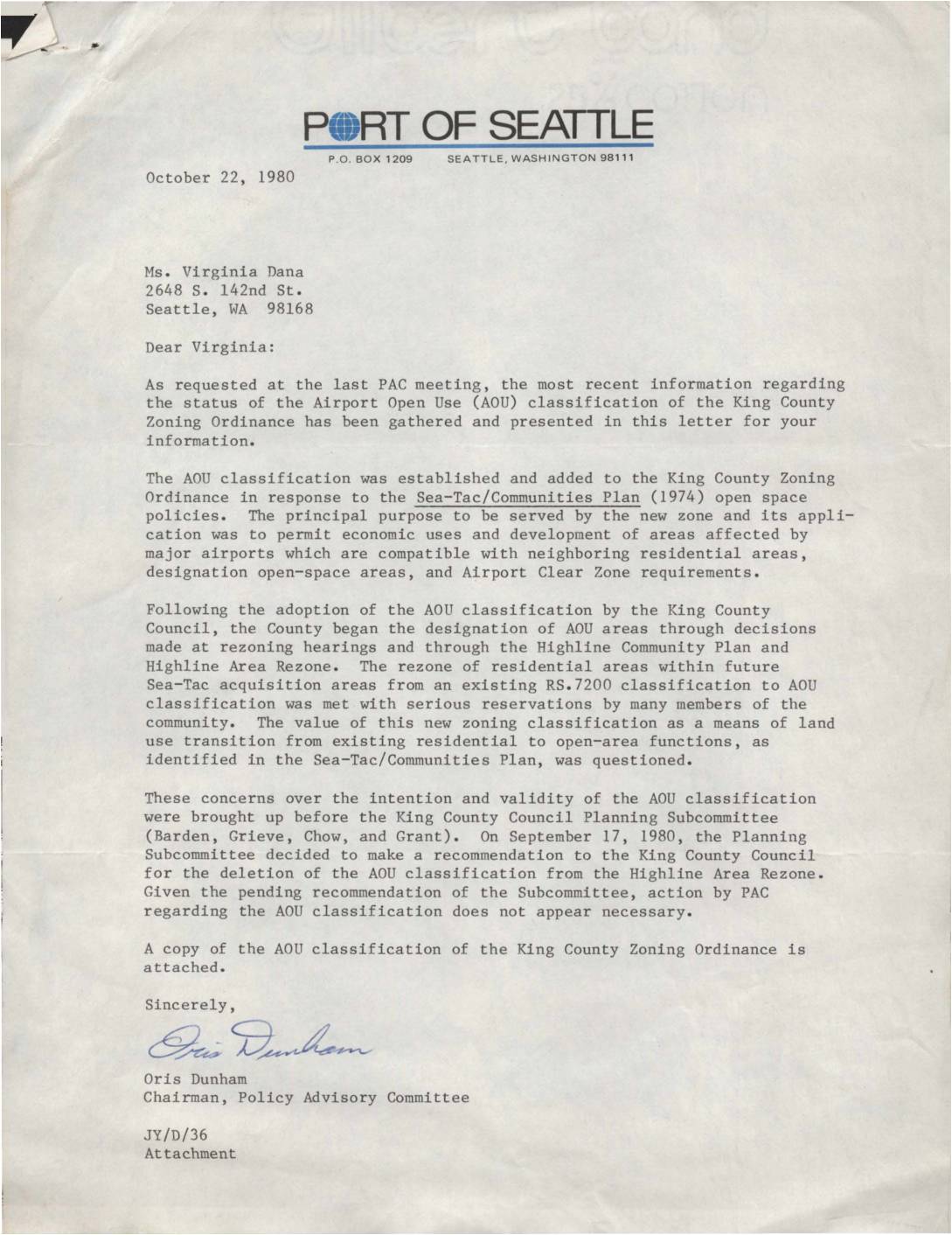 Letter from Port of Seattle Policy Advisory Committee Chairman Oris Dunham to Virginia Dana providing status update on the Airport Open Use (AOU) classification in King County Zoning Ordinance. The letter explains the AOU classification’s purpose for economic development near airports and community concerns that led to a recommendation for deletion from the Highline Area
 -
1980-01-01
Highline Community Plan: Proposed Area Zoning
★ This January 1980 King County Division of Planning report proposes new zoning maps for the Highline community, located south of Seattle between I-5 and Puget Sound, to implement the Highline Communities Plan adopted in December 1977. The plan translates land use policies into specific zoning classifications covering topics such as mixed-use development, mobile home development, an Airport Open Use Zone, and landscaping guidelines. It applies only to unincorporated King County areas and was subject to public community meetings and hearings before adoption by the County Council.
 -
1978-09-01
Policy Advisory Committee for Sea-Tac Plan Implementation
★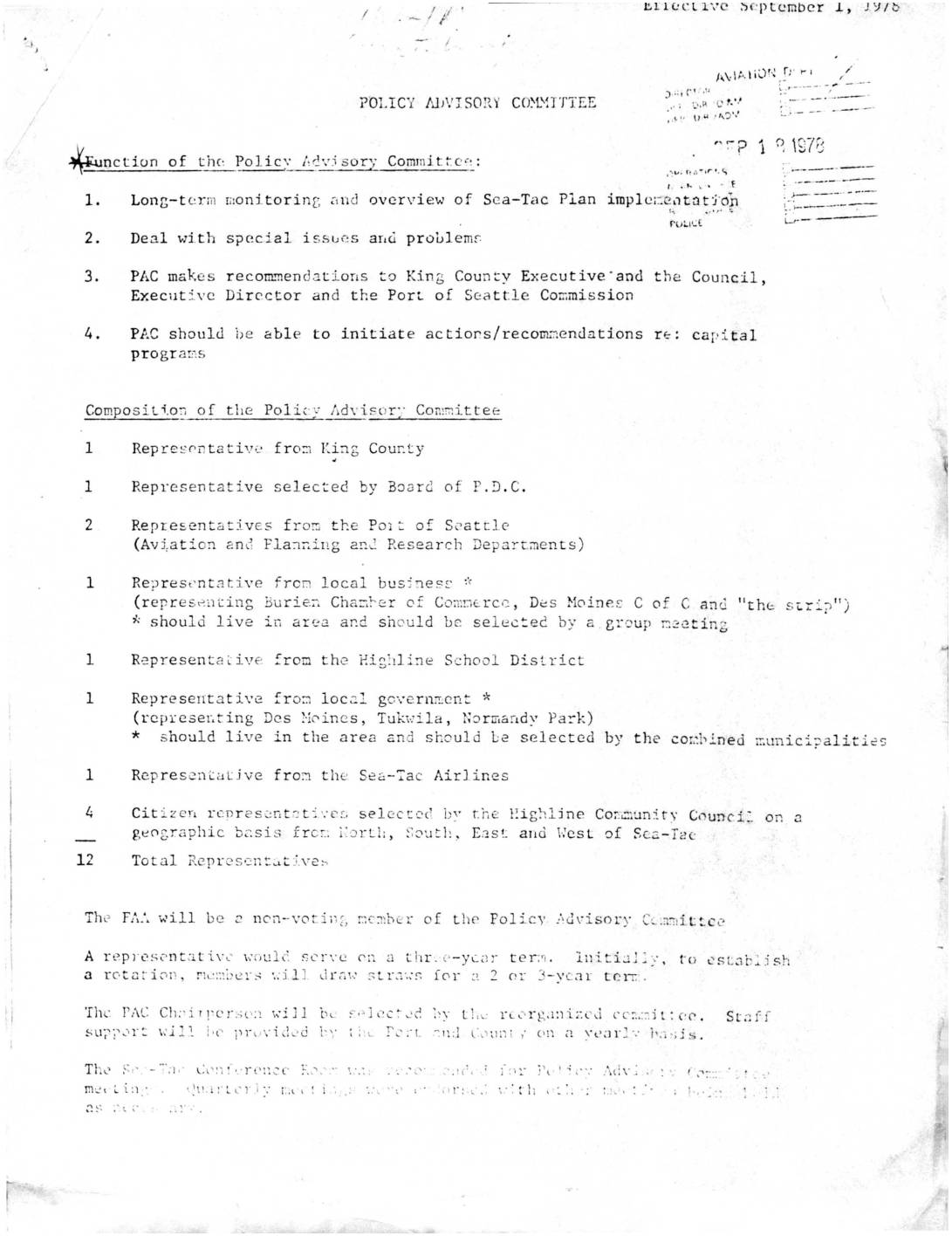 This 1978 document outlines the structure and functions of a Policy Advisory Committee (PAC) formed to oversee implementation of the Sea-Tac Airport Communities Plan, including long-term monitoring of airport noise issues and making recommendations to King County and Port of Seattle officials. The 12-member committee draws representatives from King County, local governments, businesses, schools, airlines, and community citizens. It also details noise exemption rules for daytime aircraft testing and maintenance at Seattle-Tacoma International Airport, specifying conditions such as permitted hours (7 a.m. to 10 p.m.) and geographic boundaries defined by the 'NEF 45' noise exposure contour line.
 -
1976-06-08
Resolution No. 2626: A resolution establishing planning and developmental policies relating to Sea-Tac International Airport and its vicinity
★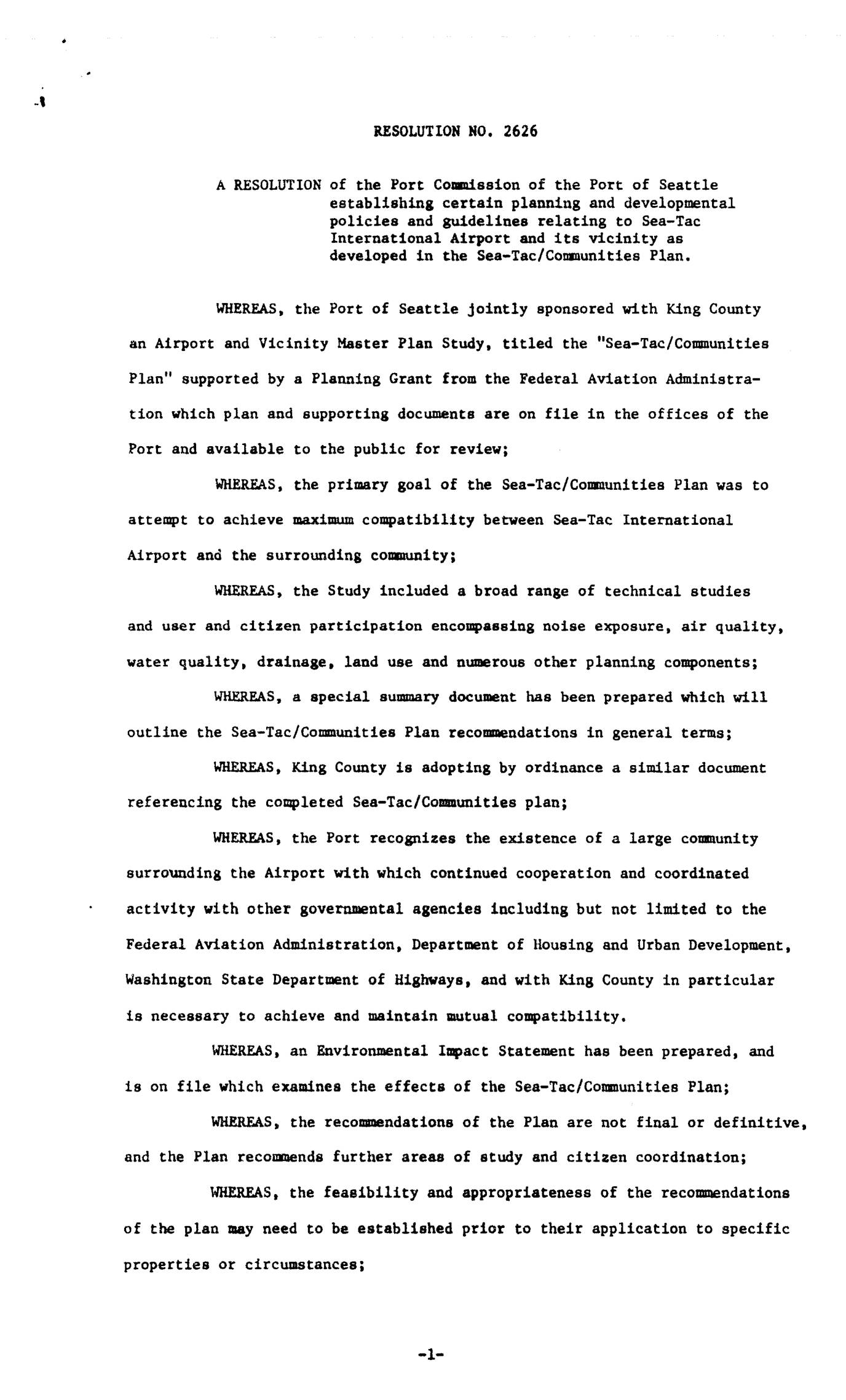 Resolution No. 2626, adopted by the Port of Seattle Commission on June 8, 1976, formally accepted the Sea-Tac/Communities Plan as a guide for developing Sea-Tac International Airport in a way that maximizes compatibility with surrounding neighborhoods. The resolution directed Port staff to pursue federal funding for land acquisition in flight path zones, establish an aircraft noise monitoring system, and launch a pilot acoustic insulation program for nearby homes. Total noise abatement efforts were estimated to cost approximately $50 million over a ten-year period, with funding expected from airport revenues and federal assistance.
 -
1973-07-01
Technical Report #2 Public Facilities and Services in the Sea-Tac Communities Plan Study Area
★ This 1973 technical report from King County's Office of Community and Environmental Development surveys the public facilities and services available in the SeaTac Communities Plan Study Area. It covers schools, parks, libraries, fire protection, sewer and water services, and other community infrastructure. The report was produced to support land use planning in the area surrounding Seattle-Tacoma International Airport.
 -
1970-12-31
42 USC Chapter 85, Subchapter II, Part B: Aircraft Emission Standards
★42 USC CHAPTER 85, SUBCHAPTER II, Part B: Aircraft Emission Standards Current 2024 Main Ed. (1/6/2025) [Titles 1 through 41] 2018 Ed. and Supplement V (1/3/2024) 2018 Ed. and Supplement IV (1/5/2023) 2018 Ed. and Supplement III (1/3/2022) 2018 Ed. and Supplement II (1/13/2021) 2018 Ed. and Supplement I (1/24/2020) 2018 Main Ed. (1/14/2019) 2012 -
1970-12-31
Clean Air Amendments of 1970 (Public Law 91-604)
★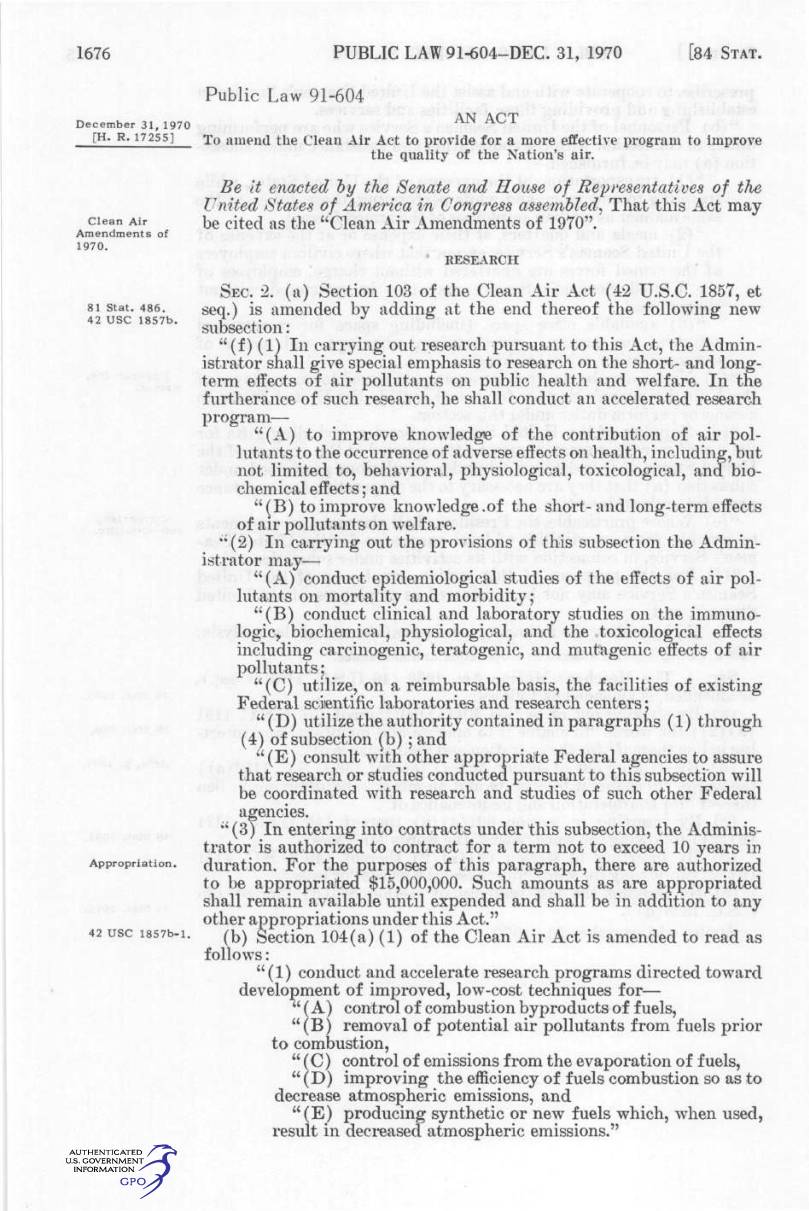 The Clean Air Amendments of 1970 (Public Law 91-604) strengthened the federal Clean Air Act by expanding research into the health and environmental effects of air pollutants, increasing grant funding to state and regional air pollution control agencies, and establishing a framework for national ambient air quality standards. The law required the EPA Administrator to publish and maintain a list of harmful air pollutants and issue scientific criteria for each within 12 months of listing. It also directed states to take primary responsibility for meeting national air quality standards within their borders through mandatory implementation plans.