Category : Meetings(469)
-
 2019-06-26
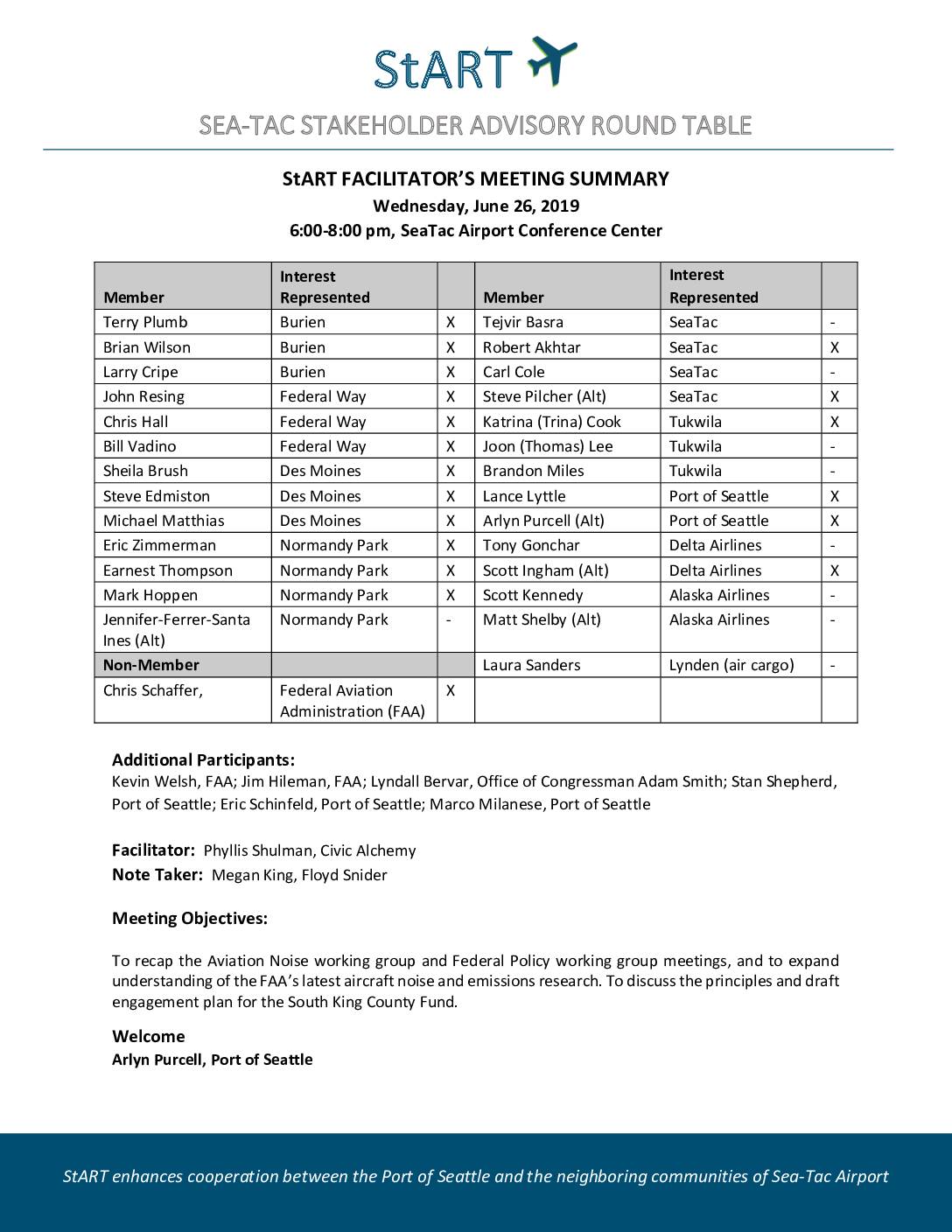
StART facilitator’s meeting summary, June 26, 2019
This document summarizes a June 26, 2019 meeting of the Sea-Tac Stakeholder Advisory Round Table (StART), a group that fosters cooperation between the Port of Seattle and neighboring communities affected by Sea-Tac Airport. Key topics included updates from the Aviation Noise and Federal Policy Working Groups, covering issues such as late-night noise limits, runway use agreements, and potential federal legislation. Representatives from the FAA also presented the latest research on aircraft noise and emissions, including studies on health impacts and alternative jet fuels. -
 2019-06-26
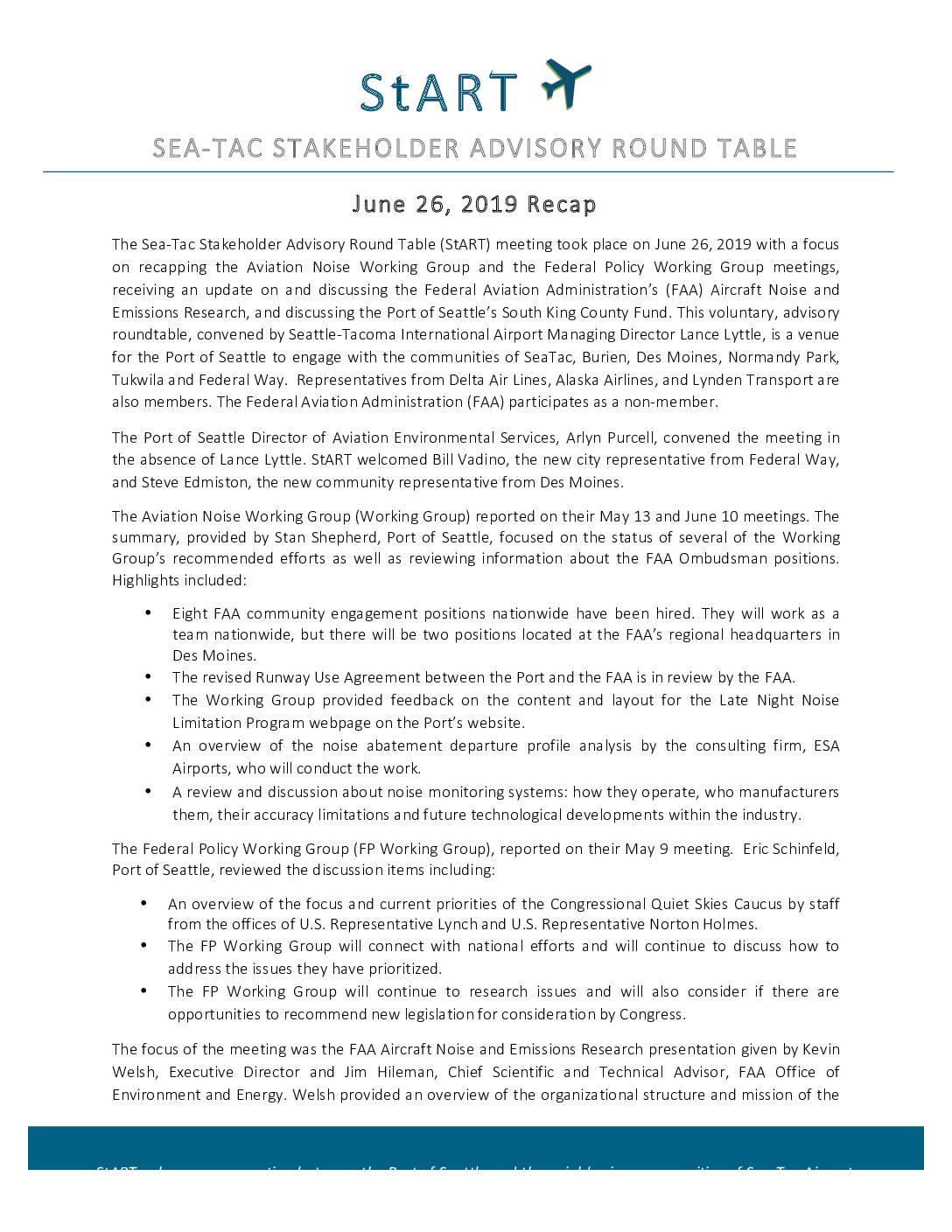
StART Meeting Recap: June 26, 2019
The Sea-Tac Stakeholder Advisory Round Table (StART) met on June 26, 2019 to discuss aircraft noise and emissions research presented by FAA officials, including studies on sleep disturbance, cardiovascular health, and alternative jet fuels. The meeting also covered updates from the Aviation Noise and Federal Policy Working Groups, and introduced the Port of Seattle's new South King County Fund, which will provide $10 million over five years for community projects addressing noise, environmental health, and sustainability. -
Study Session: Collaborating With the consultants
I’m not sure if visitors to tonight’s Des Moines City Council Study Session realized that they were attending something of a performance. I’m not sure most of the City Council did either. But the meetings (and the meeting before the meeting with the DM Airport Committee) were carefully stage-managed by City Manager Michael Matthias to -
 2019-04-24
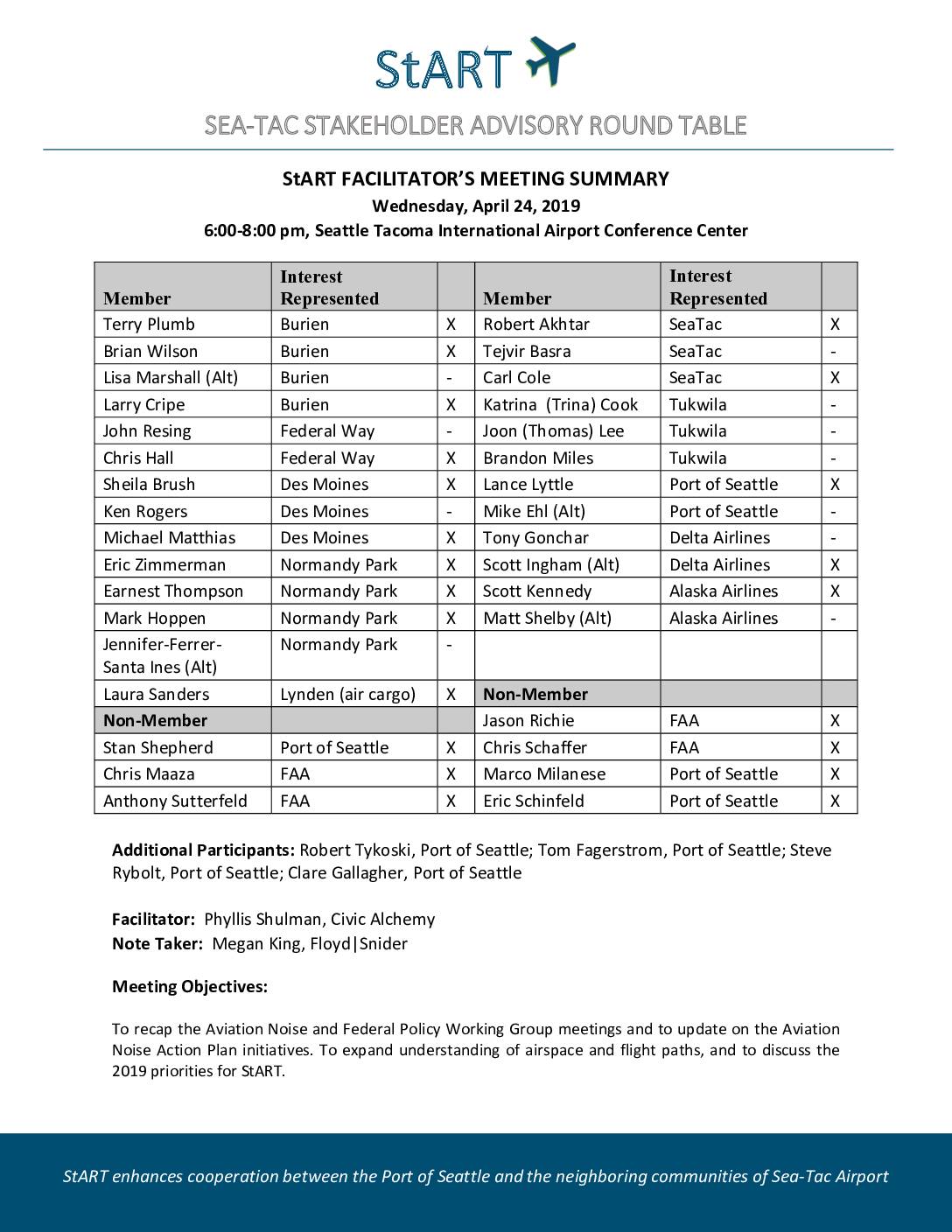
StART facilitator’s meeting summary, April 24, 2019
The April 24, 2019 StART meeting brought together community representatives, Port of Seattle staff, airlines, and FAA officials to discuss ongoing efforts to reduce aircraft noise around Seattle-Tacoma International Airport. Key updates included progress on a Revised Runway Use Agreement, plans to hire consultants to assess noise abatement procedures and airfield noise sources, and an overview of the Late Night Noise Limitation Program, which recognized Southwest, Jazz (Air Canada Express), and Spirit Airlines as top 'Fly Quiet' performers. The group also reviewed the work of a Federal Policy Working Group focused on identifying legislative priorities related to aviation noise under the FAA Reauthorization Act. -
 2019-04-24
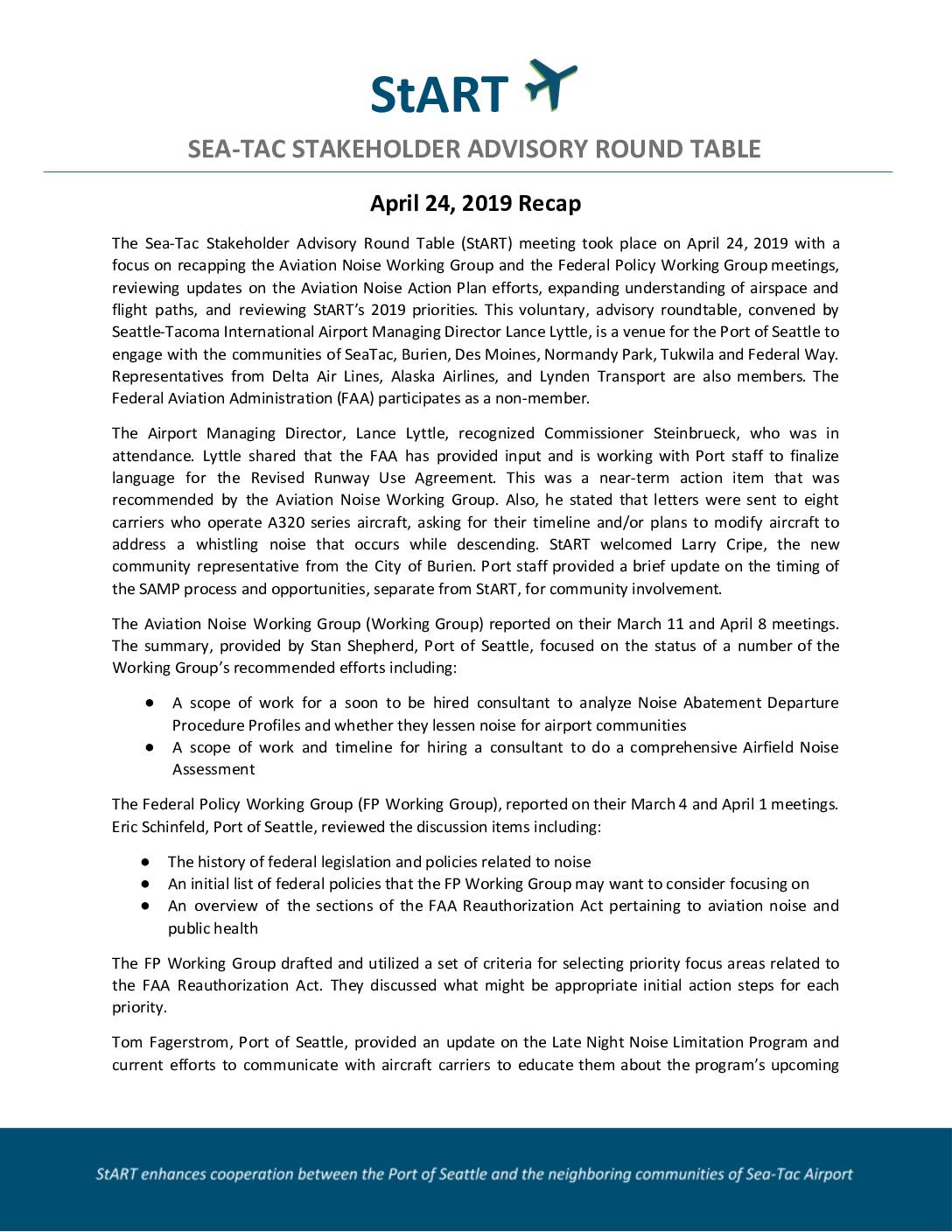
StART Sea-Tac Stakeholder Advisory Round Table April 24, 2019 recap
The Sea-Tac Stakeholder Advisory Round Table (StART) met on April 24, 2019 to discuss ongoing efforts to reduce aviation noise impacts on surrounding communities, including updates on the Revised Runway Use Agreement, a Late Night Noise Limitation Program, and plans to hire consultants for noise assessments. The meeting also featured a presentation on airspace and flight paths, covering how topography, aircraft mix, and nearby airports affect flight routes. Participants reviewed StART's five key priorities for 2019: Aviation Noise, Air Quality/Health Impacts, Future of Aviation/Mobility, Federal Policy, and Short and Mid-Term Noise Relief. -
 2019-04-24
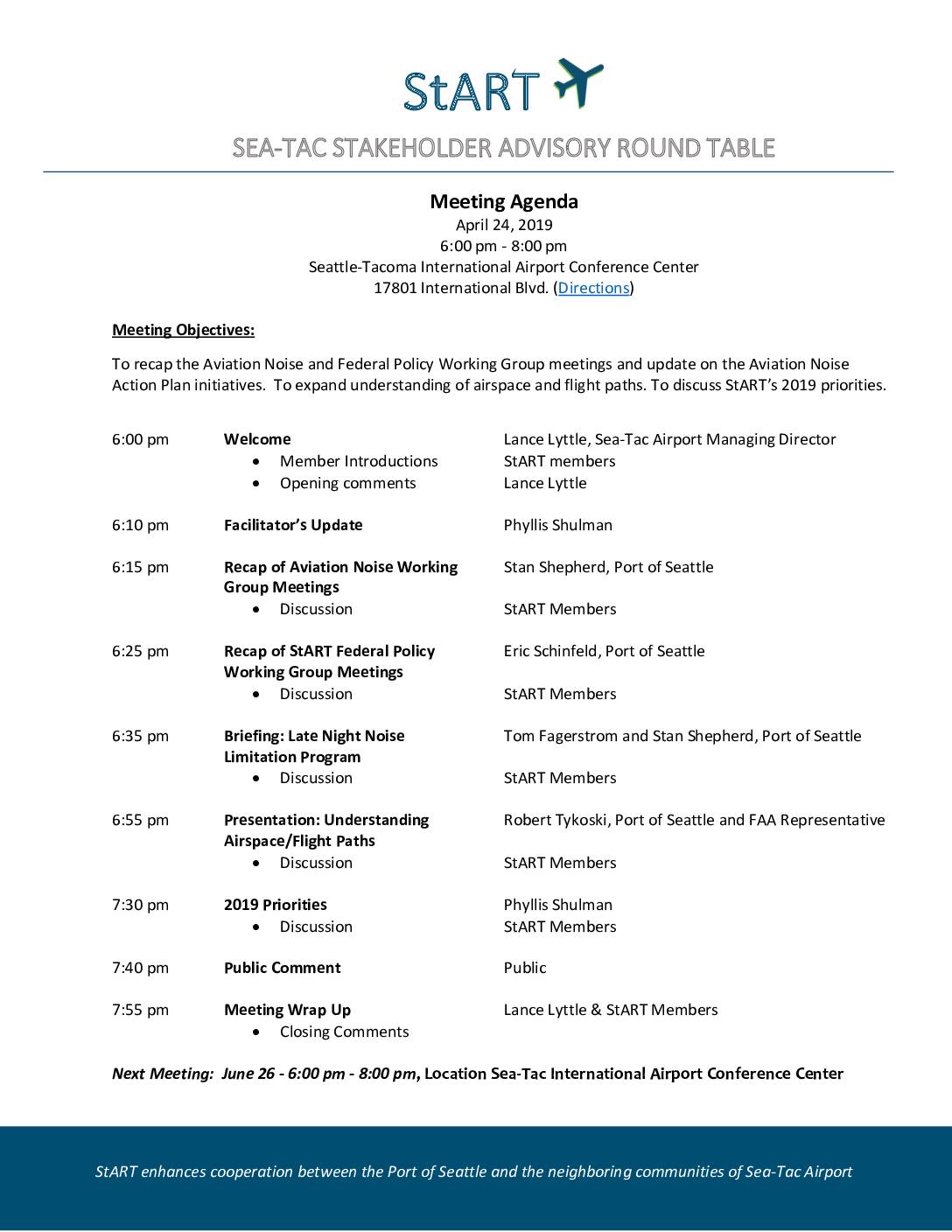
StART Sea-Tac Stakeholder Advisory Round Table meeting agenda, April 24, 2019
The StART (Sea-Tac Stakeholder Advisory Round Table) meeting held on April 24, 2019, brought together Port of Seattle representatives and community stakeholders to review aviation noise and federal policy working group updates, and receive a briefing on the Late Night Noise Limitation Program. The meeting also featured a presentation on airspace and flight paths by Port of Seattle and FAA representatives, followed by a discussion of StART's 2019 priorities and a public comment period. The group's next meeting was scheduled for June 26, 2019, at the Sea-Tac International Airport Conference Center. -
 2019-04-08
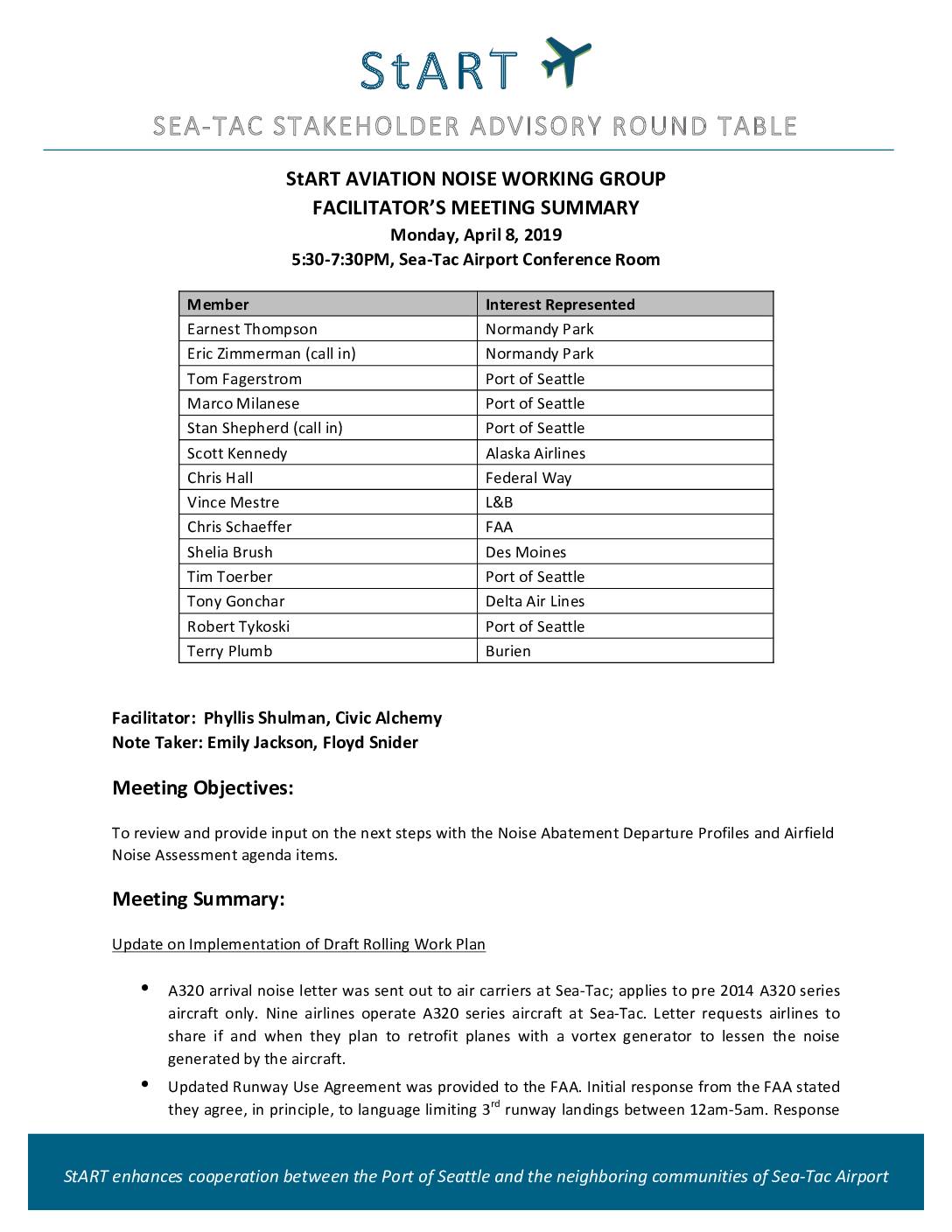
StART Aviation Noise Working Group facilitator’s meeting summary, April 8, 2019
The StART Aviation Noise Working Group met on April 8, 2019 to discuss ongoing efforts to reduce noise impacts on communities surrounding Sea-Tac Airport. Key topics included updates on a Late Night Noise Limitation Program targeting operations between 12am–5am, a technical analysis of Noise Abatement Departure Profiles to evaluate potential noise tradeoffs, and a proposed Airfield Noise Assessment to identify ground-level noise sources and possible reduction measures. The group also reviewed outreach efforts to airlines and discussed next steps for finalizing a Runway Use Agreement with the FAA. -
Public Comment on SB5370: It’s about real competition
Public comment from House Transportation Committee, reviewing Karen Kaiser’s Senate Bill SSB5370. We’re now in the phase where the House Committee reviews the Senate vaersion and vice versa to (hopefully) come to agreed upon final versions which can be voted on. One possible speed bump. The Dept. Of Aviation rep. commented that his Dept. and -
 2019-04-01
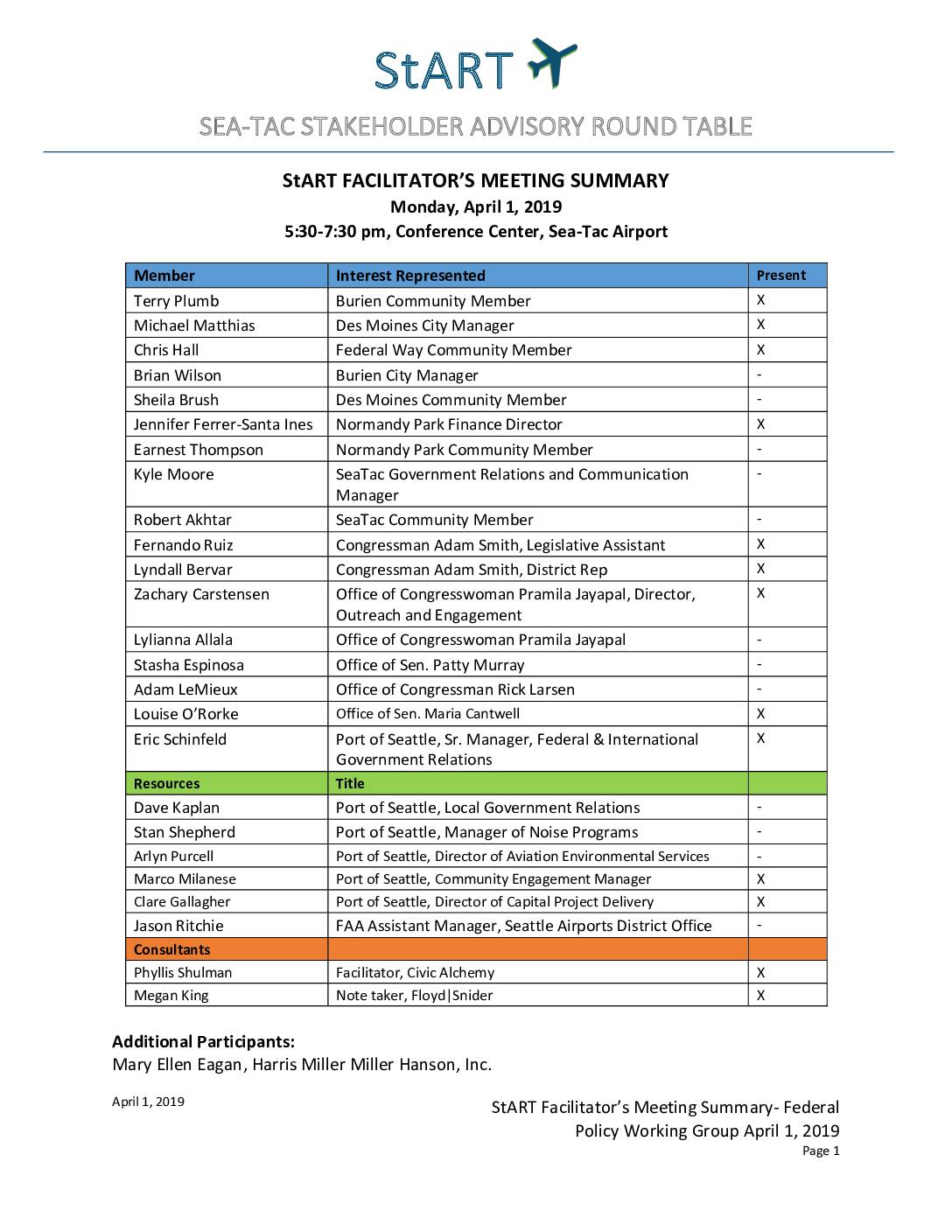
StART facilitator’s meeting summary: Federal Policy Working Group, April 1, 2019
A April 1, 2019 meeting of the Sea-Tac Stakeholder Advisory Round Table (StART) Federal Policy Working Group brought together community members, congressional staff, and Port of Seattle representatives to review noise-related provisions of the FAA Reauthorization Bill, which funds the FAA through 2023. Consultant Mary Ellen Eagan provided an overview of key noise provisions, including updates to noise exposure maps, community noise concerns, and a new grant program for environmental mitigation, while noting that the FAA is unlikely to meet many of the bill's implementation deadlines. Attendees discussed how communities and congressional offices could engage with the FAA to influence its prioritization of noise-related studies and regulatory changes affecting Sea-Tac Airport. -
2019-03-27
Highline highlights: It’s a technicality
Contrary to my expectations, today’s Highline Forum was the most ‘content-rich’ affair I’ve been to in quite a while. If you weren’t there you shoulda been there. Or maybe I’ve been going to these pointless meetings for so long I’ve become so used to boredom that any excitement gets me hot and bothered. I don’t