Category : History(230)
-
 1983-11-29 00:00
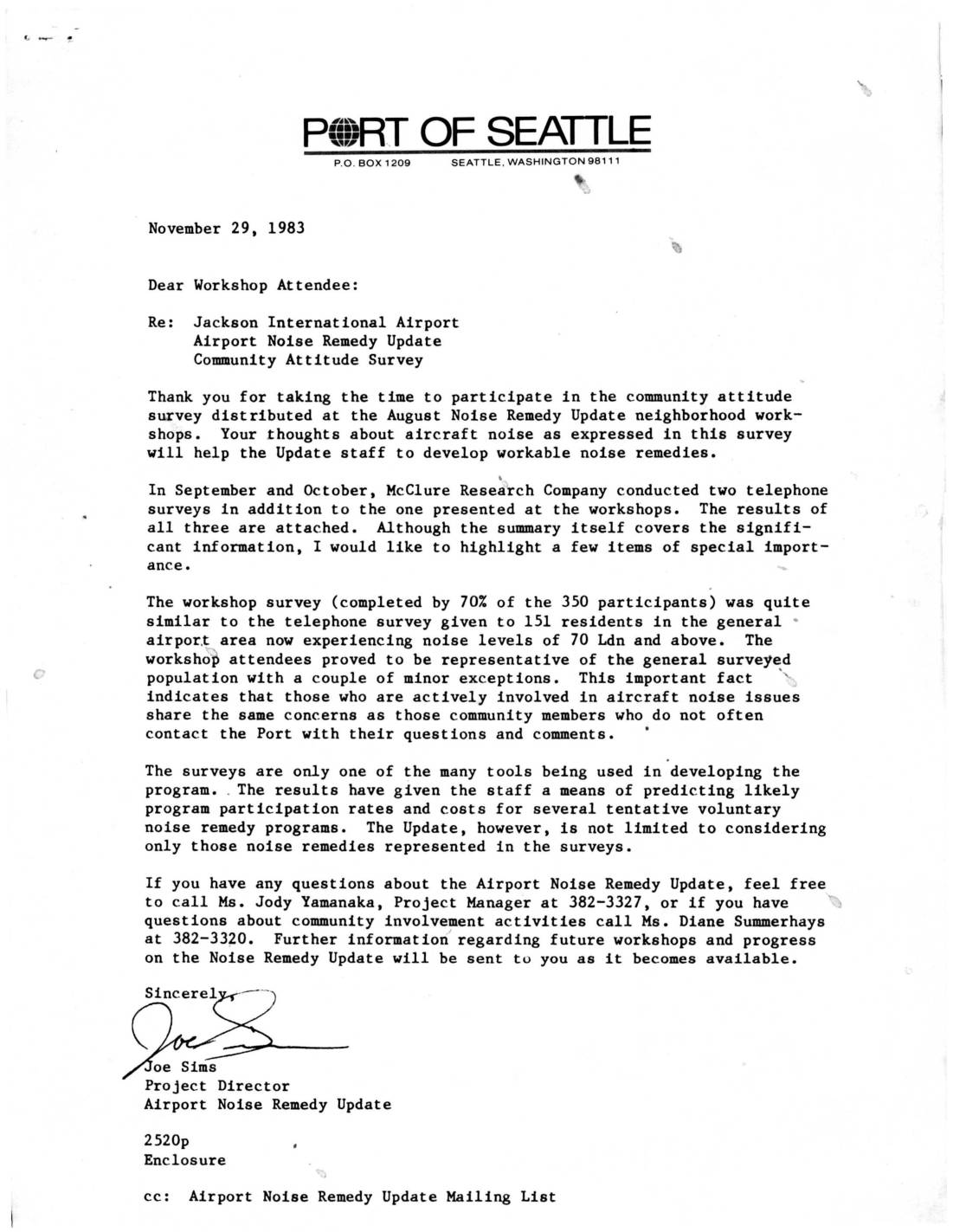
Jackson International Airport Noise Remedy Update Community Attitude Survey
Thank you for taking the time to participate in the community attitude survey distributed at the August Noise Remedy Update neighborhood work- shops. Your thoughts about aircraft noise as expressed in this survey will help the Update staff to develop workable noise remedies. ' In September and October, McClure Resea~ch Company conducted two telephone surveys in addition to the one presented at the workshops. The results of all three are attached. Although the summary itself covers the signifi- cant information, I would like to highlight a few items of special import- ance. The workshop survey {completed by 70% of the 350 participants) was quite similar to the telephone survey given to 151 residents in the general • airpor.t area now experiencing noise levels of 70 Ldn and above. The workshdP attendees proved to be representative of the general surveyed population with a couple of minor exceptions. This important fact ' J indicates that those who are actively involved in aircraft noise issues share the same concerns as those community members who do not often contact the Port with their questions and comments. The surveys are only one of the many tools being used in developing the program • . The results have given the staff a means of predicting likely program participation rates and costs for several tentative voluntary noise remedy programs. The Update, however, is not limited to considering only those noise remedies represented in the surveys. If you have any questions about the Airport Noise Remedy Update, feel… -
 1982-06-09 15:11
Noise Exposure Update
2.1 Study Scope and Purpose . . . . . . . . . . . . . 2.2 Organization . . 2.3 Sponsors. . . . . . . . . . . . 2.4 Consultants . . . . . . . . . . . . . . . . 2·5 Participants. . . . . . . . . . . . . . EXISTING CONDITIONS 3.1 Introduction. • • • • • • • • . • . •••• 3.2 Airport Facilities. • • • • • . . • ••••• 3.4 3.5 3.6 3.2.1 Runway and Taxiway System •••••••• 3. 2. 2 Passenger Terminal Facilities • • • • • • . • • • • 3.2.3 General Aviation Facilities • 3.2.4 Air Cargo Facilities. • • ••••• Aircraft Operations • • • 3.3.1 Fleet Mix ••••••••••• 3.3.2 Runway and Flight Track Utilization 3.3.3 Aircraft Fleet Noise Compliance •• Noise Monitoring System • • • • • • • • • • • • 3.4.1 Permanent Airport Noise Monitoring System 3.4.2 Portable Noise Meter ••••••••••• 3.4.3 Noise Monitoring Programs at Other Airports • Environment • • • • • • • • • • • • • • • • • Noise 3. 5.1 3.5.2 3.5.3 3.5.4 3.5.5 3.5.6 Climate 3. 6.1 3.6.2 Aircraft Noise Description Methodologies •• Aircraft Noise Levels • • • • • Ambient Noise Levels Maintenance Runup Noise Levels •• Taxiing Noise Levels ••.•.•••. Total Noise Environment • Meteorological Records… -
Sea-Tac/Boeing Field Airspace Study Newsletter May 1982
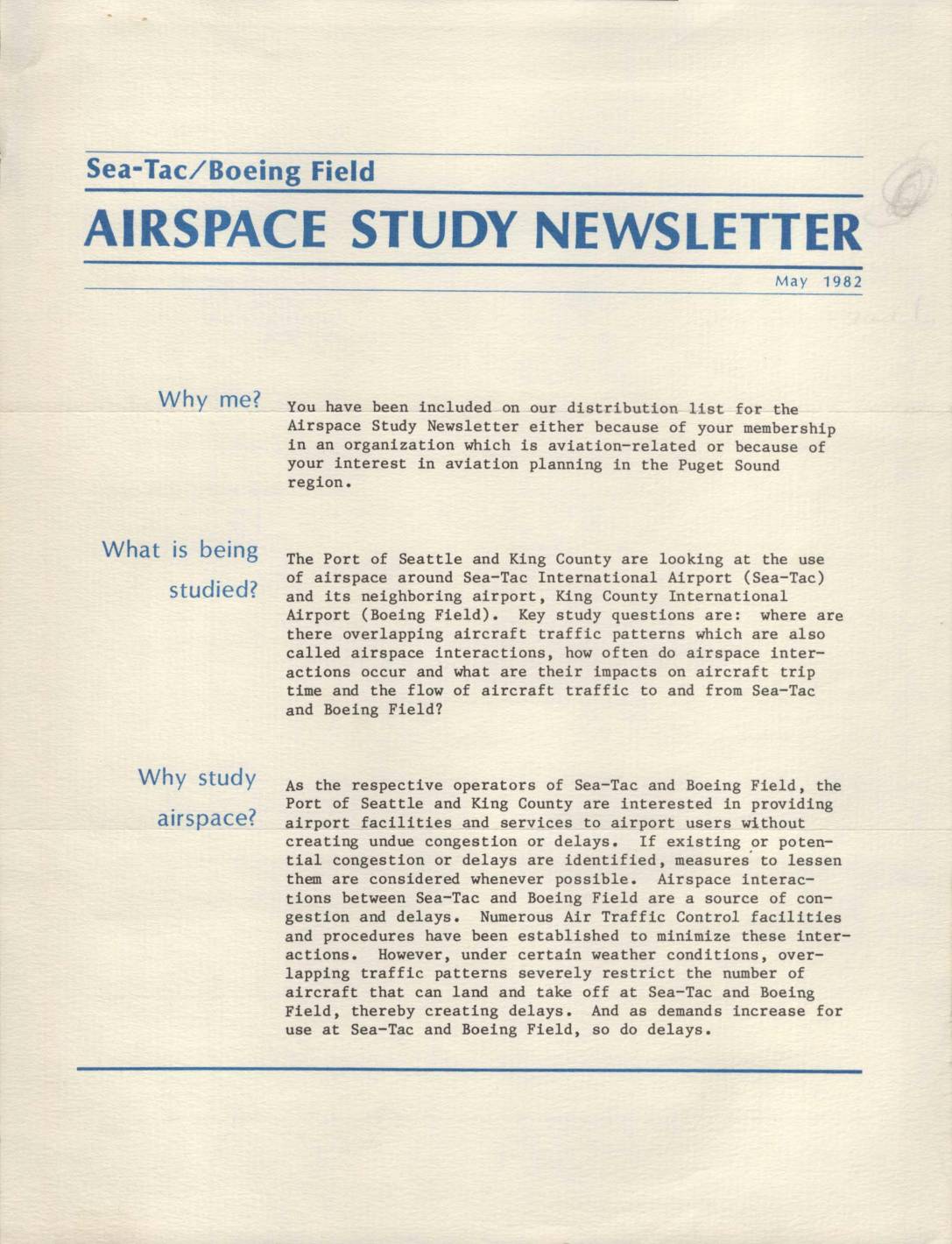
You have been included on our distribution list for the Airspace Study Newsletter either because of your membership in an organization which is aviation-related or because of your interest in aviation planning in the Puget Sound region. The Port of Seattle and King County are looking at the use of airspace around Sea-Tac International Airport (Sea-Tac) and its neighboring airport, King County International Airport (Boeing Field). Key study questions are: where are there overlapping aircraft traffic patterns which are also called airspace interactions, how often do airspace inter- actions occur and what are their impacts on aircraft trip time and the flow of aircraft traffic to and from Sea-Tac and Boeing Field? As the respective operators of Sea-Tac and Boeing Field, the Port of Seattle and King County are interested in providing airport facilities and services to airport users without creating undue congestion or delays. If existing or poten- tial congestion or delays are identified, measures· to lessen them are considered whenever possible. Airspace interac- tions between Sea-Tac and Boeing Field are a source of con- gestion and delays. Numerous Air Traffic Control facilities and procedures have been established to minimize these inter- actions. However, under certain weather conditions, over- lapping traffic patterns severely restrict the number of aircraft that can land and take off at Sea-Tac and Boeing Field, thereby creating delays. And as demands increase for use at Sea-Tac and Boeing Field, so do delays. What's happening now? How 1s the general public involved? What next? We have… -
Student Scores Rise After Nearby Subway Is Quieted
By Ari L. Goldman April 26, 1982 Fifteen times during each school day, an IRT subway train would rumble and screech past Public School 98, near the northern tip of Manhattan. In classrooms facing the elevated tracks, all work would stop until the train barreled by. After years of complaints about the disruption, the Transit Authority -
 1981-12-10 00:00
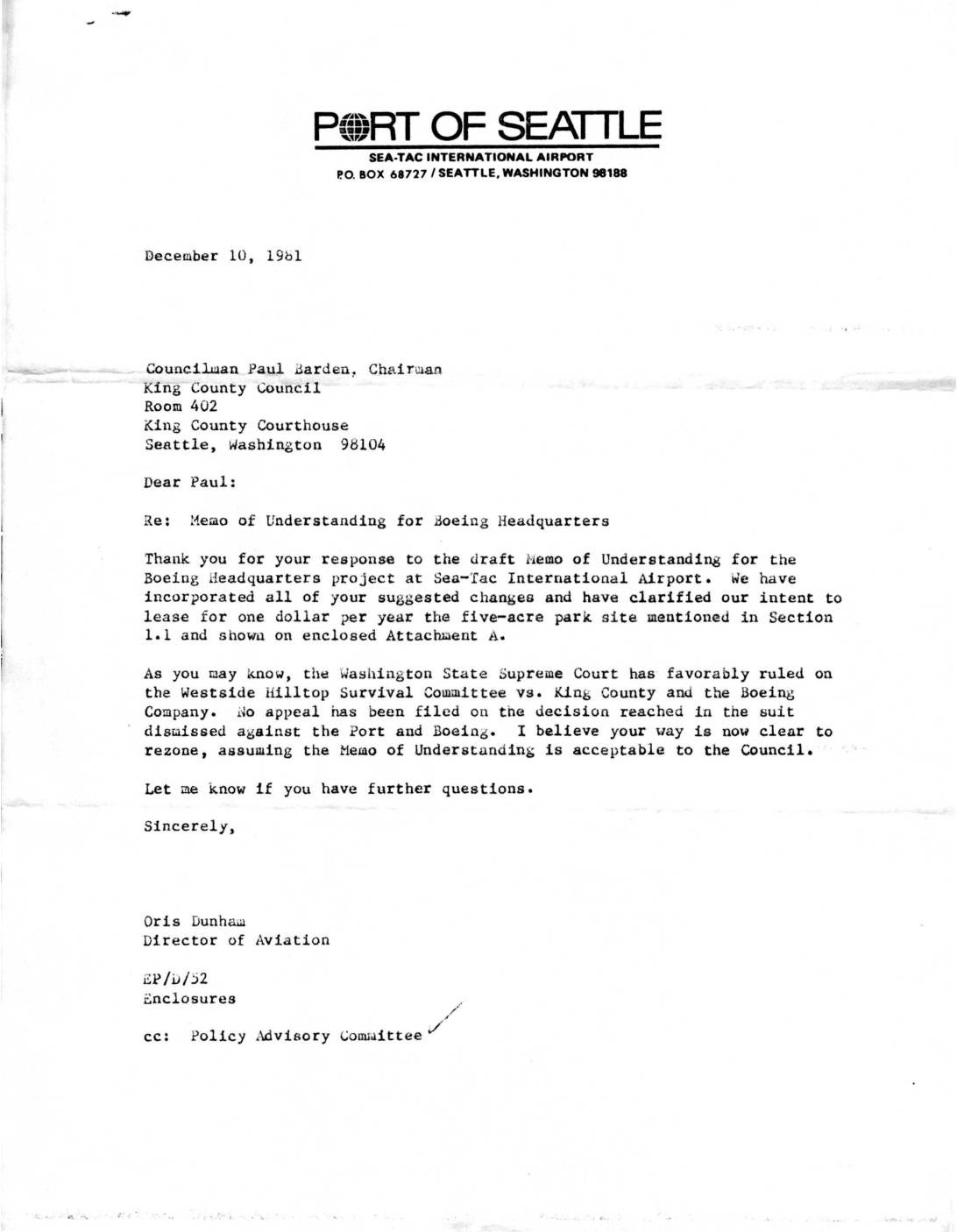
Boeing Headquarters Memo of Understanding – Port of Seattle Letter
Letter from Port of Seattle Director of Aviation Oris Dunham to King County Council Chairman Paul Barden regarding a Memo of Understanding for Boeing Headquarters project at Sea-Tac International Airport. Includes discussion of rezoning approval following favorable Washington State Supreme Court ruling. -
-
-
 1981-10-16 00:00
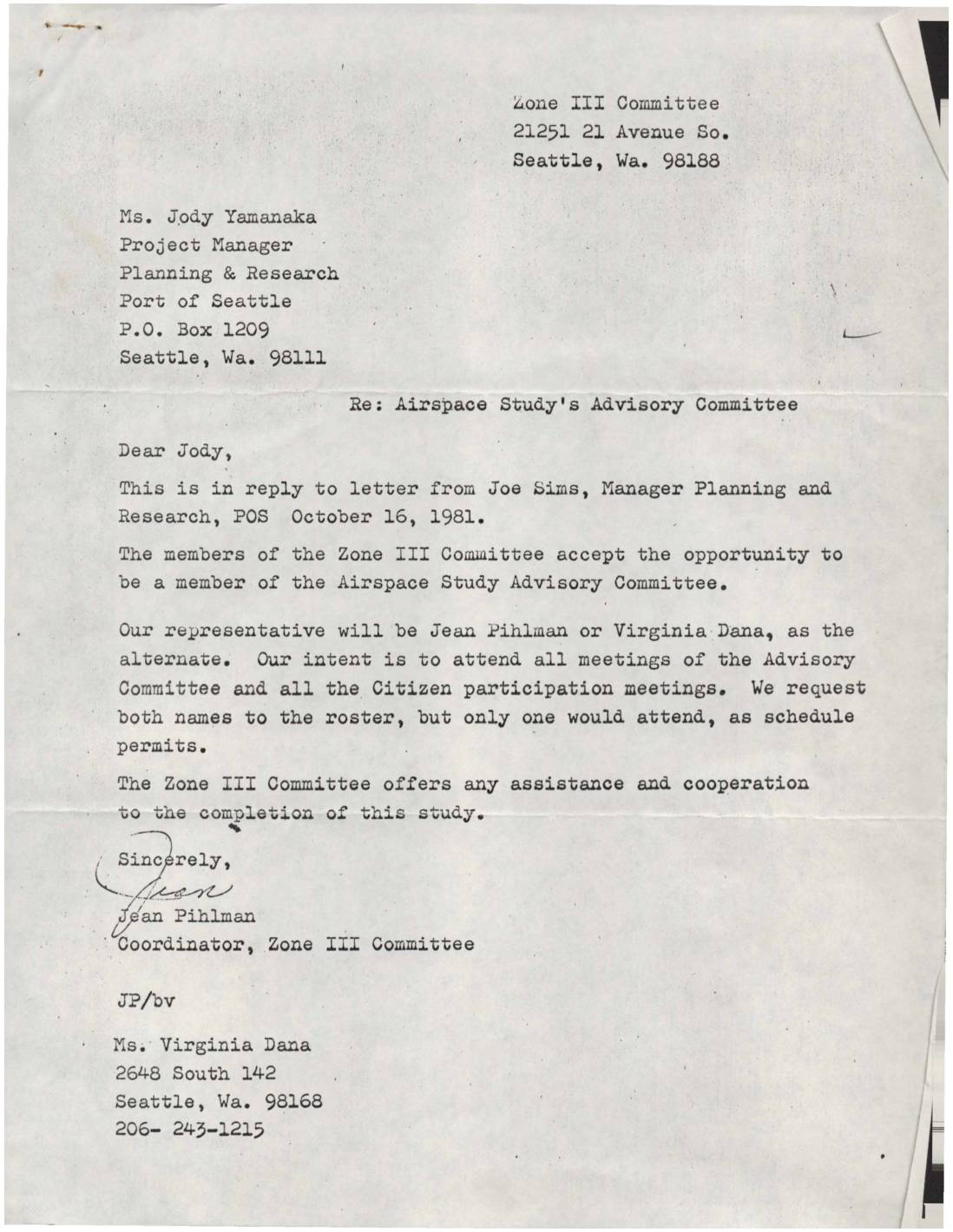
Zone III Committee Response to Airspace Study Advisory Committee Invitation
Letter from Jean Pihlman, Coordinator of Zone III Committee, accepting invitation to participate in the Port of Seattle’s Airspace Study Advisory Committee. The committee designates Jean Pihlman as representative and Virginia Dana as alternate, offering cooperation for the study completion. -
Westside Hilltop v. King County
Westside Hilltop v. King County 96 Wn.2d 171 (1981) 634 P.2d 862 WESTSIDE HILLTOP SURVIVAL COMMITTEE, ET AL, Appellants, v. KING COUNTY, ET AL, Respondents. No. 46982-2. The Supreme Court of Washington, En Banc. October 8, 1981. *172 Roger M. Leed and Jeffrey M. Eustis, for appellants. Norm Maleng, Prosecuting Attorney, and Susan R. Agid, -
 1981-09-13 00:00
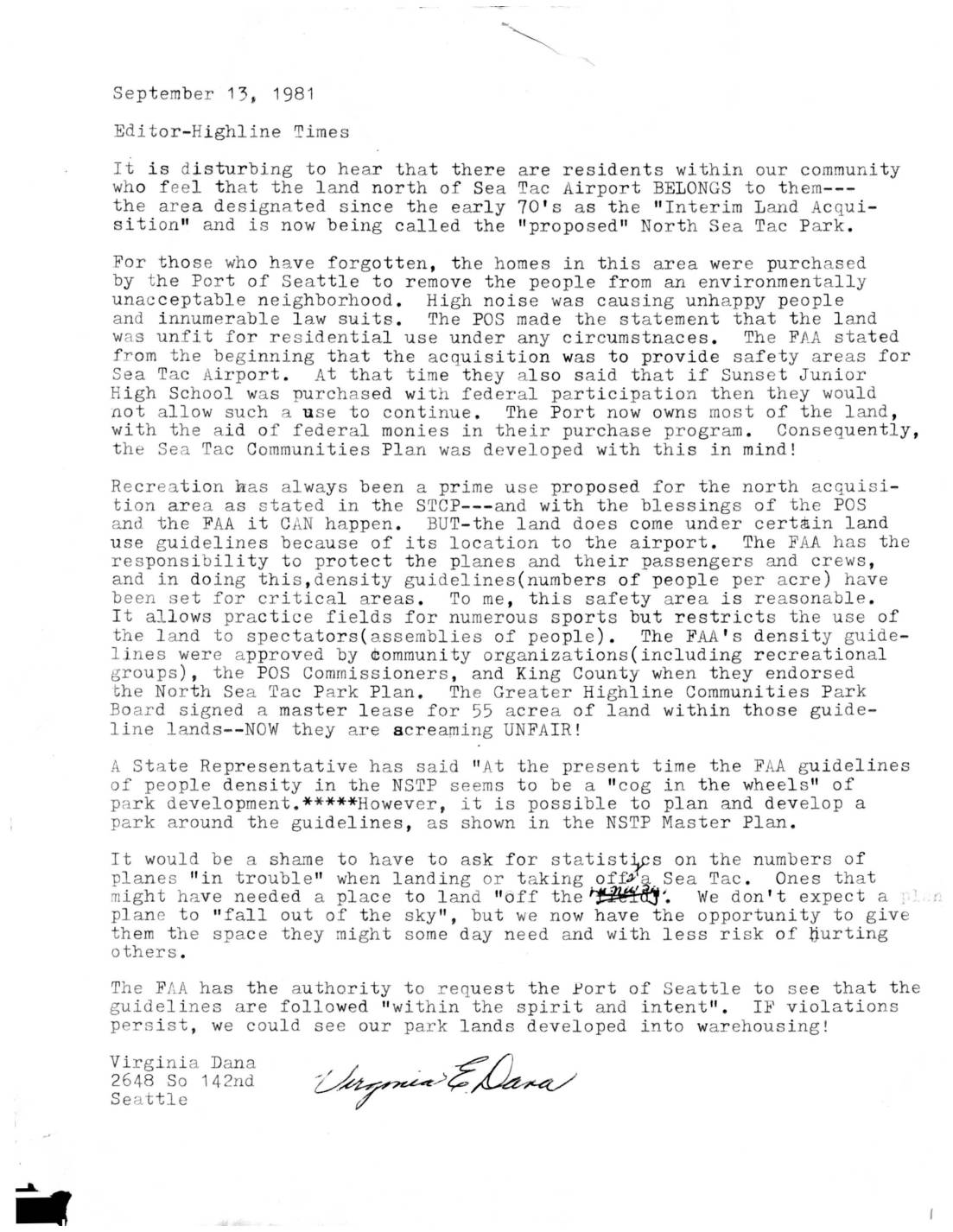
Letter to Editor about North Sea-Tac Park Land Use Guidelines
A letter to the editor of Highline Times discussing the Port of Seattle’s acquisition of land north of Sea-Tac Airport for safety purposes and defending FAA density guidelines for the proposed North SeaTac Park. The author argues that the land was purchased to remove residents from an environmentally unacceptable area and should be restricted to