TagEdmund Seto(9)
-
 2024-05-09 20:49
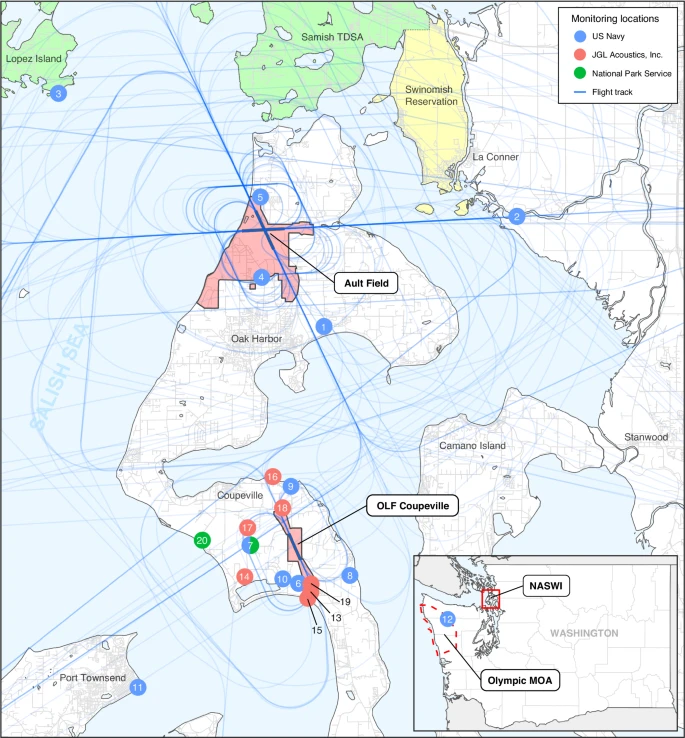
Population health implications of exposure to pervasive military aircraft noise pollution
Giordano Jacuzzi, Lauren M. Kuehne, Anne Harvey, Christine Hurley, Robert Wilbur, Edmund Seto & Julian D. Olden Journal of Exposure Science & Environmental Epidemiology (2024)Cite this article 1267 Accesses 318 Altmetric Metricsdetails Abstract Background While the adverse health effects of civil aircraft noise are relatively well studied, impacts associated with more intense and intermittent noise from military aviation have -
 2023-06-09 22:46
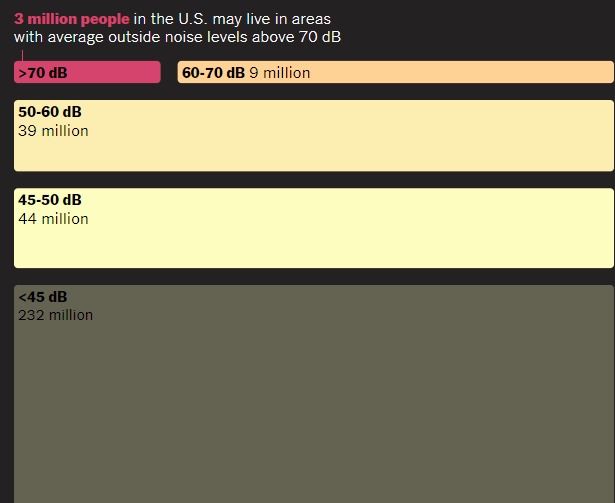
Noise could take years off your life. Here’s how.
We used a professional sound meter the din of daily life and talked to scientists about the health risks it can pose. Emily Baumgaertner, Jason Kao, Eleanor Lutz, Josephine Sedgwick, Rumsey Taylor, Noah Throop and Josh WilliamsJune 9, 2023 On a spring afternoon in Bankers Hill, San Diego, the soundscape is serene: Sea breeze rustles through the trees, and neighbors chat pleasantly -
 2020-12-05 00:00
The Relationship Between Flight Traffic, Ultrafine Particles and Noise from the Seattle Aircraft Air and Noise Study
Edmund Seto, Elena Austin, Jianbang Xiang, Jeffry Shirai, Tim Gould, Timothy Larson Washington Environmental Health Disparities Map https://fortress.wa.gov/doh/wtn/WTNIBL/ This map ranks areas in red that are more impacted by cumulative environmental hazards. Many parts of Beacon Hill and other South King County communities have rankings in the red, and are impacted by cumulative hazards. NOISE Sea-Tac Airport Noise Impacts http://www.airportsites.net/SEA-Part150/documents/final/e-Chapter-3_Noise%20Analysis.pdf DNL 65 dBA Noise exposures are associated with human health effects > Cardiovascular effects > Sleep disturbance > Annoyance > Impaired children’s learning FAA 14 CFR Part 150 Analysis (2013) for Sea-Tac includes: > A model of noise contours attributable to flights > Measured noise, only looking at levels >60 dB that are >3 secs, correlated with flights > A 65 dB noise contour is considered a threshold for incompatible residential land use without mitigation. > But this 65 dB threshold is supposed to be for “cumulative noise” – noise from all sources. http://www.airportsites.net/SEA-Part150/documents/final/e-Chapter-3_Noise%20Analysis.pdf Beacon Hill Seattle Noise Study Video of noise from flyover Particulate Air Pollution micron is 1000 nanometers. So a UFP is <0.1 microns PM2.5 Measurements at Seattle Beacon Hill Site by Puget Sound Clean Air Agency Federal standard primary and secondary 24 hr μg/m3 98th percentile, averaged over 3 years primary 1 year 12.0 μg/m3 annual mean, averaged over 3 years Despite not exceeding standard, still ranks 10 on the Environmental Health Disparities Map, indicating that historic PM levels in this area are among the highest concentrations observed in the state. PM2.5 Measurements at Seattle Beacon… -
 2020-12-01 00:00
SKCDOH Community Health and Airport Operations Related Pollution Report December 2020
Community Health and Airport Operations Related Noise and Air Pollution: Report to the Legislature in Response to Washington State HOUSE BILL 1109 -
2019-12-15 21:21
2020 Washington State Senate Bill 6168 Sec. 603 (42) Indoor Air Quality Study
State Budget (SENATE BILL 6168, Sec. 603) (42) $50,000 of the general fund—state appropriation for fiscal year 2021 is provided solely for the department of environmental and occupational health sciences to provide an air quality report. The report will study the relationship between indoor and outdoor ultrafine particle air quality at sites with vulnerable populations, -
 2019-05-07 00:00
Federal Way Letter to UW on Ultrafine Particles Study
-
2019-04-29 12:00
What are they getting exposed to out there?
April 29, 2019 | Lynn Schnaiberg Research led by UW DEOHS measures air traffic pollution around Sea-Tac Airport to understand potential health effects on nearby communities UW DEOHS leads the first study to systematically track aircraft-related air pollution in the communities around Seattle-Tacaoma International Airport. Photo: Don Wilson, Port of Seattle. JC Harris lives on -
 2018-12-21 00:00
Beacon Hill Noise Project 2018 Rpt
Members/Beacon Hill residents: Ariana Casey, Bridget Ferriss, Deirdre Curle, Joe Albert, Lynda Wong, Monique Cherrier, Ray Nicoli, Roseanne Lorenzana Advisor: Dr. Edmund Seto, Univ of Wash Dept of Occupational & Environmental Science, School of Public Health Summer interns/UW Class of 2019: Eileen Tran, Phan Su Contact: Dr. Roseanne Lorenzana, contact@chacusa.org or rlorenza@uw.edu Acknowledgements The Beacon Hill Noise Team would like to thank Alicia Diefenbach and the Verity Credit Union microgrant program for providing funds to purchase the noise measurement equipment and the Beacon Hill Merchants Association for being the fiscal sponsor for the Verity CU funds. We would also like to thank Estela Ortega, El Centro de la Raza and U.S.EPA Region 10 for providing the funds to support our summer interns (USEPA Problem Solving Collaboration 01J27101 Community Empowerment Grant). And, a big thanks to all the Beacon Hill residents who volunteered to host a noise measurement device at their home. This project was possible because of the work of the Beacon Hill volunteer community. Introduction The overarching goal of the project was to conduct Citizen Science measurements with University of Washington undergraduate student summer interns paid by El Centro de la Raza to help residents collect noise measurements. The project aimed to empower residents to collect new noise measurement data, which may benefit future follow-up activities, including collecting additional measurements, improving community awareness of noise levels, and follow-up research by others to quantify relationships to potential noise sources and health impacts. This is the first project to collect quality… -
2017-12-15 21:28
2017 Washington State Senate Bill 6032 Sec. 602 (19) MOV-UP Study
“$125,000 of the general fund—state appropriation for fiscal year 2018 and $125,000 of the general fund—state appropriation for fiscal year 2019 are provided solely for the University of Washington school of public health to study the air quality implications of air traffic at the international airport in the state that has the highest total annual