Commercial Aviation Work Group Meeting Agenda – December 9, 2025

Meeting agenda for the Commercial Aviation Work Group covering consultant introductions, strategic work plan discussions, review of ESSB 5161, and research needs including Advanced Air Mobility, Sea-Tac capacity, and aerospace employment trends. The meeting includes a tour of Boeing Field for CAWG members.

National Defense Authorization Act for Fiscal Year 2026

Rules Committee Print showing the text of the House Amendment to S. 1071, which is the National Defense Authorization Act for Fiscal Year 2026. The document is organized into 8 divisions covering Department of Defense authorizations, military construction, energy national security, funding tables, and other defense-related matters. Includes Adam Smith Sound Insulation Repair/Replacement Act

Burien Airport Committee Meeting Agenda – November 18, 2025

Agenda for the Burien Airport Committee meeting scheduled for November 18, 2025, including updates on city council actions, legislative matters, community engagement initiatives, and committee business. The meeting will cover multi-city agreements, Des Moines port package letters, and StART program updates.

Burien Airport Committee Meeting Agenda – November 18, 2025

Agenda for the Burien Airport Committee meeting scheduled for November 18, 2025, including updates on city council actions, legislative matters, community engagement initiatives, and committee business. The meeting will cover multi-city agreements, Des Moines port package letters, and StART program updates.

Port of Seattle Regular Commission Meeting November 18, 2025

Port of Seattle Commission meeting agenda for November 18, 2025, including executive session, public comment procedures, consent agenda items covering various airport and port operations including baggage control services, lease amendments, elevator modernization, and salary resolutions.

Port of Seattle Regular Commission Meeting November 18, 2025

Port of Seattle Commission meeting agenda for November 18, 2025, including executive session, public comment procedures, consent agenda items covering various airport and port operations including baggage control services, lease amendments, elevator modernization, and salary resolutions.

Port of Seattle Resolution No. 3840 – Property Tax Levy Authorization

Port of Seattle Commission resolution authorizing a property tax levy of $90,180,054 for calendar year 2026, representing a 2.0% increase from the previous year’s budgeted amount of $88,389,944. The resolution specifies the levy rate of approximately $0.0998 per thousand of assessed value.

Introduction & Public Hearing of the Preliminary 2026 Budget

Port of Seattle presentation introducing the preliminary 2026 budget for public hearing. The document outlines changes made after the preliminary budget publication, including Aviation Division expense and revenue adjustments related to STAC & TSA contracts and Amazon lease agreements. It covers operating budget highlights, commission priorities, capital planning, and equity considerations.

Port of Seattle Resolution No. 3839 – Adopting Final Budget for 2026

Port Commission resolution adopting the final 2026 budget and determining tax levies for the Port of Seattle District. The resolution outlines the Port’s commitments to economic opportunity, environmental stewardship, and community partnership while authorizing $90,180,054 in tax levies for bond payments and capital improvements.

Port of Seattle Resolution No. 3839 – Adopting Final Budget for 2026

Port Commission resolution adopting the final 2026 budget and determining tax levies for the Port of Seattle District. The resolution outlines the Port’s commitments to economic opportunity, environmental stewardship, and community partnership while authorizing $90,180,054 in tax levies for bond payments and capital improvements.

2026 – 2030 Environmental Remediation Liability Program for Cleanup and Investigation of Historical Contamination

Port of Seattle Commission agenda memorandum requesting $30 million for 2026 environmental remediation and approval of a $259 million five-year spending plan for cleanup of historical contamination at maritime and aviation properties. The program addresses contamination from past industrial operations including Lower Duwamish Waterway Superfund Site and various terminal locations.

City Council Regular Meeting Agenda – November 3, 2025

Agenda for Burien City Council regular meeting covering executive session, proclamations, public hearing on 2026 budget update, consent agenda items including voucher approvals and PSE franchise ordinance, and business agenda item on tax assessment settlement agreement.

City Council Regular Meeting Agenda – November 3, 2025

Agenda for Burien City Council regular meeting covering executive session, proclamations, public hearing on 2026 budget update, consent agenda items including voucher approvals and PSE franchise ordinance, and business agenda item on tax assessment settlement agreement.

OLR Research Report

A research report header or cover page from OLR (Office of Legislative Research) featuring a blue banner with official seal and title text.

2026 Airfield Work Areas Layout Plan

A detailed airport layout diagram showing various 2026 airfield work areas marked in different colors, including runway work areas, taxiway work areas, and cargo line work areas. The diagram includes a comprehensive legend identifying different construction and maintenance zones planned for the airfield.

Snow Storage Expansion Phase II by Lagoon 3

Aerial map showing the location of Snow Storage Expansion Phase II by Lagoon 3 at an airport facility. The map displays the completed Phase I snow storage area in green and the planned Phase II expansion in blue, with runway infrastructure visible in the background.

The Airport Law Cheat Sheet

It’s complicated I. Noise & Land Use Compatibility Aviation Safety & Noise Abatement Act (ASNA, 1979 / effective 1980) Foundation for standardized aircraft-noise metrics and land-use guidance; statutory basis for Part 150 NEM/NCP. faa.gov 49 U.S.C. §§ 47501–47510 — Airport Noise & Capacity Act (ANCA, 1990) National noise policy; authority for airport noise programs and

Port of Seattle Regular Commission Meeting

Port of Seattle Commission regular meeting agenda for October 28, 2025, including executive session, public comment procedures, consent agenda items covering construction contracts, lease agreements, and new business items including a revised welcoming port policy directive.

Port of Seattle Regular Commission Meeting

Port of Seattle Commission regular meeting agenda for October 28, 2025, including executive session, public comment procedures, consent agenda items covering construction contracts, lease agreements, and new business items including a revised welcoming port policy directive.

Urban Ultrafine Particles – Advisory Group Meeting

Advisory group meeting presentation focused on urban ultrafine particles, likely related to aviation emissions and air quality impacts on airport communities. The meeting appears to be part of ongoing research or policy discussions regarding particulate matter from aircraft operations.

Urban Ultrafine Particles Advisory Group Meeting

Meeting minutes from the UFP Advisory Group discussing research priorities for ultrafine particle health effects, mitigation strategies, and exposure reduction in aviation-impacted communities. Participants included University of Washington researchers, public health officials, school district representatives, and community leaders focusing on air quality and health impacts near Sea-Tac Airport.

Urban Ultrafine Particles Advisory Group Meeting

Meeting notes from the Urban Ultrafine Particles Advisory Group held on October 3, 2025, featuring hybrid attendance from representatives of various organizations including UW, public health departments, school districts, and community leaders. The document includes attendee lists and disclaimers about the summary notes.

Passenger Growth – Port of Seattle Commission Regular Meeting P69

A chart showing passenger growth at the Port of Seattle from 2021-2025, displaying actual passenger numbers from 2021-2024 (36.2M to 52.6M), 2025 budget of 53.5M, and forecast of 53.1M. The forecast shows 9% growth compared to 2024 actual but is 0.7% lower than the 2025 budget.

Airport Development Fund Balance

A chart showing the Airport Development Fund balance with beginning balance of $739,774, forecast ending balance of $830,000, and budget of $829,833. The ending balance forecast of $830M represents the target of 18 months of operations and maintenance for 2025.

The Gift of Public Funds Bogeyman

The authors, including Washington’s Solicitor General, Noah Purcell, reveal how the “gift of public funds” doctrine has become a false barrier for government assistance to communities. For decades, agencies like the Port of Seattle have wrongly claimed that matching requirements, narrow purposes, and small amounts are requirements of the State Constitution although there is absolutely

Transportation Budget – Engrossed Substitute Senate Bill 5161

Section 213 appropriates $16,055,000 for the Commercial Aviation Work Group. Washington State transportation budget bill for the 2025-2027 fiscal biennium, passed by the legislature and signed by Governor Ferguson with partial vetoes. The bill includes appropriations for transportation improvements and is dedicated to the memory of Senator Bill Ramos.

Transportation Budget – Engrossed Substitute Senate Bill 5161

Washington State transportation budget bill for the 2025-2027 fiscal biennium, passed by the legislature and signed by Governor Ferguson with partial vetoes. The bill includes appropriations for transportation improvements and is dedicated to the memory of Senator Bill Ramos.

Port of Seattle Regular Commission Meeting – February 11, 2025

Proclamation by the Port of Seattle Commission commemorating February 19th as the Day of Remembrance for Japanese American incarceration during World War II. The document details Executive Order 9066, the forced removal and incarceration of over 120,000 Japanese Americans, including specific references to Bainbridge Island and the Puyallup Assembly Center.

House Bill 1948 – Environmental Justice for Large Port Districts

AN ACT Relating to reducing environmental and health disparities 1 and improving the health of Washington state residents in large port 2 districts; and adding a new chapter to Title 53 RCW.3 BE IT ENACTED BY THE LEGISLATURE OF THE STATE OF WASHINGTON:4 NEW SECTION. Sec. 1. The definitions in this section apply 5 throughout this chapter unless the context clearly requires 6 otherwise.7 (1) “Cumulative environmental health impact” has the same meaning 8 as in RCW 70A.02.010.9 (2) “Environmental benefits” has the same meaning as in RCW 10 70A.02.010.11 (3) “Environmental harm” has the same meaning as in RCW 12 70A.02.010.13 (4) “Environmental impacts” has the same meaning as in RCW 14 70A.02.010.15 (5) “Evidence-based” has the same meaning as in RCW 70A.02.010.16 (6) “Overburdened communities” has the same meaning as in RCW 17 70A.02.010.18 (7) “Qualifying port district” means a port district authorized 19 to undertake programs for the abatement of aircraft noise under RCW 20 53.54.010.21 H-1300.1 HOUSE BILL 1948 State of Washington 69th Legislature 2025 Regular Session By Representatives Santos, Thai, Parshley, Pollet, Obras, and Macri Read first time 02/11/25. Referred to Committee on Local Government. p. 1 HB 1948 (8) “Significant port action” means any action involving a 1 capital improvement project, purchase, or construction of $8,000,000 2 or more in value or any action that increases the number of gates at 3 an airport.4 (9) “Vulnerable populations” has the same meaning as in RCW 5 70A.02.010.6 NEW SECTION. Sec. 2. (1) A qualifying port…

Port of Seattle Commission Regular Meeting

Agenda for the Port of Seattle Commission Regular Meeting scheduled for January 28, 2025. The meeting includes unfinished business regarding a joint marketing agreement with Washington State Tourism, consent agenda items covering various contracts and claims approvals, and multiple collective bargaining agreements with different labor unions.

HB 1303 Bill Analysis – Increasing environmental justice by improving government decisions

Brief Description: Increasing environmental justice by improving government decisions. Sponsors: Representatives Mena, Berry, Reeves, Reed, Ormsby, Salahuddin, Ramel, Pollet, Nance, Doglio and Scott. Brief Summary of Bill Adds environmental justice to the State Environmental Policy Act (SEPA) review process, including the elements of the environment considered under SEPA and the SEPA checklist filled out by project proponents or SEPA lead agencies. • Requires SEPA lead agencies to complete an environmental justice impact statement, meeting specified substantive criteria and following specified processes, for potentially impactful projects in certain communities. • Prohibits, under the Clean Air Act, approvals for certain new air contaminant sources located in specified communities. • Hearing Date: 1/23/25 Staff: Jacob Lipson (786-7196). Background: State Environmental Policy Act. The State Environmental Policy Act (SEPA) establishes a review process for state and local governments to identify environmental impacts that may result from governmental decisions, such as the issuance of permits or the adoption of land use plans. The SEPA environmental review process involves a project proponent, or the lead agency, completing an environmental This analysis was prepared by non-partisan legislative staff for the use of legislative members in their deliberations. This analysis is not part of the legislation nor does it constitute a statement of legislative intent. Washington State House of Representatives Office of Program Research HB 1303- 1 -House Bill Analysis checklist to identify and evaluate probable environmental impacts. The Department of Ecology (Ecology) has adopted rules that spell out the elements of the environment whose impacts must be…

Burien Airport Committee Agenda – January 21, 2025

Tuesday, January 21, 2025, at 6:00 p.m. Join virtually via Zoom:https://bit.ly/3RIItM0 Join at Burien City Hall: 400 SW 152nd St (3rd Floor), Burien, WA Staff Liaison: Nathan Hawthorne, Paralegal | Email nathanh@burienwa.gov 1. CALL TO ORDER 2. ROLL CALL Councilmember Sarah Moore, Chair Brian Davis, Vice Chair Dana Carmichael Karen Veloria City Manager Adolfo Bailon, Ex-Officio Member City Attorney Garmon Newsom II, Ex-Officio Member

SAMP Draft EA

Draft NEPA Environmental Assessment (EA) The draft EA presents the purpose and need for the Proposed Action, analysis of reasonable alternatives, including the No Action Alternative, discussion of environmental impacts, and supporting appendices. For ease of access, the draft EA document has been divided into the chapters and appendices listed below. It is recommended that

Port of Seattle Order No. 2024-12 – North SeaTac Park for Recreational Use

… to prepare documentation and establish a timeline for Commission action with the goal of permanently designating North SeaTac Park for recreational uses, as outlined in the 2024 Federal Aviation Administration Reauthorization Act. PROPOSED OCTOBER 8, 2024 INTRODUCTION The Port of Seattle is deeply committed to ensuring the long-term sustainability of the lands, waters, and wildlife in the Puget Sound region as well as the quality of life for local residents. In particular, the Port Commission sees North SeaTac Park as an important natural asset for the environment, for recreation, and for community use. To that end, the Port partnered with the Washington Congressional delegation to successfully advocate for the inclusion of language in the 2024 Federal Aviation Administration (FAA) Reauthorization Act to allow for “community use of airport land.” Section 706 of the legislation specifically allows the Port to “permanently restrict the use of airport property to compatible recreational and public park use” provided that it meets certain criteria. To utilize the flexibility provided by this new federal legislation, the airport must provide the FAA with written certification that the property meets the requirements laid out in the legislation. As such, the Commission directs the Executive Director to undertake the process described in Section 706 with the goal of ensuring [retaining] North SeaTac Park remains a [as] community asset [permanently]. TEXT OF THE ORDER The Port Commission hereby directs the Executive Director to undertake the Port activities necessary to meet the requirements described in Section 706 of the FAA…

Sustainable Airport Master Plan 2019 Scoping Documents

1The same documents can be found here. [get_filebird_folder folder_id=170] 1We often provide replicas of important documents, news stories, etc. We refer to this as ‘belt and suspenders’. Although we always recommend that researchers source from the original sites, computers often fail. It’s good to have backup.

AIR TRAFFIC CONTROL – FAA Actions Are Urgently Needed to Modernize Aging Systems

GAO report to Congressional committees identifying that 76% of FAA’s air traffic control systems are unsustainable or potentially unsustainable, with 58 systems having critical operational impacts on safety and efficiency. The report highlights urgent need for modernization following a 2023 national airspace shutdown due to aging system outage.

14 CFR Part 36 FAA Noise Standards: Aircraft Type and Airworthiness Certification (7-12-2024)

Chapter I —Federal Aviation Administration, Department of Transportation Subchapter C —Aircraft Part 36 Noise Standards: Aircraft Type and Airworthiness Certification Subpart A General § 36.1 Applicability and definitions. § 36.2 Requirements as of date of application. § 36.3 Compatibility with airworthiness requirements. § 36.5 Limitation of part. § 36.6 Incorporation by reference. § 36.7 Acoustical change: Transport category large airplanes and jet airplanes. § 36.9 Acoustical change: Propeller-driven small airplanes and propeller-driven commuter category airplanes. § 36.11 Acoustical change: Helicopters. § 36.13 Acoustical change: Tiltrotor aircraft. Subpart B Transport Category Large Airplanes and Jet Airplanes § 36.101 Noise measurement and evaluation. § 36.103 Noise limits. § 36.105 Flight Manual Statement of Chapter 4 equivalency. § 36.106 Flight Manual statement of Chapter 14 noise level equivalency. Subpart C [Reserved] Subpart D Noise Limits for Supersonic Transport Category Airplanes § 36.301 Noise limits: Concorde. Subpart E [Reserved] Subpart F Propeller Driven Small Airplanes and Propeller-Driven, Commuter Category Airplanes § 36.501 Noise limits. Subpart G [Reserved] Subpart H Helicopters § 36.801 Noise measurement. § 36.803 Noise evaluation and calculation. § 36.805 Noise limits. Subparts I-J [Reserved] This content is from the eCFR and is authoritative but unofficial. CFR Part 36 (up to date as of 7/12/2024) Noise Standards: Aircraft Type and Airworthiness Certification 14 CFR Part 36 (July 12, 2024) CFR Part 36 (July 12, 2024) (enhanced display) page 1 of 123 Appendix A to Part 36 Aircraft Noise Measurement and Evaluation Under § 36.101 Appendix B to Part 36 Noise Levels for…

Flight Corridor Safety Program 2024 – Category III Selection Summary

Version 8.30.19 Selection Summary Page 1 of X CATEGORY III SELECTION SUMMARY Solicitation Name: Flight Corridor Safety Program 2024 Solicitation Number: 00321214 Contract Administrator: Tae Stacy I. SOLICITATION SUMMARY Brief Description of Scope of Work: The Flight Corridor Safety Program (FCSP) is an ongoing program to manage obstructions consisting of trees and other vegetation at and around Seattle-Tacoma International Airport (Airport) and replant lower-height native vegetation on or near the removal sites. This program is necessary to meet the Aviation Division’s goals of ensuring safe and secure aircraft operations. Estimated Contract Value: Estimated Value $2M- Initial Commission Approval for Phase I $500,000. Estimated Contract Duration: Initial year plus option to extend for 3 years. Number of Contracts: 1 II. FIRMS, SHORTLISTING, & RATING A. Firm Names: Criteria A Specialized Experience & Technical Competenc y of Key Individuals Criteria B Project Approach Criteria C Diversity in Contracting Criteria D Interview Shortlist ed Y/N Awarde d Y/N Business Classificati on 1. AECOM Marginal Marginal Good N/A N N NSB 2. HNTB Outstanding Outstanding Outstanding Outstanding Y Y NSB 3. Jacobs Engineering Good Good Outstanding Good Y N NSB 4. RS&H Good Acceptable Good Acceptable Y N NSB III. SELECTION PROCESS A. Proposal Evaluation

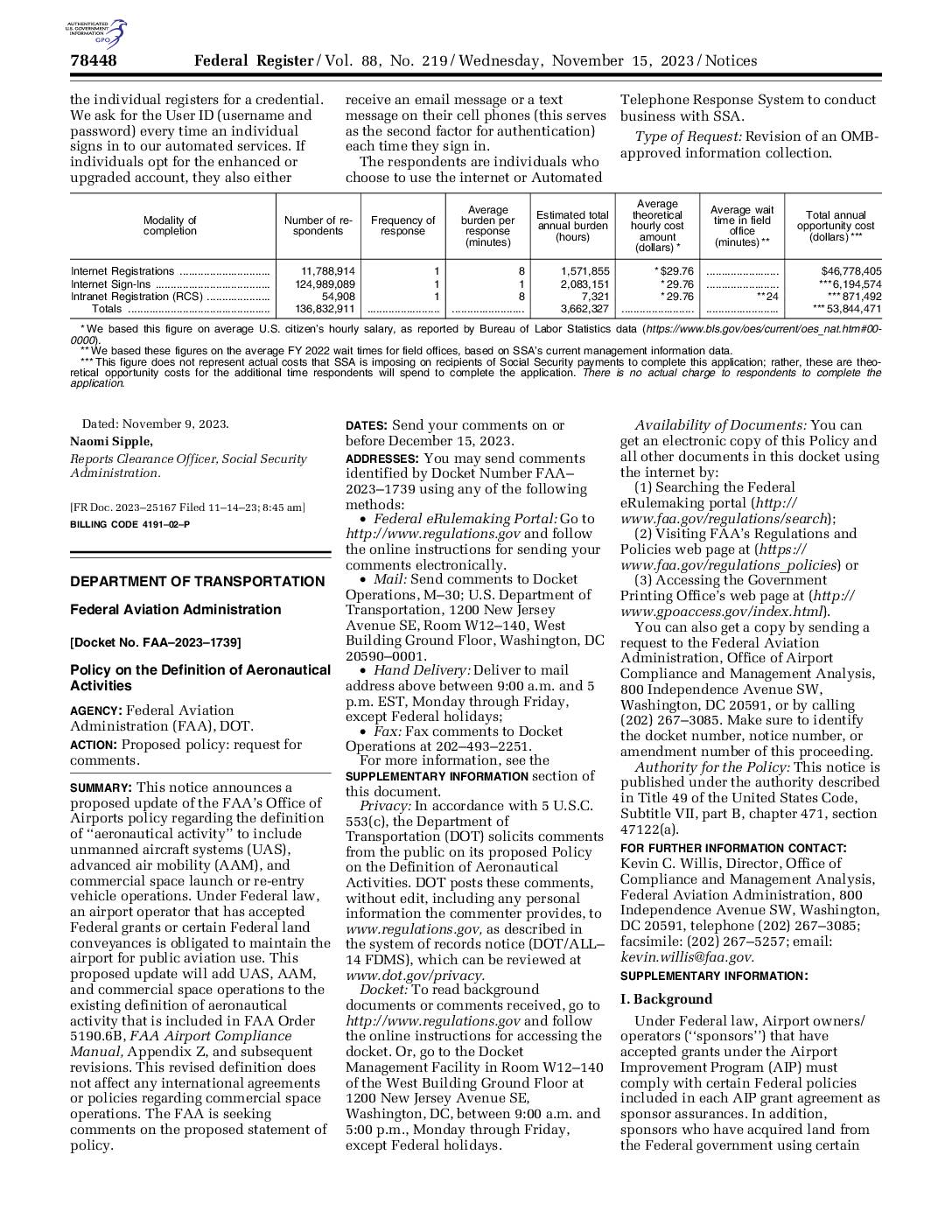
Federal Register Policy on Definition of Aeronautical Activities

78448 Federal Register / Vol. 88, No. 219 / Wednesday, November 15, 2023 / Notices the individual registers for a credential. We ask for the User ID (username and password) every time an individual signs in to our automated services. If individuals opt for the enhanced or upgraded account, they also either receive an email message or a text message on their cell phones (this serves as the second factor for authentication) each time they sign in. The respondents are individuals who choose to use the internet or Automated Telephone Response System to conduct business with SSA. Type of Request: Revision of an OMB- approved information collection. Modality of completion Number of re- spondents Frequency of response Average burden per response (minutes) Estimated total annual burden (hours) Average theoretical hourly cost amount (dollars) * Average wait time in field office (minutes) ** Total annual opportunity cost (dollars) *** Internet Registrations ………………………… 11,788,914 1 8 1,571,855 * $29.76 …………………… $46,778,405 Internet Sign-Ins ……………………………….. 124,989,089 1 1 2,083,151 * 29.76 …………………… *** 6,194,574 Intranet Registration (RCS) ………………… 54,908 1 8 7,321 * 29.76 ** 24 *** 871,492 Totals ……………………………………….. 136,832,911 …………………… …………………… 3,662,327 …………………… …………………… *** 53,844,471 * We based this figure on average U.S. citizen’s hourly salary, as reported by Bureau of Labor Statistics data (https://www.bls.gov/oes/current/oes_nat.htm#00- 0000). ** We based these figures on the average FY 2022 wait times for field offices, based on SSA’s current management information data. *** This figure does not represent actual costs that SSA is imposing…

CACC Final Report 2023

Per SSB 5370 (2019), as revised by SSB 5165 (2021), the following survey information below is provided as the final report to the Legislature from the Commercial Aviation Coordinating Commission (CACC). At the onset, it is important to note that as a result of legislative action in 2022, the timeline for the Commission’s work was extended to June 15, 2023. Executive summary The Commercial Aviation Coordinating Commission’s final hybrid in-person and online meeting June 9, 2023, focused on how to ensure that the work of the CACC provides a solid foundation and baseline of information to be used by the follow-on work group established by ESHB 1791. The CACC voted to use their last survey as the final report to the Legislature. This report has the survey results and comments for the work group in ESHB 1791 to use as a guide as they continue the work CACC started. https://app.leg.wa.gov/billsummary?BillNumber=5370&Year=2019 https://app.leg.wa.gov/billsummary?BillNumber=5165&Year=2021 https://wsdot.wa.gov/travel/aviation/commercial-aviation-coordinating-commission https://wsdot.wa.gov/travel/aviation/commercial-aviation-coordinating-commission https://app.leg.wa.gov/billsummary?BillNumber=1791&Year=2023 Survey Overview Note: The data and commentary in the survey below is subjective and to be used as a guide for the upcoming work group in ESHB 1791. The 16-question survey was completed by 16 Commissioners: 10 voting members and 6 non- voting members. The majority did not prefer a “No Action” alternative as the CACC’s response to the Legislature and believe the future of commercial aviation capacity needs (passenger and cargo) can only be met with a greenfield site that has yet to be identified. The majority also believe Paine Field will continue to add…

Port of Seattle 2023 Final Budget

Port of Seattle | P.O. Box 1209 | Seattle, WA 98111 www.portseattle.org/about/financial/budget https://www.facebook.com/portseattle https://www.linkedin.com/company/port-of-seattle

Historical Aviation Meeting or Planning Session

Black and white photograph showing people gathered around a circular table examining documents and what appears to be an airport layout plan or aviation-related map. The image appears to be from a mid-20th century aviation planning meeting or airport development discussion.

AC-13 Disposition of Property – Accounting and Financial Reporting Policy

The purpose of this policy is to establish standards for governing the activities used to dispose of Port property and is intended to support the following purposes: 1. Achieve cost savings to the Port (taxpayers) through centralized redistribution and disposal of unneeded property. 2. Create an audit trail that verifies and validates appropriate property disposal as required by legislation, and Generally Accepted Accounting Principles (GAAP). 3. Maximize the return on investment for the disposal of Port’s property. 4. Make the disposition of property standards within the Port as consistent as possible. Authority • RCW 39.33, Intergovernmental disposition of property • Resolution 3605, as amended by Resolution 3628 • GASB No. 62, Codification of Accounting and Financial Reporting Guidance contained in Pre-November 30, 1989 FASB and AICPA Pronouncements • CC-6, Loss Prevention Policy. NOTE: Upon adoption of the policies and procedures in this Series, each department should ensure proper segregation of duties are in place, i.e. no one Personnel should be able to provide transaction authorization, maintain recordkeeping and have custody of the related assets. Please refer to AC-5a, paragraph .03. Control Objective: Financial information is complete and appropriately presented in compliance with prescribed accounting standards, and all information that is necessary for fair presentation and compliance with professional standards or legal requirements is disclosed. Scope .01 This policy does not apply to property or items meeting any one of the following characteristics. a) Property related to land, easements and street vacations. b) Abandoned property that is not owned by the…

The Effect of Occupational Exposures to Aircraft Ultrafine Particles on Acute Cardiorespiratory Health, and Control Using Personal Protective Equipment

> Habre, et al., 2018 study in LA compared asthmatic adults walking in an area affected by aircraft pollution vs walking in an area “not affected” by aircraft pollution. > Study found evidence of increased inflammatory marker (IL6) in blood when walking in the aircraft area > But roadway traffic contributed to different cardiorespiratory health risks (lower FEV1 and elevated sTNFrII) > But, some limitations of the study Evidence from previous studies Mariah’s Pilot crossover study Exposed to UFPs Not-exposed to UFPsHealthy Asthmatic Baseline 30m 60m 90m Health measurements at different times > Powered Air Purifying Respirator (PAPR) – “Non-exposure” when installed with HEPA + VOC filter – “Exposure” when installed with a sham filter Method for Controlling Exposure SeaTac Community Center: 13735 24th Ave S, SeaTac, WA Study Location Study Design (cont.) Baseline Health Measurements Min Walk Min Rest Min Walk Min Rest Min Health Measurements Min Rest Min Walk Min Rest Min Walk Min Rest Min Health Measurements Min Rest Min Walk Min Rest Min Walk Min Rest Min Health Measurements Data Collection: Exposure Assessment TSI OPS 3330: PM (#/cc) TSI NanoScan SMPS: UFPs (#/cc) microAeth AE51: BC (ng/cc) Aerodyne CAPS: NO2 (ppb) 3M SoundDetector SD- 200: Noise UFP Concentration and PAPR Effectiveness Data Collection: Health Measurements Instrument/Measurement Health Outcome Stress EMA tense/anxious, anger/hostility, depression, frustration, unhappiness Stroop Test Congruent, incongruent, Stroop effect Pulse Oximeter %SpO2, HR, PI Omron BP SBP, DBP, HR Apple Watch HR, HRV Spirometer FEV1, FVC, PEF, FEV1/FVC For the Pilot Study: asthmatics non-asthmatics…

FAA Order JO 7110.65Z – Air Traffic Control

This order prescribes air traffic control procedures and phraseology for use by personnel providing air traffic control services. Controllers are required to be familiar with the provisions of this order that pertain to their operational responsibilities and to exercise their best judgment if they encounter situations not covered by it. Effective: May 19, 2022 Change:

Environmental Impact Statement Final 1996 Volume 7 Appendix T

This is a reproduction of a library book that was digitized by Google as part of an ongoing effort to preserve the information in books and make it universally accessible. https://books.google.com https://books.google.com/books?id=rq01AQAAMAAJ U.S. Department of Transportation FINAL ENVIRONMENTAL IMPACT STATEMENT for OTTON LIBRARY Aviation PROPOSED MASTER PLAN UPDATE DEVELOPMENT ACTIONS stration F A A – W A – NORTH WESTERN UNIVERSITY T t at Seattle SEATTLE -TACOMA INTERNATIONAL AIRPORT VOLUME 7 OF 7 F r z APPENDIX T This statement is submitted for review pursuant to the requirements of Section 102( 2 ) ( C ) of the National Environmental Policy Act of 1969 (42 U.S.C. 4321 et seq ); E.O. 11990, Protection of Wetlands; E.O. 11998 , Floodplain Management; the USC Subtitle VII ; 42 U.S.C. 7401 et seq; 49 U.S.C. 47101 et seq; Washington State Environmental Policy Act (RCW 43.21C ); and other applicable laws. The proposed action will impact the 100 -year floodplain as indicated on the Federal Emergency Management Agency’s Flood Insurance Rate Map. This Environmental Impact Statement (EIS) is a combined National Environmental Policy Act and Washington State Environmental Policy Act (SEPA) document. With regard io SEPA requirements, this EIS represents the second step of a phased environmental review which began with publication of the 1992 Flight Plan Final Els, which assessed alternatives for addressing regional aviation needs. This Final Eis also contains the draft conformity statement, as required by the Clean Air Act amendments. The Port of Seattle, operator of Seattle -Tacoma International Airport,…

Port Of Seattle Resolution 2626 Sea-Tac Communities Plan

A RESOLUTION of the Port CoPlPission of the Port of Seattle establishing certain planning and developmental policies and guidelines relating to Sea-Tac International Airport and its vicinity as developed in the Sea-Tac/Conmunities Plan. WHEREAS, the Port of Seattle jointly sponsored with King County an Airport and Vicinity Master Plan Study, titled the “Sea-Tac/Communities Plan” supported by a Planning Grant from the Federal Aviation Ahinistra- tion which plan and supporting documents are on file in the offices of the Port and available to the public for review; WHEREAS, the primary goal of the Sea-Tac/Comunities Plan was to attempt to achieve maximum compatibility between Sea-Tac International Airport and the surrounding community; WHEREAS, the Study included a broad range of technical studies and user and citizen participation encompassing noise exposure, air quality, water quality, drainage, land use and numerous other planning components; WHEREAS, a special suxuary document has been prepared which will outline the Sea-Tac/Communities Plan recommendations in general terns; WHEREAS, King County is adopting by ordinance a similar document referencing the completed Sea-Tac/Communities plan; WHEREAS, the Port recognizes the existence of a large cornunity surrounding the Airport with which continued cooperation and coordinated * activity with other governmental agencies including but not limited to the Federal Aviation Administration, Department of Housing and Urban Development, Washington State Department of Highways, and with King County in particular is necessary to achieve and maintain mutual compatibility. WHEREAS, an Environmental Impact Statement has been prepared, and is on file which examines the effects of the Sea-Tac/Comunities…

Worldwide Airport Slot Guidelines (WASG) 07/01/2022

© 2022 Airports Council International, International Air Transport Association, Worldwide Airport Coordinators Group All rights reserved. Montreal – Geneva NOTICE DISCLAIMER. The information contained in this publication is subject to constant review in the light of changing government requirements and regulations. No subscriber or other reader should act on the basis of any such information without referring to applicable laws and regulations and/or without taking appropriate professional advice. Although every effort has been made to ensure accuracy, Airports Council International, the International Air Transport Association and the Worldwide Airport Coordinators Group shall not be held responsible for any loss or damage caused by errors, omissions, misprints or misinterpretation of the contents hereof. Furthermore, Airports Council International, the International Air Transport Association and the Worldwide Airport Coordinators Group expressly disclaim any and all liability to any person or entity, whether a purchaser of this publication or not, in respect of anything done or omitted, and the consequences of anything done or omitted, by any such person or entity in reliance on the contents of this publication. © All Rights Reserved. No part of this publication may be reproduced, recast, reformatted or transmitted in any form by any means, electronic or mechanical, including photocopying, recording or any information storage and retrieval system, without the prior written permission from ACI Publications, IATA Marketing and Commercial Services, and the WWACG.

Everett Link – Level 2 Station and Alignment Alternatives

Sound Transit map showing the Everett Link Extension Level 2 station and alignment alternatives. The map displays representative station alternatives and other alignment options connecting Everett to West Alderwood, including stops at SW Everett Industrial Center, SR 99/Airport Road, Mariner, and Ash Way.

DCA Fly Quiet White Paper

A white paper by Vianair, Inc. examining noise abatement procedures at Ronald Reagan Washington National Airport (DCA) and proposing the development of a comprehensive Fly Quiet program to reduce aircraft noise impacts on surrounding residential communities.

DCA Fly Quiet White Paper

A white paper by Vianair, Inc. examining noise abatement procedures at Ronald Reagan Washington National Airport (DCA) and proposing the development of a comprehensive Fly Quiet program to reduce aircraft noise impacts on surrounding residential communities.

Compendium of WHO and other UN guidance on health and environment – Environmental Noise (2022)

Some rights reserved. This work is available under the Creative Commons Attribution-NonCommercial-ShareAlike 3.0 IGO licence (CC BY-NC-SA 3.0 IGO; https://creativecommons.org/licenses/by-nc-sa/3.0/igo). Suggested citation. Environmental noise. In: Compendium of WHO and other UN guidance on health and environment, 2022 update. Geneva: World Health Organization; 2022 (WHO/HEP/ECH/EHD/22.01). Licence: CC BY-NC-SA 3.0 IGO.

Paine Field – Master Plan Stakeholder Committee Roster, January 4, 2022

Washington Pilots Assoc. (Paine Field) Rich Jones Airlines Rick Duncan Airlines Hospitality Shawn Walker EASC Terrie Battuello SCCIT Andy Thompson Paine Field Airport Commission Alicia Crank Council Dist. 1 Representative Gregg Ortega Council Dist. 2 Representative Tim Krivanek Council Dist. 3 Representative Council Dist. 4 Representative Council Dist. 5 Representative Brian Copple Education Paul Pitre (WSU) Dr. Amit Singh (Edmonds) Education Everett CC Flight School Ron Morcum Fixed Base Operator (FBO) WSDOT Aviation David Fleckenstein PNBAA Becky Mares PSRC Josh Brown Jason Thibedeau Boeing Future of Flight Christi Medlyn Flying Heritage Collection Adrian Hunt Museum of Flight & Restoration Ctr. Matt Hayes Staff and Consultant Airport Director Arif Ghouse Airport Deputy Director Pete McGuire Airport Deputy Director Joshua Marcy Airport Superintendent of Operations Kara Underwood Landrum & Brown Michael Tubridy

Ground Noise Study Progress Update

• Sound level decreases by 6 dB per doubling of distance • Additional losses due to atmospheric absorption Ground Effect: • Sound levels are lower when reflected off of soft ground vs. hard ground Sound Propagation Refraction due to Temperature: • Gradients in temperature cause the bending of sound paths • Sound bends upward during a temperature lapse (cool air over warm) • Sound bends downward during a temperature inversion (warm air over cool) Sound Propagation Refraction due to Wind: • Gradients in wind speed cause the bending of sound paths • Sound bends upward causing sound shadows in the upwind direction • Sound bends downward increasing sound levels in the downwind direction • Differences between upwind and downwind directions can be 20 dB Scope of Services ✓Ground Noise Data Research • Meet with StART • Identify ground noise sources and locations • Identify atmospheric conditions that may increase ground noise • Noise Monitoring (in progress – data acquisition complete) • Obtain and analyze data from permanent monitors • Collect and analyze additional temporary noise monitoring data • Identify Mitigation Options • Present findings on ground noise sources and levels and solicit input on mitigation measures • May include changes in aircraft operating procedures or utilization of new or existing structures to reduce community noise exposure • Report Project Results Noise Measurement Locations • Site 1: Northeast • Taxiing/queueing • Start-of-takeoff roll • Engine run-ups • Site 2: East • Terminal din • Auxiliary Power Units (APU) and taxi •…

Annual Operations and Passengers

Operations Air carrier: Scheduled aircraft operation with over 70 seats Air Taxi: Scheduled aircraft operation with less than 70 seats Source: Federal Aviation Administration (FAA) Passengers *1996 total pax are correct. Domestic and International  pax, derived estimates. It’s complicated: a brief analysis Nothing about airports is simple. The Port of Seattle usually focuses on passengers–each

Seattle 2018 Greenhouse Gas Emissions Inventory

Ani Krishnan, Climate Data & Policy Manager Aaron Tam, Climate Intern With special thanks to: Radcliffe Dacanay, Seattle Department of Transportation Katie Kennedy, Seattle Public Utilities Peter Erickson, Stockholm Environment Institute December 2020 Updated Jan 2021 with minor error corrections to population figures in Tables 1 and 2. .

Common environmental noise levels

How loud is too loud? Continued exposure to noise above 85 dBA (adjusted decibels) over time will cause hearing loss. The volume (dBA) and the length of exposure to the sound will tell you how harmful the noise is. In general, the louder the noise, the less time required before hearing loss will occur. According

Miller Creek Culvert Replacement, Fish Passage and Stream Restoration

Port of Seattle Commission agenda memorandum requesting authorization for the Executive Director to execute an Interlocal Agreement with the City of Burien, contributing $800,000 toward a $3.5 million project to divert Miller Creek, abandon a failing stream culvert, and construct fish-passable culverts along 450 linear feet of restored stream habitat on Port property to protect

Miller Creek Culvert Replacement, Fish Passage and Stream Restoration

Port of Seattle Commission agenda memorandum requesting authorization for the Executive Director to execute an Interlocal Agreement with the City of Burien, contributing $800,000 toward a $3.5 million project to divert Miller Creek, abandon a failing stream culvert, and construct fish-passable culverts along 450 linear feet of restored stream habitat on Port property to protect

CFR Title 14 Part 161 NOTICE AND APPROVAL OF AIRPORT NOISE AND ACCESS RESTRICTIONS

Title 14: Aeronautics and Space PART 161—NOTICE AND APPROVAL OF AIRPORT NOISE AND ACCESS RESTRICTIONS Contents Subpart A—General Provisions §161.1   Purpose. §161.3   Applicability. §161.5   Definitions. §161.7   Limitations. §161.9   Designation of noise description methods. §161.11   Identification of land uses in airport noise study area. Subpart B—Agreements §161.101   Scope. §161.103   Notice of the proposed restriction. §161.105   Requirements for new entrants. §161.107   Implementation of the restriction. §161.109   Notice of

1050.1F 15 Cumulative Impacts

15.1. Past, Present, and Reasonably Foreseeable Future Actions ……………………….. 15-1 15.2. Defining the Study Area …………………………………………………………………………… 15-2 15.3. Significance Determination ………………………………………………………………………. 15-2 15.4. Mitigation ……………………………………………………………………………………………….. 15-2 15.5. Presentation of the Analysis Results …………………………………………………………. 15-3 The Council on Environmental Quality (CEQ) Regulations define a cumulative impact as “the impact on the environment which results from the incremental impact of the action when added to other past, present, and reasonably foreseeable future actions regardless of what agency (Federal or non-Federal) or person undertakes such other actions” (see 40 Code of Federal Regulations [CFR] § 1508.7). Cumulative impacts can be viewed as the total combined impacts on the environment of the proposed action or alternative(s) and other known or reasonably foreseeable actions. Cumulative impacts should be considered as early as possible in the project development process, as early identification of potential cumulative impacts may help in the design of alternatives or mitigation measures that minimize a project’s impacts on the environment. If it is determined that there would be no cumulative impacts, clearly document the basis for that conclusion. The depth of a cumulative impacts analysis should be commensurate with the potential for significant impacts. The scope and extent of the analysis will vary by project type, geographic location, potential to impact resources, and other factors such as the current condition of potentially affected impact categories. While significant impacts of Federal Aviation Administration (FAA) actions tend to be primarily in the airport vicinity, the consideration of cumulative impacts is not limited to the…

Air filters, Pollution and Student Achievement

This paper identifies the achievement impact of installing air filters in classrooms for the first time. To do so, I leverage a unique setting arising from the largest gas leak in United States history, whereby the offending gas company installed air filters in every classroom, office and common area for all schools within five miles of the leak (but not beyond). This variation allows me to compare student achievement in schools receiving air filters relative to those that did not using a spatial regression discontinuity design. I find substantial improvements in student achievement: air filter exposure led to a 0.20 standard deviation increase in mathematics and English scores, with test score improvements persisting into the following year. Air testing conducted inside schools during the leak (but before air filters were installed) showed no presence of natural gas pollutants, implying that the effectiveness of air filters came from removing common air pollutants and so these results should extend to other settings. The results indicate that air filter installation is a highly cost-effective policy to raise student achievement and, given that underprivileged students attend schools in highly polluted areas, one that can reduce the pervasive test score gaps that plague public education. Suggested citation: Gilraine, Michael. (2020). Air Filters, Pollution and Student Achievement. (EdWorkingPaper: 20-188). Retrieved from Annenberg Institute at Brown University: http://www.edworkingpapers.com/ai20-188 Michael Gilraine New York University VERSION: January 2020 EdWorkingPaper No. 20-188 Air Filters, Pollution and Student Achievement Michael Gilraine∗ Department of Economics New York University December 20, 2019 ABSTRACT…

Mobile ObserVations of Ultrafine Particles: The MOV-UP study report

The Mobile ObserVations of Ultrafine Particles (MOV-UP) study was a two-year project funded by the State of Washington to study air quality impacts of air traffic for communities located near and below the flight paths of Seattle-Tacoma International Airport. The University of Washington research team that led the study coordinated with local governments and solicited

Airport Noise and Capacity Act of 1990 (ANCA)

(1) aviation noise management is crucial to the continued increase in airport capacity; (2) community noise concerns have led to uncoordinated and inconsistent restrictions on aviation that could impede the national air transportation system; (3) a noise policy must be carried out at the national level; (4) local interest in aviation noise management shall be considered in determining the national interest; (5) community concerns can be alleviated through the use of new technology aircraft and the use of revenues, including those available from passenger facility fees, for noise management; (6) revenues controlled by the United States Government can help resolve noise problems and carry with them a responsibility to the national airport system; (7) revenues derived from a passenger facility fee may be applied to noise management and increased airport capacity; and (8) a precondition to the establishment and collection of a passenger facility fee is the prescribing by the Secretary of Transportation of a regulation establishing procedures for reviewing airport noise and access restrictions on operations of stage 2 and stage 3 aircraft. § 47522. Definitions In this subchapter– (1) “air carrier”, “air transportation”, and “United States” have the same meanings given those terms in section 40102(a) of this title. (2) “stage 3 noise levels” means the stage 3 noise levels in part 36 of title 14, Code of Federal Regulations, in effect on November 5, 1990. § 47523. National aviation noise policy (a) General requirements.–Not later than July 1, 1991, the Secretary of Transportation shall establish by regulation…

Sea-Tac Airport Key Map (2016)

Port of Seattle Lease Boundary Non Port Property Zone Matchline Aerial Photo Taken Spring 2012 Airfield CommercialTerminal South of 200th South Airfield of Proposed SR 509 (APPROXIMATE) inch = 2,000 feet Date Published: 06-15-2014 North of Airfield Available for Redevelopment Port of Seattle Property Airport Key Map Disclaimer: This map is for general reference only. Data Layers that appear on this map may or may not be accurate, current, or otherwise reliable. THIS MAP IS NOT TO BE USED FOR NAVIGATION. Auburn

The Sea-Tac Communities Plan

Overview The draft Sea-Tac Communities Plan (STCP) (known as “the Redbook” was delivered to the King County Council and Port of Seattle Commissioners in January 1975 after eighteen months of work and a $641,000 grant from the FAA. The authors were the Policy Advisory Committee, a twelve member group of citizens, King County, Port staff,

Environmental Impact Statement EIS-1996

The 1996 Environmental Impact Statement (EIS) by Landrum & Brown. This will give you an idea of what to expect from the upcoming EIS (if it is determined to be necessary.) Sea-Tac Airport Final EIS, Feb. 1996, Vol. 1 of 7 Sea-Tac Airport Final EIS, Feb. 1996, Vol. 2 of 7 Sea-Tac Airport Final EIS,

Noise Boundary Maps 2013, 2018, 2021

If you live in the area, you may hear about ‘Noise Boundary Maps’. These are maps with a boundary drawn showing the furthest extent of the DNL65. Your residence must be within this boundary in order to be eligible for ‘The Port Package’, ie. insulation and triple-pane windows. (However, there are other criteria discussed in

Sea-Tac Part 2013 150 Noise Compatibility Study: Chapter 1 (Inventory)

Landrum & Brown Team Chapter One – Inventory October 2013 Page 1-1 CHAPTER ONE INVENTORY Seattle-Tacoma International Airport (Sea-Tac Airport) is the primary air transportation hub of Washington State and the Northwest United States. The Airport is located within King County and the City of SeaTac, approximately miles south of downtown Seattle and approximately 20 miles north of the City of Tacoma. As of May 2012, Sea-Tac Airport was served by 25 commercial passenger airlines with scheduled passenger service. There are also several scheduled all-cargo carriers serving Sea-Tac Airport. Sea-Tac Airport provides non-stop air service to 71 cities within the United States and 17 additional cities worldwide. In terms of passenger activity, in 2011 Sea-Tac Airport was the 16th busiest airport in the United States and is the primary commercial service airport for the Pacific Northwest. In terms of operations, it was the 23th busiest airport in the United States in 2011. It is the only airport that provides primary scheduled commercial service in the Puget Sound Region. The generalized location of Sea-Tac Airport is illustrated on Exhibit 1-1, Airport Location Map. Sea-Tac Airport is owned and operated by the Port of Seattle (Port), which is led by a five-member governing body called the Port of Seattle Commission (Commission). The Commission is elected at large to direct Port policy. The Port district boundaries are contiguous with those of King County. The Managing Director of the Aviation Division is responsible for the day-to-day operations of Sea-Tac Airport. While state enabling legislation…

Port Of Seattle – Resolution No 3212

A RESOLUTION of the Port Commission of the Port of Seattle, King County, Washington, adopting a Master Plan Update for Seattle-Tacoma International Airport, approving development of a new dependent air carrier runway, authorizing certain actions relating to the new runway and other improvements in the Master Plan Update, and committing to fulfill additional noise reduction measures in accordance with Puget Sound Regional Council Resolution A-96-02. WEBEREAS, the number of passengers served by Seattle-Tacoma International Airport (STIA) increased from approximately 4.7 million in 1970 to approximately 2 2 . 8 million in 1995, an increase of 385%, and the Master Plan Update forecast prepared in 1994 projects that the number of passengers will continue to increase significantly in the future; and VHEREAS, the number of airctaft operations and the amount of cargo tonnage at STIA increased from 150,676 operations in 1970 to 386,500 operations in 1995 and from 130,171 metric tons of cargo in 1970 to 408,200 metric tons in 1995, and the Master Plan Update Forecast prepared in 1994 projects that the number of aircraft operations and the amount of cargo tonnage will increase significantly in the future; and WHEREAS* in the mid-1980rs, the Port completed the Airport Comprehensive Planning Review 6 Airspace Update Study which concluded that the existing runway system at STIA would not be capable of serving efficiently the increasing demand past the year 0 0 , and the Federal Aviation Administration (FAA) initiated an Airport Capacity Enhancement StUdy which concluded that. there was extensive d’.lay primarily…

NextGen Implementation Plan 2016

Working in close collaboration with our aviation community partners, the FAA completed the majority of NextGen’s foundational infrastructure in 2015. Operators are already reaping benefits from the delivery of these programs, upon which we are continuing to build in 2016. We are pleased to provide you with the latest information on six of the programs that are reshaping operations in the National Airspace System (NAS): • Automatic Dependent Surveillance–Broadcast (ADS-B) • Data Communications (Data Comm) • En Route Automation Modernization (ERAM) • Terminal Automation Modernization and Replacement (TAMR) • NAS Voice System (NVS) • System Wide Information Management (SWIM) With the exception of NVS, which is still in the test and evaluation phase, each of these programs is delivering benefits today while providing a platform for additional capabilities that will provide even more benefits in the coming years. Timelines for new NextGen capabilities that are being developed and matured through our implementation portfolio process are highlighted in the second half of this report. Data Comm wrapped up operational trials in Memphis and Newark, and as of this writing, tower departure clearance services are now available at more than airports, including all of the New York area airports. Towers at a total of 56 airports are expected to be equipped for Data Comm departure clearances by the end of 2016 — 3 years ahead of schedule. Through our Equip 2020 outreach effort, we have made tremendous strides in fostering ADS-B equipage well in advance of the 1 January 2020 mandate. Since…

Port of Seattle SAMP 2015 Briefing to Washington State Transportation Commission

Presentation to Washington State Transportation Commission May 20, 2015 Mark Reis Managing Director, Aviation Division Port of Seattle SUSTAINABLE AIRPORT MASTER PLAN (SAMP) Fastest Growing Large Hub Airport in the U.S. Sea-Tac Airport Today • 37.5 million passengers in 2014, up 7.7% • 340,000 Flight Operations • 327,00 Metric Tons Cargo, up 9% • $220

Informal Runway Use Agreement (Appendix I 2013 Part 150 Study)

Appendix I from the 2013 Part 150 Study by Landrum & Brown. A Letter Of Agreement (LOA) where the Port Of Seattle agrees to using the Third Runway primarily for overflows and bad weather. Note the very official looking signature of the Port CEO, Tay Yoshitani. Also note that it is described as an ‘informal

Part 150 Study 2013

The 2013 Part 150 Study as specified by Chapter 14 of the Federal Code conducted by Landrum & Brown. Volume One: Chapters 1-7 (The main document) Chapter 1: Inventory Chapter-2: Forecast Chapter 3: Noise Analysis Volume Two: Appendices (1,072 pages, including Public Engagement, Technical Review, Comments, Maps) Appendix F – Supplemental Noise Analysis Appendix G

Aircraft Impacts on Local and Regional Air Quality in the United States Partner Project 15 Final Report

Aircraft Impacts on Local and Regional Air Quality in the United States Partnership for AiR Transportation Noise And Emissions Reduction Project Final Report Gayle Ratliff, Christopher Sequeira, and Ian Waitz Massachusetts Institute of Technology, Cambridge, Massachusetts Melissa Ohsfeldt and Theodore Thrasher CSSI Inc, Washington DC Michael Graham and Terence Thompson Metron Aviation, Herndon, Virginia

Council On Environmental Quality: Consideration of Past Actions In Cumulative Effects Analysis

In this Memorandum, the Council on Environmental Quality (CEQ) provides guidance on the extent to which agencies of the Federal government are required to analyze the environmental effects of past actions when they describe the cumulative environmental effect of a proposed action in accordance with Section 102 of the National Environmental Policy Act (NEPA), 42 U.S.C. § 4332, and the CEQ Regulations for Implementing the Procedural Provisions of NEPA, 40 C.F.R. parts 1500-1508. CEQ’s interpretation of NEPA is entitled to deference. Andrus v. Sierra Club, 442 U.S. 347, 358 (1979). II. Guidance The environmental analysis required under NEPA is forward-looking, in that it focuses on the potential impacts of the proposed action that an agency is considering. Thus, review of past actions is required to the extent that this review informs agency decisionmnaking regarding the proposed action. This can occur in two ways: First, the effects of past actions may warrant consideration in the analysis of the cumulative effects of a proposal for agency action. CEQ interprets NEPA and CEQ’s NEPA regulations on cumulative effects as requiring analysis and a concise description of the identifiable present effects of past actions to the extent that they are relevant and useful in analyzing whether the reasonably foreseeable effects of the agency proposal for action and its alternatives may have a continuing, additive and significant relationship to those effects. In determining what information is necessary for a cumulative effects analysis, agencies should use scoping to focus on the extent to which information is…

Aviation Mitigation Zones – HB 2276 Striking Amendment (H-3175.2/03)

Legislative memorandum analyzing a striking amendment to HB 2276 that establishes aviation mitigation zones for large regional airports. The amendment requires qualifying port districts to levy $10 million annually for four years (2004-2007) for mitigation purposes and creates an advisory board to assist with grant distribution.

Aviation Mitigation Zones – HB 2276 Striking Amendment (H-3175.2/03)

Legislative memorandum analyzing a striking amendment to HB 2276 that establishes aviation mitigation zones for large regional airports. The amendment requires qualifying port districts to levy $10 million annually for four years (2004-2007) for mitigation purposes and creates an advisory board to assist with grant distribution.

NE Special Planning Area ~ 1/27/03

A planning map of the Northeast Special Planning Area dated January 27, 2003, showing different development areas (A, B, C), Miller Creek, wetlands, property boundaries, and buffers. The map includes a legend identifying NESPA boundary, various land use designations, waterways, and development constraints.

King County Motion 11600 – FAA Part 150 Noise and Land Use Compatibility Study

A King County motion to adopt the King County International Airport’s Federal Aviation Regulation Part 150 Noise and Land Use Compatibility Study and to accept federal grants for implementing recommended programs. The motion outlines the airport’s economic importance and various noise mitigation strategies including sound insulation programs, flight restrictions, and a Ground Run-up enclosure.

Legal Analysis of King County’s Role in Des Moines Beach Park Conveyor Belt Proposal

FM: James L. Brewer, Legal Counsel (“{i;f” RE: Des Moines Beach Park Kimberly Lockard has asked me to give you a written analysis of the County’s role and jurisdiction on the issue of the proposed operation in Des Moines Beach Park of a fill material conveyor belt. I would like to thank Scott Johnson, Deputy Prosecuting Attorney, for his assistance to me in responding to your request. King County owns a real property interest in one section of the Des Moines Beach Park. The deed conveying that portion of the park from the County to Des Moines has a covenant granting: “King County and its people for their benefit the right to use the real property herein for public park and recreation purposes in perpetuity.” If that portion of the park is ever used for other purposes without the written consent of King County, ownership of the park property reverts to King County. In addition, Des Moines is under a contractual obligation to King County to only use the park for “park and recreation” purposes unless King County consents to the inconsistent use and other land is substituted. This obligation applies to the entire park. It is likely these covenants were included, in part, because King County’s contribution to the purchase of the park came from Forward Thrust bond proceecis. The Office of the Prosecuting Attorney has indicated that it is their understanding that Des Moines Creek Park also was purchased by King County with Forward Thrust bond proceeds. The…

C.A.S.E. MEETING MINUTES May 1, 2002

+Senator Karen Keiser: new 33rd District Senator 7:05pm – A State Senate Transportation Committee hearing will be held on July 18th. On the agenda is consideration of the need for a second regional airport. This is the first step of many to get the legislature to approve the study and proceed to site a new airport. Meeting to be held in neutral Wenatchee. + Welcome comments by CASE President Brett Fish 7:10 pm In the News: The Port is shooting Canadian Geese across from Sunnydale grade school. The Port does the FAA requirement & the Fish & Wildlife permits to keep birds away from the airport. Brett contacted KOMO & KING TV and South and East County Journal picked it up along with Tacoma News Tribune … all talking abut the geese. Brett then showed a recording of the KOMO TV New article questioning the use of firearms around homes, business and schools. The Port needs to disperse information to the schools before shooting. The Highline Times ran an advertisement “10 Reasons for a Conveyor Belt”. The Westcot Co. must be desperate to be running these ads. They are also running TV adds on CNN, History Channel, Cable News & Fox. For all of this media advertising blitz, as of this date, only 2 favorable e-mail responses to the Des Moines City Hall for the conveyor and close to 100 negative against. .. Westcot’s media campaign is falling way short of their goal to get the Des Moines City Council…

Final Staff Evaluation for SEPA Environmental Checklist – Des Moines Creek Basin Restoration Projects

PROJECT: Des Moines Creek Basin Restoration Projects APPLICANT: Des Moines Creek Basin Cornmittee (city of SeaTac, city of Des Moines, Port of Seattle, King County, Washington State Department of Transportation) CONTACT: City of SeaTac: Michael Scarey, Senior Planner at (206) 241-1893/TDD (206) 241-0091 . Corbin Loch, Planning Manager for the City of Des Moines at (206) 870-7576 David Masters, Project Coordinator at (206) 354-9749 [E-mail: mikes(@seatac.wa.gov City of Des Moines: Basin Committee: LOCATION: Des Moines Creek Corridor, and Wetlands South of Sea-Tac Airport Runways, East of Des Moines Memorial Drive, (see attached map). PROPOSAL: The proposal involves the construction of several coordinated surface water management facilities to improve existing water quality conditions and to reduce existing flooding conditions within the Des Moines Creek basin. The irnprovements were identified in the Des Moines Creek Basin Plan which was published in 1997. More specifically, the proposal includes improvement of in-stream conditions by reduction of high flows, reduction in stream erosion, improvement of water quality, and improvement of in-stream fish habitat. The proposal includes numerous mitigation measures recommended by state, regional and local agencies to prevent and/or minimize potential adverse impacts. Projects include a new detention facility near the headwaters of Des Moines Creek, a high flow bypass pipe along Des Moines Creek, improving fish habitat conditions within Des Moines Creek, and low-flow augmentation to maintain fish-friendly water flows during dry summer months. These improvements are inter-related and operate in a coordinated fashion to reduce existing impacts to Des Moines (-“reek. The projects…

SR-509 – Revised Draft EIS, Section 4(f) Evaluation

City of SeaTac City of Des Moines ��������� FHW A-W A-RDEIS-95-2 SR 509: Corridor Completion/1-5/South Access Road King County, SeaTac, Des Moines, Kent, and Federal Way, Washington NEPA/SEPA Revised Draft Environmental Impact Statement and Draft Section 4(0 Evaluation Submitted Pursuant to 42 USC 4332(2)(c), 23 USC 138, and 49 USC 303, and RCW 43.21C, WAC 197- and WAC 468-12. by the U.S. Department of Transportation, Federal Highway Administration (FHW A); the Washington State Department of Transportation (WSDOT); the Port of Seattle, King County, City of SeaTac, and City of Des Moines in cooperation with: SR 509/South Access Road Executive Committee This action complies with Executive Order 11990, Protection of Wetlands; and Executive Order 12898, Environmental Justice in Minority and Low.-Income Populations. ttls-!o ‘- ~te of Approval /~ /o~ ~a. … c..~ Date of Approval StePbeJlB tler, Dir. of Planning, J~ · ~oirJCdJdYj Date of~ Paul Toliver, Dir. of Transportation, Kin unty Date of Approval s may be contacted for additional information concerning t is document: Jim Leonard Urban Transportation and Environmental Engineer Federal Highway Administration 711 South Capitol Way, Suite 501 Olympia, Washington 98501 Telephone (360) 753-9480 Jerry Alb Director of Environmental Services W A State Dept of Transportation 310 Maple Park A venue SE P.O. Box 47331 Olympia, Washington 98504-7331 Telephone (360) 705-7480 The Federal Highway Administration, the Washington State Department of Transportation, the Port of Seattle, King County, and the Cities of Des Moines and SeaTac propose to improve regional highway connections with an extension of SR 509…

Passenger Facility Charge; Final Rule: 14 CFR Part 158

VerDate 112000 20:09 May 26, 2000 Jkt 190000 PO 00000 Frm 00001 Fmt 4717 Sfmt 4717 E:FRFM30MYR2.SGM pfrm11 PsN: 30MYR2 34536 Federal Register / Vol. 65, No. 104 / Tuesday, May 30, 2000 / Rules and Regulations DEPARTMENT OF TRANSPORTATION Federal Aviation Administration CFR Part 158 [Docket No. FAA–2000–7402; Amendment No. 158–2] RIN 2120–AH05 Passenger Facility Charges AGENCY: Federal Aviation Administration (FAA), DOT. ACTION: Final rule. SUMMARY: This action amends regulations pertaining to passenger facility charges (PFC’s) to incorporate administrative and statutory changes in the procedures to establish PFC’s based on recent enactments by Congress and records of decision by the FAA. This action is issued as a final rule without prior notice and comment because the changes are administrative and/or required by statute. Also the immediate adoption of these regulations is in the public interest and is necessary for public safety. DATES: Effective June 29, 2000. FOR FURTHER INFORMATION CONTACT: Eric Gabler, Office of Airport Planning and Programming, Federal Aviation Administration, 800 Independence Avenue, SW, Washington, DC 20591; Telephone: (202) 267–3845. SUPPLEMENTARY INFORMATION: Final Rule Procedure This final rule amends 14 CFR part 158 to incorporate administrative and statutory changes to the PFC program. The FAA has determined that this action can be issued as a final rule without prior public notice and comment because the amendments are rules of agency procedure required by statute. Further, the FAA has found prior public notice and comment on this action is contrary to the public interest. The PFC’s approved pursuant to…

Letter to U.S. Senators Gorton and Murray Regarding Sea-Tac Airport Safety Issues

On February 3rd and 4th, Seattle television station KIRO aired an expose titled “Exposed Hidden Dangers at Sea-Tac Airport”. Their investigation ofthe NASA AMES files documented hundreds of near misses, close incursions, and mechanical problems in the very crowded airspace near Sea-Tac airport. The fact that these incidents are not reported (by the pilots, the airlines, or the aircraft controllers) to the FAA and then to the decision making local public officials is very serious. The FAA is the public lead ~gency responsible for protecting public safety in aviation matters. The KIRO report uncovered very disturbing information that may be only the tip of the iceberg. ‘Ihe investigation indicated that there could be other agencies keeping information about safety issues at Sea-Tac Airport. The combined airspace of the Sea-Tac, Boeing Field, Renton, and Auburn airports now produces more than one million (1,000,000) aircraft operations a year. It should be a cause for concern that in addition to this very large number of current operations the Port of Seattle’s Master Plan includes a major expansion with a 3rd runway to increase the number of operations. Would the FAA and our local officials support this expansion had they been aware of the dangers to public safety that the KIRO documentary has revealed? We are requesting that you initiate an investigation of the public safety issues that this very limited expose has uncovered. We suggest that the investigation should also cover any additional safety issues that come to light as it progresses. From…

FAA Technical Library

Welcome to the FAA Technical Library, located at the William J. Hughes Technical Center in southern New Jersey. The Library provides technical reference, research and document delivery services to FAA engineers, researchers, and the international aviation research community. RSS feeds provide notifications to recently published reports.

Maury Island Gravel Mining Impact Studies – Mid-Study Fact Sheet

A mid-study fact sheet from January 2000 detailing the progress and interim findings of environmental impact studies for a proposed gravel mining expansion on Maury Island. The studies cover groundwater, surface water, nearshore environment, and contaminated soils assessments.

Minnie O. Brasher: Port Of Seattle in violation of Federal Grant Assurance C.6

Port of Seattle in violation of Federal Grant Assurance C.6 And State RCW 53.54.020 Contents: Item #1: Letter from U.S. Congressman Adam Smith dated May 27, 1998 asking for a GAO Audit. Item #2: Letter to FAA from Shawn M. Lewis, Manager for Special Investigations, State Auditors Office dated June 17, 1998. Letter to Shawn Lewis from Minnie 0. Brasher dated June 22,1998. Item #3: Letter from State Representative Karen Keiser and State Senator Julia Patterson dated June I 0, 1998 to The Seattle Times. Item #4: Memos from Minnie 0. Brasher to Elected Officials. Item #5: Violations of Federal Grant Assurance C.6 from 1990 to 1994 reported by Deloitte & Touche, auditors for the port of Seattle. Item #6: Letters from FAR-150 Governments with land use control, i.e. governments that represent the people. Item #7: The port applied for and received more than $100,000,000 million federal dollars for FAR 150 Noise Compatibility Program at Sea-Tac Airport under Federal Grant Agreement Assurance C.6. Item #8: Part 150 -Airport Noise Compatibility Planning. (Also known as FAR 150); and Advisory Circular- Noise Control and Compatibility Planning for Airports. Item #9: Acceptance letters from FAA to the Port of Seattle on Noise Exposure Maps and Noise Compatibility Program, dated April 16, 1993 and May 25, 1993. Item #10: RCW 53.54.020, Noise Mediation Agreement and letter from Dennis Ossenkop, FAA, dated March 19, 1992. – Item #11: Court Ruling: Compliance with FAR 150 regulations becomes mandatory after a plan is approved by the FAA…

Port Package Homeowner Handbook

This is a ‘live’ example of the handbook that every homeowner received describing the process involved in receiving a Port Package–replacement windows, insulation and other modifications to the structure of one’s home in order to reduce the interior sound level. We chose this one to point out just how seriously many homeowners took the process.

Sea-Tac International Airport Impact Mitigation Study (HOK)

The Helmuth, Obata Kassabaum study, referred to as ‘HOK’, began as an individual community grant application by the City of Burien. Understandably it became associated with the ACC (plaintiffs in lawsuits attempting to stop the Third Runway) and a response to the defects of the Third Runway EIS. However, this was an independent effort, put

Final Decision on Noise Issues – Expert Arbitration Panel’s Review of Noise and Demand/System Management Issues at Sea-Tac International Airport

This is the final decision by the Expert Arbitration Panel on Noise and Demand/System Management Issues regarding Sea-Tac International Airport. The majority of the panel concluded that while the Port of Seattle has implemented noise abatement and mitigation programs, they have not shown sufficient reduction in real on-the-ground noise impacts to satisfy the requirements of

ENGROSSED SUBSTITUTE HOUSE BILL 1410 – Operating Budget, 1995-1997

Washington State operating budget bill for fiscal biennium 1995-1997, establishing appropriations for state agencies including $47.5 million for House of Representatives operations. The bill was passed by both chambers and signed by Governor Mike Lowry with partial vetoes of specific sections.

ENGROSSED SUBSTITUTE HOUSE BILL 1410 – Operating Budget, 1995-1997

Washington State operating budget bill for fiscal biennium 1995-1997, establishing appropriations for state agencies including $47.5 million for House of Representatives operations. The bill was passed by both chambers and signed by Governor Mike Lowry with partial vetoes of specific sections.

PSRC Resolution EB-94-01

A RESOLUTION of the Executive Board of the Puget Sound Regional Council, Seattle, Washington, WHEREAS, regional studies completed by the Puget Sound Air Transportation Committee, the Washington State Air Transportation Cormnittee, and the Puget Sound Regional Council (PSRC) have clearly identified a near-term air transportation capacity problem at Sea-Tac International Airport, and concluded that the addition of a third all-weather runway at Sea-Tac would provide adequate capacity for the region through the year 2030; and WHEREAS, the PSRC General Assembly adopted Resolution A-93-03 approving the addition of a third Sea-Tac runway subject to certain conditions, including studying the feasibility of siting a major supplemental airport in the four-county region, and delegating implementation of the resolution to the PSRC Executive Board; and WHEREAS, the PSRC Executive Board established Implementation Steps and has responsibility for the Regional Council’s work program, budget and contracts; and WHEREAS, the Executive Board concludes that there are no feasible sites for a major ) supplemental airport within the four-county region and that continued examination of any local sites will prolong community anxiety while eroding the credibility of regional governance; and WHEREAS, the need for a major supplemental airport continues to be questioned, especially in light of emerging long-term transportation initiatives, including high speed rail and demand/system management programs which may reduce long-range air travel demand; and WHEREAS, State law fails to address the issue of incentives and compensation beyond norrnal mitigation for those cornunities which are recipients of essential public facilities; and WHEREAS, the cost of building…

North SeaTac Park Master Plan 1992 (draft)

Michael Knapp, Director of Planning and Community Development Cheryl Eastberg; Planner Lawrence Ellis, Recreation Activities Coordinator Mayor and Council Members: Frank Hansen, Mayor Joe Brennan, Deputy Mayor Julia Patterson Terry Anderson Shirley Thompson Kathy Gehring Don DeHan C ,~~ ‘l~v’-S North SeaTac Park Advisory Committee Alan Abe /’- . Fran Chang Ola Mae Crawford Barbara Hacker Sheila Kollmorgen Beverley Brown Losey Dick Pierce Tom Reeder David Scheer, Chairperson Diana Seely King County Bud Parker, Parks Division North Sea Tac Park Master Plan 1992

FAA – Role in Use of Land at Sea-Tac (NSTP), January 8, 1990

AU’rnORITY FOR INVOLVEMENI’: FEDERAL FUNDS SPEN!’ ON THE AIRroRT Planning Land acquisition • Construction Noise Insulation Equiprent SOURCE OF FUNDS: Federal Aid Airport Program (FAAP) 1946 Airp:>rt Developnent aid program (ADAP) 1970 Planning Grant Program (:ECP) Aviation Safety and Noise Abatement Act 1979 Airport Improverrent Program (AIP) 1982 AIDUNI’ OF FUNDS: Approx 115 Million since 1970 OBLIG.lTIONS TO BE CARRIED OUT BY AIRIORT CMNER: !ORr CF SE1d”1LE · YUse Pro:wrty in accord®ce with reason for acquiring am and cm.IKlL the airport .. Use owned property for compatible uses only Prntect ~p~roacb~R Properly manage the airport funds and revenues ie: Insure airport funds are used for airport purp:>ses. Numerous other· obligations- Civil Rights, Non discrimination, etc FAA fOSITION: We will assist when p:>ssible but all our fonnal agreements must be with the Airp:>rt owner. We have worked with the POS and Counly over the years regarding the proposed park. We concur with the concept of a park provided: The Airp:>rt owner :rraintains ownership and control of the land Airport funds are not used for the park Park only allows uses compatible with the airport The process becomes nuch more complex if the Airp:>rt Owner elects to relinquish fee sinple title. FAA would have to determine that the Federal interest is being protected. The Airport owner would also be required to repay the Govt. the fair :rrarket value of any property given up for the park. It nay be possible to build a taxiway or other developrent in lieu of cash. l…

Resolution No. 2943 – Updated Noise Remedy Program

A RESOLUTION of the Port Commission of the Port of Seattle, King County Washington, adopting an updated Noise Remedy Program for Sea-Tac International Airport as an ele- ment to replace the Noise Remedy element of the previously adopted Sea-Tac Communities Plan described in Resolution No. 2626. Wllt:KEAS, the l:’Or’t OI ‘>ea..::t.:.Le· aJ.oug Wl. LU 1..LU~ .IVUln.y . . ..Vdi)!J.t::l..c::.u Sea-Tac Communities Plan and the Port adopted it by Resolution No. 2626 on ‘• June 8, 1976, as-a-~id~development and environmental compatihiliLy for~th~e ______ __ Airport and its vicinity; WHEREAS, the Sea-Tac Communities Plan contained a major element deal- ing with noise impact and mitigation; WHEREAS, that element contained a series of noise remedy proposals . dealing with property acquisition and measures to reinforce or stabilize other impacted residential areas; WHEREAS, the Port of Seattle in accordance with the Sea-Tac Communities Plan has continued a program of land acquisition for noise compatibility purposes; WHEREAS, such programs are based on extensive technical analysis of noise exposure patterns; WHEREAS, periodic updating of such noise exposure information is desirable to determine changes in noise patterns and to employ more recent measurement technology; WHEREAS, the Port Commission authorized an updated Noise Exposure Study which was completed in June 1982; WHEREAS, a complete update of the Noise Remedy Program portion of the Sea-Tac Communities Plan was authorized by the Commission on October 26, 1982; and WHEREAS, the previous Environmental Impact Statement has been adopted and an addendum has been prepared in compliance with the State Environment Policy…

Asbestos Research – Sunset Jr. High School

high line public schools 5}J 1′. 0. lOX 66100 51ATTLI, WASHINGTON DATI May 9, 1984 A~ION REQUIRED ASBESTOS–SUNSET JR. HIGH U INfORMATIONAL have researched our asbestos program files seeking references to the former Sunset Jr. High. The following are the only references found. January 27, 1977 -Memo- Blaine Larsen to Dave Zeigler “Sumnary of Locations With Asbestos Ceilings” 8. Sunset Jr. High A. All Classroom Areas B. Shop Building–all areas (Note: The title would more accurately read “Surrmary of Locations With Friable ) Ceilings” because the district had not begun to sarrple or test for asbestos content. January 5, 1979 – Memo – Blaine Larsen This memo indicates that all sites with friable materials are being tested except Mt. Rainier and Sunset. August 8, 1979 – Seattle Times article quoting Bob Sealey to the effect that Sunset will be checked. The record indicates an early identification that there was friable material on the ceiling at Sunset. It is also apparent that no samples were taken or tested for asbestos content. The following chronology for the closure and disposition of Sunset may explain the circumstances. June 1973 July 1975 Fall 1976 January 1977 December 1977 January 1979 District files airport noise impact suit against Port of Seattle. – Sunset closed as a school. – Voluntary asbestos inspections begun. – Memo listing locations with friable material (Sunset included) – Settlement of noise suit. As a condition of the settlement the Port off Seattle acquired the Sunset site. Title was transferred upon receipt…

Final Evaluation of Noise Abatement and Noise Remedy Measures – Acoustical Treatment of Existing Structures

(Taken From Ch. 5, “Final Evaluation of Noise Abatement and Noise Remedy Measures” by Peat Marwick, const .. lltants to the Port.) 5. Acoustical treatment of existing structures. This measure was an integral part of the 1976 Sea-Tac/Communities Plan and should be retained. As mentioned in Chapter 2 of this report (p. 2-16), noise grid cells were primarily used to determine where and to what extent acoustical treatment and other remedy programs might be applied within the Airport Environs. However, noise contours were also used to ensure 5-8 DRAFT ,, .• that all possible eligible areas are covered by this and other noise remedy programs. Detailed evaluation of acoustical treatment as a noise remedy measure and its application within the Airport Environs has resulted in development of the following suggested · eligibility criteria for sound insulation: (a) Existing single-family structures located in areas with a noise exposure of Ldn 70 and above in 1980 (present condition-base year) or Ldn 65 and above in the year 2000. (b) Structures/uses identified under the sound insulation noise remedy program included as part of the Sea-Tac/Communities Plan. [Note: Criteria used in the original Sea-Tac/Communities Plan for acoustical treatment involved the ANE (adjusted . noise expo- sure) noise metric. The day-night level or Ldn metric is being used for this Noise Remedy Update Study, in accordance with national trends. A given ANE value such as ANE 40 can be converted to an equivalent <.:!:) Ldn value by adding 35; thus, Ldn 75 approximates ANE 40.…

Jackson International Airport Noise Remedy Update Community Attitude Survey

Thank you for taking the time to participate in the community attitude survey distributed at the August Noise Remedy Update neighborhood work- shops. Your thoughts about aircraft noise as expressed in this survey will help the Update staff to develop workable noise remedies. ‘ In September and October, McClure Resea~ch Company conducted two telephone surveys in addition to the one presented at the workshops. The results of all three are attached. Although the summary itself covers the signifi- cant information, I would like to highlight a few items of special import- ance. The workshop survey {completed by 70% of the 350 participants) was quite similar to the telephone survey given to 151 residents in the general • airpor.t area now experiencing noise levels of 70 Ldn and above. The workshdP attendees proved to be representative of the general surveyed population with a couple of minor exceptions. This important fact ‘ J indicates that those who are actively involved in aircraft noise issues share the same concerns as those community members who do not often contact the Port with their questions and comments. The surveys are only one of the many tools being used in developing the program • . The results have given the staff a means of predicting likely program participation rates and costs for several tentative voluntary noise remedy programs. The Update, however, is not limited to considering only those noise remedies represented in the surveys. If you have any questions about the Airport Noise Remedy Update, feel…

Detailed Analysis of Airspace Interactions – Chapter 6

Technical analysis of airspace interactions between Sea-Tac Airport and Boeing Field, examining runway capacity models, aircraft delay calculations, and the effects of airspace interactions on airport operations. The document presents detailed capacity and delay calculations using computerized models.

Noise Exposure Update

2.1 Study Scope and Purpose . . . . . . . . . . . . . 2.2 Organization . . 2.3 Sponsors. . . . . . . . . . . . 2.4 Consultants . . . . . . . . . . . . . . . . 2·5 Participants. . . . . . . . . . . . . . EXISTING CONDITIONS 3.1 Introduction. • • • • • • • • . • . •••• 3.2 Airport Facilities. • • • • • . . • ••••• 3.4 3.5 3.6 3.2.1 Runway and Taxiway System •••••••• 3. 2. 2 Passenger Terminal Facilities • • • • • • . • • • • 3.2.3 General Aviation Facilities • 3.2.4 Air Cargo Facilities. • • ••••• Aircraft Operations • • • 3.3.1 Fleet Mix ••••••••••• 3.3.2 Runway and Flight Track Utilization 3.3.3 Aircraft Fleet Noise Compliance •• Noise Monitoring System • • • • • • • • • • • • 3.4.1 Permanent Airport Noise Monitoring System 3.4.2 Portable Noise Meter ••••••••••• 3.4.3 Noise Monitoring Programs at Other Airports • Environment • • • • • • • • • • • • • • • • • Noise 3. 5.1 3.5.2 3.5.3 3.5.4 3.5.5 3.5.6 Climate 3. 6.1 3.6.2 Aircraft Noise Description Methodologies •• Aircraft Noise Levels • • • • • Ambient Noise Levels Maintenance Runup Noise Levels •• Taxiing Noise Levels ••.•.•••. Total Noise Environment • Meteorological Records…

Boeing Headquarters Memo of Understanding – Port of Seattle Letter

Letter from Port of Seattle Director of Aviation Oris Dunham to King County Council Chairman Paul Barden regarding a Memo of Understanding for Boeing Headquarters project at Sea-Tac International Airport. Includes discussion of rezoning approval following favorable Washington State Supreme Court ruling.

Letter to PAC Members Regarding Riverton Heights Community Meeting

Letter from Oris Dunham Jr., Chairman, to PAC members inviting them to a community meeting with Riverton Heights residents to address their grievances related to Sea-Tac International Airport. The meeting was scheduled for November 13, 1980 at Riverton Heights Elementary School.

Regional Airport System Plan 1980-2000 (11/80)

Vice President: John Enbom, Mayor, Mountlake Terrace Executive Director: Mart Kask This draft report has been prepared for review and policy guidance by: THE STANDING COMMITTEE ON TRANSPORTATION Mrs. Jeanette Williams, Chairman Councilman, City of Seattle Ray Aardal, Commissioner Washington State Transportation Commission Bruce Agnew, Councilman Snohomish County Jack Bujacich, Commissioner Pierce County William Bulley, Secretary Washington State Department of Transportation Richard Hays, Acting Director Pierce County PTBA John Horsley, Commissioner Kitsap County Bruce Laing, Councilman King County Robert Neir, Councilman City of Kirkland Dale Pope, Councilman City of Everett Albert Rosellini, Commissioner Washington State Transportation Commission Vic Sood, Director Community Transit Tom Swanson, Commissioner City of Bremerton Mab Tocher, Councilwoman City of Bellevue

Letter from Oris Dunham Airport Open Use (AOU) Classification Status Update

Letter from Port of Seattle Policy Advisory Committee Chairman Oris Dunham to Virginia Dana providing status update on the Airport Open Use (AOU) classification in King County Zoning Ordinance. The letter explains the AOU classification’s purpose for economic development near airports and community concerns that led to a recommendation for deletion from the Highline Area

Aviation Safety and Noise Abatement Act of 1979 ASNA Public Law 96-193

To provide assistance to airport operators to prepare and carry out noise compatibil- ity programs, to provide assistance to assure continued safety in aviation, and for other purposes. Be it enacted by the Senate and House of Representatives of the United States of America in Congress assembled. That this Act may be cited as the “Aviation Safety and Noise Abatement Act of 1979”. TITLE I SEC. 101. For purposes of this t i t l e – CD the term “airport” means any air carrier airport whose projects for airport development are eligible for terminal devel- opment costs under section 20(b) of the Airport and Airway Development Act of 1970 (49 U.S.C. 1720(b)); (2) the term “airport operator” means any person holding a valid certificaite issued pursuant to section 612 of the Federal Aviation Act of 1958 (49 U.S.C. 1432) to operate an airport; and (3) the term “Secretary” means the Secretary of Transporta- tion. SEC. 102. Not later than the last day of the twelfth month which begins after the date of enactment of this Act, the Secretary, after consultation with the Administrator of the Environmental Protec- tion Agency and such other Federal, State, and interstate agencies as he deems appropriate, shall by regulation— (1) establish a single system of measuring noise, for which there is a highly reliable relationship between projected noise exposure and surveyed reactions of people to noise, to be uni- formly applied in measuring the noise at airports and the areas surroimding such airports; (2)…

Letter from State Representative John Jovanovich to Jean Pihlman regarding STCP Policy Advisory Committee

The STCP is the PLAN adopted by the Port of Seattle and King County. The major th1~st of that PLAN addresses the airport and its noise impacted areas. The Policy Advisory Committee is the group that monitors the PLAN. It is critical that the Port of Seattle and King County understand the needs of those most affected by the PLAN – therefore I would urge that the citizen representatives in that committee come from the noise impacted areas. Sincerely, &J~~~~-tv-JL John Jovanovich State Representative 31st District cc: Virginia Davis JJ:lm FOaTY -S1XTI1 LEG1SlA TURE 1979-10 l.J

Airline Deregulation Act of 1978 – Statute 92, Page 1705

To amend the Federal Aviation Act of 1958, to encourage, develop, and attain Oct. 24, 1978 an air transportation system which relies on competitive market forces to [S. 2493] determine the quality, variety, and price of air services, and for other purposes. Be it enacted hy the Senate and House of Representatives of the United States of America in Congress assemhled, Airline SHORT TITLE Deregulation Act of 1978. SECTION 1. This Act may be cited as the “Airline Deregulation Act 49 USC 1301 of 1978”. note. DEFINITIONS SEC. 2. (a) Section 101 of the Federal Aviation Act of 1958 (49 U.S.C. 1301) is amended— (1) by inserting after paragraph (13) the following new paragraphs: “(14) ‘Charter air carrier’ means an air carrier holding a certificate of public convenience and necessity authorizing it to engage in charter air transportation, “(15) ‘Charter air transportation’ means charter trips, including inclusive tour charter trips, in air transportation, rendered pursuant to authority conferred under this Act under regulations prescribed by the Board.”; (2) by inserting after paragraph (32) the following new paragraph: ” (33) ‘Predatory’ means any practice which would constitute a viola- tion of the antitrust laws as set forth in the first section of the Clayton Act (15U.S.C. 12).”; (3) by inserting after paragraph (35) the following new para- graph : “(36) ‘State agency’ means that department, agency, officer, or other entity of a State government which has been designated accord- ing to State law as— “(A) the recipient of any notice required…

Policy Advisory Committee for Sea-Tac Plan Implementation

1. Long-t e: r m won i torin r, .:-mel overv iew of Se a-Tac Plan impl c::-.c.1t,nt:i ·cn :.:. __ ,,. ‘.: 2. Deal with speci al i ss~ c s aDd proLlemG 3. PAC mske s recom.TTien da. t i ons to Kin g Coun ::y Executive · and t he Council, Execat ::.vc Director and the Port o f Sea ttle Corr.mi ss ion 4. PAC should he able to initiate ac tior.s/recom;:;endations r ~;- : ca pi tal pro gr aF:S Composil i.o;; of the Fol i c •,.; lldvi.su r·: Comr;;itte e Repre s 0ntativ0 fro~ K~ng Cou~ ty Representativ e selected by Board o f P.J .C. Rep resent a tive s f r o!” the Po1:: of Se at tle (Av j,ation a n d Flan~ing a~J Research Departmen ts) Rep re s ~ nt a t ive f ran loca l bus jn e s~ * – ——· .. – —· ~- 978 ~ -: – —– — ~ ;.—·· –·- ~——-~–:– ~—- (rep r es~nting Buri e.:;t Cha:::-,:–er of Con:Dt. rc .-:; , De s Hoine f: C o f C an d “th(;. s L.r i.~ ” ) ~should live i n area and s hould be selected by a . gra up cee ting Repre sen t ai: ive from the P.i;h line School Distr ic t Represen t a t ive fr o:-:1 loc a.l goYe rnrr,c nt * (rcpreser.ting De s !·k·ine s, Tuh.’i l a ,…

King County Ordinance 2883 1976 Sea-Tac Communities Plan

AN ORDINANCE adopting the Sea-Tac Conununi tie~ PJab; !·as an addendum to the King County Comprehens;ive I i Plan for the future growth, development and rede- 1 ‘ ,,,velopment of· Sea-Tac International Airport apd ~he1 surrounding communi ties, , I ! S’FAT~MENT OF’ FACTS: . I i 1. The King County Council passed Motion 1019 on NoVi ember 27, ~972, authorizing King County to apply for Federa:l 1 ‘ . Aviation Administration Planning ·Grant Funds with th~ . Por.t :.of Seattle to conduct ·master pl.nnirtg :for Se~~T~c 1 • ·International Airport and the _surrounding vicinity .. J i 2.. ‘fhe application was approved by the Federal A:Viatti):n Administration for a sum of $641,468 on January 28, ~973’_,, .. • I I’ “· ‘ ‘, I I • I ‘! i ‘. 3. The contracted and in- kind portions of that gran’tl ~ave been! satisfactorily accomplisbed. . j !” ! 4. Community involvement was a: thorough ·and conttnu~·ng! · elf:’ment of the Sea-Tac Communi~ies Plan as certif’ied jby the ~ing. County Policy Development Commission and: doeu·h ment~d in their report “Report ·on Community Invol;vemdnt: in the sea-Tac C~unities Planning Process.!’ ! I ! ‘ . . I’ • I 5. King· County has considerable land use controlj in the . :i~~~~~~;lned as_ the vicinity of ~e~-Tac Internatilonalll i i , I 6. ~n Environmental Impact· Statement has· been pr’epaljed: which examines the effects of the Sea-Tac Communilties ! ‘ Plani · .. I 1 . . • I : .7. The…

Port of Seattle – Noise Remedies (PARKS/850/14/10)

In keeping with the goal of achieving a compatible relationship between the airport and the surroundIng comunity, the noise exposur:e study has conducted a thorough measurement and analysis of Sea-Tac ‘s probleras . Details of this study are described under ENVIRONMENT. Objectives have been to (1) minimize noise at the source directly through local programs where possible, (2) to accurately identify and use source reduction pro- grams that are occurring nationwide, and (3) to apply a complete set of community-based remedies directly in the neighborhoods affected signif i-. cantly by noise exposure, Such programs are designed to deal with the residual problem not resolvable at the source, e As indicated in the noise exposure studies, time is an important factor. Noise exposure is presently at a peak level and will be decreasing through source changes (engine retro-fitting, increasing use of new air- craft , modified operating procedures, etc, ) . Thus , programs must be applied that deal with anticipated long-term duration of exposure. In addition, as the exposure studies indicate, reaction to noise is a highly subjective matter . Annoyance is a complex nix of factors attributable both to the noise Itself as a prhnary component and to ttsecondary com.- ponents’1 that are also present. These ‘1secondary components” include difficulty in selling property, concern over property value, fear of increasing ,noise, fear of neighborhood deterioration, uncertainty in planning for home improvements and repairs and many other similar con- cel:ns e @ PARKS / 850/14/02 The following noIse programs have…

City of Burbank v. Lockheed Air Terminal

In one of the most maddening examples of airport law, the United States argued for reversal (ie. allowing for local airport control) of curfews. The FAA, which had previously supported the ban, adopted a neutral position when the The Department of Transportation, filed a Friend of the Court brief arguing for reversal. Summary Holding that

Clean Air Act 1970 Public Law 91-604 Statute 84 Pg 1676

December 31 , 1970 A N A C T [H. R. 17255] Xo amend the Clean Air Act to provide for a more effective program to improve the quality of the Nation’s air. Be it enacted hy the Seriate and House of Bepresentatives of the United States of America in Congress asseinbled^ That this Act may be cited as the “Clean Air Amendments of 1970”. Clean Air Amendments of 1970. Stat. 486. u s e 1857b. Appropriation. u s e 1857b-l . RESEARCH SEC. 2. (a) Section 103 of the Clean Air Act (42 U.S.C. 1857, et seq.) is amended by adding at the end thereof the following new subsection: “(f) (1) In cari*ying out research pursuant to this Act, the Admin- istrator shall give special emphasis to research on the short- and long- term effects of air pollutants on public health and welfare. In the furtherance of such research, he shall conduct an accelerated research program— “(A) to improve knowledge of the contribution of air pol- lutants to the occurrence of adverse effects on health, including, but not limited to, behavioral, physiological, toxicological, and bio- chemical effects; and ” (B) to improve knowledge.of the short-and long-term effects of air pollutants on welfare. “(2) In carrying out the provisions of this subsection the Admin- istrator may— ” (A) conduct epidemiological studies of the effects of air pol- lutants on mortality and morbidity; ” (B) conduct clinical and laboratory studies on the immuno- logic, biochemical, physiological, and the toxicological effects including…

42 USC Chapter 85, Subchapter II, Part B: Aircraft Emission Standards

42 USC CHAPTER 85, SUBCHAPTER II, Part B: Aircraft Emission Standards Current 2024 Main Ed. (1/6/2025) [Titles 1 through 41] 2018 Ed. and Supplement V (1/3/2024) 2018 Ed. and Supplement IV (1/5/2023) 2018 Ed. and Supplement III (1/3/2022) 2018 Ed. and Supplement II (1/13/2021) 2018 Ed. and Supplement I (1/24/2020) 2018 Main Ed. (1/14/2019) 2012

Building the Seattle-Tacoma Air Gateway

A 1968 report analyzing the development of Seattle-Tacoma International Airport as an air transportation hub. The document examines air traffic growth patterns, airline service routes, and the evolution of commercial aviation at Sea-Tac from 1958-1967, showing dramatic increases in passengers, cargo, and aircraft movements.

Building the Seattle-Tacoma Air Gateway

A 1968 report analyzing the development of Seattle-Tacoma International Airport as an air transportation hub. The document examines air traffic growth patterns, airline service routes, and the evolution of commercial aviation at Sea-Tac from 1958-1967, showing dramatic increases in passengers, cargo, and aircraft movements.