TagEcology(33)
-
 2025-12-01 00:00
South Seattle Community 2025 Environmental Justice Report
A community report from the Washington State Department of Ecology providing information about air quality, demographic data, greenhouse gas emissions, and health impacts for the South Seattle community. The report identifies the community as overburdened and highly impacted by air pollution based on screening criteria. -
 2025-12-01 00:00
South King County Community 2025 Environmental Justice Report
An environmental justice report by the Washington State Department of Ecology’s Air Quality Program analyzing air pollution impacts in South King County communities. The report provides demographic data, air quality information, and health impact assessments for overburdened communities highly impacted by air pollution. -
2024-10-24 20:29
Toxics in firefighting law
Final AFFF EIS published The final AFFF environmental impact statement (EIS) is published. The EIS is based on feedback received during a public comment period on the draft EIS, which assessed disposal options for an AFFF collection and disposal program. In 2018, Washington passed the Firefighting Agents and Equipment law (Chapter 70A.400 RCW). This law does the following: Restricts -
 2023-10-05 20:11
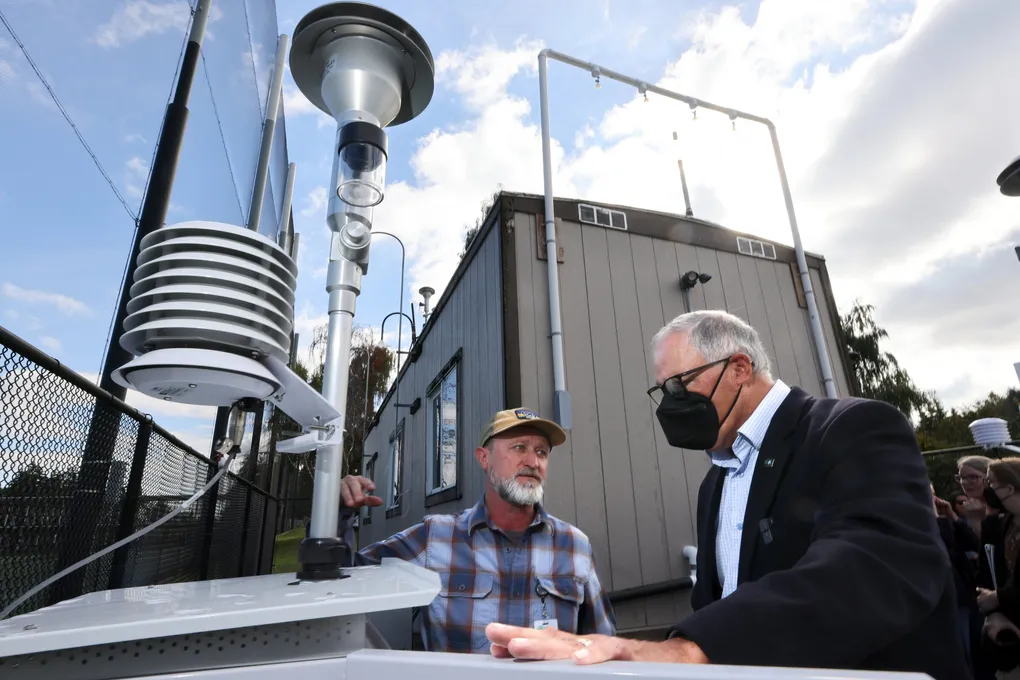
Air Quality Monitor Jay Inslee Ecology Jefferson
Gov. Jay Inslee, right, speaks with Greg Crider, an air monitoring scientist with the Department of Ecology, as he visits the Jefferson Park-Beacon Hill Air Monitoring Station in Seattle on Tuesday. (Karen Ducey / The Seattle Times) -
2023-09-28 01:23
Ecology Shoreline Photo Viewer
-
 2023-07-29 20:52
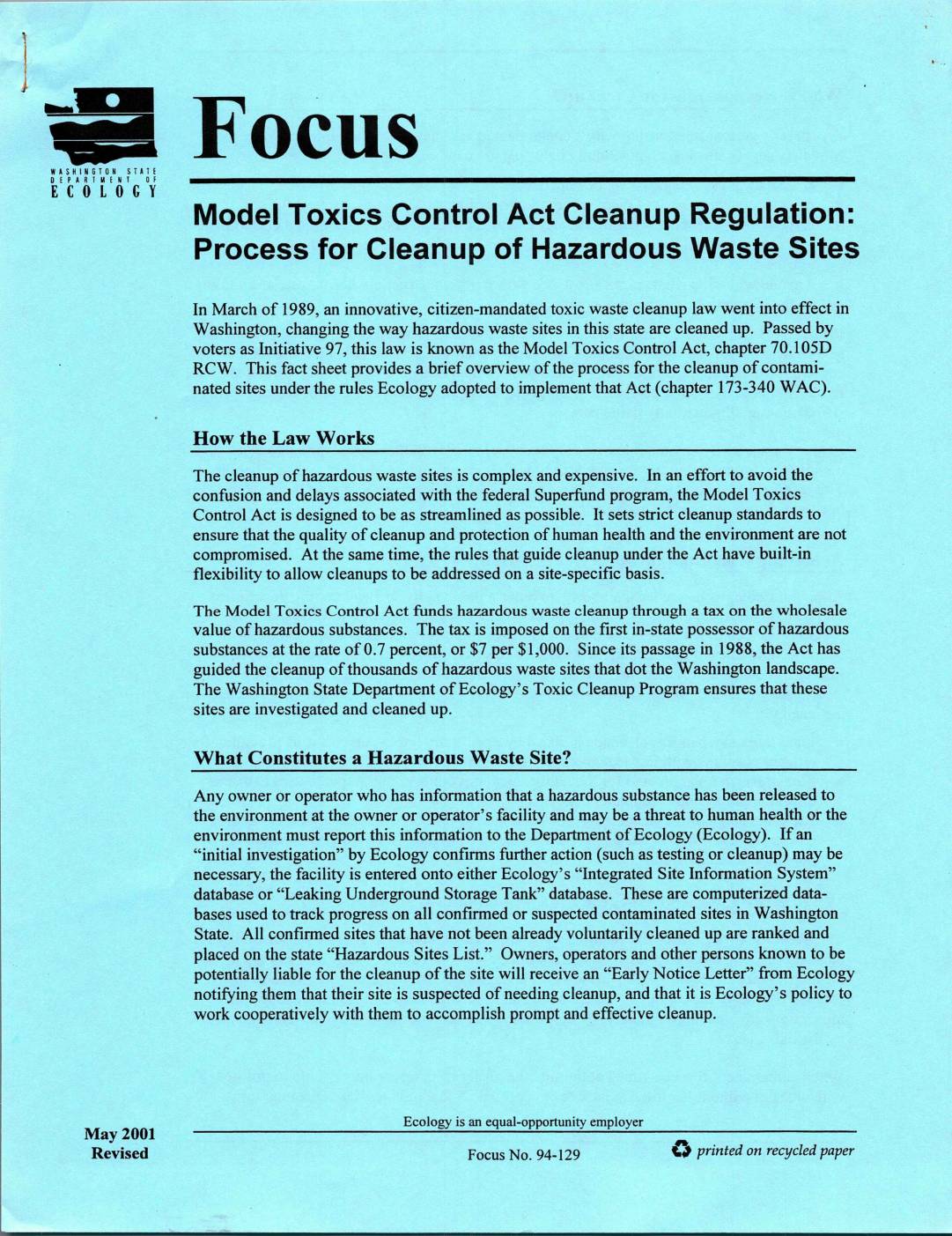
Ecology Focus Model Toxic Control Act Cleanup Regulation Process For Cleanup Of Hazardous Waste Sites May 2001 0001
Process for Cleanup of Hazardous Waste Sites In March of 1989, an innovative, citizen-mandated toxic waste cleanup law went into effect in Washington, changing the way hazardous waste sites in this state are cleaned up. Passed by voters as Initiative 97, this law is known as the Model Toxics Control Act, chapter 70.105D RC'W. This fact sheet provides a brief overview of the process for the cleanup of contami- nated sites under the rules Ecology adopted to implement that Act (chapter 173-340 WAC). How the Law Works The cleanup of hazardous waste sites is complex and expensive. In an effort to avoid the confusion and delays associated with the federal Superfund program, the Model Toxics Control Act is designed to be as streamlined as possible. It sets strict cleanup standards to ensure that the quality of cleanup and protection of human health and the environment are not compromised. At the same time, the rules that guide cleanup under the Act have built-in flexibility to allow cleanups to be addressed on a site-specific basis. The Model Toxics Control Act funds hazardous waste cleanup through a tax on the wholesale value of hazardous substances. The tax is imposed on the first in-state possessor of hazardous substances at the rate of 0.7 percent, or $7 per $1,000. Since its passage in 1988, the Act has guided the cleanup of thousands of hazardous waste sites that dot the Washington landscape. The Washington State Department of Ecology’s Toxic Cleanup Program ensures that these sites are… -
 2022-11-04 22:59
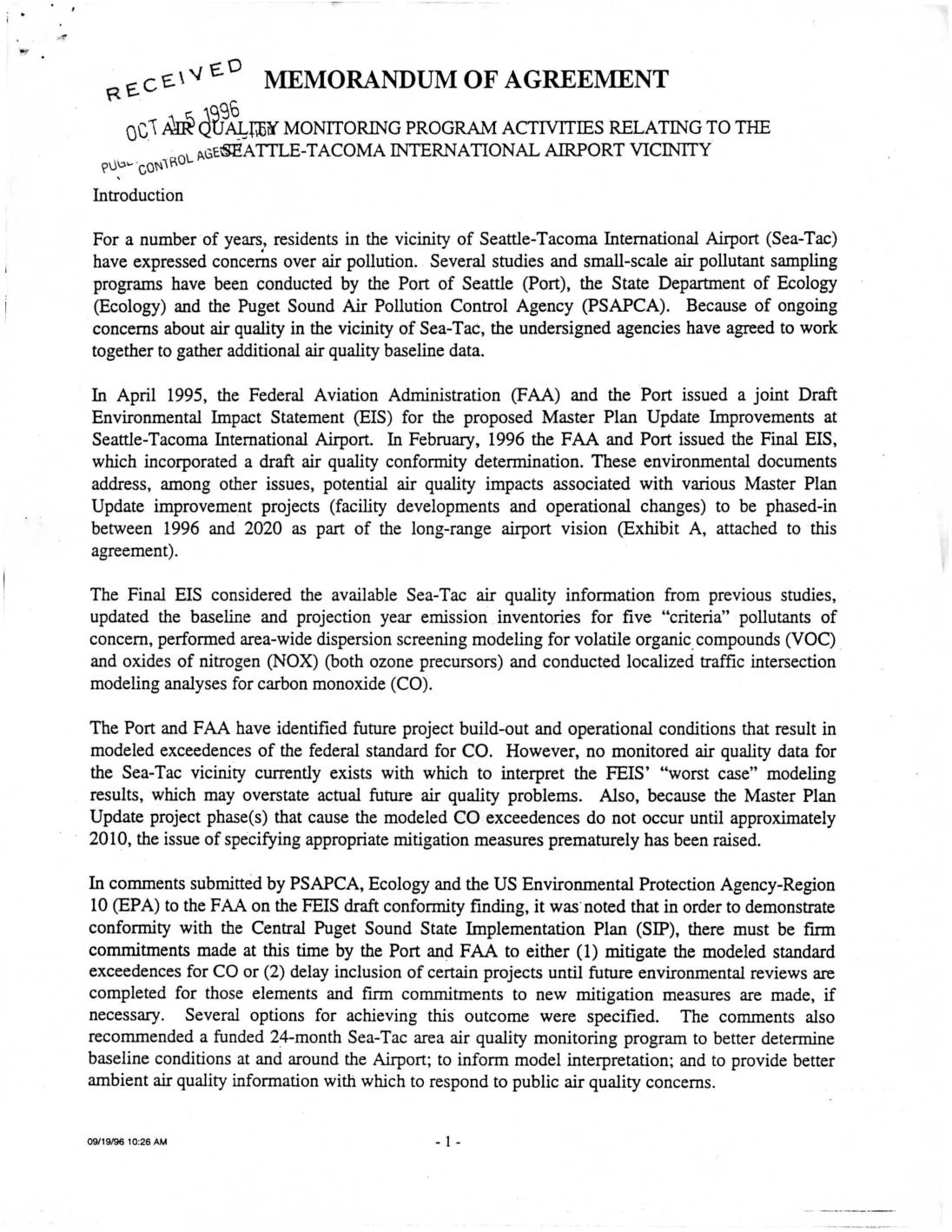
MOA – Air Quality Monitoring at Sea-Tac Vicinity, October 15, 1996
. €. c s '-J €. 0 MEMORANDUM OF AGREEJ.IIENT R . oCI ~ d~~r;Eti MONITORING PROGRAM ACTIVITIES RELATING TO THE . . · oL p..Gt~ATTLE-TACOMA INTERNATIONAL AIRPORT VICINITY ~0~-- cotf ~ Introduction For a number ·of years, residents in the vicinity of Seattle-Tacoma International Airport (Sea-Tac) have expressed concerns over air pollution . . Several studies and small-scale air pollutant sampling programs have been conducted by the Port of Seattle (Port), the State Department of Ecology (Ecology) and the Puget Sound Air Pollution Control Agency (PSAPCA). Because of ongoing concerns about air quality in the vicinity of Sea-Tac, the undersigned agencies have agreed to work together to gather additional air quality baseline data. In April 1995, the Federal Aviation Administration (FAA) and the Port issued a joint Draft Environmental Impact Statement (EIS) for the proposed Master Plan Update Improvements at Seattle-Tacoma International Airport. In February, 1996 the FAA and Port issued the Final EIS, which incorporated a draft air quality conformity determination. These environmental documents address, among other issues, potential air quality impacts associated with various Master Plan Update improvement projects (facility developments and operational changes) to be phased-in between 1996 and 2020 as part of the long-range airport vision (Exhibit A, attached to this agreement). The Final EIS considered the available Sea-Tac air quality information from previous studies, updated the baseline and projection year emission . inventories for five "criteria" pollutants of concern, performed area-wide dispersion screening modeling for volatile organic. compounds (VOC) _ and oxides of nitrogen… -
 2022-10-30 01:21
Identifying Overburdened Communities
Introduction The Climate Commitment Act requires Ecology to create a Cap & Invest program to lower greenhouse gas emissions across the state. Additionally, the Climate Commitment Act requires us to identify “ overburdened communities highly impacted by air pollution,” and make sure that this program reduces a class of pollutants called “criteria” air pollutants , as well -
2022-09-09 23:35
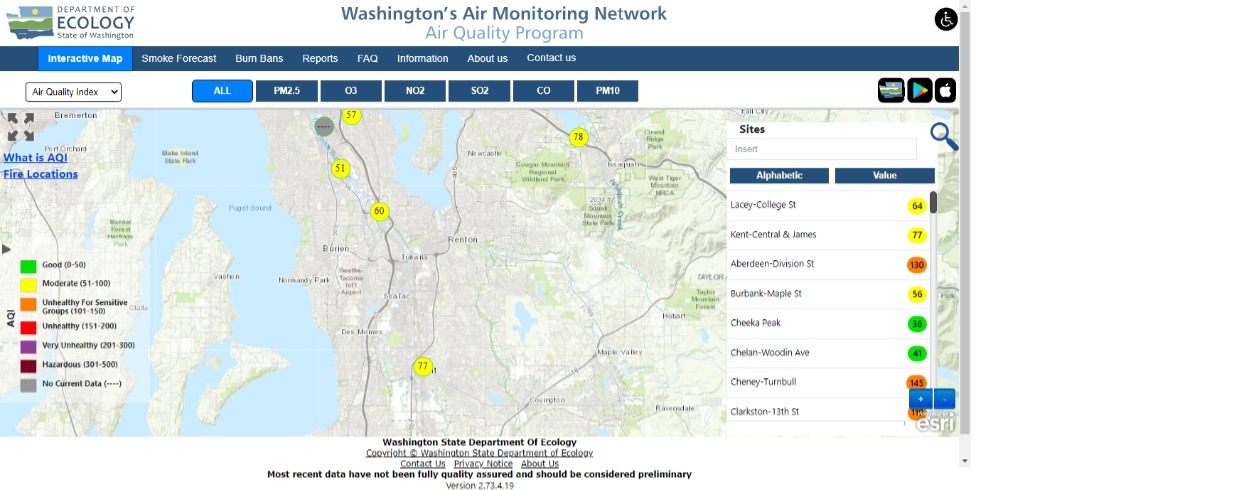
Washington Air Monitoring Network: Air Quality Program
Washington State Department of Ecology -
 2022-09-09 23:25
Web Capture 9-9-2022 222436 Enviwa.ecology.wa.gov