TagEcology(788)
-
 2024-06-12
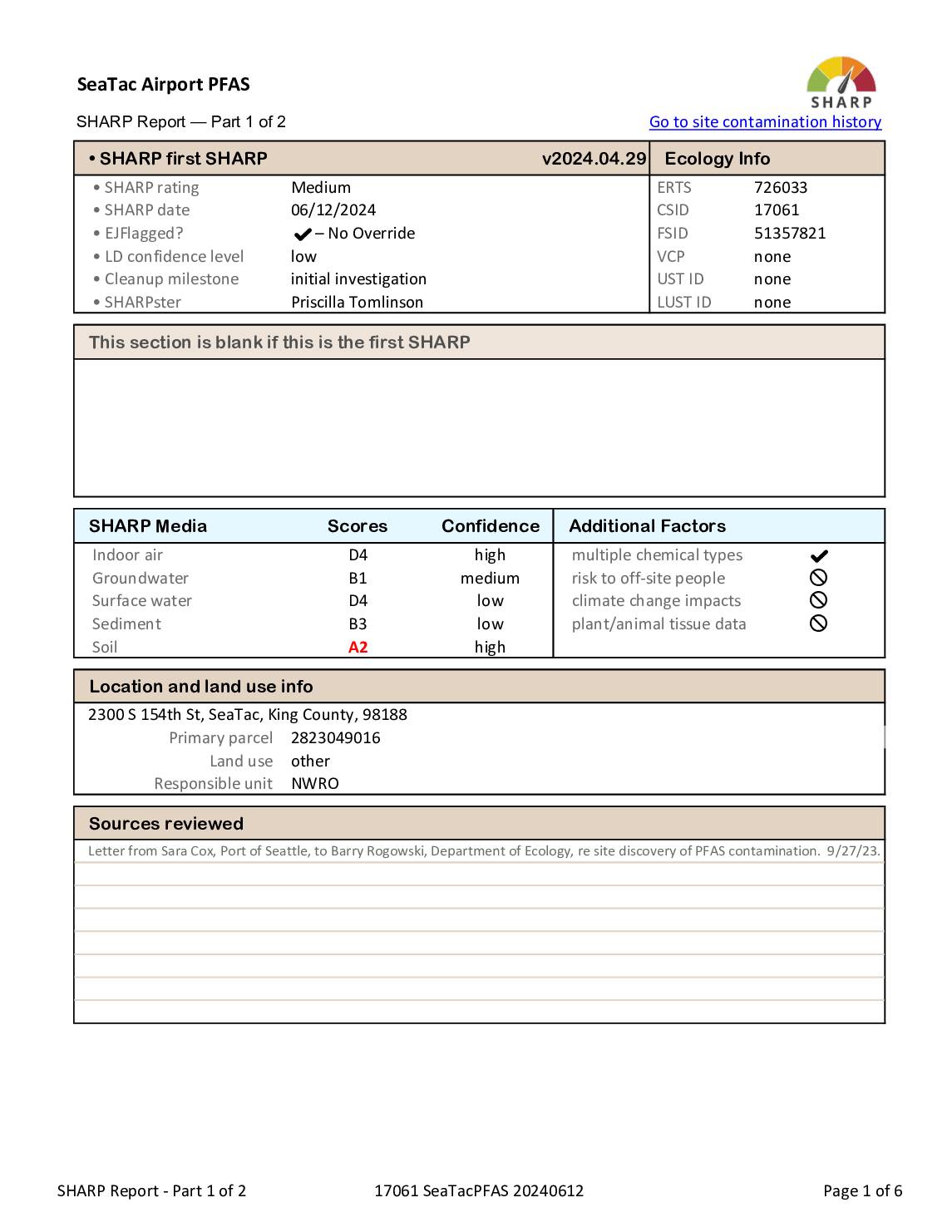
Sea-Tac Airport PFAS SHARP report — part 1 of 2
A SHARP (Site Hazard Assessment Ranking and Prioritization) report for SeaTac Airport covering PFAS contamination identified at four areas: fire station, fuel farm, fire training area, and industrial wastewater system. The report details media scores for groundwater, soil, surface water, sediment, and indoor air, noting concerns about Des Moines Creek and the City of Highline’s -
 2024-01-30
HB 2070: Multiple Agency Fiscal Note Summary — Environmental Justice/SEPA Projects
This Washington State fiscal note summarizes the estimated costs of House Bill 2070, which relates to environmental justice and State Environmental Policy Act (SEPA) projects. The bill is projected to cost multiple state agencies a combined total of approximately $1.28 million in operating expenditures for 2023-25, rising to $2.64 million in 2025-27, before declining to about $1.61 million in 2027-29. The Department of Ecology, Department of Fish and Wildlife, and Office of the Attorney General are among the primary agencies expected to incur costs, with some impacts remaining indeterminate. -
 2024-01-01
Hazardous Materials, Solid Waste, and Pollution Prevention Technical Report: Appendix F — Hazardous Materials and Solid Waste
This technical report, prepared by Landrum & Brown for the Port of Seattle in January 2024, covers hazardous materials, solid waste, and pollution prevention as part of the Sustainable Airport Master Plan's near-term projects at Seattle-Tacoma International Airport. It includes assessments of contaminated fuel farm sites, regulated building materials such as asbestos and lead in airport structures, and environmental investigation reports for fueling sites. Supporting attachments document findings from agencies like Washington State Ecology and surveys of specific airport buildings managed by tenants including United Airlines and Swissport. -
 2024-01-01
Hazardous Materials, Solid Waste, and Pollution Prevention Technical Report: Sustainable Airport Master Plan – Near-Term Projects
This technical report, prepared by Landrum & Brown for the Port of Seattle in January 2024, addresses hazardous materials, solid waste, and pollution prevention as part of the Sustainable Airport Master Plan's near-term projects at Seattle-Tacoma International Airport. It documents environmental assessments of various airport sites, including fuel farm areas, cargo buildings, and airline maintenance facilities, examining issues such as soil contamination, regulated building materials like asbestos and lead, and fueling site investigations. The report compiles findings and supporting attachments from multiple environmental studies conducted across the airport campus. -
 2024-01-01
Appendix F: Hazardous Materials, Solid Waste, and Pollution Prevention Technical Report: Sustainable Airport Master Plan Near-Term Projects
This technical report, prepared by Landrum & Brown for the Port of Seattle in January 2024, assesses hazardous materials, solid waste, and pollution prevention concerns related to near-term construction projects under the Sustainable Airport Master Plan at Seattle-Tacoma International Airport. It includes investigations of contaminated fuel farm sites, environmental baseline studies, and regulated building materials surveys (such as asbestos and lead) for several airport facilities slated for redevelopment. The report compiles findings and regulatory correspondence from Washington State Department of Ecology to guide safe handling and cleanup of hazardous materials during planned airport improvements. -
 2023-12-01
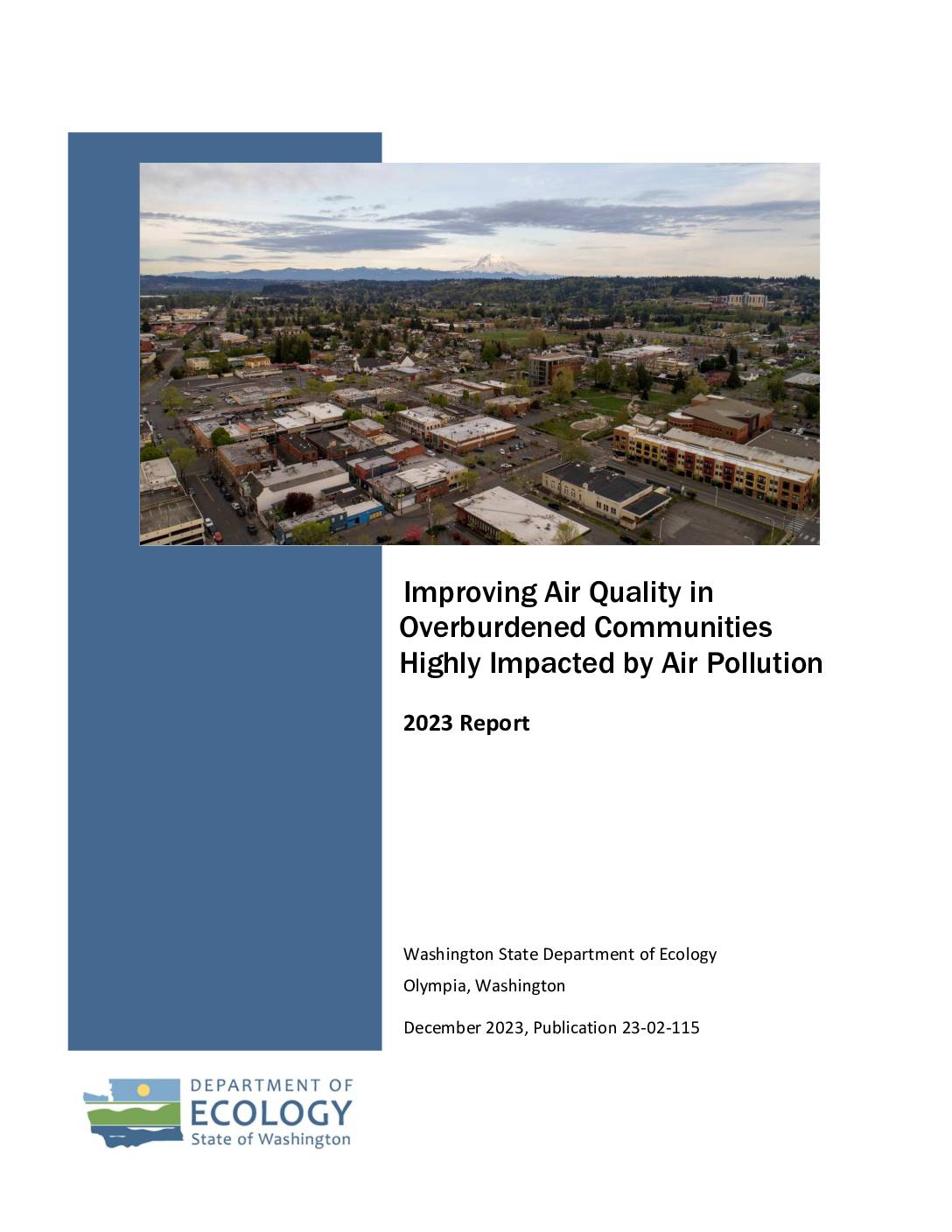
Improving air quality in overburdened communities highly impacted by air pollution: 2023 report
This 2023 report from the Washington State Department of Ecology focuses on improving air quality in overburdened communities that are highly impacted by air pollution across Washington State. It outlines regional office contacts, accessibility services, and language assistance resources available to affected residents. Note: This document does not specifically address Sea-Tac Airport noise policy and may not be directly relevant to airport noise concerns. -
Air Quality Monitor Jay Inslee Ecology Jefferson
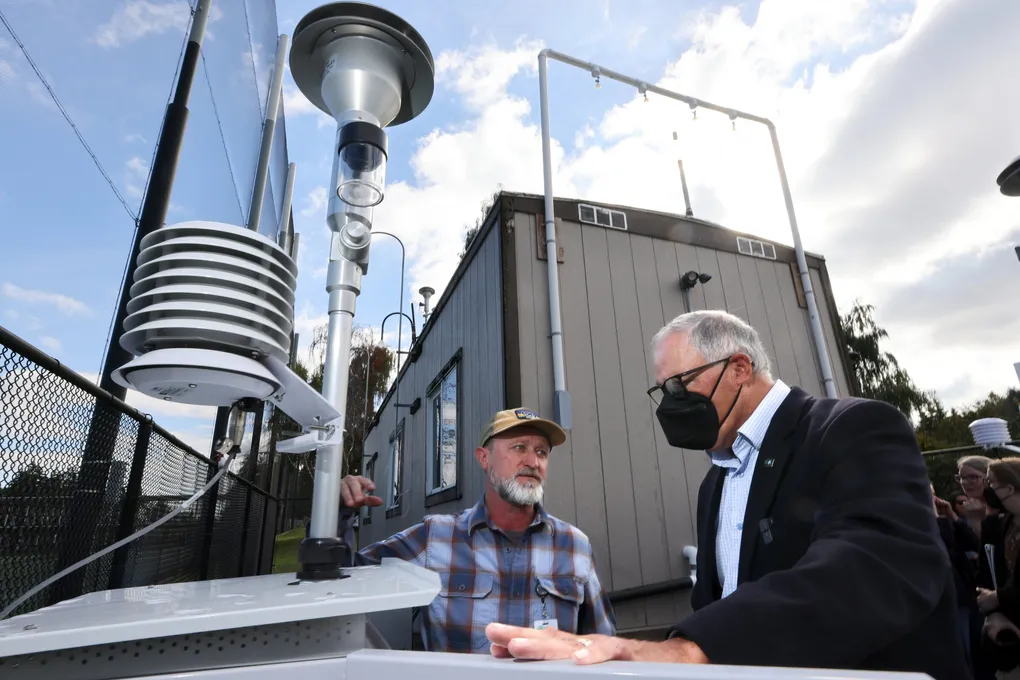
Two men examine meteorological or air quality monitoring instruments mounted on a pole at an outdoor monitoring station. One man wears a black KN95 mask and a blazer; the other wears a plaid shirt and baseball cap with a visible badge. A small building consistent with an environmental monitoring station is visible in the background. -
 2023-10-01
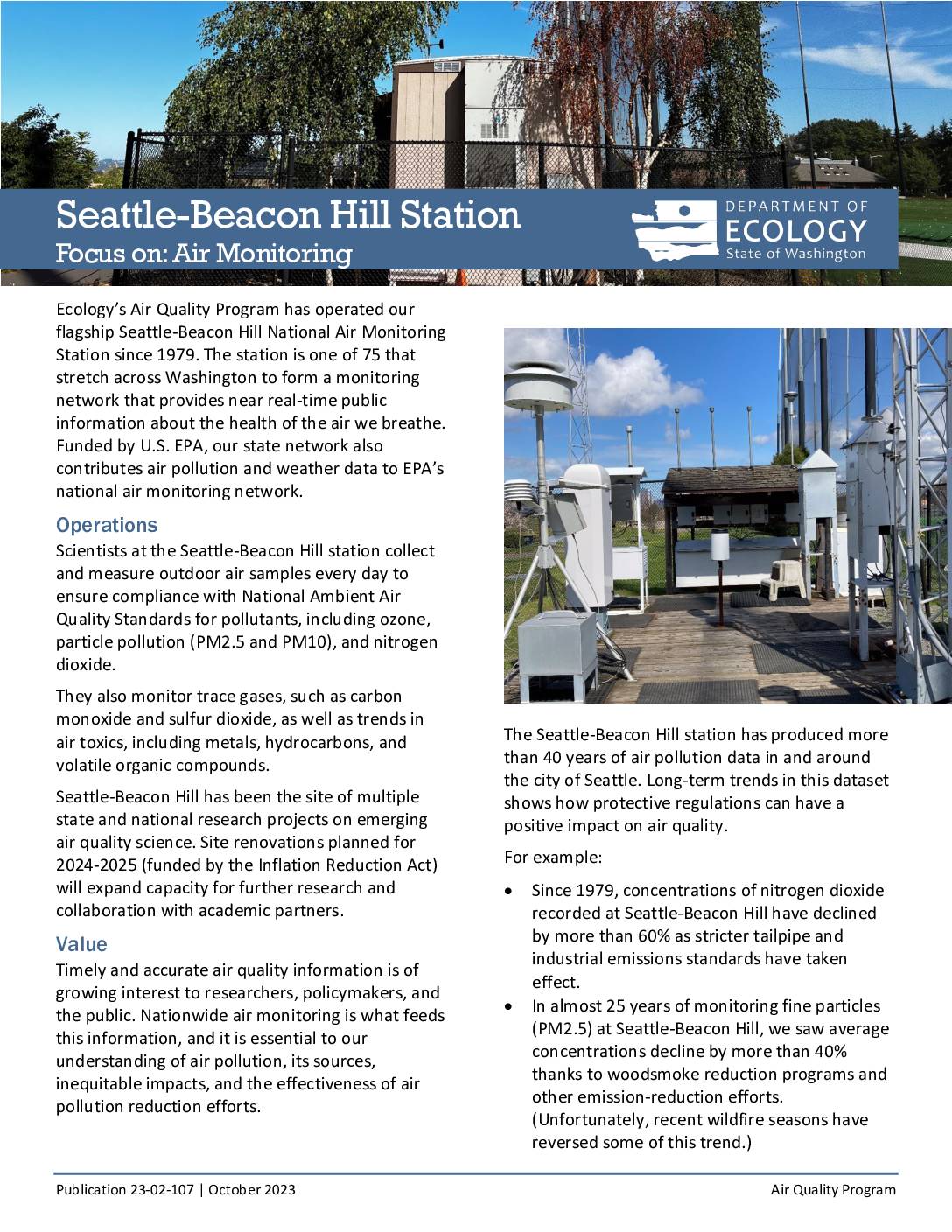
Seattle-Beacon Hill Station: Focus on Air Monitoring
Washington State's Department of Ecology has operated the Seattle-Beacon Hill Air Monitoring Station since 1979, tracking pollutants such as ozone, nitrogen dioxide, fine particles, and air toxics to ensure compliance with national air quality standards. Over four decades of data show significant air quality improvements, including a 60% decline in nitrogen dioxide and a 40% reduction in fine particle concentrations, largely due to stricter emissions regulations. The station also supports ongoing research and community efforts to address air pollution disparities in overburdened neighborhoods of South Seattle. -
 2023-06-05
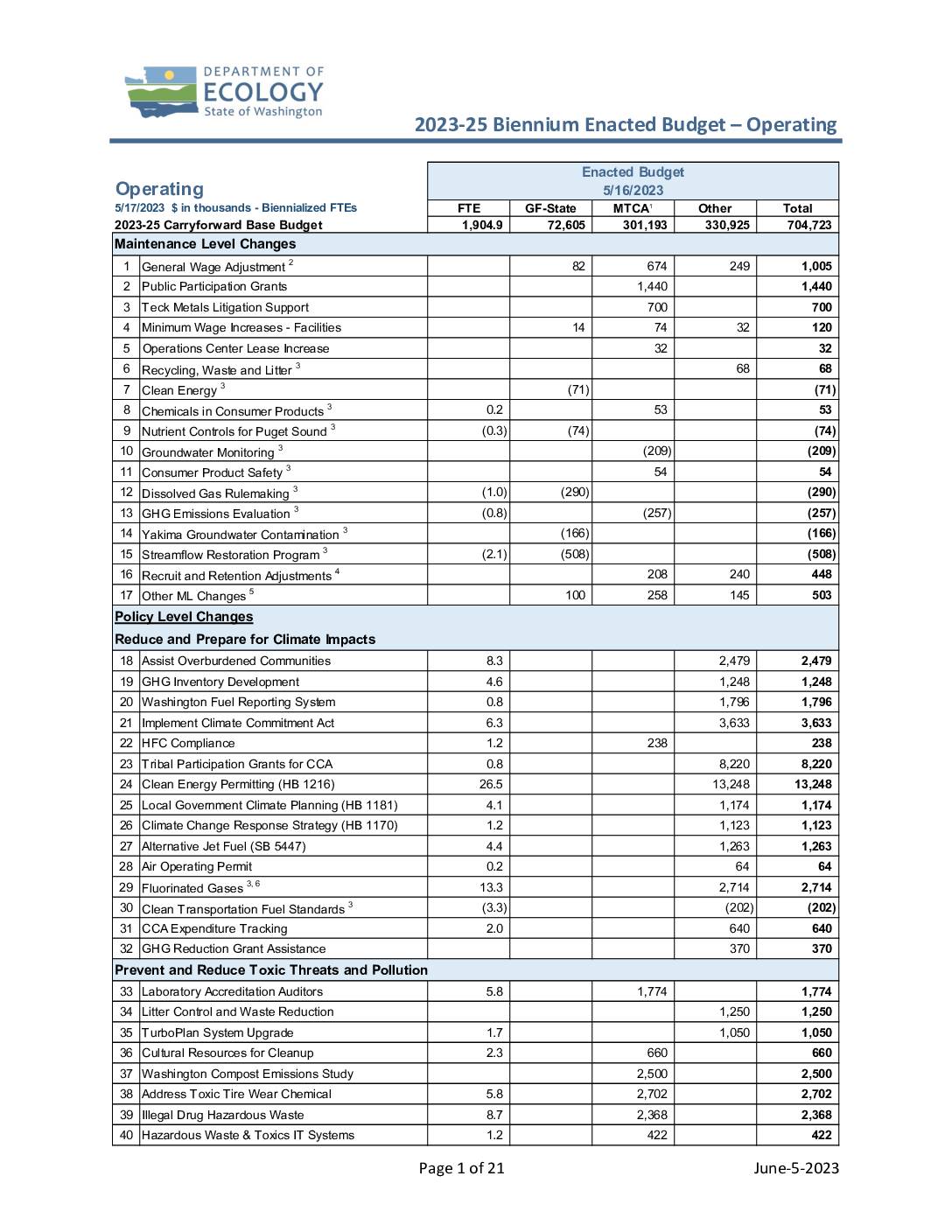
2023-25 Biennium Enacted Budget – Operating
This document outlines the Washington State Department of Ecology's 2023-25 Biennium Enacted Operating Budget, totaling approximately $862.6 million with 2,136.5 full-time employees. It details funding changes across priority areas including climate impact reduction, toxic threat prevention, and water protection, with notable investments in Clean Energy Permitting, Climate Commitment Act implementation, and water quality programs. The budget reflects a net increase of roughly $157.8 million over the carryforward base budget through a combination of maintenance level adjustments and new policy-level initiatives.