TagPSCleanAir(6)
-
 2019-10-09 19:47
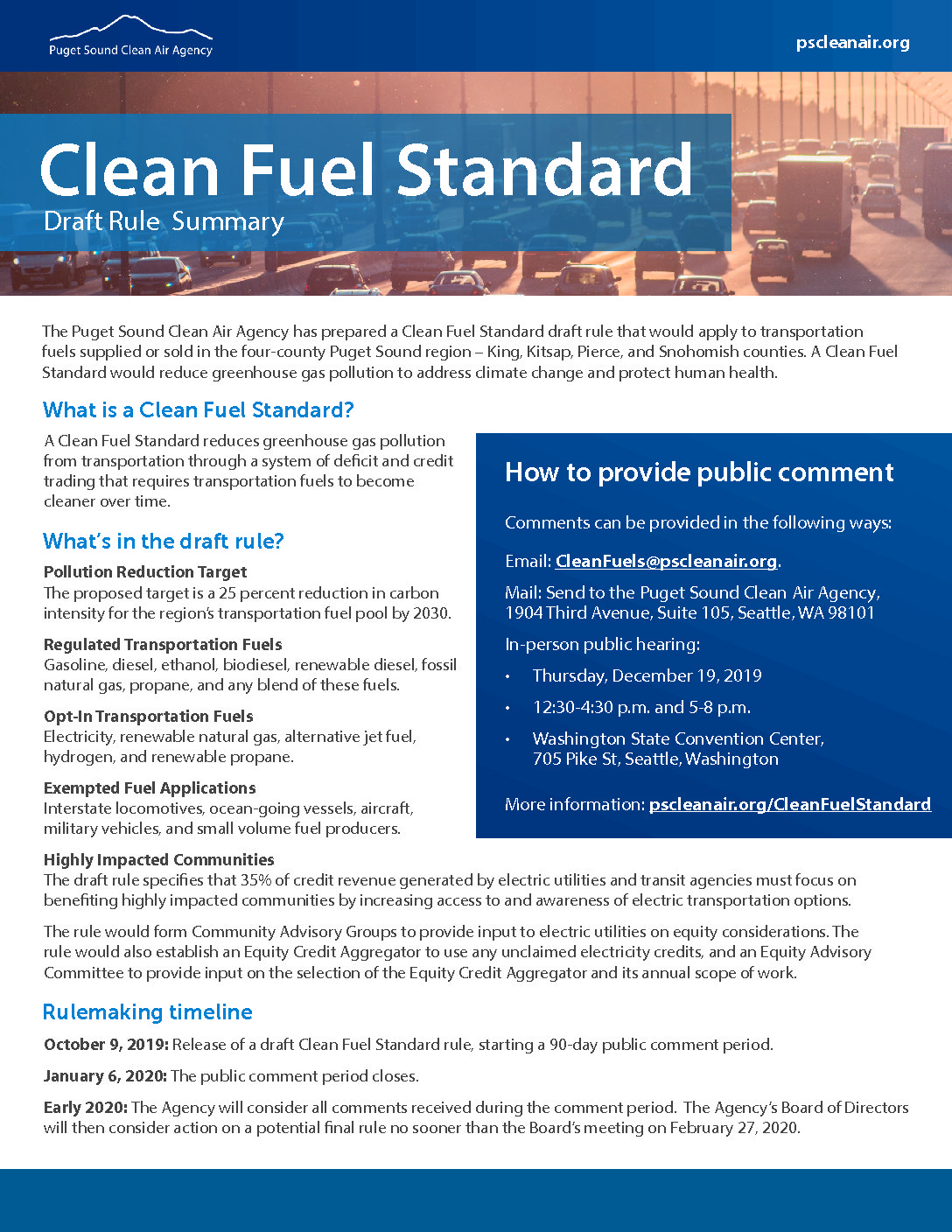
Clean Fuel Standard Draft Rule Summary
The Puget Sound Clean Air Agency has prepared a Clean Fuel Standard draft rule that would apply to transportation fuels supplied or sold in the four-county Puget Sound region – King, Kitsap, Pierce, and Snohomish counties. A Clean Fuel Standard would reduce greenhouse gas pollution to address climate change and protect human health. What is a Clean Fuel Standard? pscleanair.org Clean Fuel Standard Draft Rule Summary Rulemaking timeline October 9, 2019: Release of a draft Clean Fuel Standard rule, starting a 90-day public comment period. January 6, 2020: The public comment period closes. Early 2020: The Agency will consider all comments received during the comment period. The Agency’s Board of Directors will then consider action on a potential final rule no sooner than the Board’s meeting on February 27, 2020. What’s in the draft rule? Pollution Reduction Target The proposed target is a 25 percent reduction in carbon intensity for the region’s transportation fuel pool by 2030. Regulated Transportation Fuels Gasoline, diesel, ethanol, biodiesel, renewable diesel, fossil natural gas, propane, and any blend of these fuels. Opt-In Transportation Fuels Electricity, renewable natural gas, alternative jet fuel, hydrogen, and renewable propane. Exempted Fuel Applications Interstate locomotives, ocean-going vessels, aircraft, military vehicles, and small volume fuel producers. How to provide public comment Comments can be provided in the following ways: Email: CleanFuels@pscleanair.org. Mail: Send to the Puget Sound Clean Air Agency, 1904 Third Avenue, Suite 105, Seattle, WA 98101 In-person public hearing: • Thursday, December 19, 2019 • 12:30-4:30 p.m. and 5-8… -
2018-08-27 14:53
Puget Sound Clean Air Agency
Provides air quality monitoring stations throughout the region. Oddly, they are currently not testing air quality around Sea-Tac. -
2018-08-06 14:01
Puget Sound Clean Air Advisory Council
Our Advisory Council provides guidance and input on agency programs and regulations. The Advisory Council is made up of representatives of large and small businesses, suburban cities, area sources, education, transportation, health, tribal nations, fire chiefs, environmental justice, local ports, the environmental community, and the Public-at-Large. Meetings Agendas & Minutes Advisory Council Members Advisory council -
 2015-06-01 12:39
PSCAA 2015 Greenhouse Gas Emissions Inventory
-
 2003-10-01 00:00
Puget Sound Air Toxics Evaluation Final Report, October 2003
For more information about this report, call Leslie Keill at (206) 689-4022 -
 2000-03-01 00:00
Addressing Community Health Concerns Around Sea-Tac Airport 2000
Addressing Community Health Concerns Around SeaTac Airport Response to the question, “Is it possible to monitor jet engine exhaust emissions or to model their path using data on prevailing winds and takeoff patterns?” March 2000 Prepared by Washington State Department of Health Washington State Department of Ecology Puget Sound Clean Air Agency In consultation with Public Health – Seattle & King County SeaTac Airport Area Community Representatives United States Environmental Protection Agency University of Washington Washington State University For more information contact Juliet VanEenwyk Washington State Department of Health (360) 236-4250 juliet.vaneenwyk@doh.wa.gov Naydene Maykut Puget Sound Clean Air Agency (206) 689-4062 nmaykut@pscleanair.org John Williamson Washington State Department of Ecology (425) 649-7118 jwil461@ecy.wa.gov Additional copies of this report are available at: http://www.doh.wa.gov/EHSPHL/Epidemiology/NICE/default.htm CONTENTS Abbreviations.................................................................................................................................................. ii Executive Summary ........................................................................................................................................ 1 Preface ............................................................................................................................................................ 5 Background..................................................................................................................................................... 5 Conclusions Based On Previous Air Quality Studies...................................................................................... 6 Rationale For Further Study............................................................................................................................ 7 Health Issues............................................................................................................................................ 7 Environmental Justice.............................................................................................................................. 8 Recommendations........................................................................................................................................... 9 Goals of an Air Quality Study.................................................................................................................. 9 General Recommendations For an Air Quality Study.............................................................................. 9 Methods ........................................................................................................................................................ 10 Manual Methods .................................................................................................................................... 10 Automated Methods............................................................................................................................... 11 Quality Assurance Procedures ............................................................................................................... 11 Data Analysis And Interpretation.................................................................................................................. 12 Initial Data Analysis .............................................................................................................................. 12 Additional Data Analysis ....................................................................................................................... 14 Timeframe..................................................................................................................................................... 16 Estimated Costs as of March 2000................................................................................................................ 17 References..................................................................................................................................................... 18 Attachment 1: Committee Members ............................................................................................................. 19 Attachment 2: Summary of Recent Studies................................................................................................... 21 Attachment 3: Draft List of Recommended Pollutants For Air Monitoring.................................................. 25 Attachment 4: Compendium Method TO-11A.............................................................................................. 27 Attachment 5: Compendium Method TO-13A.............................................................................................. 29 Attachment 6: Compendium Method…