TagEcology(33)
-
 2006-11-06 16:44
Spatial and Temporal Patterns of Airborne Toxic Species in Seattle Neighborhoods 2006
Spatial and Temporal Patterns of Airborne Toxic Species in Seattle, WA Neighborhoods Paper # 456 Hal Westberg, Brian Lamb and Doris Montacastro Laboratory for Atmospheric Research Washington State University Pullman, WA 99111 John Williamson Washington Department of Ecology 3190 160th Ave. SE Bellevue, WA 98008 -
2004-05-14 20:45
Port Of Seattle v. Airport Communities Coalition; Citizens Against Sea-Tac Expansion; and State of Washington, Department of Ecology
Supreme Court of Washington,En Banc. PORT OF SEATTLE, a port district of the State of Washington, Petitioner, v. The POLLUTION CONTROL HEARINGS BOARD, an agency of the State of Washington, Respondent, Airport Communities Coalition; Citizens Against Seatac Expansion; and State of Washington, Department of Ecology, an agency of the State of Washington, Respondents/Cross-Petitioners. No. 73419-4. Decided: -
 2003-10-01 00:00
Puget Sound Air Toxics Evaluation Final Report, October 2003
For more information about this report, call Leslie Keill at (206) 689-4022 -
 2002-10-19 17:51
PCHB003000013
PORT OF SEATTLE, a port district of the State of Washington, NO. 02-2-25658-9 SEA Petitioner, DECLARATION OF KEVIN L. STOCK IN v. RESPONSE TO PORT OF SEATTLE'S APPLICATION FOR DIRECT REVIEW THE POLLUTION CONTROL HEARINGS -
 2002-08-12 00:00
Pollution Control Hearings Board Case No. 01-160
March 18-29, 2002. The Board was comprised of Kaleen Cottingham, presiding, Robert V. Jensen, and William H. Lynch. The Appellant, Airport Communities Coalition (ACC), and Intervenor, Citizens Against Airport Expansion (CASE), challenge the Port of Seattle‘s (Port) -
 2002-02-15 00:00
Tacoma Asarco Smelter Plume Ecology Presentation February 2002
air emissions from the old Asarco smelter. risk associated with low-level area-wide contamination. about project status contamination over time. 2 Area Wide Contamination Strategy WASHINGTON STATE DEPARTMENT OF ECOLOGY as the Area-wide Contamination Strategy. • Other area-wide sites Everett Smelter Site Mining Lands purposes Area Wide Contamination Strategy WASHINGTON STAIE DEPARTMENT OF ECOLOGY Health, and Office of Community Development Nature and extent of contamination Protective measures land use policies Sampling Guidance Histo W WASHINGTON STATE DEPARTMENT OF ECOLOGY Asarco) 1992 - EPA Superfund Cleanup of Ruston site begins 1998 - Maury Island Gravel Pit Study Department What is a Site Hazard Assessment ? WASHINGTON STATE DEPARTMENT OF ECOLOGY where hazardous substances are known or the environment through the environment The Plume WASHI'N GT ON STATE DEPARTMENT OF ECOLOGY Arsenic is prirnaW contarninant Lead is of lesser concern or E Coli outbreak Closer to smelter is more contaminated Contamination follows wind paUerns The Plume W'A SHING TON STATE DEPARTMENT OF ECOLOGY Undisturbed soils most contaminated Topography aKects contamination (slopes/floodplains) Boundaw of contamination is not known tJ MTCA Cleanul Levels WASHINGTON STATE DEPARTMENT OF ECOLOGY Arsenic 20 parts per million Lead 250 parts per million & What levels of Arsenic have been found in the TSP area? WASHINGTON STATE DEPARTMENT OF ECOLOGY AveraGes – 170 ppm Maximum 281 ppm 460 ppm VI VI IJb V dIV}/uJ I I VI/bl LI VMI-Phase 1 Study &MI-Child Use Areas UP Residential King Co. Mainland e • Everett ppm (South Vashon) - 50 ppm ppm Due… -
 2001-08-30 20:46
RCAA Flyer Conveyor 2001
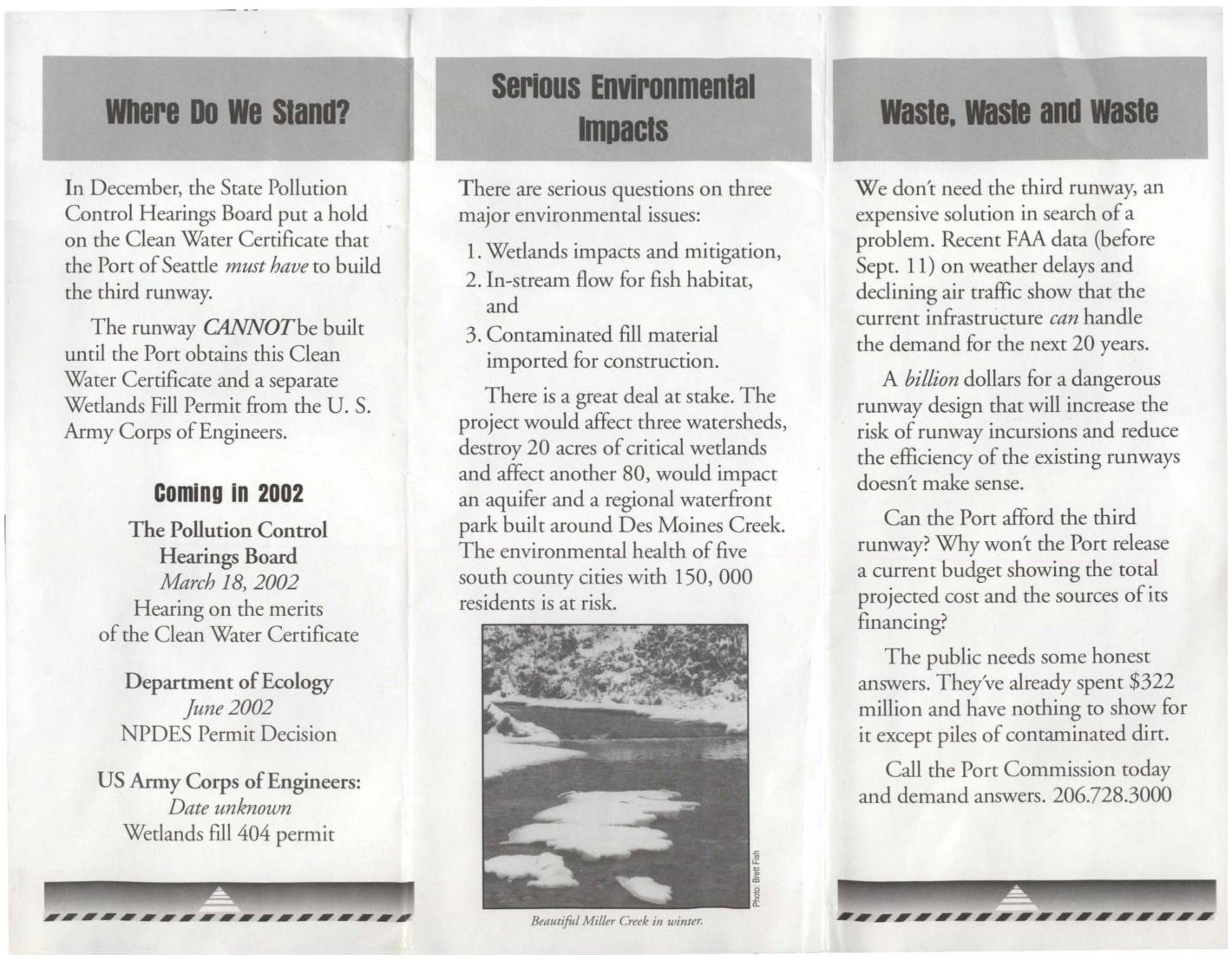
the Port of Seattle must have to build the third runway. The runway CANNOTbe built until the Port obtains this Clean Water Certificate and a separate Wetlands Fill Permit from the U.S. Army Corps of Engineers. coming in 2002 The Pollution Control Hearings Board March 18, 2002 Hearing on the merits of the Clean Water Certificate Department of Ecology June2002 NPDES Permit Decision US Army Corps of Engineers: Date unknown Wetlands fill404 permit il : Serious Environmental -CIS There are serious questions on three major environmental issues: 1. Wetlands impacts and mitigation, 2. In-stream flow for fish habitat, and 3. Contaminated fill material imported for construction. There is a great deal at stake. The project would affect three watersheds, destroy 20 acres of critical wetlands and affect another 80, would impact an aquifer and a regional waterfront park built around Des Moines Creek The environmental health of five south county cities with 150, 000 residents is at risk Beautifi<L MilLer Creek in winter. wasta, ··-· We don't need the third runway, an expensive solution in search of a problem. Recent FAA data (before Sept. 11) on weather delays and declining air traffic show that the current infrastructure can handle the demand for the next 20 years. A billion dollars for a dangerous runway design that will increase the risk of runway incursions and reduce the efficiency of the existing runways doesn't make sense. Can the Port afford the third runway? Why won't the Port release a current budget showing the… -
 2000-03-01 00:00
Addressing Community Health Concerns Around Sea-Tac Airport 2000
Addressing Community Health Concerns Around SeaTac Airport Response to the question, “Is it possible to monitor jet engine exhaust emissions or to model their path using data on prevailing winds and takeoff patterns?” March 2000 Prepared by Washington State Department of Health Washington State Department of Ecology Puget Sound Clean Air Agency In consultation with Public Health – Seattle & King County SeaTac Airport Area Community Representatives United States Environmental Protection Agency University of Washington Washington State University For more information contact Juliet VanEenwyk Washington State Department of Health (360) 236-4250 juliet.vaneenwyk@doh.wa.gov Naydene Maykut Puget Sound Clean Air Agency (206) 689-4062 nmaykut@pscleanair.org John Williamson Washington State Department of Ecology (425) 649-7118 jwil461@ecy.wa.gov Additional copies of this report are available at: http://www.doh.wa.gov/EHSPHL/Epidemiology/NICE/default.htm CONTENTS Abbreviations.................................................................................................................................................. ii Executive Summary ........................................................................................................................................ 1 Preface ............................................................................................................................................................ 5 Background..................................................................................................................................................... 5 Conclusions Based On Previous Air Quality Studies...................................................................................... 6 Rationale For Further Study............................................................................................................................ 7 Health Issues............................................................................................................................................ 7 Environmental Justice.............................................................................................................................. 8 Recommendations........................................................................................................................................... 9 Goals of an Air Quality Study.................................................................................................................. 9 General Recommendations For an Air Quality Study.............................................................................. 9 Methods ........................................................................................................................................................ 10 Manual Methods .................................................................................................................................... 10 Automated Methods............................................................................................................................... 11 Quality Assurance Procedures ............................................................................................................... 11 Data Analysis And Interpretation.................................................................................................................. 12 Initial Data Analysis .............................................................................................................................. 12 Additional Data Analysis ....................................................................................................................... 14 Timeframe..................................................................................................................................................... 16 Estimated Costs as of March 2000................................................................................................................ 17 References..................................................................................................................................................... 18 Attachment 1: Committee Members ............................................................................................................. 19 Attachment 2: Summary of Recent Studies................................................................................................... 21 Attachment 3: Draft List of Recommended Pollutants For Air Monitoring.................................................. 25 Attachment 4: Compendium Method TO-11A.............................................................................................. 27 Attachment 5: Compendium Method TO-13A.............................................................................................. 29 Attachment 6: Compendium Method… -
 1999-12-13 00:00
SeaTac Oxides Of Nitrogen and Particulate Matter Study 1999
-
 1999-12-01 00:00
Addressing Community Health Concerns Around Sea-Tac Airport Second Report On The Work Plan Proposed August 1998 December 1999 Wdoh Skc Doh 0001 0001
Public Health – Seattle & King County Community Representatives tS\ HiIIi:l Xhq Addressing Community Health Concerns Around SeaTac Airport Second Report on the Work Plan Proposed in August 1998 December 1999 Prepared by Washington State Department of Health Juliet VanEenwyk, PhD, Epidemiologist, Office of Epidemiology (Chair) Lillian Bensley, PhD, Epidemiologist, Office of Epidemiology David McBride, MS, Toxicologist, Office of Environmental Health Assessment Services Richard Hoskins, PhD, Spatial Epidemiologist, Office of Epidemiology Public Health – Seattle & King County David Solet, PhD, Epidemiologist, Epidemiology, Planning and Assessment Unit Community Representatives Arlene McKeeman Brown, Materials Engineer (joined work group June 1999) Hansa Topiwala, MD Goined work group August 24, 1999) Audrey Richter Goined work group August 24, 1999) Rose Clark Goined work group August 24, 1999) • For questions about this report, please contact: Juliet VanEenwyk Washington State Dept. of Health Office of Epidemiology P.O. Box 47812 Olympia, WA 98504-7812 Tel: (360) 236-4250 Fax: (360) 236-4245 E-Mail: juliet.vaneenwyk@doh.wa.gov TABLE OF CONTENTS ackground ........................................................................................................................1 uestion l: What types of cancer are the most prevalent in the proximity of the airport, and what are their risk factors? ....................................................................1 uestion 2: Are rates of breast cancer elevated in the proximity of the airport? .......1 uestion 3: Do we know of all cases of glioblastoma in the proximity of the airport?..........:................................................................................................................2 uestion 4: Can we confirm that all of the suspected cases of gUoblastoma have been properly diagnosed as such?...............................................................................2 Community Reports .................................................................................................3 Buyout Area ..............................................................................................................6 Employment at SeaTac Airport...............................................................................7 uestion 5: Are incidence rates of…