TagSupreme Court(6)
-
2025-06-12 13:46
Supreme Court Clarifies NEPA Scope in Light of Loper Bright
By: Steven M. Taber, Esq. In Seven County Infrastructure Coalition v. Eagle County, Colorado (May 29, 2025), the U.S. Supreme Court held that the Surface Transportation Board (STB) complied with the National Environmental Policy Act (NEPA) when it declined to evaluate environmental impacts from increased oil drilling and refining that could result from a newly approved railway -
 2025-05-30 16:24
U.S. Supreme Court Narrows NEPA Review
Court removes “indirect effects” requirement The U.S. Supreme Court issued a unanimous decision, on May 29, 2025, narrowing the scope of environmental review under the National Environmental Policy Act (NEPA). In Seven County Infrastructure Coalition v. Eagle County, Colorado, the Court reversed in part the D.C. Circuit Court of Appeals’ finding that the Surface Transportation -
 2024-06-28 18:48
Supreme Court weakens federal regulators, overturning decades-old Chevron decision
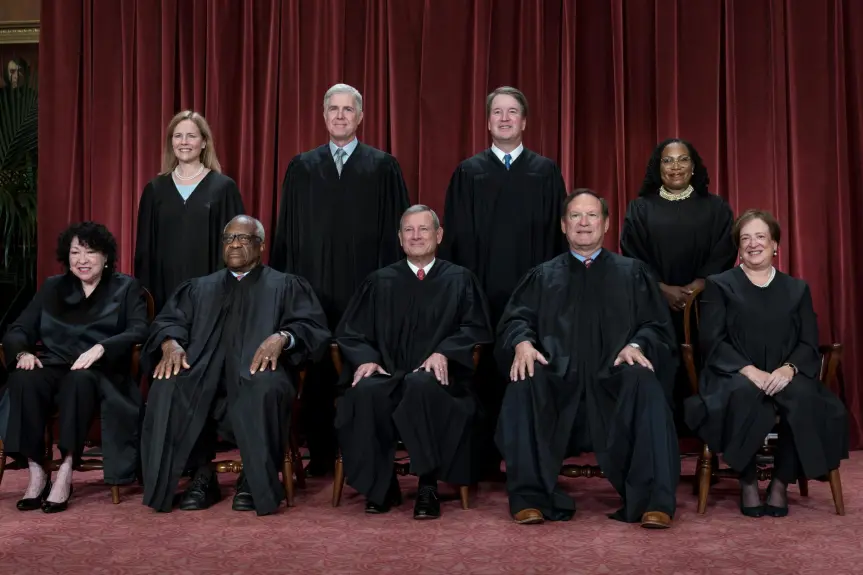
BY MARK SHERMAN WASHINGTON (AP) — The Supreme Court on Friday upended a 40-year-old decision that made it easier for the federal government to regulate the environment, public health, workplace safety and consumer protections, delivering a far-reaching and potentially lucrative victory to business interests. The court’s six conservative justices overturned the 1984 decision colloquially known as Chevron, long a -
2023-05-10 11:17
Supreme Court May Have Dealt Death Blow to Judicial Deference
By Barbara Lichman on May 10, 2023 Posted in Federal Aviation Administration (FAA), Federal Regulation, Litigation, National Environmental Policy Act (NEPA) Less than two weeks ago, the United States Supreme Court took the first of several actions meant to close the door on what has become a standard in opposing citizens’ efforts to challenge the -
 2007-04-02 00:00
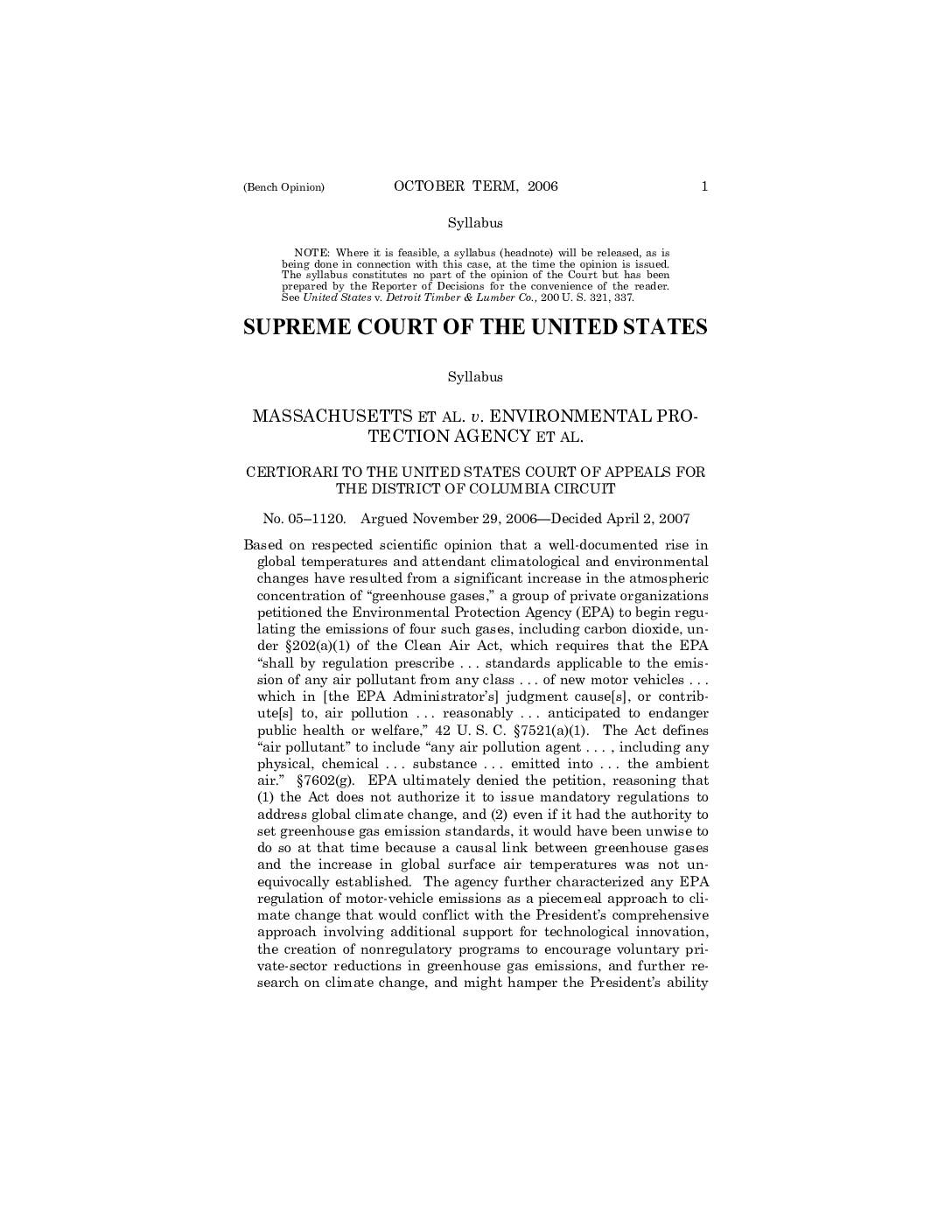
Massachusetts v. Environmental Protection Agency Supreme Court Decision
Supreme Court syllabus for Massachusetts v. EPA case regarding EPA’s denial of petition to regulate greenhouse gas emissions from motor vehicles under the Clean Air Act. The Court ruled that petitioners have standing to challenge EPA’s denial and that the agency must consider regulating greenhouse gases. -
1984-06-25 00:29
Chevron U.S.A., Inc. v. Natural Resources Defense Council, Inc.
Chevron U.S.A., Inc. v. Natural Resources Defense Council, Inc., 467 U.S. 837 (1984), was a landmark decision of the United States Supreme Court that set forth the legal test for when U.S. federal courts must defer to a government agency’s interpretation of a law or statute.[1] The decision articulated a doctrine known as “Chevron deference“.[2] Chevron deference consisted of a two-part test that was