Tagindoor air quality(21)
-
 2022-09-20 00:00
Atmosphere 2022: UWDEOHS Healthy Air, Healthy Schools
Atmosphere 2022: https://www.mdpi.com/2073-4433/13/10/1623 -
 2021-05-01 00:00
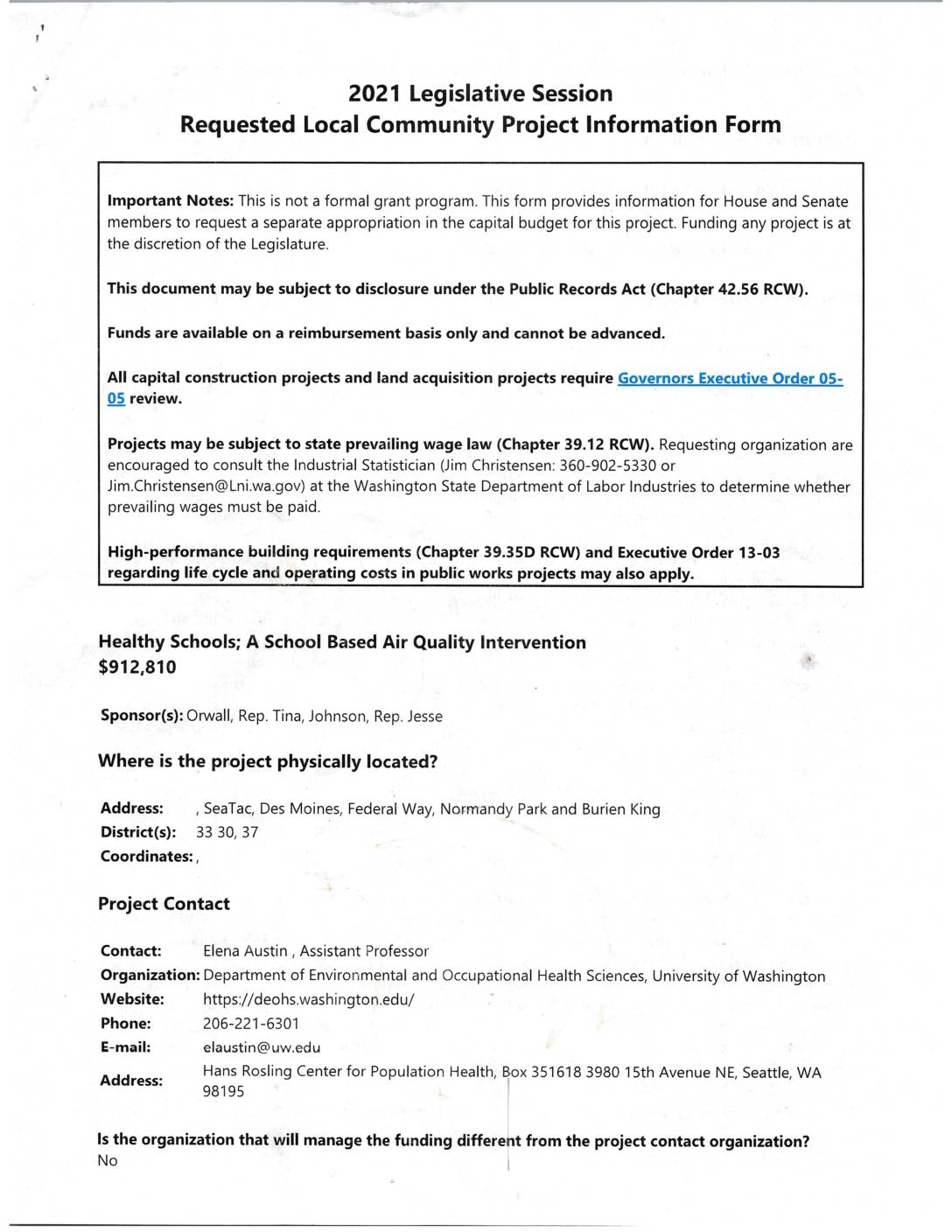
Healthy Schools: A School Based Air Quality Intervention
Important Notes: This is not a formal grant program. This form provides information for House and Senate members to request a separate appropriation in the capital budget for this project. Funding any project is at the discretion of the Legislature. This document may be subject to disclosure under the Public Records Act (Chapter 42.56 RCW). Funds are available on a reimbursement basis only and cannot be advanced. All capital construction projects and land acquisition projects require Governors Executive Order 05- review. Projects may be subject to state prevailing wage law (Chapter 39.12 RCW). Requesting organization are encouraged to consult the Industrial Statistician (Jim Christensen: 360-902-5330 or Jim.Christensen@LrIi.wa.gov) at the Washington State Department of Labor Industries to determine whether prevailing wages must be paid. High-performance building requirements (Chapter 39.35D RCW) and Executive Order 13-03 regarding life cycle and operating costs in public works projects may also apply. Healthy Schools; A School Based Air Quality Intervention $912.810 Sponsor(s): Orwall, Rep. Tina, Johnson, Rep. Jesse Where is the project physically located? Address: , SeaTac, Des Moines, Federal Way, Norrnandy Park and Burien King District(s): 33 30, 37 Coordinates: , Project Contact Contact: Elena Austin , Assistant Professor Organization: Department of Environmental and Occupational Health Sciences, University of Washington Website: https://deohs.washington.edu/ Phone: 206-221 -6301 E-mail: elaustin@ uw.edu Hans Rosling Center for Population Health, Box 351618 3980 15th Avenue NE, Seattle, WA i:TIM=:::,„„_ I„. w„_.[„„„„j„„_. I„„ I Address: -
2020-11-12 21:43
Treat air quality to safeguard buildings against COVID-19
By Gus Simonds Special to The Times Enough sweatpants and Zoom meetings already. Employees who have worked from home since March because of COVID-19 want to get back to the office to enjoy the face-to-face camaraderie and collaboration with mentors and teammates. Parents are anticipating getting their children back into the classroom. Winter is approaching, making -
2020-08-26 09:46
Sea-Tac Airport improves air quality in new North Satellite Terminal amid COVID-19 concerns
Engineers at Sea-Tac Airport are working to boost safety around the coronavirus inside the new North Satellite Terminal with an improved HVAC system. Author: Glenn Farley Published: 8:30 PM PDT August 26, 2020 SEATAC, Wash. — Some passengers may be nervous about flying in airplanes right now over the fear of contracting coronavirus, but what -
2020-08-19 18:43
Coronavirus is in the air. Here’s how to get it out.
How to make indoor air safer (but not necessarily safe) during the pandemic. By Brian Resnick@B_resnickbrian@vox.com Part of The Vox guide to navigating the coronavirus crisis SARS-CoV-2, the virus that causes Covid-19, can float in the air. In particular, it can linger in poorly ventilated indoor spaces, spreading farther than 6 feet from -
 2020-07-28 13:08
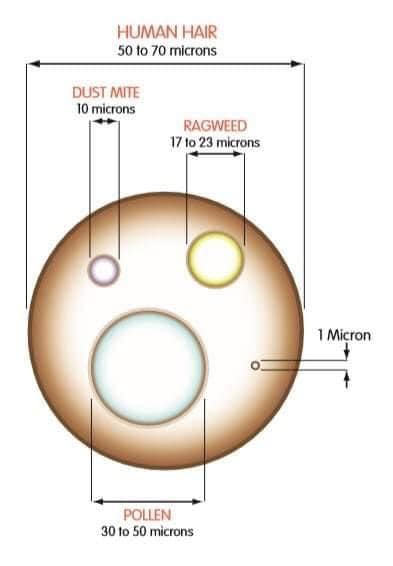
Relative sizes of various allergens
Diagram showing the relative sizes of a human hair, dust mite, ragweed, pollen in microns. PM25 refers to 2.5 microns. -
2020-01-23 16:51
An Open Letter To Joel Wachtel re. HB2315
Mr. Wachtel is a member of the SeaTac City Council and chairs their Aviation Advisory Committee. The following letter was e-mailed to key Councilmembers in Des Moines, SeaTac, Normandy Park, Tukwila and Federal Way. Hi Joel, As I mentioned at yesterday’s Highline Forum, HB2315 is moving ahead very fast. There have been two hearings so -
2020-01-08 11:45
Installing air filters in classrooms has surprisingly large educational benefits
$1,000 can raise a class’s test scores by as much as cutting class size by a third. By Matthew Yglesias@mattyglesiasmatt@vox.com An emergency situation that turned out to be mostly a false alarm led a lot of schools in Los Angeles to install air filters, and something strange happened: Test scores went up. By a -
 2018-07-15 00:00
EPA: Residential Air Cleaners – a technical summary 3rd edition
EPA 402-F-09-002 | July 2018 | EPA Indoor Environments Division | www.epa.gov/iaq R E S I D E N T I A L A I R C L E A N E R S A T e c h n i c a l S u m m a r y www.epa.gov/iaq RESIDENTIAL AIR CLEANERS FOREWORD This document was developed by the U.S. Environmental Protection Agency (EPA), Office of Radiation and Indoor Air, Indoor Environments Division. It focuses on air cleaners for residential use; it does not address air cleaners used in large or commercial structures such as office buildings, schools, large apartment buildings, or public buildings. It should be particularly useful to residential housing design professionals, public health officials, and indoor air quality professionals. It may serve as a reference for anyone who designs, builds, operates, inspects, maintains, or otherwise works with buildings, heating, ventilating and air conditioning (HVAC) equipment, and/or portable air cleaners/sanitizers. This includes home services professionals, builders, remodelers, contractors, and architects. In addition to providing general information about the types of pollutants affected by air cleaners, this document discusses the types of air-cleaning devices and technologies available, metrics that can be used to compare air-cleaning devices, the effectiveness of air-cleaning devices in removing indoor air pollutants, and information from intervention studies on the effects that air cleaners can have on health and on health markers. A briefer companion publication, designed for the general public, Guide to Air Cleaners in the Home, is also available on the… -
 2018-02-07 11:17
Aviation-Related Impacts on Ultrafine Particle Number Concentrations Outside and Inside Residences near an Airport
Concentrations Outside and Inside Residences near an Airport N. Hudda,*,† M.C. Simon,†,‡ W. Zamore,§ and J. L. Durant† †Department of Civil and Environmental Engineering, Tufts University, 200 College Ave, 204 Anderson Hall, Medford, Massachusetts 02155, United States ‡Department of Environmental Health, Boston University, 715 Albany Street, Boston, Massachusetts 02118, United States §Somerville Transportation Equity Partnership, 13 Highland Ave, #3, Somerville, Massachusetts 02143, United States *S Supporting Information ABSTRACT: Jet engine exhaust is a significant source of ultrafine particles and aviation-related emissions can adversely impact air quality over large areas surrounding airports. We investigated outdoor and indoor ultrafine particle number concentrations (PNC) from 16 residences located in two study areas in the greater Boston metropolitan area (MA, USA) for evidence of aviation-related impacts. During winds from the direction of Logan International Airport, that is, impact-sector winds, an increase in outdoor and indoor PNC was clearly evident at all seven residences in the Chelsea study area (∼4−5 km from the airport) and three out of nine residences in the Boston study area (∼5−6 km from the airport); the median increase during impact-sector winds compared to other winds was 1.7-fold for both outdoor and indoor PNC. Across all residences during impact-sector and other winds, median outdoor PNC were 19 000 and 10 000 particles/cm3, respectively, and median indoor PNC were 7000 and 4000 particles/cm3, respectively. Overall, our results indicate that aviation-related outdoor PNC infiltrate indoors and result in significantly higher indoor PNC. Our study provides compelling evidence for the impact of aviation-related emissions…