TagFlyer(21)
-
 2022-09-12 15:25
NL Fall 00v 2
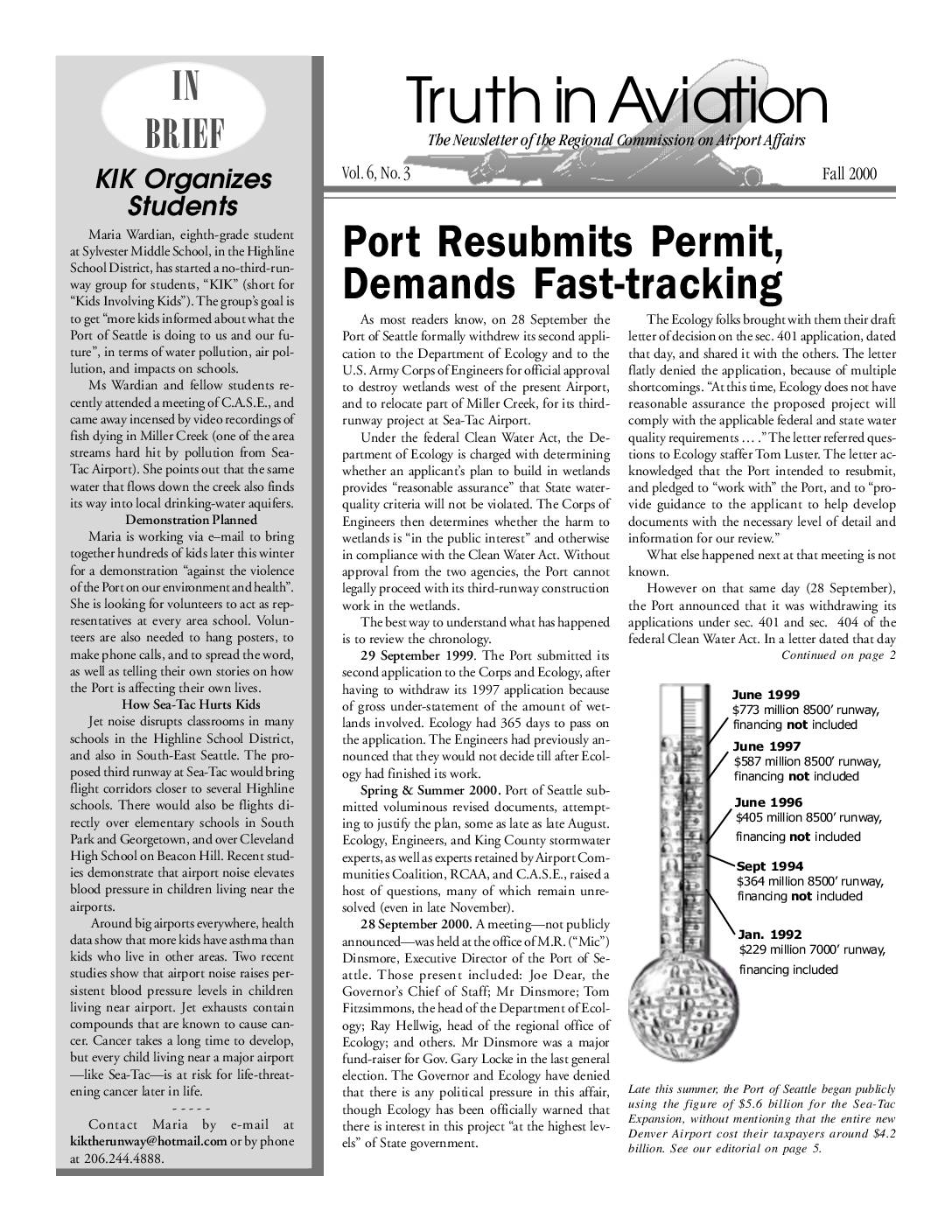
The Newsletter of the Regional Commission on Airport Affairs Vol. 6, No. 3 Fall 2000 ����� ��� ����� ������ �������� ������������� As most readers know, on 28 September the Port of Seattle formally withdrew its second appli- cation to the Department of Ecology and to the U.S. Army Corps of Engineers for official approval to destroy wetlands west of the present Airport, and to relocate part of Miller Creek, for its third- runway project at Sea-Tac Airport. Under the federal Clean Water Act, the De- partment of Ecology is charged with determining whether an applicant’s plan to build in wetlands provides “reasonable assurance� that State water- quality criteria will not be violated. The Corps of Engineers then determines whether the harm to wetlands is “in the public interest� and otherwise in compliance with the Clean Water Act. Without approval from the two agencies, the Port cannot legally proceed with its third-runway construction work in the wetlands. The best way to understand what has happened is to review the chronology. September 1999. The Port submitted its second application to the Corps and Ecology, after having to withdraw its 1997 application because of gross under-statement of the amount of wet- lands involved. Ecology had 365 days to pass on the application. The Engineers had previously an- nounced that they would not decide till after Ecol- ogy had finished its work. Spring & Summer 2000. Port of Seattle sub- mitted voluminous revised documents, attempt- ing to justify the plan, some as late as… -
 2022-09-12 15:24
NL Winter 2000v 4
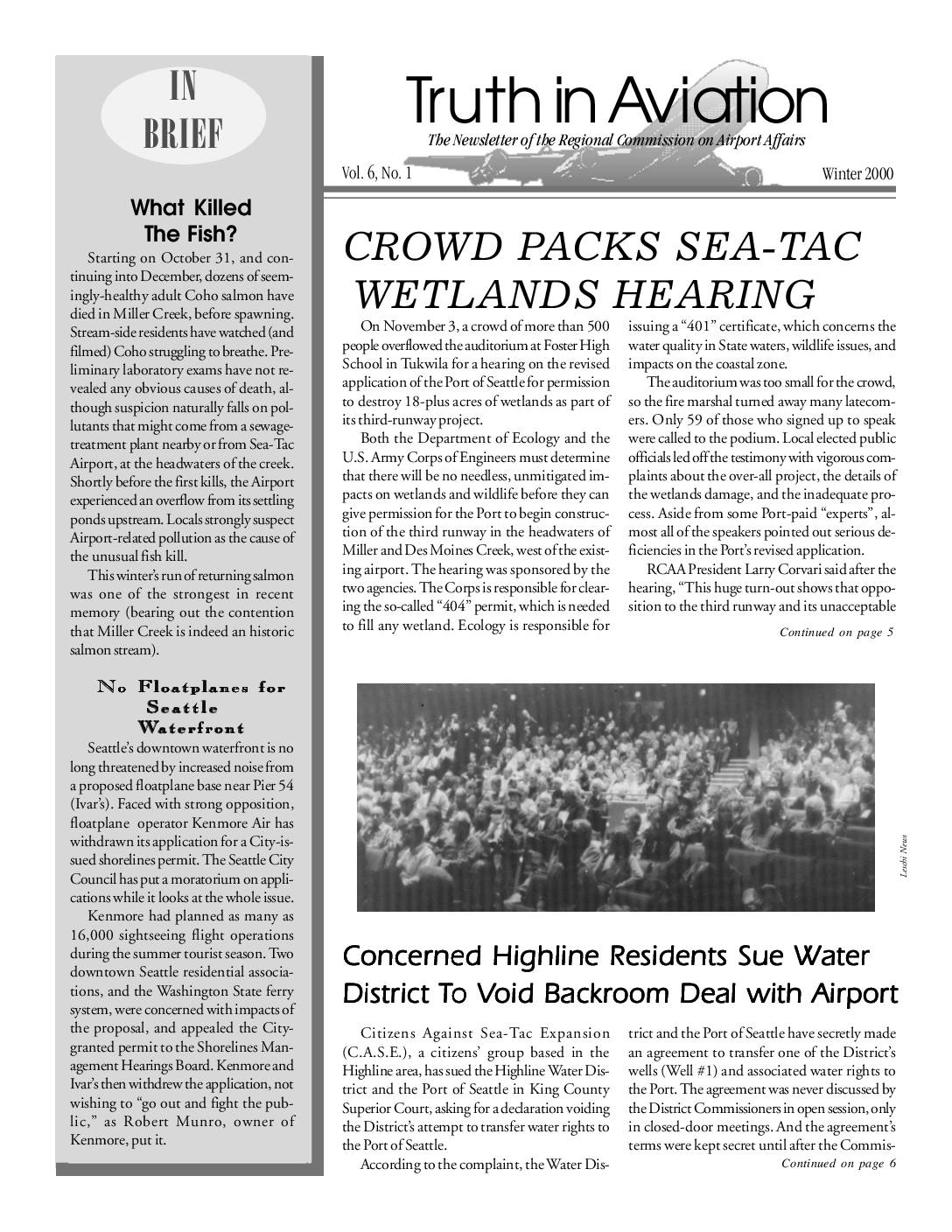
The Newsletter of the Regional Commission on Airport Affairs Vol. 6, No. 1 Winter 2000 CROWD PACKS SEA-TAC WETLANDS HEARING On November 3, a crowd of more than 500 people overflowed the auditorium at Foster High School in Tukwila for a hearing on the revised application of the Port of Seattle for permission to destroy 18-plus acres of wetlands as part of its third-runway project. Both the Department of Ecology and the U.S. Army Corps of Engineers must determine that there will be no needless, unmitigated im- pacts on wetlands and wildlife before they can give permission for the Port to begin construc- tion of the third runway in the headwaters of Miller and Des Moines Creek, west of the exist- ing airport. The hearing was sponsored by the two agencies. The Corps is responsible for clear- ing the so-called “404� permit, which is needed to fill any wetland. Ecology is responsible for issuing a “401� certificate, which concerns the water quality in State waters, wildlife issues, and impacts on the coastal zone. The auditorium was too small for the crowd, so the fire marshal turned away many latecom- ers. Only 59 of those who signed up to speak were called to the podium. Local elected public officials led off the testimony with vigorous com- plaints about the over-all project, the details of the wetlands damage, and the inadequate pro- cess. Aside from some Port-paid “experts�, al- most all of the speakers pointed out serious de- ficiencies in the Port’s… -
 2022-08-24 15:45
Port of Seattle Part 150 Your Comments Are Welcome Post Card
-
 2022-07-24 16:18
Sea-Tac Communities Plan Brochure (blue)
THE PROJECT. In March of 1973, the Port of Seattle Com- mission and the King County Council initiated a jointly sponsored study to develop a plan for the coordinated im- provement of Sea-Tac Internat ional Airport and surrounding communities . Based upon a detailed work program, and funded in part by a grant from the Federal Aviation Adminis- tration (FAA), the project was undertaken for the express purpose of determining how the Airport and its neighbors could best achieve maximum compatibility . The Sea-Tac Communities Plan, summarized by the text and exhibits that follow , represents the key end product of this important effort. THE AIRPORT. According to the latest published figures on passenger enplanements , Sea-Tac International Airport ranks as the 19th busiest air carrier airport in the United States. In 1974, a total of 5,772,216 passengers and 106,466 airline aircraft operations were handled by this public facility lo- cated in the southwestern part of King County some 15 miles south of Seattle . Starting from an in itial 906-acre site acquired by the Port of Seattle in 1942, the Sea-Tac Airport has been expanded and improved through the years to keep pace with the Pacific Northwest 's dynamic and specialized air travel market. Within its present boundary of 2,200 acres , the Airport now accom- modates a parallel runway airfield system ; a terminal com- plex designed to process up to 20 million passengers per year ; a computer-operated subway circulation network; and air cargo , aircraft maintenance,… -
 2011-11-10 00:00
Pfau Cochran third runway lawsuit.com post card 11/10/2011
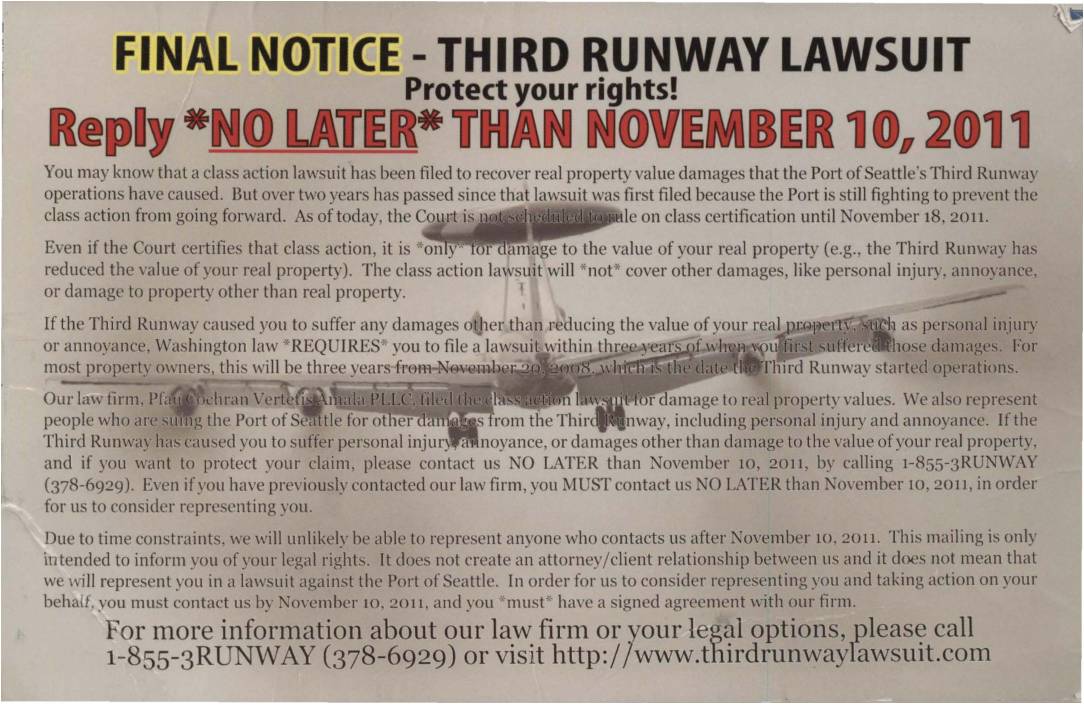
Rep y * 0 LAY R* T A OVEMBER 10,2011 You may know that a class action lawsuit has been filed to recover real property value damages that the Port of Seattle's Third Runway operations have caused. But over two years has passed since that lawsuit was first filed because the Port is still fighting to prevent the class action from going forward. As of today, the · on class certification until November 18, 2011. Even if the Court certifies that class action, it is to the value of your real property (e.g., the Third Runway has reduced the value of your real property). The class action lawsuit will *not* cover other damages, like personal injury, annoyance, or damage to property other than real property. If the Third Runway caused you to suffer any damages other than reducing the value of your real prQJilert~', su !:J. as personal injury or annoyance, Washington law *REQUIRES* you to file a lawsuit within three wlwB ~..ou first suffere hose damages. For most property owners, this will be three years from tlw date I bird Runway started operations. Our law firm, Pfm 'lLhran Vertet''L· mala PLLC, fill'd t• .......... ,.,.., people who are stung the Port of Seattle for other Cl. m Third Runway has caused you to suffer personal injur a noyance, or damages other than damage to the value of your real property, and if you want to protect your claim, please contact us NO LATER than November 10, 2011, by calling… -
 2009-07-01 00:00
Port of Seattle Air Mail Summer 2009
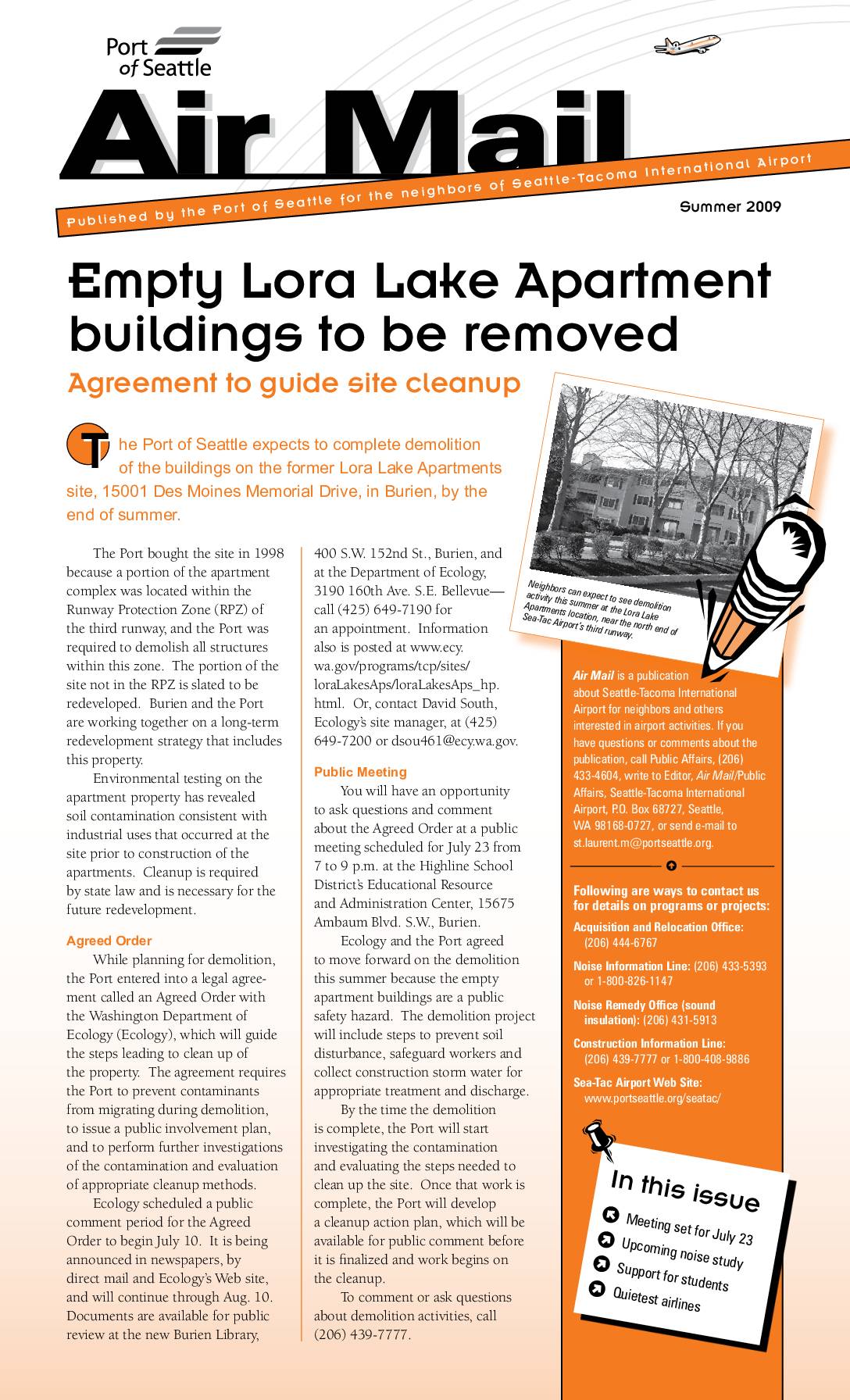
he Port of Seattle expects to complete demolition of the buildings on the former Lora Lake Apartments site, 15001 Des Moines Memorial Drive, in Burien, by the end of summer. The Port bought the site in 1998 because a portion of the apartment complex was located within the Runway Protection Zone (RPZ) of the third runway, and the Port was required to demolish all structures within this zone. The portion of the site not in the RPZ is slated to be redeveloped. Burien and the Port are working together on a long-term redevelopment strategy that includes this property. Environmental testing on the apartment property has revealed soil contamination consistent with industrial uses that occurred at the site prior to construction of the apartments. Cleanup is required by state law and is necessary for the future redevelopment. Agreed Order While planning for demolition, the Port entered into a legal agree- ment called an Agreed Order with the Washington Department of Ecology (Ecology), which will guide the steps leading to clean up of the property. The agreement requires the Port to prevent contaminants from migrating during demolition, to issue a public involvement plan, and to perform further investigations of the contamination and evaluation of appropriate cleanup methods. Ecology scheduled a public comment period for the Agreed Order to begin July 10. It is being announced in newspapers, by direct mail and Ecology’s Web site, and will continue through Aug. 10. Documents are available for public review at the new Burien Library, 400… -
 2001-08-30 20:46
RCAA Flyer Conveyor 2001
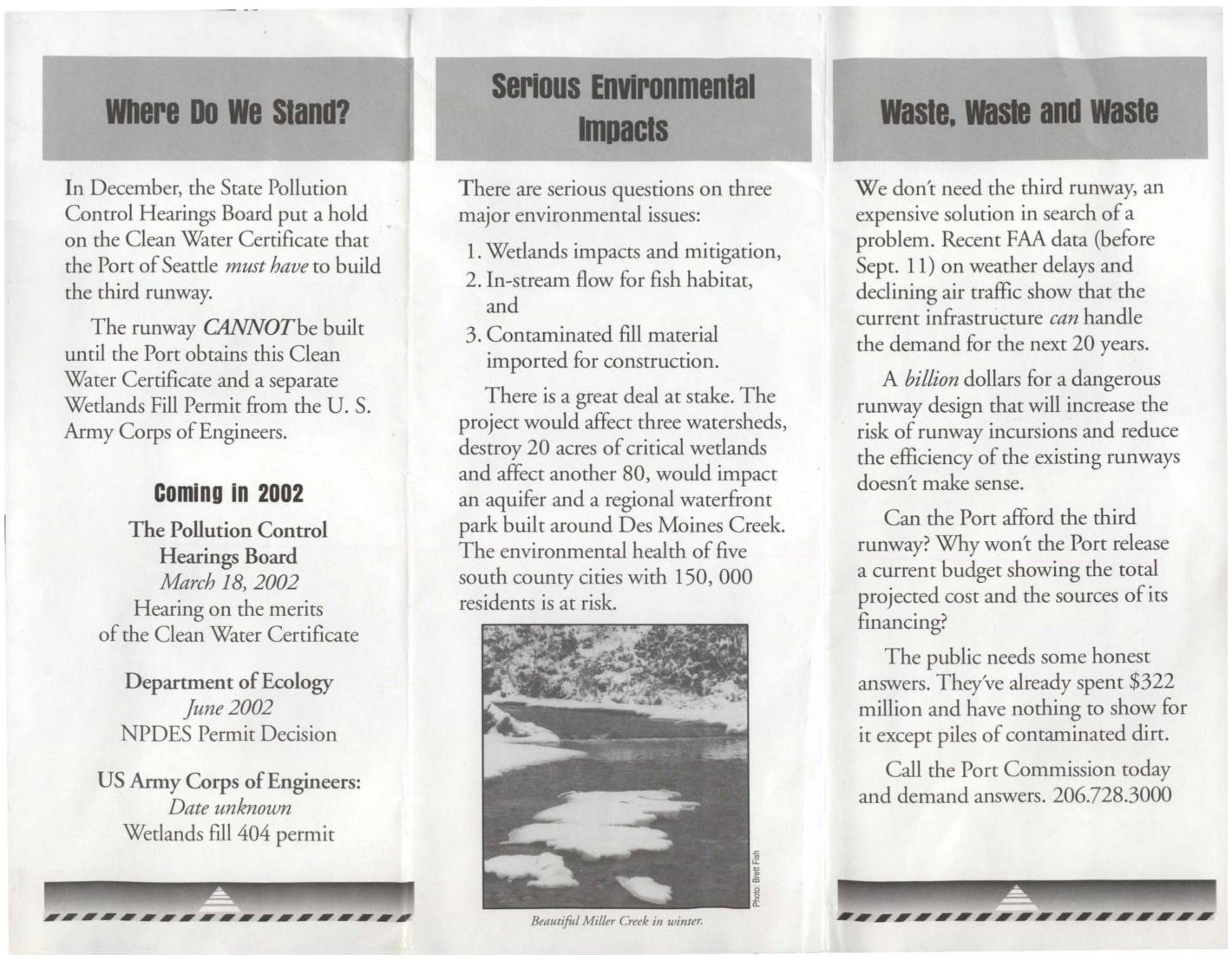
the Port of Seattle must have to build the third runway. The runway CANNOTbe built until the Port obtains this Clean Water Certificate and a separate Wetlands Fill Permit from the U.S. Army Corps of Engineers. coming in 2002 The Pollution Control Hearings Board March 18, 2002 Hearing on the merits of the Clean Water Certificate Department of Ecology June2002 NPDES Permit Decision US Army Corps of Engineers: Date unknown Wetlands fill404 permit il : Serious Environmental -CIS There are serious questions on three major environmental issues: 1. Wetlands impacts and mitigation, 2. In-stream flow for fish habitat, and 3. Contaminated fill material imported for construction. There is a great deal at stake. The project would affect three watersheds, destroy 20 acres of critical wetlands and affect another 80, would impact an aquifer and a regional waterfront park built around Des Moines Creek The environmental health of five south county cities with 150, 000 residents is at risk Beautifi<L MilLer Creek in winter. wasta, ··-· We don't need the third runway, an expensive solution in search of a problem. Recent FAA data (before Sept. 11) on weather delays and declining air traffic show that the current infrastructure can handle the demand for the next 20 years. A billion dollars for a dangerous runway design that will increase the risk of runway incursions and reduce the efficiency of the existing runways doesn't make sense. Can the Port afford the third runway? Why won't the Port release a current budget showing the… -
 2001-05-01 00:00
RCAA – Conveyor Belt Through Des Moines Flyer, 2001
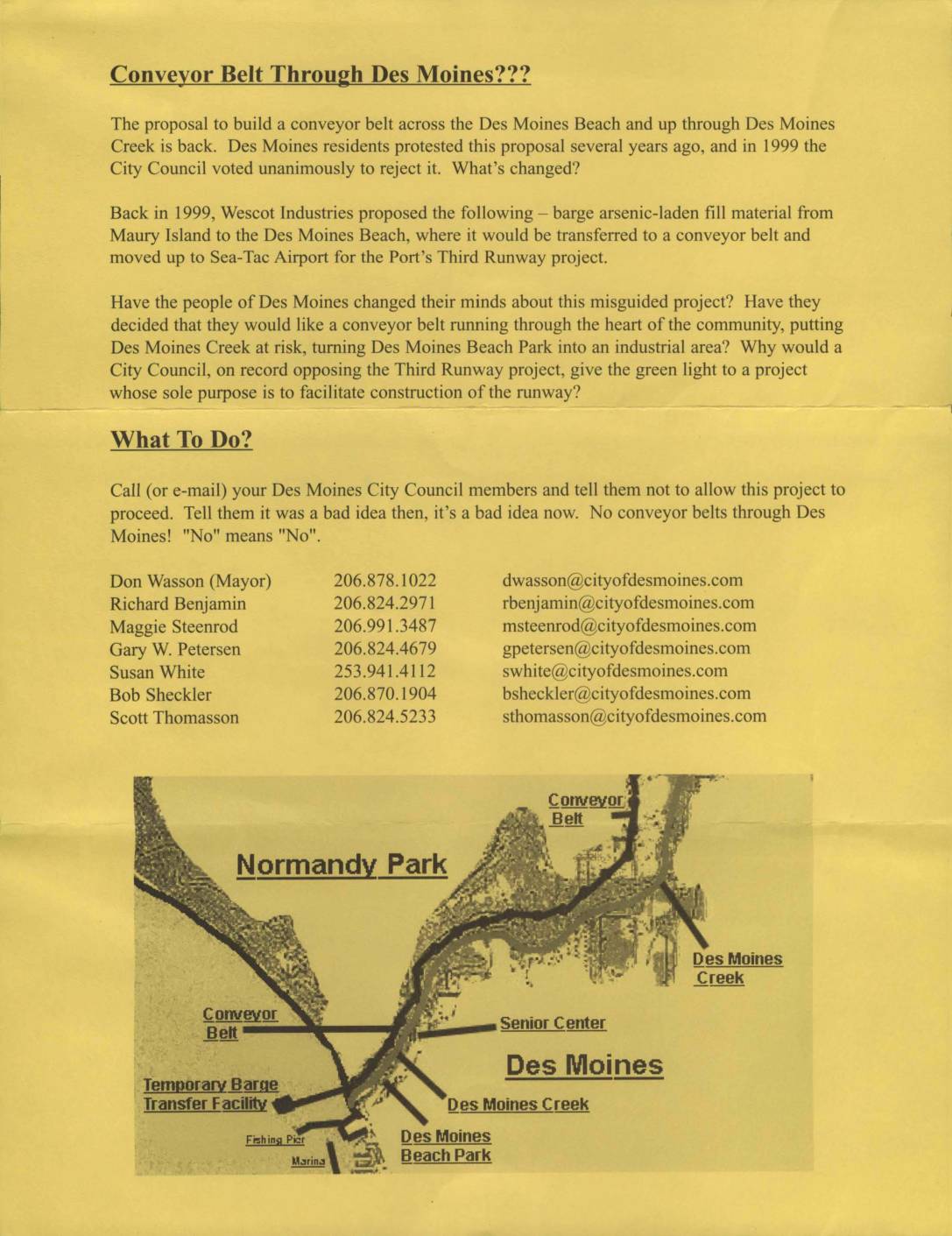
The proposal to build a conveyor belt across the Des Moines Beach and up through Des Moines Creek is back. Des Moines residents protested this proposal several years ago, and in 1999 the City Council voted unanimously to reject it. What's changed? Back in 1999, Wescot Industries proposed the following - barge arsenic-laden fill material from Maury Island to the Des Moines Beach, where it would be transferred to a conveyor belt and moved up to Sea-Tac Airport for the Port's Third Runway project. Have the people of Des Moines changed their minds about this misguided project? Have they decided that they would like a conveyor belt running through the heart of the community, putting Des Moines Creek at risk, turning Des Moines Beach Park into an industrial area? Why would a City Council, on record opposing the Third Runway project, give the green light to a project whose sole purpose is to facilitate construction of the runway? What To Do? Call (or e-mail) your Des Moines City Council members and tell them not to allow this project to proceed. Tell them it was a bad idea then, it's a bad idea now. No conveyor belts through Des Moines! "No" means "No". Don Wasson (Mayor) Richard Benjamin Maggie Steenrod Gary W. Petersen Susan White Bob Sheckler Scott Thomasson 206.878.1022 206.824.2971 206.991.3487 206.824.4679 253.941.4112 206.870.1904 206.824.5233 Normandy Park Temporary Barge Transfer F acilitv .-~-- dwasson@cityofdesmoines.com rben j amin@cityofdesmoines. com msteenrod@cityofdesmoines.com gpetersen@cityofdesmoines.com swhite@cityofdesmoines.com bsheckler@cityofdesmoines.com sthomasson@cityofdesmoines.com Des Moines -
 2001-04-01 00:00
RCAA Truth in Aviation – Vol. 6 No. 4, Spring 2001
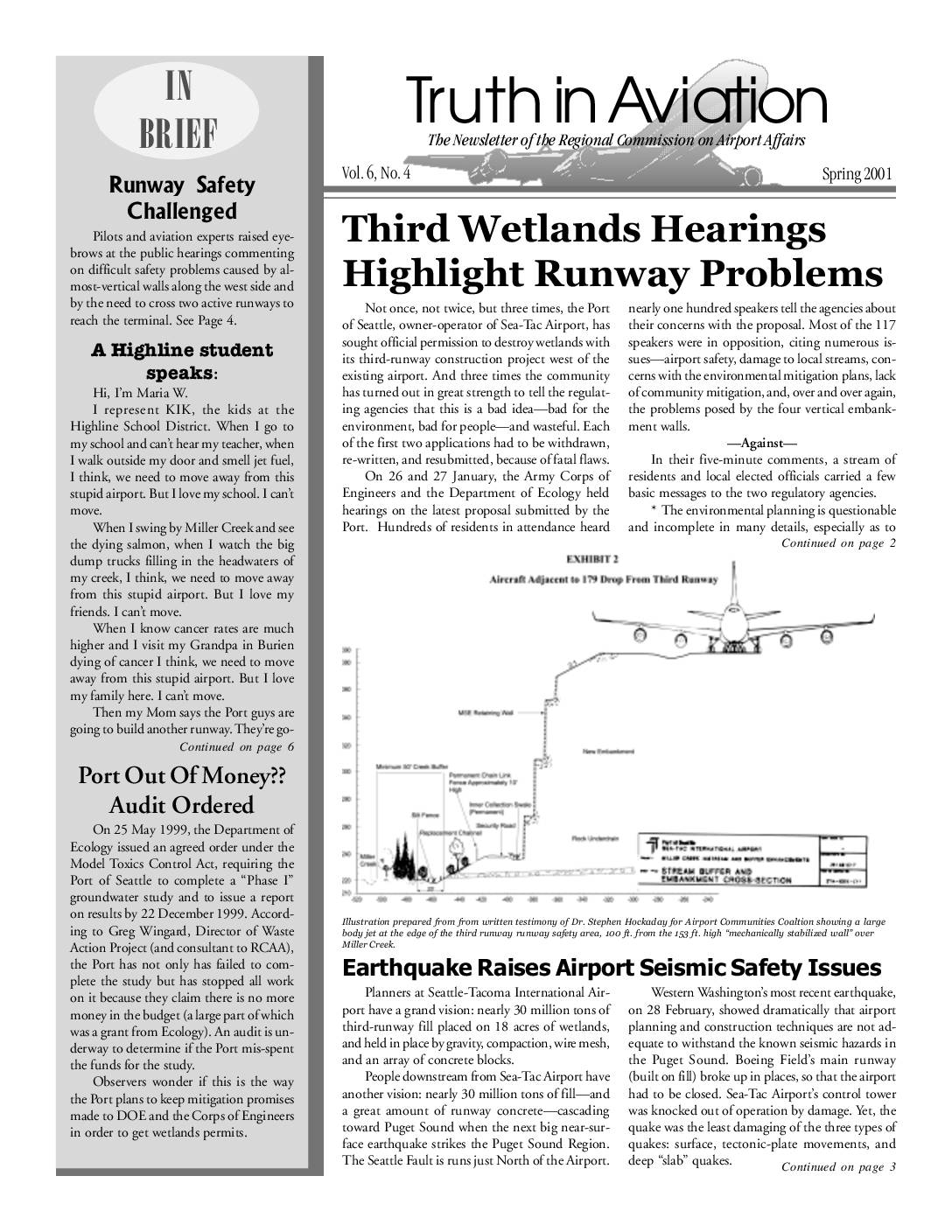
The Newsletter of the Regional Commission on Airport Affairs Vol. 6, No. 4 Spring 2001 IN BRIEF �������� ��� �������� ���� ��� ������������ �� Not once, not twice, but three times, the Port of Seattle, owner-operator of Sea-Tac Airport, has sought official permission to destroy wetlands with its third-runway construction project west of the existing airport. And three times the community has turned out in great strength to tell the regulat- ing agencies that this is a bad idea—bad for the environment, bad for people—and wasteful. Each of the first two applications had to be withdrawn, re-written, and resubmitted, because of fatal flaws. On 26 and 27 January, the Army Corps of Engineers and the Department of Ecology held hearings on the latest proposal submitted by the Port. Hundreds of residents in attendance heard nearly one hundred speakers tell the agencies about their concerns with the proposal. Most of the 117 speakers were in opposition, citing numerous is- sues—airport safety, damage to local streams, con- cerns with the environmental mitigation plans, lack of community mitigation, and, over and over again, the problems posed by the four vertical embank- ment walls. —Against— In their five-minute comments, a stream of residents and local elected officials carried a few basic messages to the two regulatory agencies. * The environmental planning is questionable and incomplete in many details, especially as to ���������� ��� ��� ���� ���� ������� �� ���� �� �������� �� �� �������� ������ ���� ��� ��� ��� ���� ��� �� �������� �… -
 1982-04-26 00:00
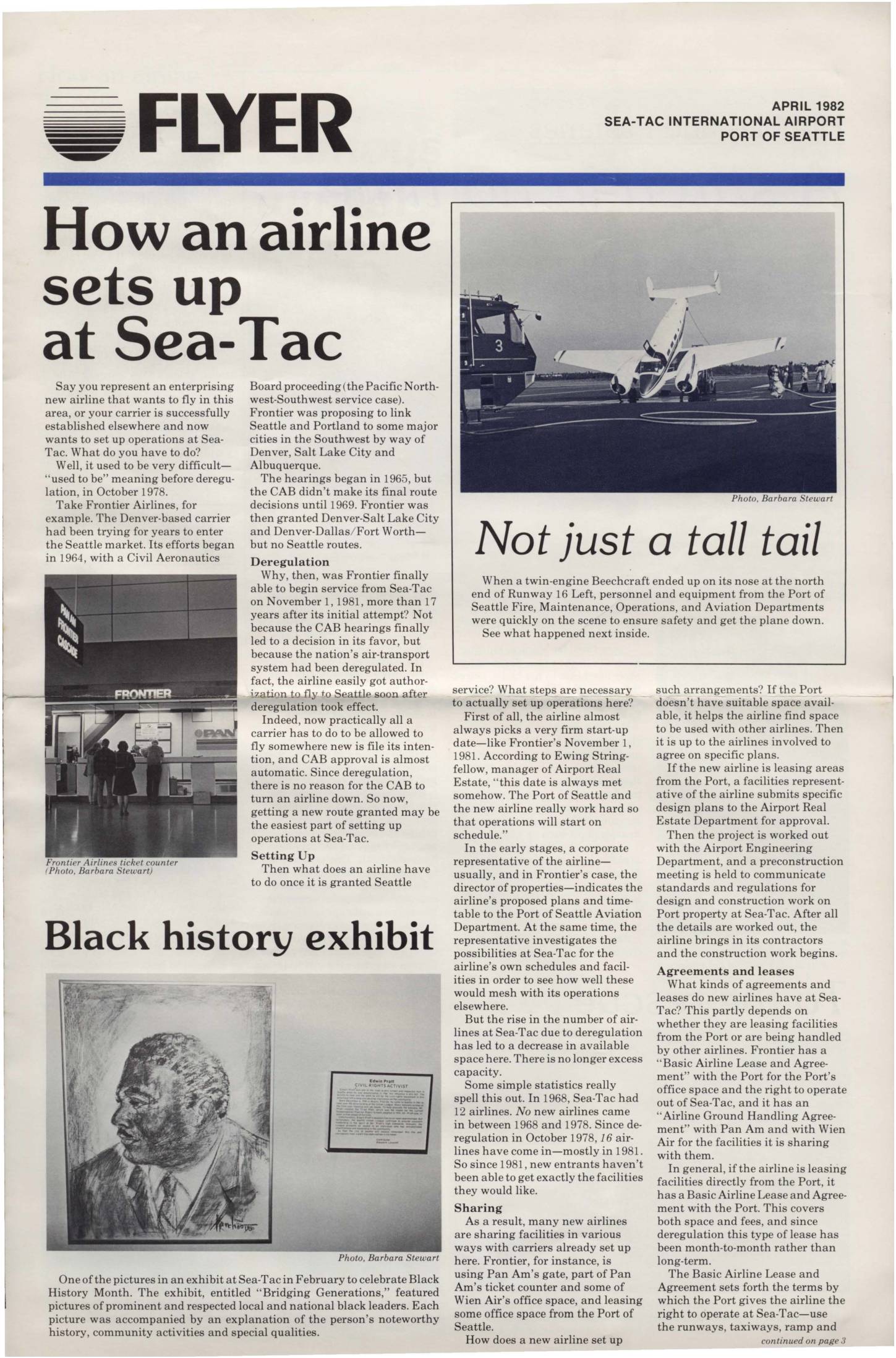
FLYER How an airline sets up at Sea-Tac