TagGreener Skies(28)
-
 2017-04-25
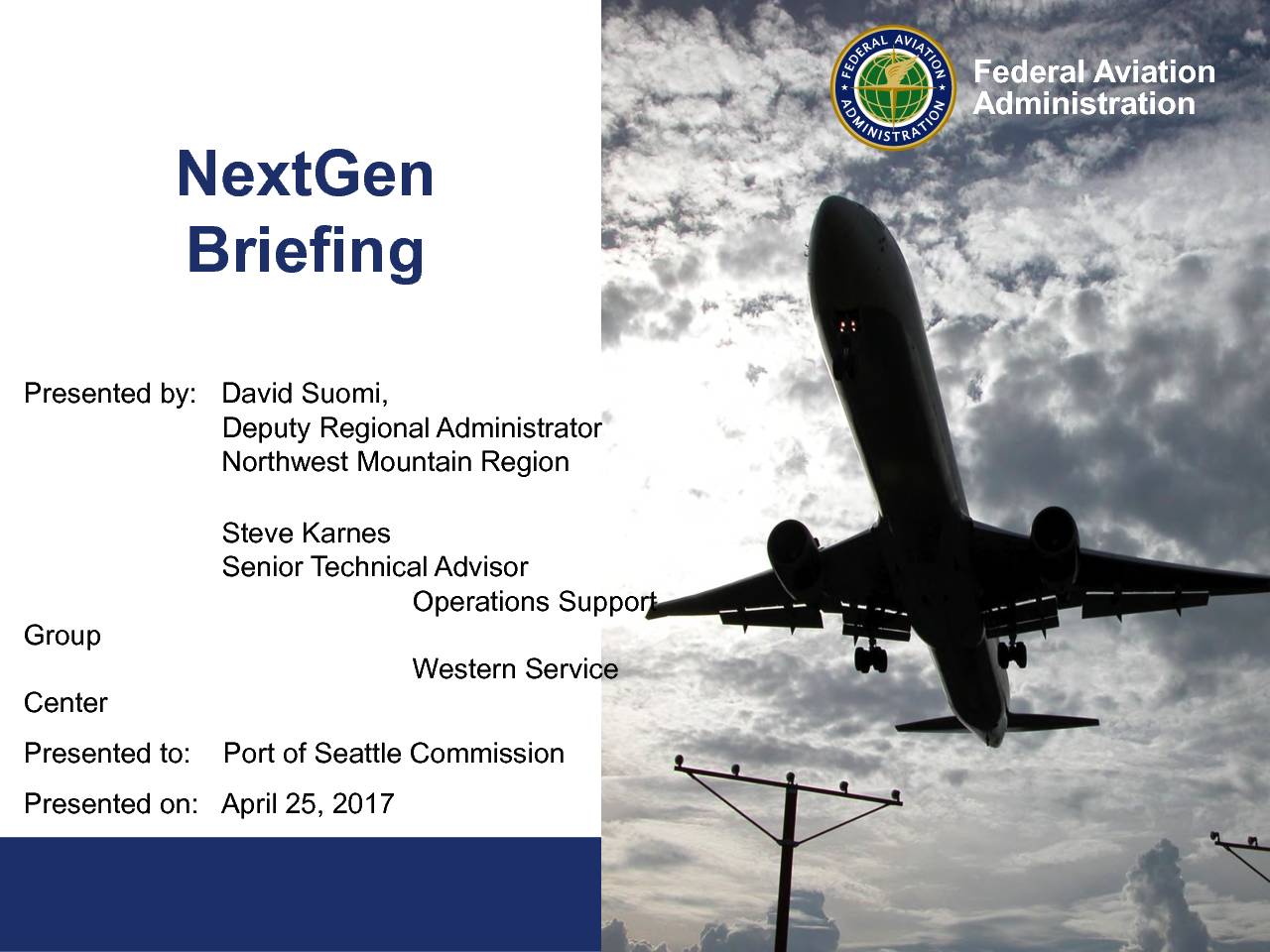
NextGen briefing
In April 2017, the Federal Aviation Administration (FAA) presented a NextGen briefing to the Port of Seattle Commission, outlining the agency's initiative to modernize the U.S. air traffic system. NextGen aims to improve safety, reduce flight delays, cut fuel consumption and emissions, and handle growing air travel demand. The briefing is relevant to Sea-Tac Airport stakeholders as these airspace changes can directly affect flight paths and noise impacts on surrounding communities. -
 2016-02-01
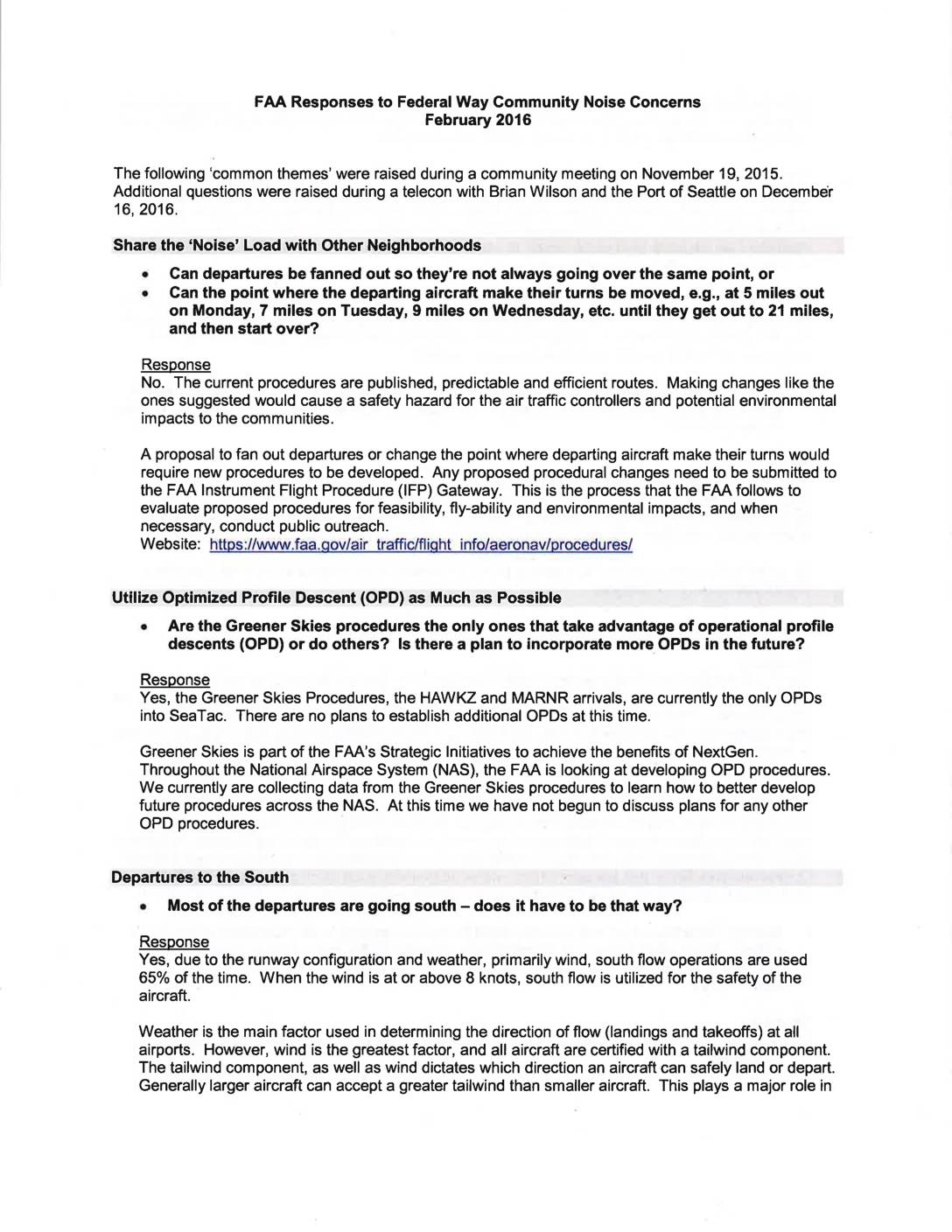
FAA Responses to Federal Way Community Noise Concerns
This February 2016 document contains FAA responses to noise complaints from Federal Way residents affected by Sea-Tac Airport flight operations. The FAA explains why departures are concentrated to the south 65% of the time due to wind and runway configuration, why flight paths cannot simply be rerouted or 'fanned out' to spread noise across neighborhoods, and why aircraft may appear lower than in the past despite following all published procedures. Any proposed changes to flight routes or procedures must be submitted through the FAA Instrument Flight Procedure (IFP) Gateway for safety, feasibility, and environmental review. -
 2013-04-01
NextGen air transportation system: FAA has made some progress in midterm implementation, but ongoing challenges limit expected benefits
A 2013 U.S. Government Accountability Office report found that the FAA made limited progress in modernizing the air transportation system through its NextGen initiative, with ongoing challenges reducing expected benefits. The report highlights the FAA's Greener Skies project at Seattle-Tacoma International Airport, initiated by Alaska Airlines, which aimed to shorten flight paths and route aircraft over water to save fuel, but excluded certain eastern flight procedures due to community concerns about aviation noise. The report notes that the full benefits of new flight procedures depend heavily on how often airlines and pilots actually use them. -
2013-03-13
Crosscut : Jet noise jeopardy: Seattle’s skies will soon get quieter — except on Beacon Hill
Describes the effects of NextGen and Greener Skies on the Beacon Hill neighborhood. Most of this applies to the Sea-Tac communities. -
 2013-03-07
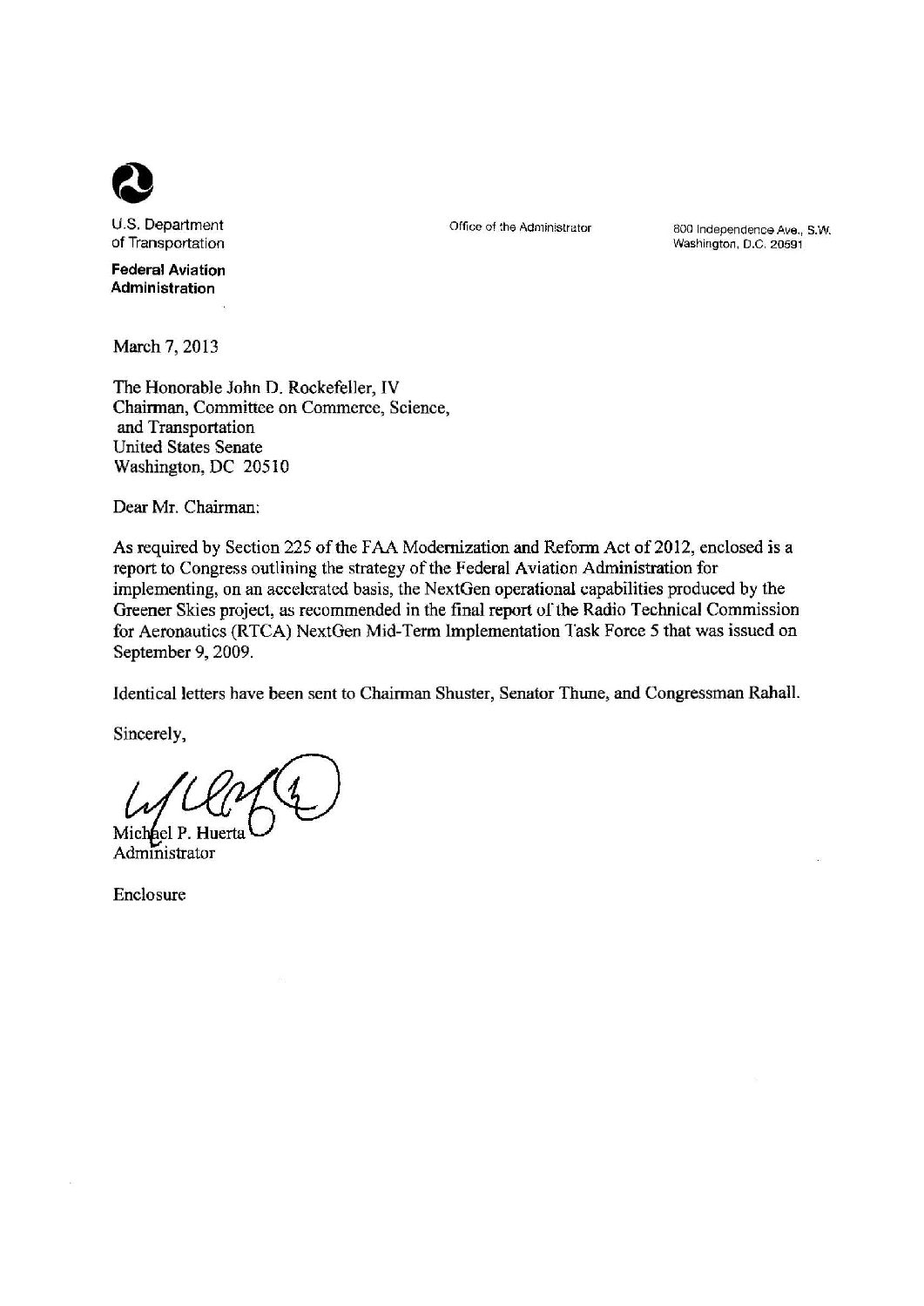
FAA report to Congress on Greener Skies NextGen implementation strategy
In March 2013, FAA Administrator Michael Huerta sent letters to key members of Congress reporting on the FAA's strategy to accelerate implementation of NextGen air traffic management capabilities developed through the Greener Skies project. The report was submitted as required by Section 225 of the FAA Modernization and Reform Act of 2012, and draws on recommendations from the RTCA NextGen Mid-Term Implementation Task Force 5 report issued in September 2009. The Greener Skies project aimed to modernize flight procedures in ways that could affect flight paths and noise exposure at airports such as Sea-Tac. -
STOP THE NOISE! Ears and a Voice for Beacon Hill & SE Seattle Citizens
Erik Stanford started this petition to Federal Aviation Administration & Port of Seattle Beacon Hill and Southeast Seattle have 80,000 residents. The community has the city’s largest populations of children, the elderly, disabled persons, people of color, and first-generation Americans who do not speak English as their first language. We are impacted by THREE airports; Renton Airport, -
 2012-11-01
Final Environmental Assessment for Greener Skies Over Seattle: Proposed Arrival Procedures to Seattle-Tacoma International Airport — Volume 2 Appendices
This November 2012 Federal Aviation Administration report evaluates the environmental impacts of proposed new arrival flight procedures at Seattle-Tacoma International Airport, part of the 'Greener Skies Over Seattle' initiative. It includes detailed appendices covering noise modeling, effects of aircraft noise on communities, historic and endangered species considerations, and agency coordination records. The goal of the proposed procedures was to reduce fuel consumption and emissions while assessing changes in noise exposure for surrounding neighborhoods. -
 2012-11-01
Finding of No Significant Impact (FONSI) and Record of Decision (ROD) for the Implementation of RNAV/RNP Procedures at Seattle-Tacoma International Airport (Greener Skies over Seattle)
In November 2012, the Federal Aviation Administration (FAA) issued a Finding of No Significant Impact (FONSI) and Record of Decision (ROD) approving new satellite-based navigation procedures at Seattle-Tacoma International Airport (Sea-Tac) under the 'Greener Skies over Seattle' initiative. The new procedures, developed with Alaska Airlines, Boeing, and the Port of Seattle, use advanced RNAV/RNP technology to guide arriving aircraft along more precise, optimized descent paths, reducing fuel burn and environmental impact. The FAA determined that these airspace changes would not result in significant environmental harm or any physical airport development. -
 2012-11-01
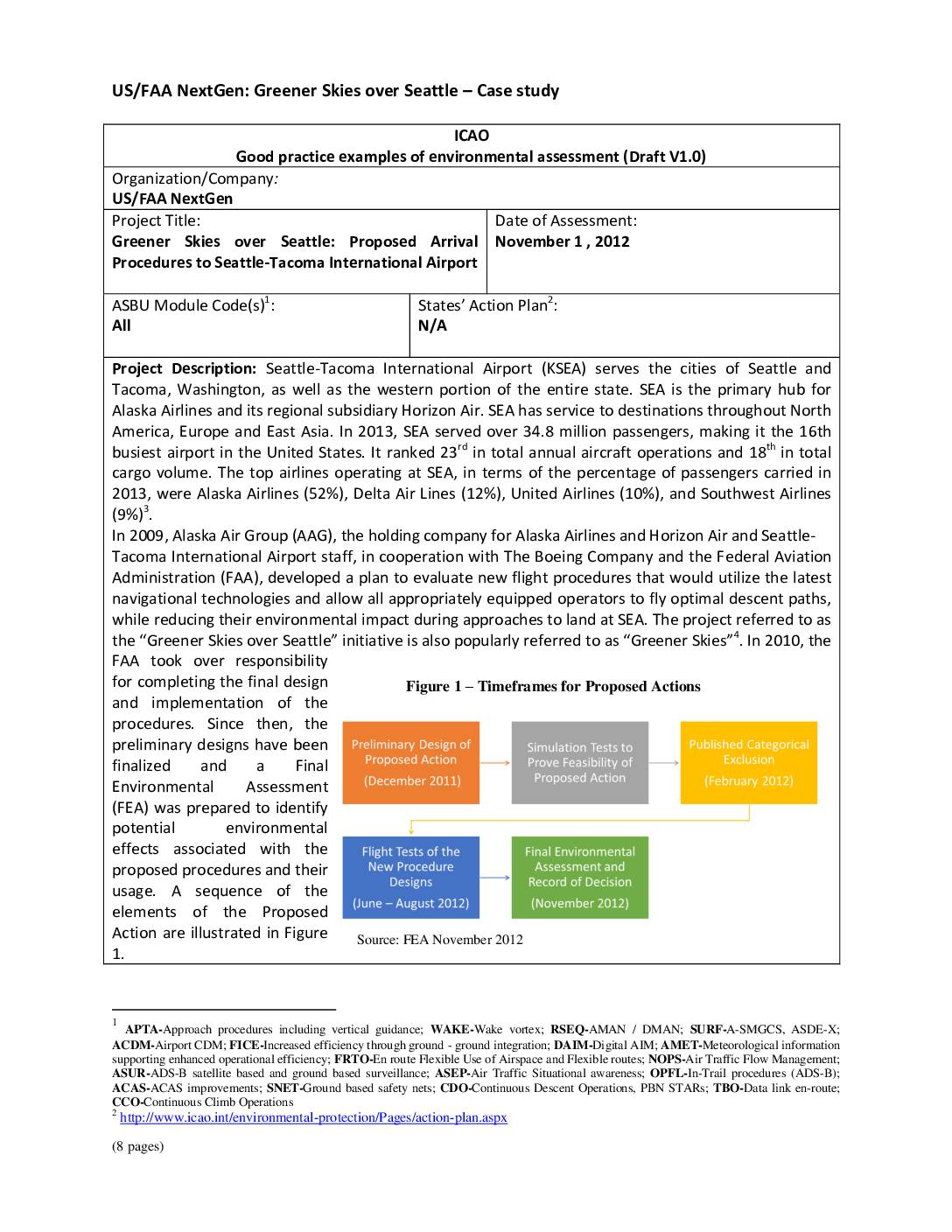
Greener Skies over Seattle: Proposed Arrival Procedures to Seattle-Tacoma International Airport — ICAO Good Practice Case Study
ICAO good practice case study documenting the US/FAA NextGen ‘Greener Skies over Seattle’ initiative — a Final Environmental Assessment (FEA) completed November 1, 2012 for proposed PBN arrival procedures (STARs and RNP with Optimized Profile Descents) at Seattle-Tacoma International Airport (KSEA/Sea-Tac Airport). Collaborative project between FAA, Alaska Air Group (Alaska Airlines, Horizon Air), The Boeing -
 2012-11-01
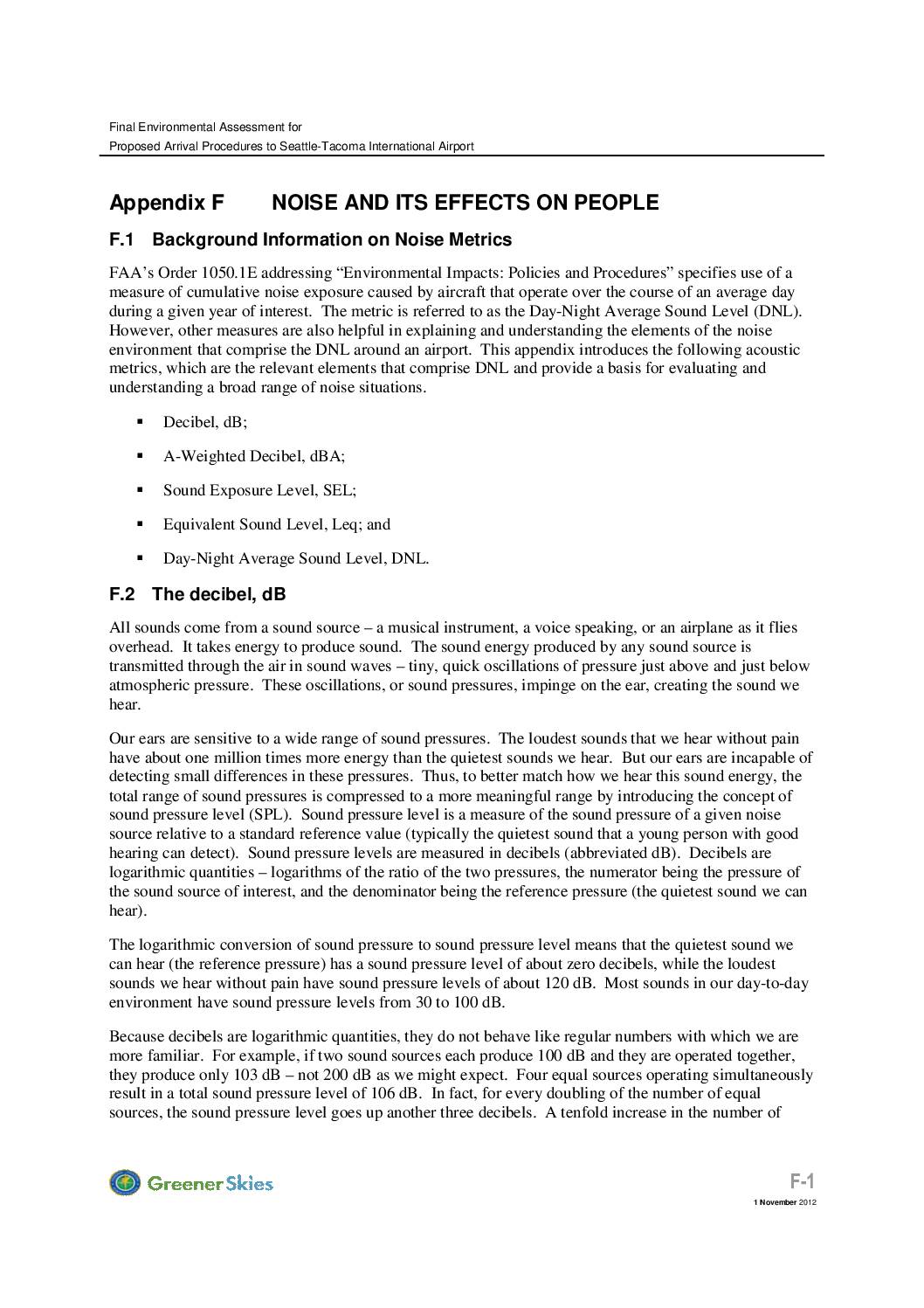
Final Environmental Assessment for Proposed Arrival Procedures to Seattle-Tacoma International Airport: Appendix F — Noise and Its Effects on People
This document explains the noise metrics used to evaluate aircraft noise around Seattle-Tacoma International Airport, including decibels (dB), A-weighted decibels (dBA), and the Day-Night Average Sound Level (DNL). It describes how sound is measured on a logarithmic scale, meaning noise levels don't add up the way ordinary numbers do, and explains why A-weighted measurements are the standard used by the FAA and EPA because they best match how human ears perceive sound. These concepts form the technical foundation for assessing the environmental impact of proposed flight arrival procedures at Sea-Tac.