The most requested documents–and all related-content
This page is an attempt to solve a problem we’ve had since the beginning: how to get visitors to study documents and all the related content which often provides the necessary context. For example, most studies are meant to be read by specialists. If you are a layperson, you may only be interested in the ‘one-pager’. This page shows you both.
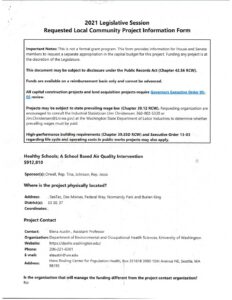
Healthy Schools: A School Based Air Quality Intervention
Discussion
Important Notes: This is not a formal grant program. This form provides information for House and Senate members to request a separate appropriation in the capital budget for this project. Funding any project is at the discretion of the Legislature. This document may be subject to disclosure under the Public Records Act (Chapter 42.56 RCW). Funds are available on a reimbursement basis only and cannot be advanced. All capital construction projects and land acquisition projects require Governors Executive Order 05- review. Projects may be subject to state prevailing wage law (Chapter 39.12 RCW). Requesting organization are encouraged to consult the Industrial Statistician (Jim Christensen: 360-902-5330 or Jim.Christensen@LrIi.wa.gov) at the Washington State Department of Labor Industries to determine whether prevailing wages must be paid. High-performance building requirements (Chapter 39.35D RCW) and Executive Order 13-03 regarding life cycle and operating costs in public works projects may also apply. Healthy Schools; A School Based Air Quality Intervention $912.810 Sponsor(s): Orwall, Rep. Tina, Johnson, Rep. Jesse Where is the project physically located? Address: , SeaTac, Des Moines, Federal Way, Norrnandy Park and Burien King District(s): 33 30, 37 Coordinates: , Project Contact Contact: Elena Austin , Assistant Professor Organization: Department of Environmental and Occupational Health Sciences, University of Washington Website: https://deohs.washington.edu/ Phone: 206-221 -6301 E-mail: elaustin@ uw.edu Hans Rosling Center for Population Health, Box 351618 3980 15th Avenue NE, Seattle, WA i:TIM=:::,„„_ I„. w„_.[„„„„j„„_. I„„ I Address:
Herbert Engineering Carbon Footprint Study for the Asia to North America

Discussion
Carbon Footprint Study for the Asia to North America Intermodal Trade Table of Contents Table of Contents EXECUTIVE SUMMARY ........................................................................................................................I STUDY OVERVIEW ..............................................................................................................................1 KEY FACTS AND FINDINGS ..................................................................................................................2 2.1 General 2.2 Regional 2.2.1 Pacific Northwest (Prince Rupert and Seattle) 2.2.2 California Ports (Los Angeles / Long Beach and Oakland) 2.2.3 Southern East Coast (Houston and Savannah) 2.2.4 Northern East Coast (New York and Norfolk) METHODOLOGY .................................................................................................................................4 3.1 Container Ships 3.1.1 Maximum Continuous Ratings of Propulsion and Auxiliary Engines 3.1.2 Load Factors for Container Ships 3.1.3 Activity Time in Mode 3.1.4 Emission Factors 3.1.5 Speed‐ Power Curve 3.1.6 Fuel Consumption 3.1.7 Utilization 3.2 Locomotives 3.2.1 Maximum Continuous Ratings for Locomotives 3.2.2 Load Factors for Locomotives 3.2.3 Activity Time in Mode 3.2.4 Emission Factors for Locomotives 3.3 Heavy Duty Diesel Vehicles Carbon Footprint Study for the Asia to North America Intermodal Trade Table of Contents
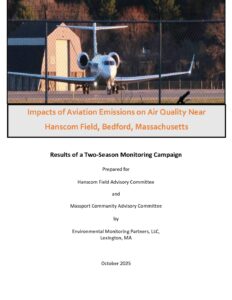
Impacts of Aviation Emissions on Air Quality Near Hanscom Field, Bedford, Massachusetts – Results of a Two-Season Monitoring Campaign
Leigh-Fisher Sea-Tac Airport Air Quality Criteria Pollutant Emissions Inventory Task 2.8
Discussion
EDMS was used to estimate emissions from non‐road mobile sources, such as, aircraft engines, auxiliary power units, ground support equipment, ground access vehicles, training fires, and stationary sources, such as generators, commercial kitchens, cooling towers, boilers, and bulk liquid storage tanks. For this evaluation, detailed airport activity characteristics were collected to model each of these sources. Relative to what is typically the dominant airport source (aircraft), data was collected and incorporated into EDMS details on types of aircraft, engine combinations, number of landing and takeoffs (LTOs), and the operating time in each of the LTOs modes (takeoff, climbout, taxi-idle, startup, and approach). The purpose of this paper is to supplement the Protocol document that was prepared before the analysis was initiated, but documenting the assumptions that produced the results to be used as the existing conditions in the SAMP.
McClure Community Attitude Survey (Noise Remedies for the Airport Community) 1983-10
Discussion
D. Awareness of Airport Noise Remedy Update Program 45 APPENDIX I. I. • INTRODUCTION A. Purpose of Study The Port of Seattle is currently in the process of updating the 1976 Noise Remedy Plan for the Airport Community. Final recommendations concerning appropriate noise remedies that can be applied within the community will take into consideration at least three parameters: o cost feasibility and effectiveness of program options o implementation feasibility o the community's views and concerns The third parameter -- the community's perspective-- has been actively explored through the Community Involvement Program component of the Update process, including a series of Port- sponsored neighborhood workshops, regular meetings of a Technical Advisory Working Committee, and a series of surveys in the community. This report covers the findings of the community surveys, which will be used as a guideline to determine: o suitability and acceptability of various noise remedy programs in the community (in particular: purchase guarantee, cost sharing of noise insulation, direct purchase of homeowners' avigation easements) o likely participrtion rates for each program option, in order to project the financial feasibility of various combinations of programs. o probable rate of participation in a purchase guarantee program in terms of time to help establish an overall program schedule o level of the Port's financial participation in program options. The issues relevant to providing this input to the Port's planning were divided into two general categories and covered in two separate random sample surveys: o Overall noise management issues, such as residential…
McCulley, Frick & Gilman Final Air Quality Survey for Sea-Tac Airport 1993
Discussion
..... ) Executive Summary . . . . . . . . . . . . . . . . . . . . . . . . . . . . . . . . . . . . . . . . . . . . . . . . . . . . . . . . . . . . iii 1.0 Introduction . . . . . . . . . . . . . . . . . . . . . . . . . . . . . . . . . . . . . . . . . . . . . . . . . . . . . . . . . . . . 1 1.1 Background . . . . . . . . . . . . . . . . . . . . . . . . . . . . . . . . . . . . . . . . . . . . . . . . . . . . . . 1 1.2 Objectives & Study Overview . . . . . . . . . . . . . . . . . . . . . . . . . . . . . . . . . . . . . . . . . 2 2.0 Sampling Methodology . . . . . . . . . . . . . . .…
MOA – Air Quality Monitoring at Sea-Tac Vicinity, October 15, 1996
Discussion
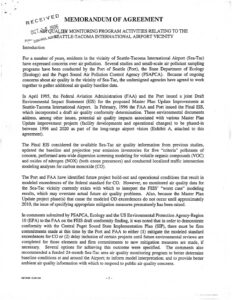
. €. c s '-J €. 0 MEMORANDUM OF AGREEJ.IIENT R . oCI ~ d~~r;Eti MONITORING PROGRAM ACTIVITIES RELATING TO THE . . · oL p..Gt~ATTLE-TACOMA INTERNATIONAL AIRPORT VICINITY ~0~-- cotf ~ Introduction For a number ·of years, residents in the vicinity of Seattle-Tacoma International Airport (Sea-Tac) have expressed concerns over air pollution . . Several studies and small-scale air pollutant sampling programs have been conducted by the Port of Seattle (Port), the State Department of Ecology (Ecology) and the Puget Sound Air Pollution Control Agency (PSAPCA). Because of ongoing concerns about air quality in the vicinity of Sea-Tac, the undersigned agencies have agreed to work together to gather additional air quality baseline data. In April 1995, the Federal Aviation Administration (FAA) and the Port issued a joint Draft Environmental Impact Statement (EIS) for the proposed Master Plan Update Improvements at Seattle-Tacoma International Airport. In February, 1996 the FAA and Port issued the Final EIS, which incorporated a draft air quality conformity determination. These environmental documents address, among other issues, potential air quality impacts associated with various Master Plan Update improvement projects (facility developments and operational changes) to be phased-in between 1996 and 2020 as part of the long-range airport vision (Exhibit A, attached to this agreement). The Final EIS considered the available Sea-Tac air quality information from previous studies, updated the baseline and projection year emission . inventories for five "criteria" pollutants of concern, performed area-wide dispersion screening modeling for volatile organic. compounds (VOC) _ and oxides of nitrogen…
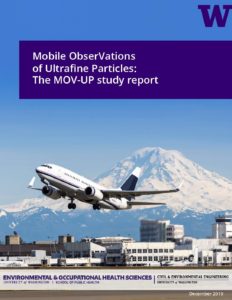
Mobile ObserVations of Ultrafine Particles: The MOV-UP study report
Modeling variability in air pollution-related health damages from individual airport emissions – Stefani L. Penn
Discussion
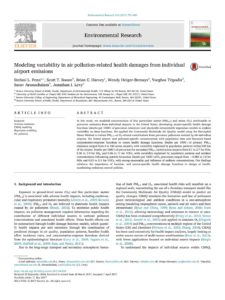
Modeling variability in air pollution-related health damages from individual airport emissions Stefani L. Penna,⁎, Scott T. Booneb, Brian C. Harveyc, Wendy Heiger-Bernaysa, Yorghos Tripodisd, Sarav Arunachalamb, Jonathan I. Levya a Boston University School of Public Health, Department of Environmental Health, 715 Albany St 4W Boston, MA 02118, United States b University of North Carolina at Chapel Hill, UNC Institute for the Environment, 100 Europa Dr., Chapel Hill, NC 27517, United States c Boston University College of Engineering, Department of Biomedical Engineering, 44 Cummington Mall, Boston, MA 02215, United States d Boston University School of Public Health, Department of Biostatistics, 801 Massachusetts Ave., Boston, MA 02118, United States A R T I C L E I N F O Keywords: Aviation emissions CMAQ modeling Regression modeling Air pollution A B S T R A C T In this study, we modeled concentrations of fine particulate matter (PM2.5) and ozone (O3) attributable to precursor emissions from individual airports in the United States, developing airport-specific health damage functions (deaths per 1000 t of precursor emissions) and physically-interpretable regression models to explain variability in these functions. We applied the Community Multiscale Air Quality model using the Decoupled Direct Method to isolate PM2.5- or O3-related contributions from precursor pollutants emitted by 66 individual airports. We linked airport- and pollutant-specific concentrations with population data and literature-based concentration-response functions to create health damage functions. Deaths per 1000 t of primary PM2.5 emissions ranged from 3 to 160 across airports, with variability explained by population patterns within 500…
Neighborhood Impact Matrices of proposed Third Runway Raytheon-Thomas/Lane (1996)
Discussion
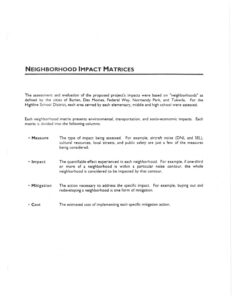
The assessment and evaluation of the proposed project's impacts were based on "neighborhoods" as defined by the cities of Burien, Des Moines, Federal Way, Normandy Park, and Tukwila. For the Highline School District, each area served by each elementary, middle and high school were assessed. Each neighborhood matrix presents environmental, transportation, and socio-economic impacts. Each matrix is divided into the following columns: • Measure • Impact • Mitigation • Cost The type of impact being assessed. For example, aircraft noise (DNL and SEL). cultural resources, local streets, and public safety are just a few of the measures being considered. The quantifiable effect experienced in each neighborhood. For example, if one-third or more of a neighborhood is within a particular noise contour, the whole neighborhood is considered to be impacted by that contour. The action necessary to address the specific impact. For example, buying out and redeveloping a neighborhood is one form of mitigation. The estimated cost of implementing each specific mitigation action. NEIGHBORHOOD Et~~ v IRONMENTAL IMPACTS MEASURE ! IMPACT MITIGATION NOISE AND VIBRATION DNL SEL , · ,. ·, 1) 1/3 or more of a neighborhood is in the 65 DNL 11) Buyout and redevelop contour (and higher) 2) 113 or more of a neighborhood is in the 60 to 65 I 2) Easement and insulation DNL contour Neighborhoods within the 400' topographic line that are also within 5 miles of the airport. Easement and insulation 1) $760,000/acre 2) $37,500/acre $37,500/acre ; !::;;!::,~{~'~ ~.;:::'ber of minutes per average annual…
NEST Development Properties around Sea-Tac (6882)
Noise Exposure Update
Discussion
2.1 Study Scope and Purpose . . . . . . . . . . . . . 2.2 Organization . . 2.3 Sponsors. . . . . . . . . . . . 2.4 Consultants . . . . . . . . . . . . . . . . 2·5 Participants. . . . . . . . . . . . . . EXISTING CONDITIONS 3.1 Introduction. • • • • • • • • . • . •••• 3.2 Airport Facilities. • • • • • . . • ••••• 3.4 3.5 3.6 3.2.1 Runway and Taxiway System •••••••• 3. 2. 2 Passenger Terminal Facilities • • • • • • . • • • • 3.2.3 General Aviation Facilities • 3.2.4 Air Cargo Facilities. • • ••••• Aircraft Operations • • • 3.3.1 Fleet Mix ••••••••••• 3.3.2 Runway and Flight Track Utilization 3.3.3 Aircraft Fleet Noise Compliance •• Noise Monitoring System • • • • • • • • • • • • 3.4.1 Permanent Airport Noise Monitoring System 3.4.2 Portable Noise Meter ••••••••••• 3.4.3 Noise Monitoring Programs at Other Airports • Environment • • • • • • • • • • • • • • • • • Noise 3. 5.1 3.5.2 3.5.3 3.5.4 3.5.5 3.5.6 Climate 3. 6.1 3.6.2 Aircraft Noise Description Methodologies •• Aircraft Noise Levels • • • • • Ambient Noise Levels Maintenance Runup Noise Levels •• Taxiing Noise Levels ••.•.•••. Total Noise Environment • Meteorological Records…
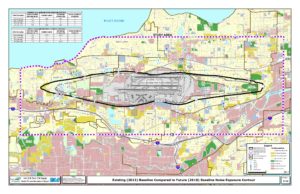
Part 150 Study 2013 vs 2018 NEM Comparison
Discussion
!Existing (2013) Baseline Compared to Future (2018) Baseline Noise Exposure Contour Exhibit:3-16 ± ! ! ! Airport Property Boundary Municipal Boundary Hospitalv Churchæ Schooln Water Nursing Home× Libraryc Existing Land Use Single-Family Residential Two-Family Residential Multi-Family Residential Agriculture/Open Space Park/Recreation Institutional Commercial/Industrial Mobile Home Park Future (2018) Baseline Noise Exposure Contour Existing (2013) Baseline Noise Exposure Contour Study Area PUGET SOUND CONTOUR BAND CONTOUR AREA (SQUARE MILES) HOUSING UNITS ESTIMATED POPULATION NOISE SENSITIVE FACILITIES DNL 65-70 dBA 4.4 3,771 9,712 9 DNL 70-75 dBA 1.8 0 0 0 DNL 75+ dBA 1.1 0 0 0 DNL 65+ dBA 7.3 3,771 9,712 9 FUTURE (2018) BASELINE NOISE EXPOSURE CONTOUR CONTOUR BAND CONTOUR AREA (SQUARE MILES) HOUSING UNITS ESTIMATED POPULATION NOISE SENSITIVE FACILITIES DNL 65-70 dBA 3.7 1,887 4,879 9 DNL 70-75 dBA 1.3 0 0 0 DNL 75+ dBA 0.9 0 0 0 DNL 65+ dBA 5.9 1,887 4,879 9 EXISTING (2013) BASELINE NOISE EXPOSURE CONTOUR DNL 65 dBA ! FINAL 5/30/2013 Prepared by Landrum & Brown Filename: P:SEAPart 150 Update - 2009GIS MXDExhibitsDocument3-16_Existing_Baseline_ vs_Future_2018_Baseline.mxd Contours: SEA2013Noise-Contours/SEA2018Noise-Contours
Planning For The Airport And Its Environs: ‘The Sea-Tac Success Story’ 09/1977
Discussion
In the absence of such guidance, what may be termed a "let them sue" approach was essentially followed by the Port during the period from 1957 to 1972.
Port of Seattle/City of SeaTac Joint Transporation Study Fact Sheet February 1999
Discussion
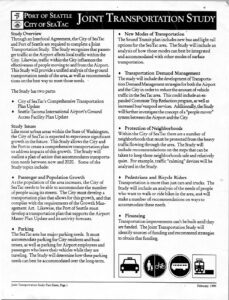
Thlough an Interlocal Agreement, the City ofSeaTac and Port of Seattle are required D complete a Joint Transportation Study. The Study recognizes that passen- ger traffic at the Airport affects local traffic within the CiV Likewise, aMc withinthe City influences the e£fectiveness o£people movingto and fromt:he Airport. This Study will provide a'uni6ed analysis of the ground transportation needs of the area, as well as recommend& tions on the best way n meet those needs. ' The Study has two parts: City ofSeaTac’s Comprehensive Transportation Plan Update Seattle-Tacoma International Airport’s Ground Access Facility Plan Update + + Study Issues Like most urban areas within the State of Washington, the City of SeaTac is expected to experience significant growth in the future. This Study allows the City and the Port to create a comprehensive transportation plan to address impacts of this growth. The Study will outline a plan of action that accommodates transport& tion needs between now and 2020. Some of the Study topics include: + Passenger and Population Growth As the population of the area increases, the City of SeaTac needs to be able to accommodate the number of peopie using its streets. The City must develop a transponat:ion plan that allows for this growth, and that complies with the requirements of the Growth Man- agement: Act. Likewise, the Port of Seattle must develop a transportation plan that supports the Airport Master Plan Update and its activity forecasts. + Parking The SeaTac area has major parking needs. It must accommodate parking…
Preliminary Assessment Of Airspace Interactions Draft Working Paper
Projecting the Health and Economic Burden of Aircraft Noise – Final Report
Discussion
Projecting the health and economic burden of aircraft noise Authors: Zafar Zafari, MSc, PhD University of Maryland School of Pharmacy Jeong-eun Park, MS University of Maryland School of Pharmacy
Property Acquisition Feasibility Study July 1997 (6214)
PSCAA 2015 Greenhouse Gas Emissions Inventory
PSRC Regional Airport System Plan RASP 2001
Discussion
2030DESTINATIONThe 2001 Regional Airport System Plan is a Modal Component of Puget Sound Regional Council PSRC August 2001 Puget Sound Regional Council 2001 Regional Airport System Plan August 2001 This report was prepared by Puget Sound Regional Council Staff with input from the Regional Airport System Plan Advisory Committee The 2001 Regional Airport System Plan is a Modal Component of Destination 2030 the Metropolitan Transportation Plan for the Central Puget Sound Region Disclaimer The preparation of this report was financed in part through a planning grant from the Federal Aviation Administration (FAA). The grant was provided under Section 505 of the Airport and Airway Improvement Act of 1982, as amended by the Aviation Safety and Capacity Expansion Acts of 1987 and 1990, and the Airport Noise and Capacity Act of 1990. The contents do not necessarily reflect the official views or policy of the FAA. Acceptance of this report by the FAA under the terms of the scope of work and the grant agreement does not in any way constitute a commitment on the part of the United States to participate in any policy, plan, or development depicted herein, nor does it indicate that the proposed policy, plan, or development is environmentally acceptable in accordance with appropriate public laws. For additional information or to obtain copies of the 2001 Regional Airport System Plan report, please contact the Puget Sound Regional Council’s Information Center at 1-206-464-7532 or infoctr@psrc.org Regional Airport System Plan Project Team The following members of the Regional Airport…