Skip to content
  • STNI
  • Statistics
    • Ops and Passengers
      • King County International Airport (Boeing Field) Annual Operations
    • Financials
    • Aviation fuel uplift in the State of Washington 2018 – 2025
      • Aviation Fuel Tax Revenue in the State of Washington 1983-2025
      • Aviation Fuel Uplift at Sea-Tac Airport
    • Air Quality Monitoring
    • Flight Tracking
      • Flow and Flight Tracks
      • Five Year Comparison
      • Busiest Hours and Days
    • SEL Noise Reports & Graphs
      • About The Permanent Noise Monitors
      • Minutes of Quiet by Noise Monitor
      • Noise Events mapped
      • Noise Events (SEL)
    • Runways
    • Employees
    • Real Estate
      • Port Properties and Trees mapped
    • Parking
  • Events
  • Protest
    • Regular Events
    • Legislation 2026
    • Complain about a particular flight
    • Advocacy Organizations
    • Media Outlets
    • People
    • The Port of Seattle
      • Commission Meetings
      • Public Records Requests
      • StART
      • Highline Forum
    • Contact Your Electeds
  • Resources
    • FAQs
      • FAA Occurrences/Accidents/Indents
    • The SAMP
      • SAMP Public Comment Template
        • Two versions of Appendix K: NEPA/SEPA 2018 vs 2023
      • SAMP NTP: 31 projects by the numbers
      • SEPA Draft EIS (2026)
      • SAMP Record of Decision/FONSI (2025)
      • SAMP Draft EA (October 2024)
      • 2018 Scoping
    • Port Packages
      • Port Package Property Costs
      • Port Packages mapped
      • The Port Package Explainer
      • So you want a (first-time) Port Package? Start here
      • Port Package Looker Upper
      • How do I determine if I have a Port Package or Avigation Easement?
      • Progress on Port Package Update legislation
      • Having a Port Package Problem?
      • Port Package Site Visit Follow-Up
    • Document Library
    • Explainers
      • The Airport Law Cheat Sheet
      • The Grant Explainer
    • External Articles
    • History
      • Timeline
      • The Sea-Tac Communities Plan
        • Sea-Tac Communities Plan – Planning Maps
      • PSRC Third Runway Decision Process
    • Studies
    • Videos
  • Stories
  • Mission
  • Subscribe
  • Contact
Scroll down to content

Get InformedStay Informedx

I understand that you will never share my information with anyone, you will only use it to keep me updated on relevant events and that I may unsubscribe at any time.

STNI

STNISea-Tac Noise.Info

  • Solve for Sea-Tac. Solve for every airport.
  • Since 2016, working to obtain justice for everyone living under the flight path.
  • Less Noise. Cleaner Air. Better Public Health. Compensation.
  • Everything you think you know about the airport is wrong.

TagForecast(43)

Advanced Search Options

  • Dates
  • Media
    • External Articles
    • Images
    • PDFs
    • Video
    • Audio
  • Order By
  • 2022-01-31

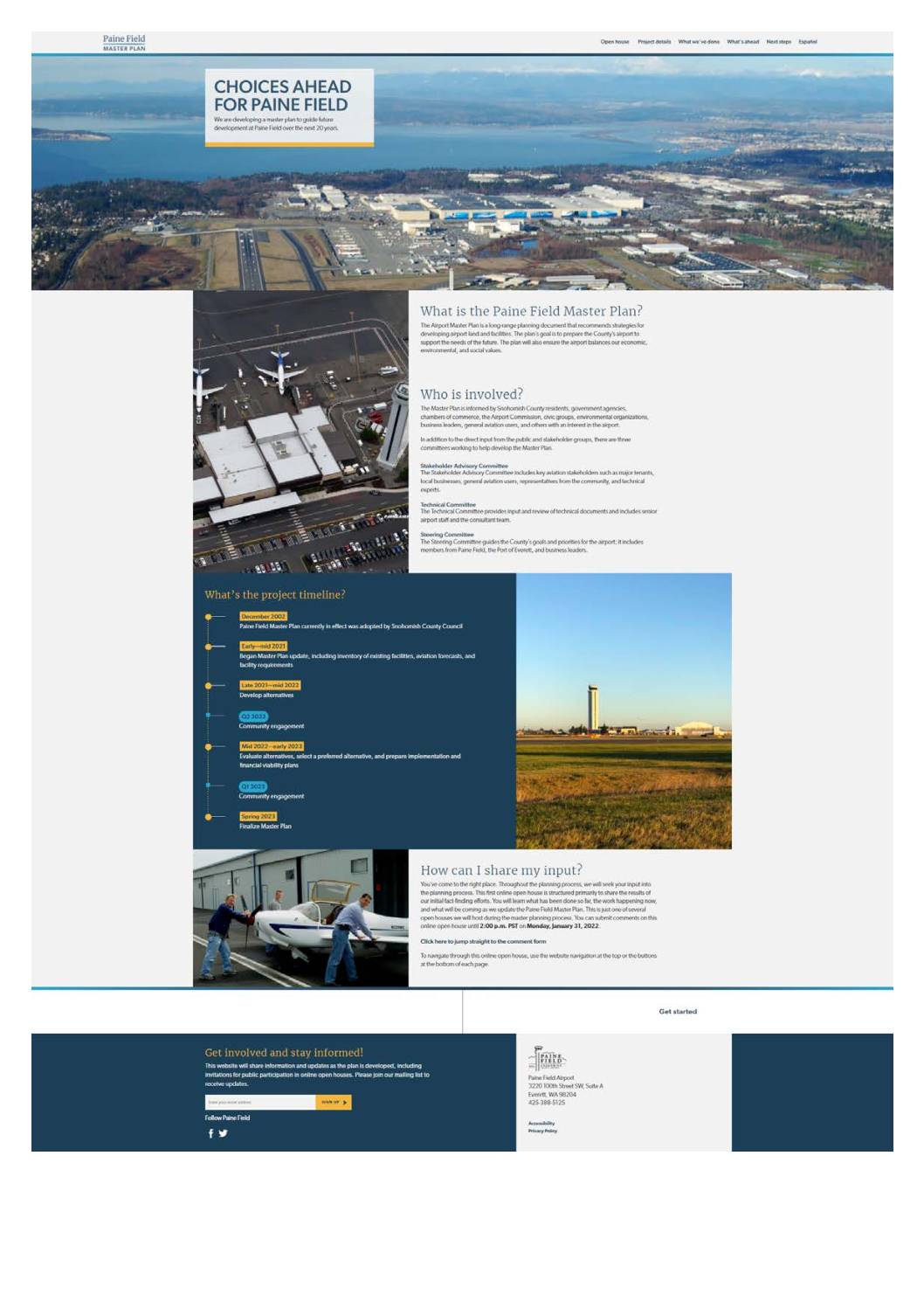
    Choices Ahead for Paine Field: Master Plan Open House

    Snohomish County is developing a 20-year Master Plan for Paine Field Airport near Everett, WA, driven by growing aviation demand and Sea-Tac International Airport approaching its capacity limits. The plan examines existing facilities, passenger and cargo forecasts, and development alternatives, with passenger volume projected to exceed 4 million annually by 2040. Public input is being gathered through online open houses and community engagement sessions throughout the planning process.
    Tagscommunity engagement, Forecast, Master Plan, Open House, Paine FieldFolderPaine Field
  • 2021-01-01

    Climate change and aviation: Opportunities in the midst of adversity

    A 2021 EUROCONTROL presentation examines how COVID-19 devastated European aviation, with flights dropping as much as 88% below 2019 levels and airlines, airports, and air navigation service providers suffering €56.2 billion in net losses. The presentation outlines three recovery scenarios ranging from an optimistic return to 2019 traffic levels by 2024 (if vaccines proved effective quickly) to a prolonged recovery not expected until 2029 if vaccines failed. It frames the crisis as an opportunity to advance aviation sustainability, including reduced carbon emissions and noise impacts.
    TagsAviation Emissions, Aviation Noise & Emissions Symposium, COVID-19, Europe, ForecastFolderANES
  • 2019-01-01

    FAA aerospace forecast: Fiscal years 2019-2039

    The FAA Aerospace Forecast for Fiscal Years 2019–2039 projects steady growth in U.S. air travel, with domestic passenger traffic expected to increase an average of 1.8 percent per year over the next two decades. The report highlights how U.S. airlines have restructured since the 2007–09 recession, achieving ten consecutive years of profitability by cutting costs and consolidating operations. Increased flight activity and a growing commercial aircraft fleet may have implications for noise levels at busy airports such as Seattle-Tacoma International.
    TagsAirline Industry, FAA, Forecast, General AviationFolderFAA
  • 2018-11-13

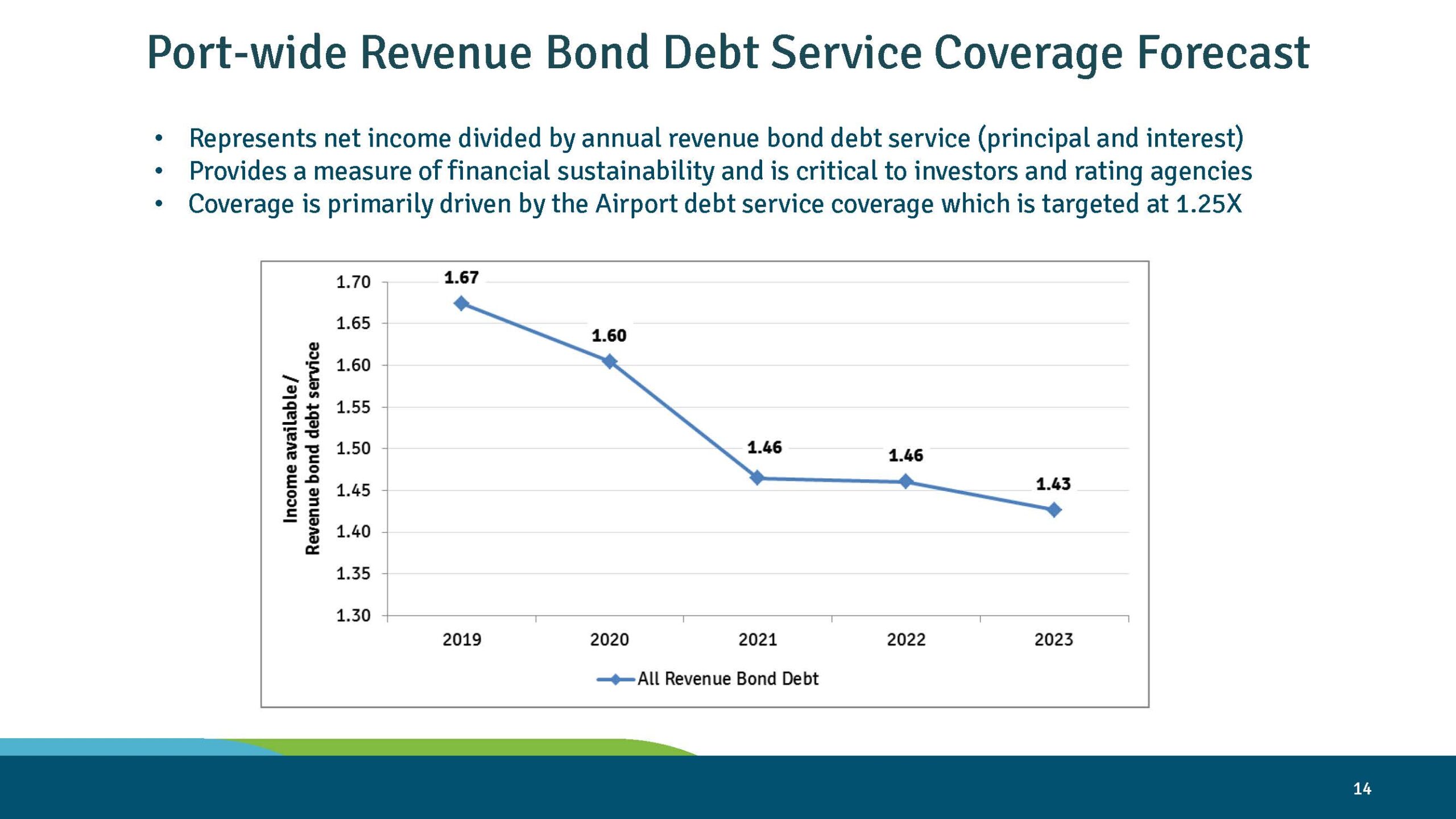
    Port Of Seattle Draft Finance Plan 2019–2023 — Revenue Bond Debt Service Coverage Forecast (Page 14)

    A Port of Seattle presentation slide showing the Port-wide Revenue Bond Debt Service Coverage forecast from 2019 to 2023, with coverage ratios declining from 1.67x in 2019 to a projected 1.43x in 2023. The slide notes that coverage is primarily driven by Airport debt service coverage targeted at 1.25X and serves as a measure of financial sustainability for investors and rating agencies.
    TagsBudget, Forecast, Port Of Seattle, Property Tax Levy, Sea-Tac AirportFolderBudget & Tax Levy 2019
  • 2015-09-01

    Technical Memorandum No. 4: Forecasts of Aviation Activity, Seattle-Tacoma International Airport

    This September 2015 technical report, prepared by Leigh Fisher for the Port of Seattle, provides long-range forecasts of aviation activity at Seattle-Tacoma International Airport as part of the Sustainable Airport Master Plan. It examines historical and projected trends in enplaned passengers, air cargo, and aircraft operations, drawing on regional socioeconomic data such as population growth, employment, and income in the Seattle-Tacoma area. The forecasts are intended to support future airport planning decisions, including infrastructure and capacity needs.
    TagsForecast, Port Of Seattle, SAMP, Sea-Tac Airport, SEPA, Sustainable Airport Master PlanFolderTechnical Memos
  • 2013-10-01

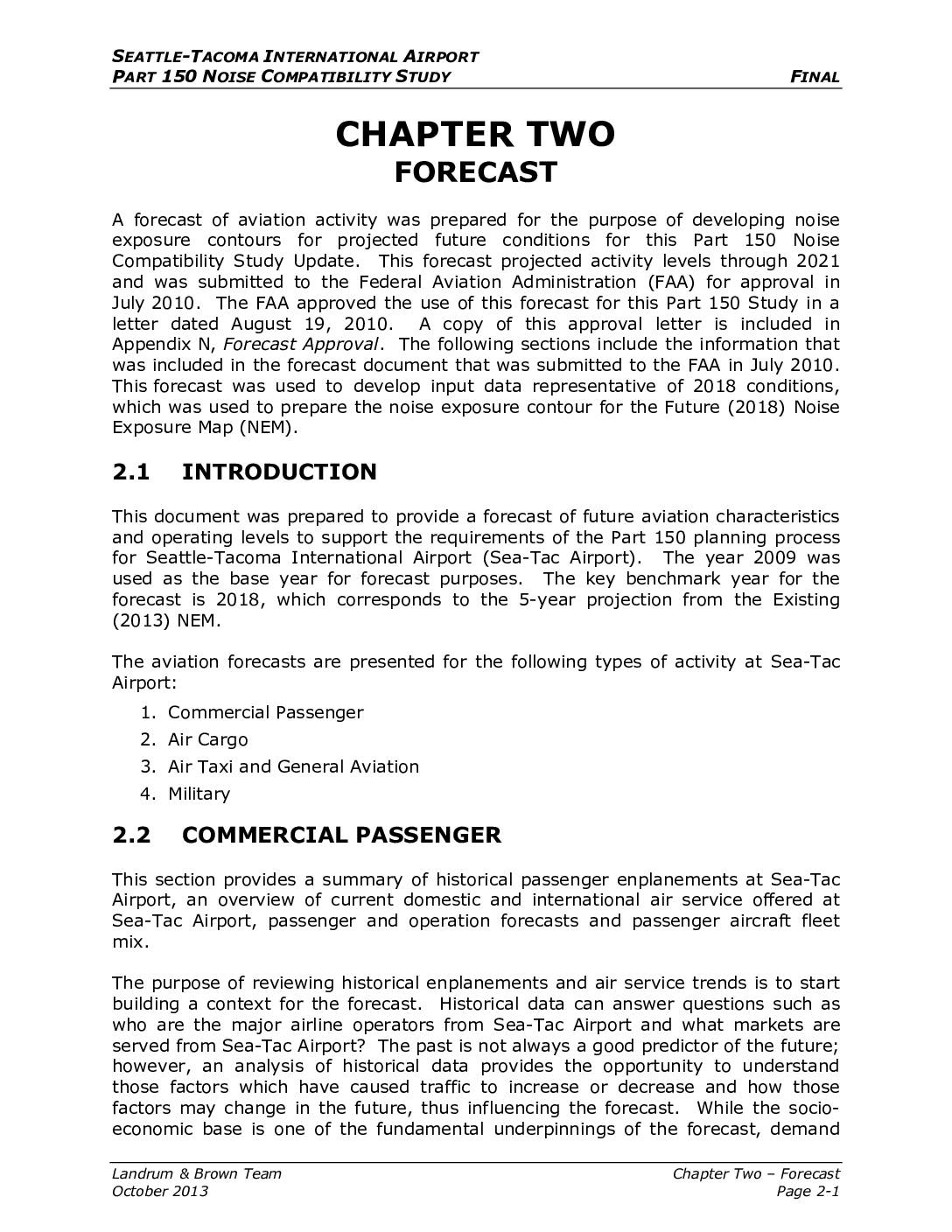
    Seattle-Tacoma International Airport Part 150 noise compatibility study final: Chapter two – forecast

    This chapter from the Seattle-Tacoma International Airport Part 150 Noise Compatibility Study presents aviation activity forecasts developed to support noise exposure planning through 2018 and beyond. It covers historical passenger enplanement trends showing growth from 8.2 million in 1990 to 15.6 million in 2009, as well as domestic and international air service patterns dominated by Alaska Airlines. The forecasts, approved by the FAA in August 2010, were used to project aircraft fleet mix and noise exposure contours for future planning purposes.
    TagsForecast, Landrum & Brown, Noise Countour, Part 150, Sea-Tac AirportFolder2013
  • 2010-08-19

    Appendix N – Forecast approval

    This document is Appendix N of the Seattle-Tacoma International Airport Part 150 Noise Compatibility Study Update, compiled by Landrum & Brown in October 2013. It contains the FAA's official approval, dated August 19, 2010, of the aviation activity forecast submitted by Sea-Tac Airport in July 2010. The FAA determined that the forecast provided adequate justification for total aircraft operations and authorized its use in the airport's Noise Compatibility Plan Update.
    TagsFAA, Forecast, Noise, Part 150, Sea-Tac AirportFolder2013
  • 2009-07-01

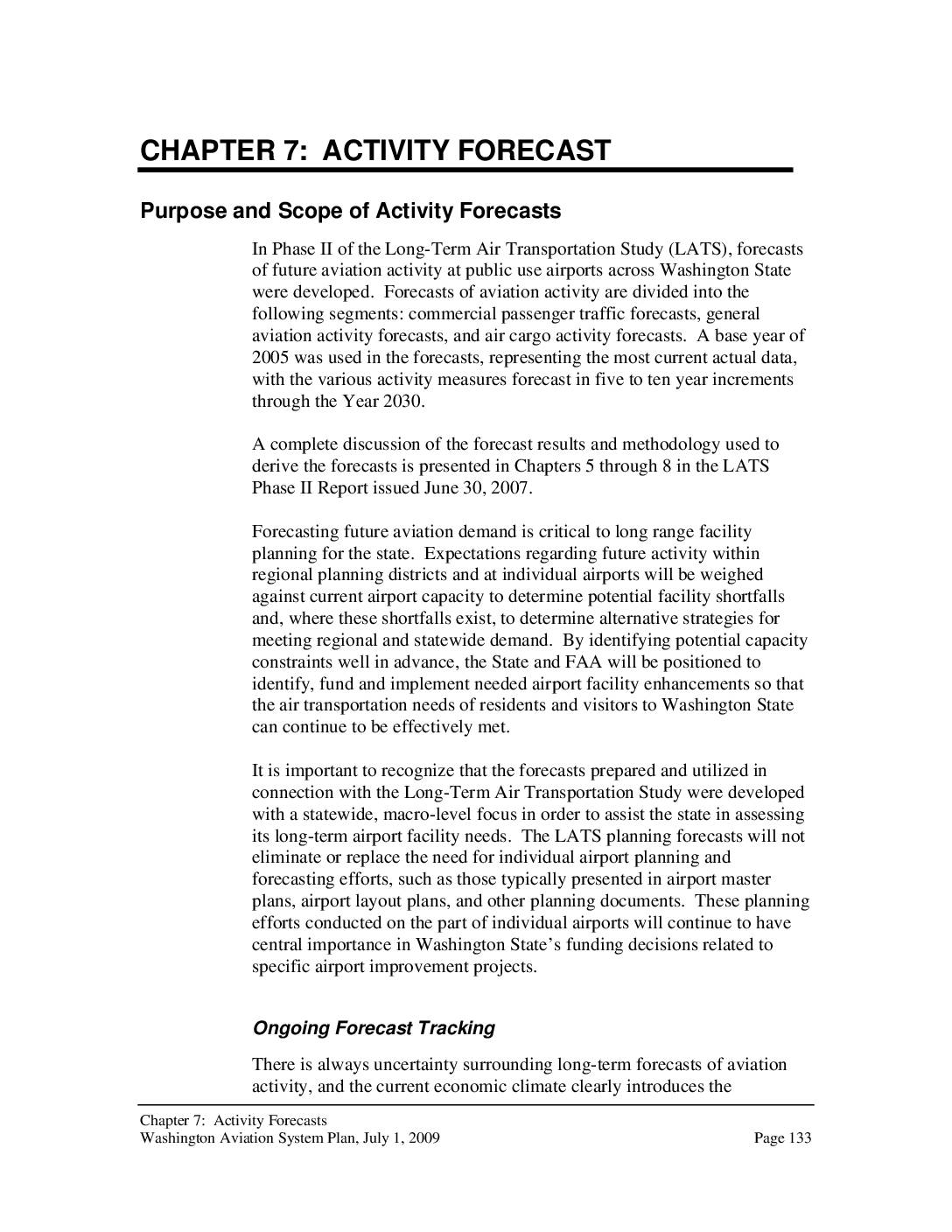
    Washington Aviation System Plan, Chapter 7: Activity Forecast

    This 2009 Washington Aviation System Plan chapter presents long-term forecasts of passenger traffic at Washington State airports through 2030, with Sea-Tac projected to grow from roughly 14.6 million to 26.6 million enplanements—an 82% increase. Sea-Tac is expected to continue dominating statewide air travel, accounting for 85% of all passenger enplanements in 2030. The forecasts were developed to help the state and FAA identify future capacity constraints and plan necessary airport infrastructure improvements.
    TagsForecast, Sea-Tac Airport, State of Washington, Washington Aviation System Plan, WASPFolder2009
  • 1992-07-01

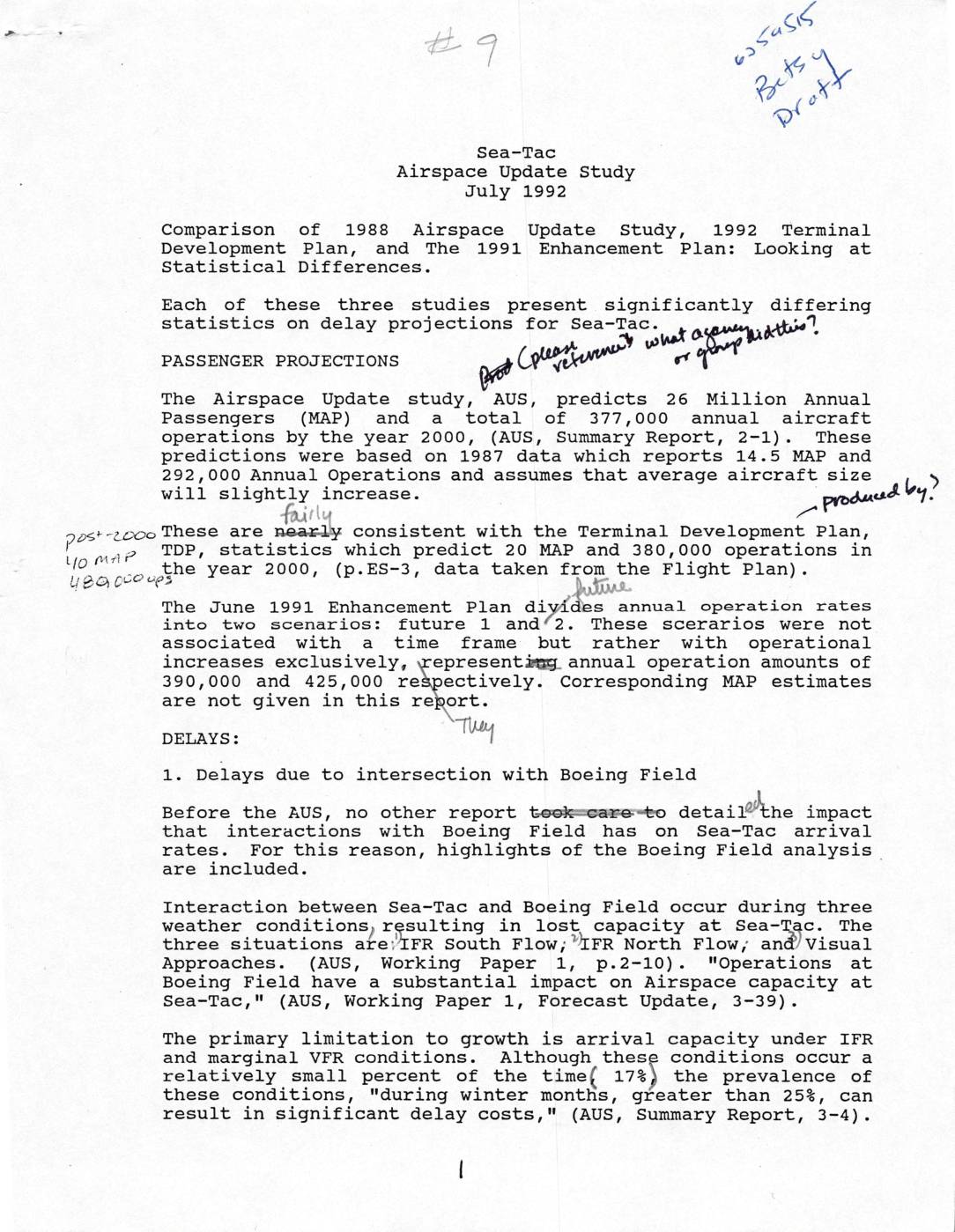
    Sea-Tac Airspace Update Study: Comparison of 1988 Airspace Update Study, 1992 Terminal Development Plan, and the 1991 Enhancement Plan

    This 1992 study compares three planning reports on Sea-Tac Airport's future capacity and delays: the 1988 Airspace Update Study, the 1992 Terminal Development Plan, and the 1991 Enhancement Plan. The reports differ significantly in their passenger and flight operation projections for the year 2000, and show striking discrepancies in delay estimates — with the Enhancement Plan projecting delay hours more than five times higher than the Airspace Update Study. The document also outlines proposed solutions to reduce delays, including new runway construction, airspace conflict resolution with nearby Boeing Field, and improved approach procedures.
    TagsAirspace Study, Boeing Field, Forecast, RCAA, Sea-Tac Airport, StatisticsFolderRCAA
  • 1982-02-24

    Forecasts of Peak Hour and Annual Aircraft Operations by Aircraft Classification: Sea-Tac International Airport and King County International Airport, 1980–2000

    This document presents forecasts of aircraft operations at Seattle-Tacoma (Sea-Tac) International Airport and King County International Airport from 1980 to 2000, broken down by aircraft classification and flight category including air carrier, general aviation, and military. It projects that total annual operations at Sea-Tac will grow from approximately 213,600 in 1980 to over 260,800 by 2000, driven largely by increases in larger Class D air carrier aircraft. Peak hour operation estimates are provided for both Visual Flight Rules (VFR) and Instrument Flight Rules (IFR) conditions, offering planners a detailed basis for noise impact and capacity assessments.
    TagsAir Traffic Control, Airspace Study, ANCA, ATC, Boeing Field, Forecast, KCIA, Port Of Seattle, Sea-Tac AirportFolderNoise Exposure Update

Posts pagination

Page 1 Page 2 Page 3 Page 4 Page 5
Sidebar On/Off

Upcoming Events

  • Stay Grounded Event: Night trains, not night planes!
    Add to CalendarMSunday Sep 13: 12:00am
    Ntnnp social media3

    For the past two years, more than 220 initiatives from 15 countries have declared September 13th as the International day for the ban of night flights at airports. In parallel, activists across Europe have been gathering for pyjama parties for night trains – coordinated in 2024 and 2025 by Back on Track and Stay Grounded.

    [...]
  • Burien Airport Committee Meeting September 15, 2026
    Add to CalendarMTuesday Sep 15: 6:00pm
    400 SW 152nd St, Burien, WA 98166
    Burien airport committee 15 sep 2026 agenda pdf pdf

    a) Part 150 Noise Study (Emily Inlow-Hood) — 15 minutes
    b) SAMP Update and Next Steps (Brian Davis and Sarah Moore) — 15 minutes
    c) Legislative Updates — 10 minutes
       • SCA (Sarah Moore)
       • Work with Sen. Orwall (Brian Davis)
    d) StART Reorganization (Jeff Harbaugh and Karen Veloria) — 10 minutes

    [...]

[See all...]


Help study childhood asthma. Get free HEPA filter!

read more...

Issues

Sea-Tac Airport is currently undergoing the largest and longest expansion in its history, collectively known as the Sustainable Airport Master Plan (SAMP). Some of it you can already hear, but you’re probably not aware of what it all means. Here’s what you need to know.
read more...

Read This!

As the source for federal transportation grants, the Puget Sound Regional Council was charged with developing a system to meet the growing need for commercial aviation. When the search for a second airport failed, they authorized the Port of Seattle to build the Third Runway, with a mandate to develop a noise abatement and mitigation program. In their effort to stop the Third Runway, the ACC argued over every detail of the Port's efforts--including property buyouts and sound insulation. The dispute was meant to be settled by a three member Expert Arbitration Panel. This is their final report. It finds 2-1, that the Port's program was insufficient in several respects. Despite that, funding for the Third Runway was approved by the PSRC, and the 'Port Package' program, proceeded largely unchanged. Expert Arbitration Panel's final decision finding that the Port of Seattle had not shown sufficient reduction in real on-the-ground noise impacts to satisfy noise reduction conditions required for approval of a third runway at Sea-Tac International Airport. The majority decision concluded the Port's noise abatement programs were insufficient despite being impressive in scope.
continue...

The Podcast!

Subscribe to the only podcast devoted to policies, politics, history, impacts for people living under the flight path everywhere. It’s definitely not just about noise!
  • Sea-Tac Noise.Info
  • Connect with STNI

    • Subscribe
    • Port Package Problem?
    • Donate
    • Podcast
    • Socials
      • Facebook
      • X (Twitter)
      • Bluesky
      • Instagram

    "Four nodes in 400 words" — , 2023

  • Learn

    • Frequently Asked Questions
    • Explainers
    • Youtube
    • Research Requests
    • Make a complaint
  • Goals

    Fulfill the promises of 1976:
    • Compensation
    • Reduced noise
    • Improved air quality
    • Environmental remediation
Login/Register
©2026•Data Privacy

Message

We use cookies to provide basic functionality. We also provide access to search engines in order to provide site analytics. We do not sell or share your data.
V V