TagForecast(50)
-
2015-09-01
Technical Memorandum No. 4: Forecasts of Aviation Activity, Seattle-Tacoma International Airport
Technical Memorandum No. 4 (Final) prepared by Leigh Fisher for Port Of Seattle as part of the Sustainable Airport Master Plan (SAMP) for Seattle-Tacoma International Airport. Covers forecasts of aviation activity including enplaned passengers (domestic and international), air cargo, aircraft operations, origin-destination markets, airline market shares, connecting hub role, and international gateway function. Analyzes socioeconomic -
2013-10-01
Seattle-Tacoma International Airport Part 150 noise compatibility study final: Chapter two – forecast
This chapter from the Seattle-Tacoma International Airport Part 150 Noise Compatibility Study presents aviation activity forecasts developed to support noise exposure planning through 2018 and beyond. It covers historical passenger enplanement trends showing growth from 8.2 million in 1990 to 15.6 million in 2009, as well as domestic and international air service patterns dominated by Alaska Airlines. The forecasts, approved by the FAA in August 2010, were used to project aircraft fleet mix and noise exposure contours for future planning purposes. -
2010-08-19
Appendix N – Forecast approval
This document is Appendix N of the Seattle-Tacoma International Airport Part 150 Noise Compatibility Study Update, compiled by Landrum & Brown in October 2013. It contains the FAA's official approval, dated August 19, 2010, of the aviation activity forecast submitted by Sea-Tac Airport in July 2010. The FAA determined that the forecast provided adequate justification for total aircraft operations and authorized its use in the airport's Noise Compatibility Plan Update. -
2009-07-01
Washington Aviation System Plan, Chapter 7: Activity Forecast
This 2009 Washington Aviation System Plan chapter presents long-term forecasts of passenger traffic at Washington State airports through 2030, with Sea-Tac projected to grow from roughly 14.6 million to 26.6 million enplanements—an 82% increase. Sea-Tac is expected to continue dominating statewide air travel, accounting for 85% of all passenger enplanements in 2030. The forecasts were developed to help the state and FAA identify future capacity constraints and plan necessary airport infrastructure improvements. -
1992-07-01
Sea-Tac Airspace Update Study: Comparison of 1988 Airspace Update Study, 1992 Terminal Development Plan, and the 1991 Enhancement Plan
This 1992 study compares three planning reports on Sea-Tac Airport's future capacity and delays: the 1988 Airspace Update Study, the 1992 Terminal Development Plan, and the 1991 Enhancement Plan. The reports differ significantly in their passenger and flight operation projections for the year 2000, and show striking discrepancies in delay estimates — with the Enhancement Plan projecting delay hours more than five times higher than the Airspace Update Study. The document also outlines proposed solutions to reduce delays, including new runway construction, airspace conflict resolution with nearby Boeing Field, and improved approach procedures. -
1982-02-24
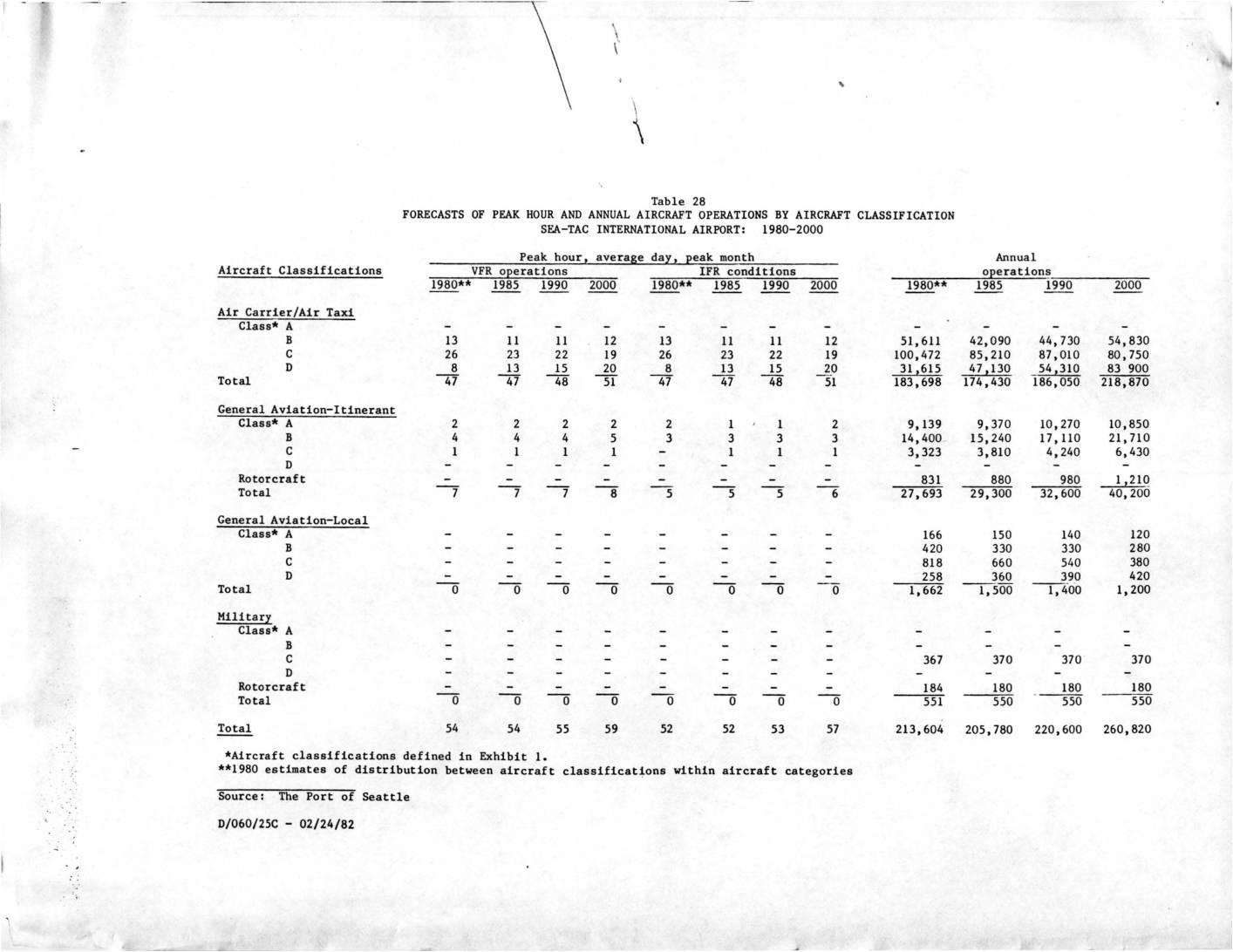
Forecasts of Peak Hour and Annual Aircraft Operations by Aircraft Classification: Sea-Tac International Airport and King County International Airport, 1980–2000
This document presents forecasts of aircraft operations at Seattle-Tacoma (Sea-Tac) International Airport and King County International Airport from 1980 to 2000, broken down by aircraft classification and flight category including air carrier, general aviation, and military. It projects that total annual operations at Sea-Tac will grow from approximately 213,600 in 1980 to over 260,800 by 2000, driven largely by increases in larger Class D air carrier aircraft. Peak hour operation estimates are provided for both Visual Flight Rules (VFR) and Instrument Flight Rules (IFR) conditions, offering planners a detailed basis for noise impact and capacity assessments. -
1982-02-11
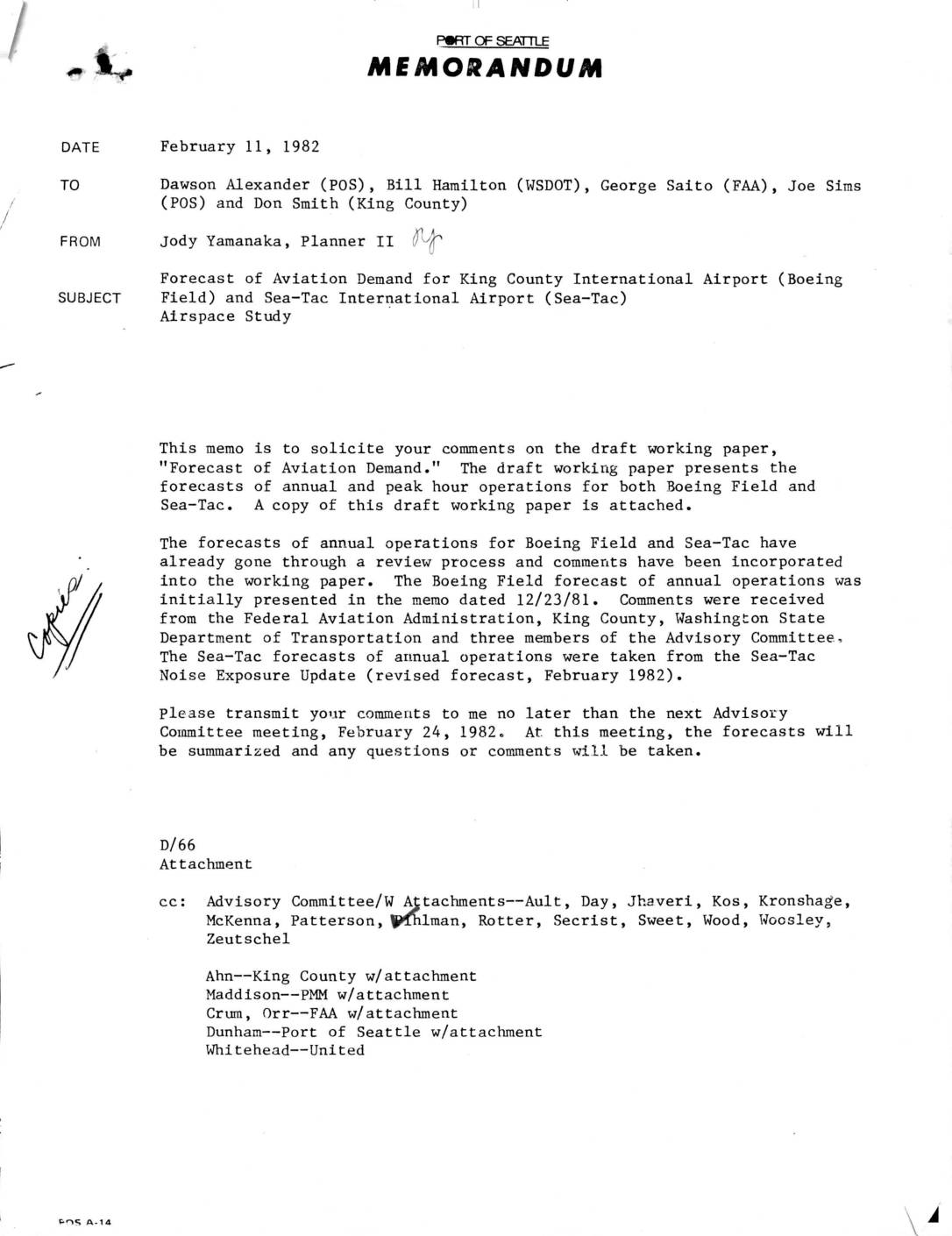
Port Of Seattle Memorandum: Forecast of Aviation Demand for King County International Airport (Boeing Field) and Sea-Tac International Airport — Airspace Study
A 1982 Port of Seattle memorandum presents draft forecasts of aviation demand for Sea-Tac International Airport and Boeing Field, projecting aircraft operations through the year 2000. The forecasts cover annual take-offs and landings as well as peak-hour traffic under both visual and instrument flight conditions, with Sea-Tac's total annual operations expected to grow from roughly 214,000 in 1980 to over 261,000 by 2000. The document was circulated to FAA, King County, and Washington State DOT representatives for review as part of an airspace capacity and noise planning study. -
1981-12-28
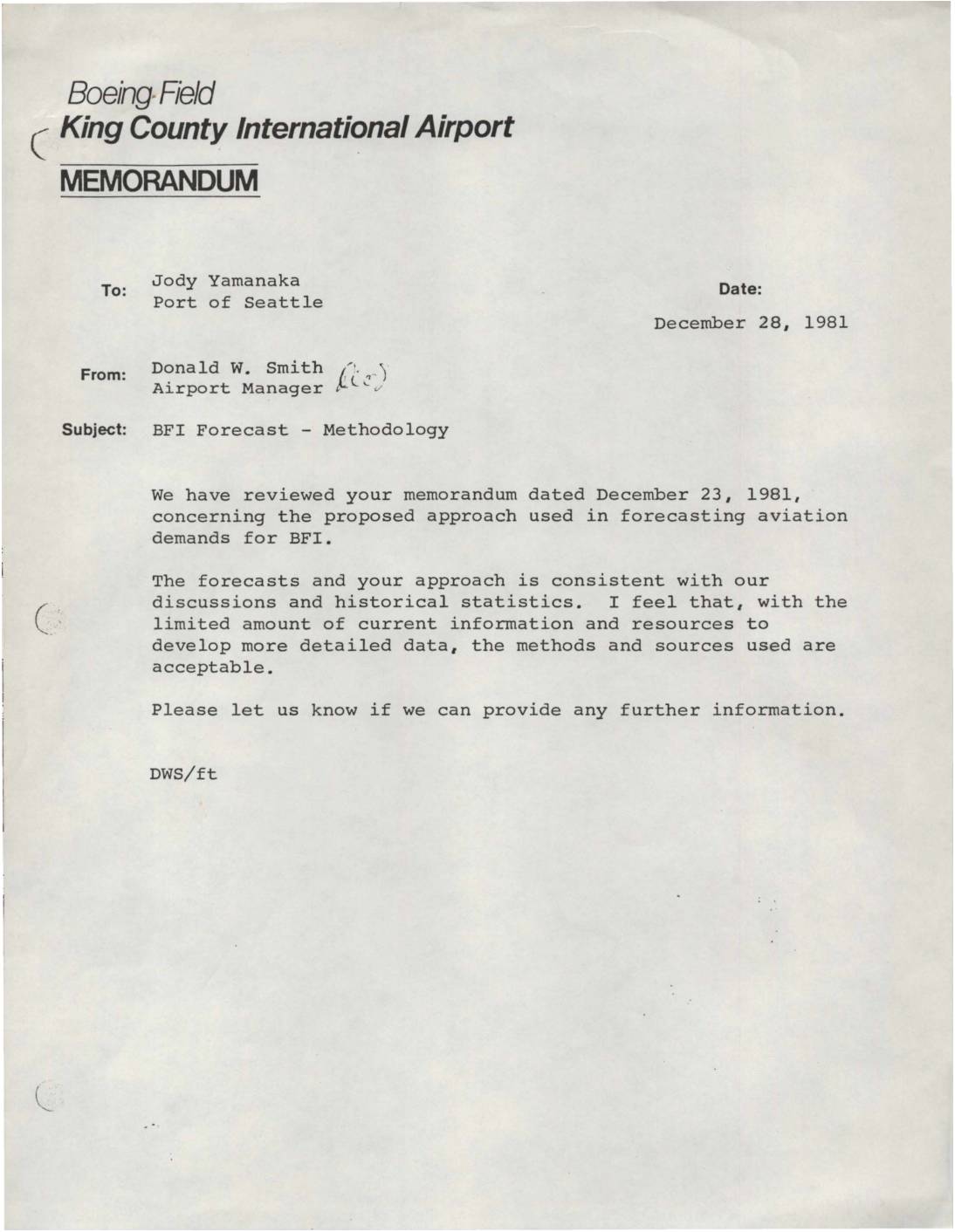
Memorandum: BFI Forecast — Methodology
In a December 28, 1981 memorandum from Boeing Field/King County International Airport, Airport Manager Donald W. Smith responds to a Port of Seattle representative regarding the forecasting methodology for aviation demands at BFI. Smith confirms that the proposed approach is consistent with prior discussions and historical statistics, and acknowledges that, given limited current information and resources, the methods and sources used are acceptable. -
1981-12-28
Memorandum: BFI Forecast — Methodology
Memorandum dated December 28, 1981, from Donald W. Smith, Airport Manager at Boeing Field / King County International Airport, to Jody Yamanaka of Port of Seattle. Smith confirms that the BFI aviation demand forecast methodology described in Yamanaka’s December 23, 1981 memorandum is consistent with discussions and historical statistics, and that the methods and sources -
1975-04-22
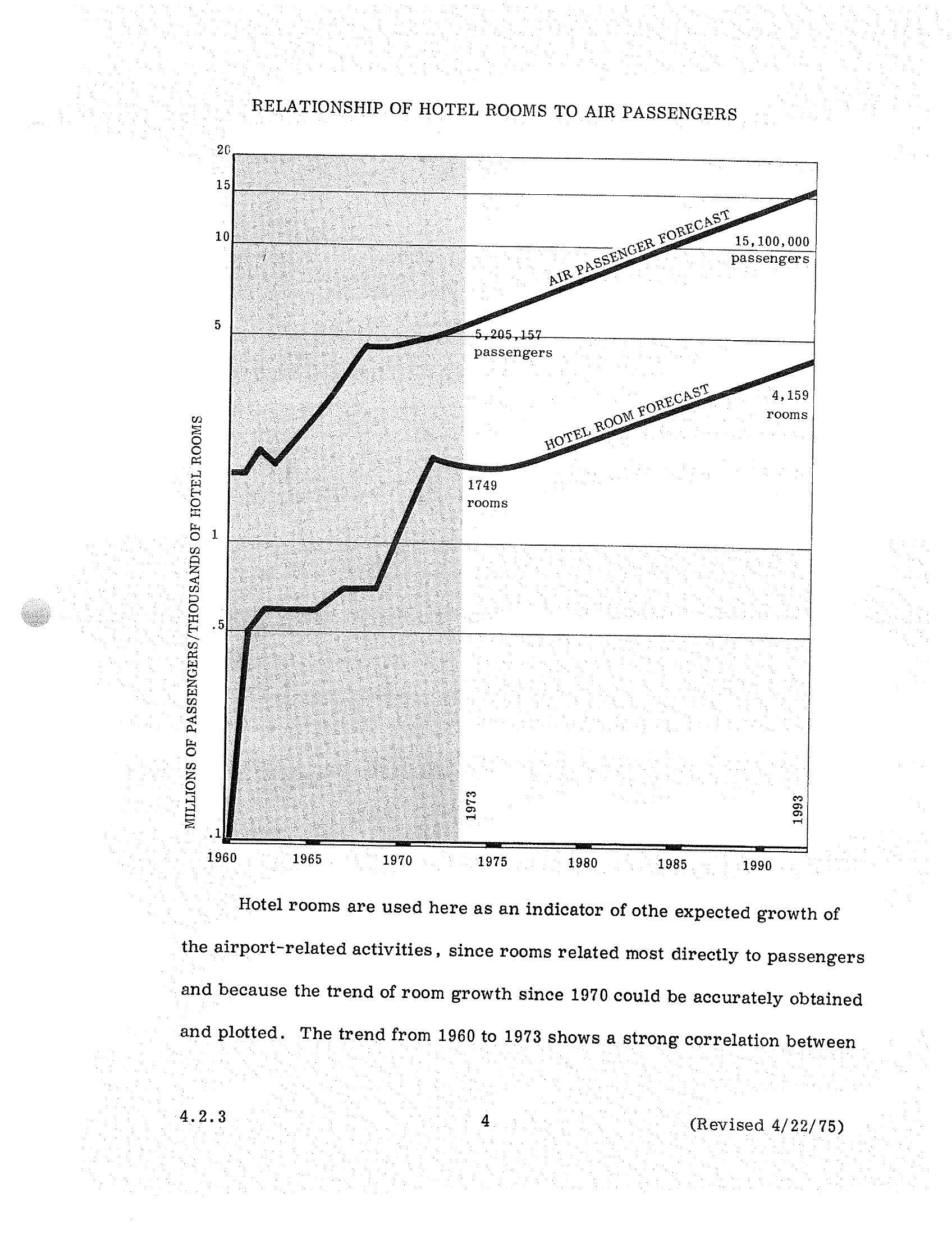
Sea-Tac Airport STCP Section 4.2.3: Air Passengers vs. Hotel Rooms Forecast, 1960–1993
A dual-axis chart from a Sea-Tac Airport planning document (revised April 22, 1975, section 4.2.3) plotting historical and forecast air passenger volumes against hotel room counts from 1960 to 1993. The chart projects growth from 5,205,157 passengers and 1,749 hotel rooms in 1973 to 15,100,000 passengers and 4,159 rooms by 1993, using hotel room growth as an indicator of airport-related activity expansion.