TagACC(1548)
-
 2000-07-27
EXH AR023201: Letter to Ecology Transmitting Third Runway Fill Material Env. Docs, Q2 2000
A July 27, 2000 letter from the Port of Seattle's Environmental Program Manager transmits environmental documentation to the Washington Department of Ecology regarding fill material used in the Sea-Tac Airport Third Runway Project during the second quarter of 2000. The documentation, developed in accordance with the 1999 Airfield Project Soil Fill Acceptance Criteria, includes a fill summary table listing sources such as borrow pits, port property transfers, and construction sites, along with estimated fill volumes. A cumulative fill summary is also provided, covering all fill material placed from January 1998 through December 1999. -
 2000-07-25
EXH AR025068: Letter and Implementation Plan, Des Moines Creek Flow Augmentation Facility
In July 2000, the Port of Seattle submitted an Implementation Plan to the Washington Department of Ecology outlining a proposed Des Moines Creek Flow Augmentation Facility near Seattle-Tacoma International Airport. The plan describes using water from a Port-owned well — currently used for golf course irrigation — to boost creek streamflow to at least one cubic foot per second and lower water temperatures to 16°C during summer low-flow periods. An automated monitoring station downstream would control pump operations, with a backup option to draw from the Port's municipal water distribution system if well water became unavailable. -
 2000-07-25
EXH AR020963: Sea-Tac Groundwater Study Flat File Format Ref Data — Associated Earth Sciences Inc
This document contains reference data for the Seatac Groundwater Study, compiled by Associated Earth Sciences, Inc. The dataset, totaling 10.4 MB across 17 files, includes flat-file format tables covering bore holes, water levels, geology, hydraulic parameters, and well segments related to groundwater conditions in the Sea-Tac area. The materials were submitted as a legal exhibit and are part of the broader environmental record associated with Sea-Tac Airport. -
 2000-07-25
EXH AR023777: Letter & Implementation Plan — Des Moines Creek Flow Augmentation Facility
In July 2000, the Port of Seattle submitted an Implementation Plan to the Washington Department of Ecology outlining a proposed flow augmentation facility for Des Moines Creek, located near Seattle-Tacoma International Airport. The plan described using water from a Port-owned well to increase stream flow to one cubic foot per second and reduce water temperatures to 16 degrees Celsius during summer low-flow periods, with the goal of improving water quality and aquatic habitat. The facility would involve reconfigured well pumps, an 800-foot pipeline, a stilling basin, and an automated monitoring station to regulate flow and temperature in the creek. -
 2000-07-17
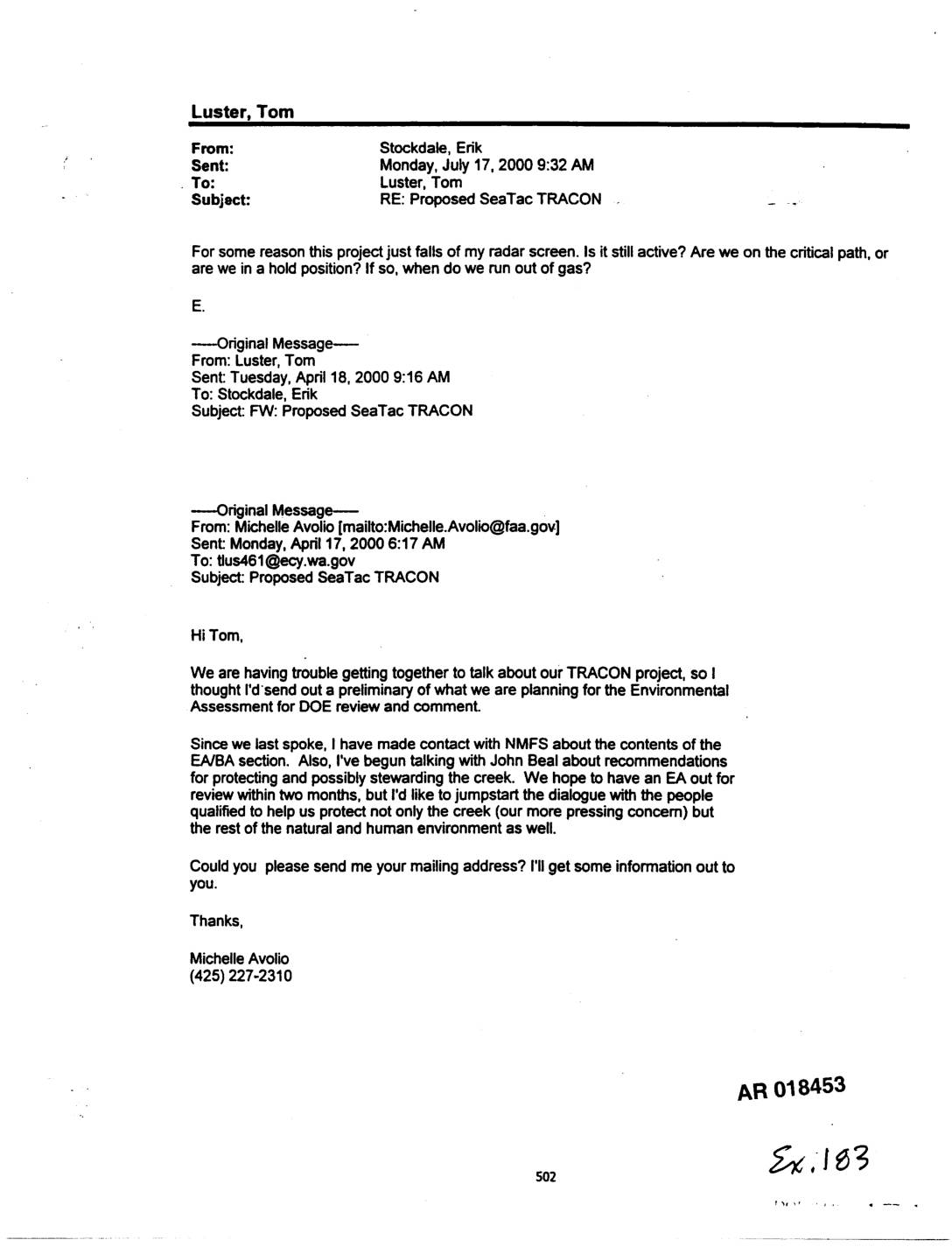
Exhibit 183: Email Chain RE: Proposed Sea-Tac TRACON — Stockdale, Luster, Avolio
Email chain (AR 018453) among Erik Stockdale, Tom Luster (Ecology, tlus461@ecy.wa.gov), and Michelle Avolio (FAA, Michelle.Avolio@faa.gov) regarding the proposed SeaTac TRACON project. Avolio’s April 17, 2000 email to Luster describes FAA planning for an Environmental Assessment (EA) and Biological Assessment (BA) for DOE review and comment, contact with NMFS regarding EA/BA section contents, and discussions -
 2000-07-11
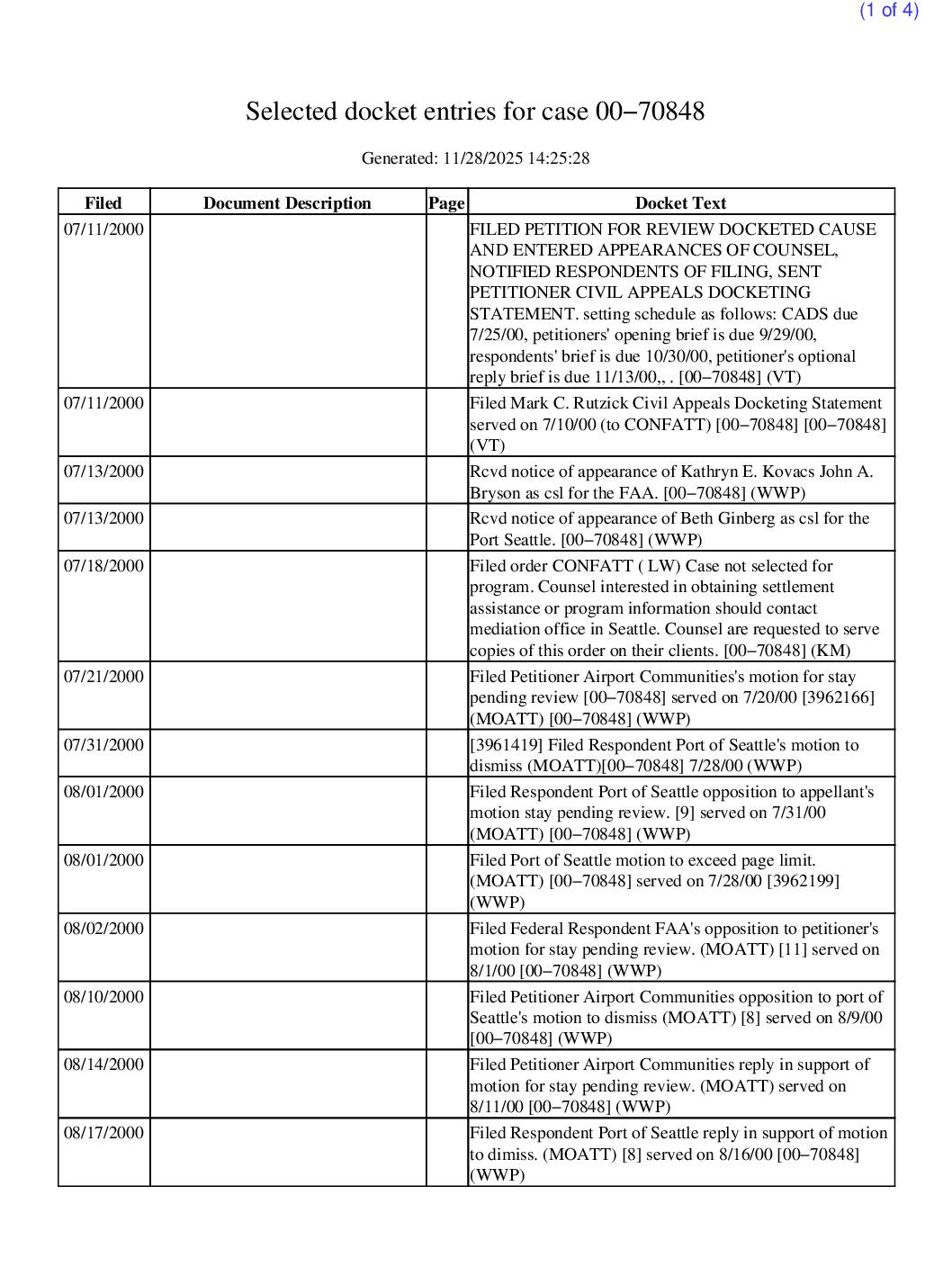
Selected Docket Entries: Airport Communities Coalition v. FAA, Case 00-70848 (9th Cir.)
This court docket covers a 2000–2001 federal appellate case (No. 00-70848) in which Airport Communities petitioned the Ninth Circuit to review a Federal Aviation Administration decision related to Seattle-Tacoma International Airport. The petitioner sought a stay pending review, while the Port of Seattle moved to dismiss the case on jurisdictional grounds, arguing the petition was not filed in time. The court ultimately denied the stay and the motion to dismiss without prejudice, directing all parties to address jurisdictional issues in their merits briefs. -
 2000-06-27
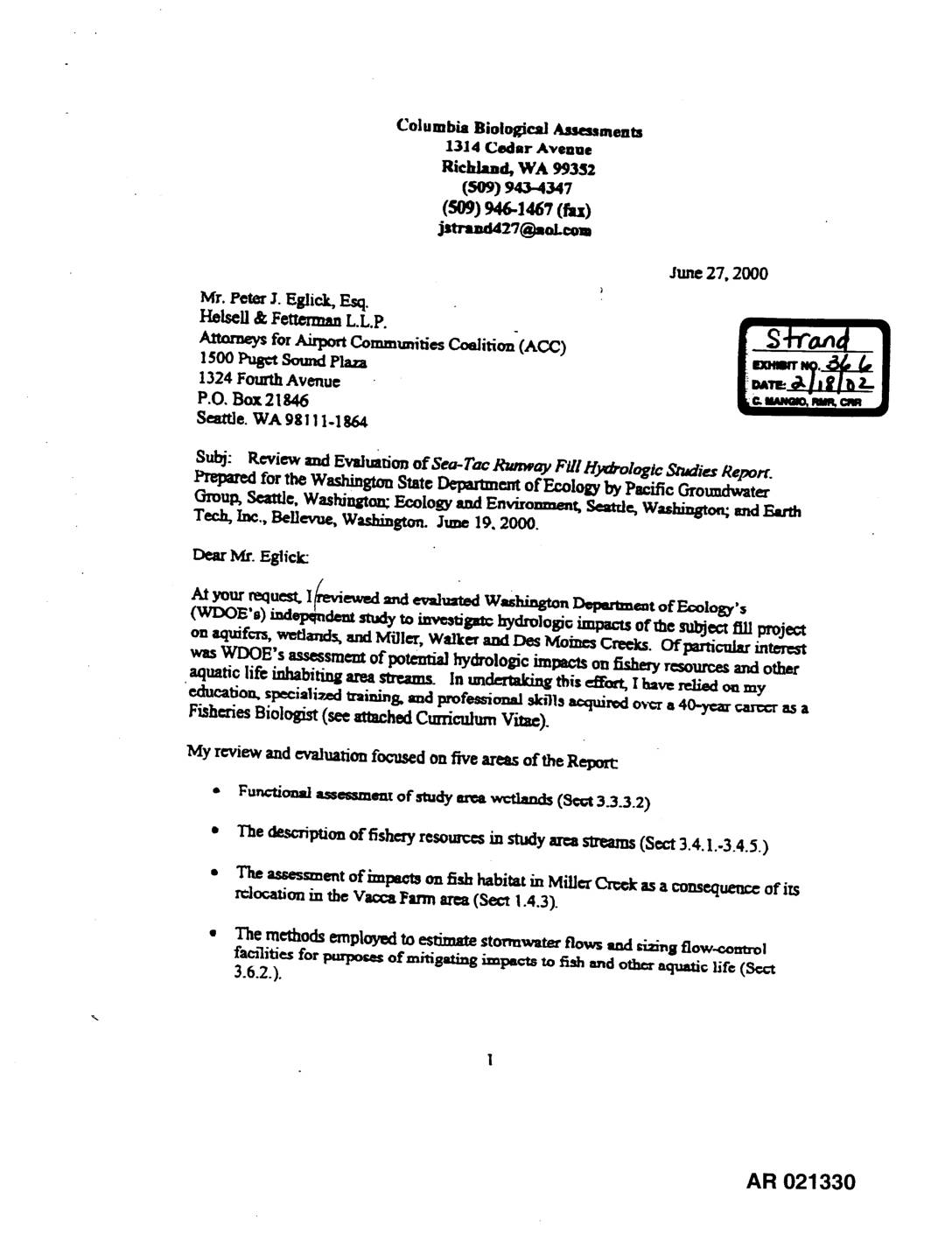
EXH 366: Columbia Biological Assessments Letter Reviewing STIA Runway Fill Hydrologic Studies — ACC Expert Review Fishery Wetland Impacts
A fisheries biologist hired by the Airport Communities Coalition reviewed a Washington State Department of Ecology hydrologic study of the Sea-Tac runway fill project, concluding that the study significantly underestimated impacts on local fish and wetland habitats in Miller, Walker, and Des Moines Creeks. The reviewer found that the study failed to accurately document fish species present, overlooked key wetlands supporting salmon and cutthroat trout, and inadequately assessed the consequences of relocating nearly 1,000 feet of Miller Creek to accommodate runway expansion. The letter argues that the Ecology department accepted the Port's claims of habitat improvement without requiring a thorough analysis of the substantial fish and invertebrate communities that would be destroyed. -
 2000-06-21
EXH AR023949: Hydrogeologic Study — IWS Plant and Lagoons, STIA
This 2000 hydrogeologic study, prepared by Associated Earth Sciences, Inc. for the Port of Seattle, examines groundwater conditions beneath the Industrial Waste System (IWS) plant and lagoons at Seattle-Tacoma International Airport. The report assesses soil geology, groundwater flow direction, and water quality — including levels of volatile organic compounds, petroleum hydrocarbons, and ethylene glycol — near three wastewater lagoons on airport property. It concludes with findings and recommendations related to potential contaminant releases and ongoing groundwater monitoring needs. -
 2000-06-19
EXH AR023782: Port Of Seattle Letter to Department of Ecology — Change of Water Right Application for Des Moines Creek Flow Augmentation
In June 2000, the Port of Seattle submitted a formal application to the Washington Department of Ecology to add a new use to an existing groundwater right for a well located on Port property near Seattle-Tacoma International Airport. The well, originally drilled in the late 1940s and previously used to irrigate the Tyee Valley Golf Course, was proposed to also provide flow augmentation and temperature control for Des Moines Creek as part of a jointly funded basin restoration plan. The application addressed the well's ownership history, its continuous use for golf course irrigation since the mid-1960s, and the Port's agreement with Highline Water District confirming the Port's title to the associated water right (Certificate No. 2369). -
 2000-06-19
EXH AR045023: Sea-Tac Runway Fill Hydrologic Studies Report
Sea-Tac Runway Fill Hydrologic Studies Report (AR 045023, project JE9907) prepared by Pacific Groundwater Group, Ecology and Environment, and Earth Tech Inc. for Washington State Department of Ecology Northwest Regional Office, dated June 19, 2000. Report covers hydrologic and hydrogeologic characterization of the Sea-Tac Airport third runway embankment fill area, including Miller Creek and Walker