Notes
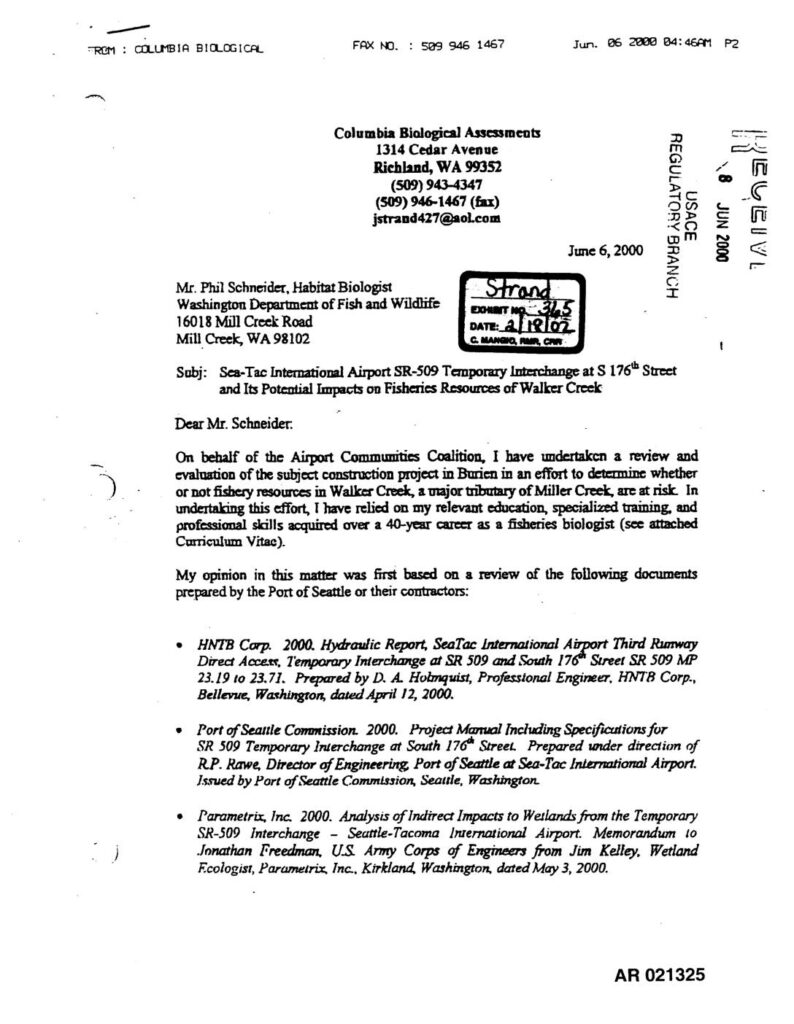
Letter dated June 6, 2000 from J. Strand of Columbia Biological Assessments (Richland, WA) to Phil Schneider, Habitat Biologist, Washington Department of Fish and Wildlife, filed on behalf of the Airport Communities Coalition (ACC). Evaluates potential fisheries impacts of the Sea-Tac International Airport SR-509 Temporary Interchange at S 176th Street on Walker Creek and Miller Creek. Concludes that proposed construction will result in periodic stormwater discharges of sediment-laden water to Wetland 43 and Wetland 44 east and west of SR-509, harming fish species including salmonids. Criticizes Parametrix Inc. erosion control mitigation as grossly inadequate given 40-60 percent slopes, proximity of on/off-ramps to wetlands (10-12 feet), and failure to inventory fish species. Raises concerns about polycyclic aromatic hydrocarbons, metals, bioswale establishment timeline, and underestimation of sediment discharge. References HNTB Corp. hydraulic report (April 12, 2000), Port of Seattle Commission Project Manual, and Parametrix Inc. wetland indirect impacts memorandum (May 3, 2000). AR021325–AR021327.