TagSea-Tac Airport(1835)
-
 2012-05-23
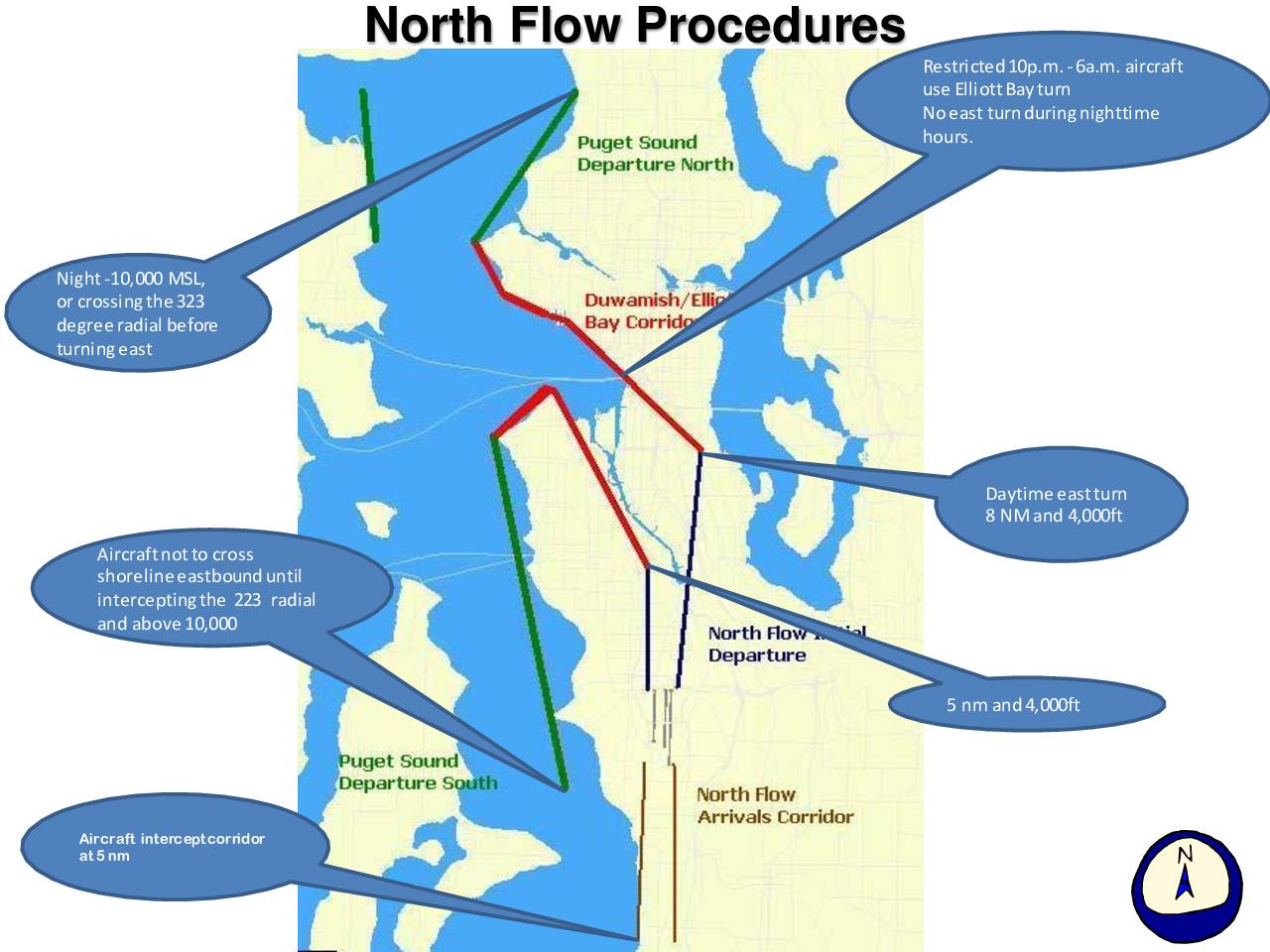
North Flow and South Flow Noise Abatement Procedures: Sea-Tac Airport
This document outlines flight procedures for Seattle-Tacoma International Airport (Sea-Tac) designed to reduce noise impacts on surrounding communities, covering both North Flow and South Flow operations. Key rules include restrictions on eastbound turns during nighttime hours (10 p.m.–6 a.m.), minimum altitude and distance requirements before turning, and designated corridors for arrivals and departures over Puget Sound and Elliott Bay. Compliance data from March 2012 shows that 89 out of 2,431 daytime South Flow eastbound arrivals turned south of the 520 Bridge early, violating the preferred procedure, with Alaska Airlines (ASA) and Southwest Airlines (SWA) accounting for the largest shares of non-compliant flights. -
 2012-05-01
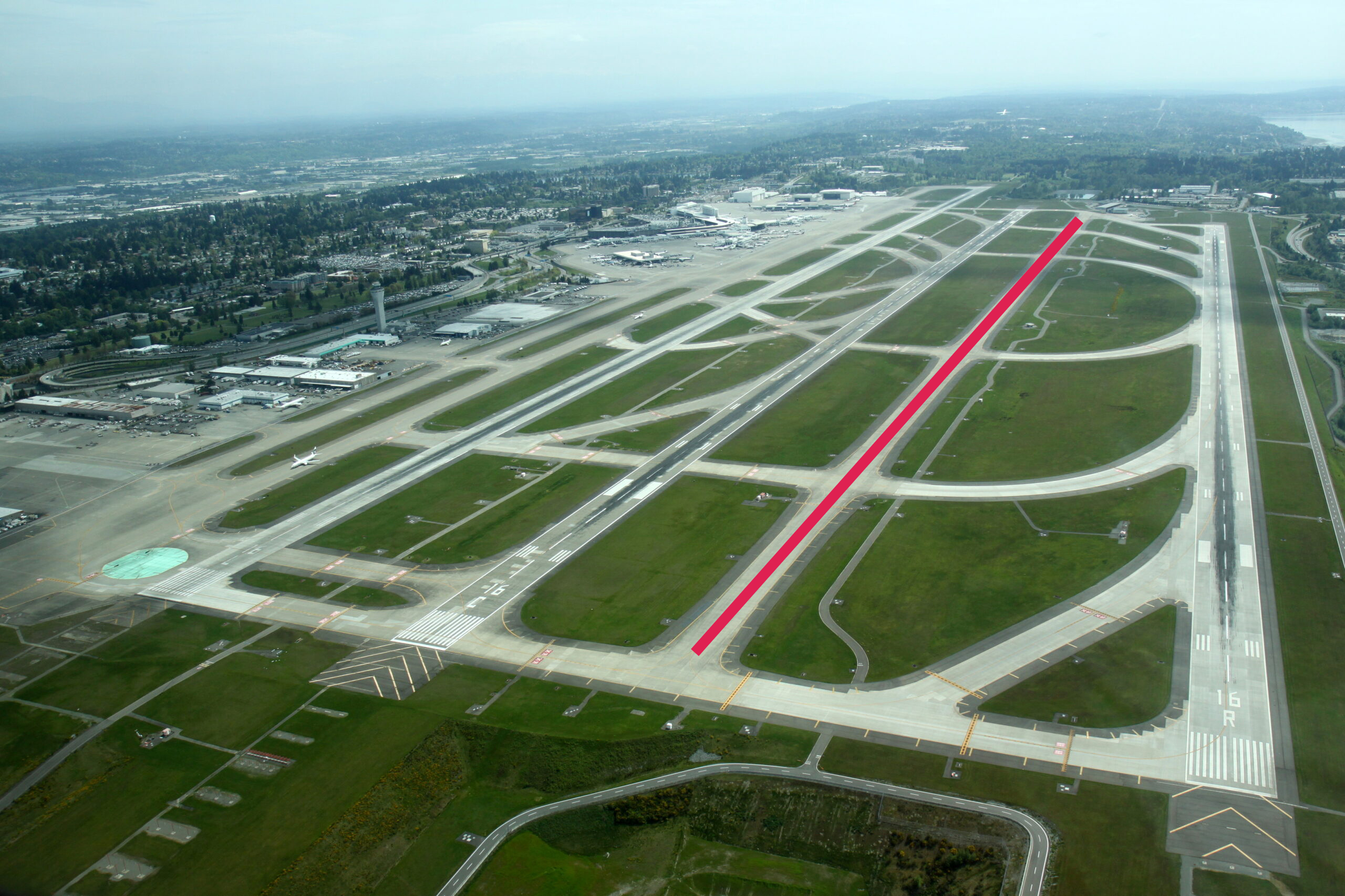
Sea-Tac Airport Parallel Runway Complex Aerial, May 2012
Aerial photograph of Seattle-Tacoma International Airport showing the parallel runway complex, with runway designation '16R' visible in the lower right. A red line is overlaid on what appears to be a taxiway or runway segment between the center and east runways, likely marking a specific infrastructure element for noise-policy or planning documentation purposes. -
 2012-05-01
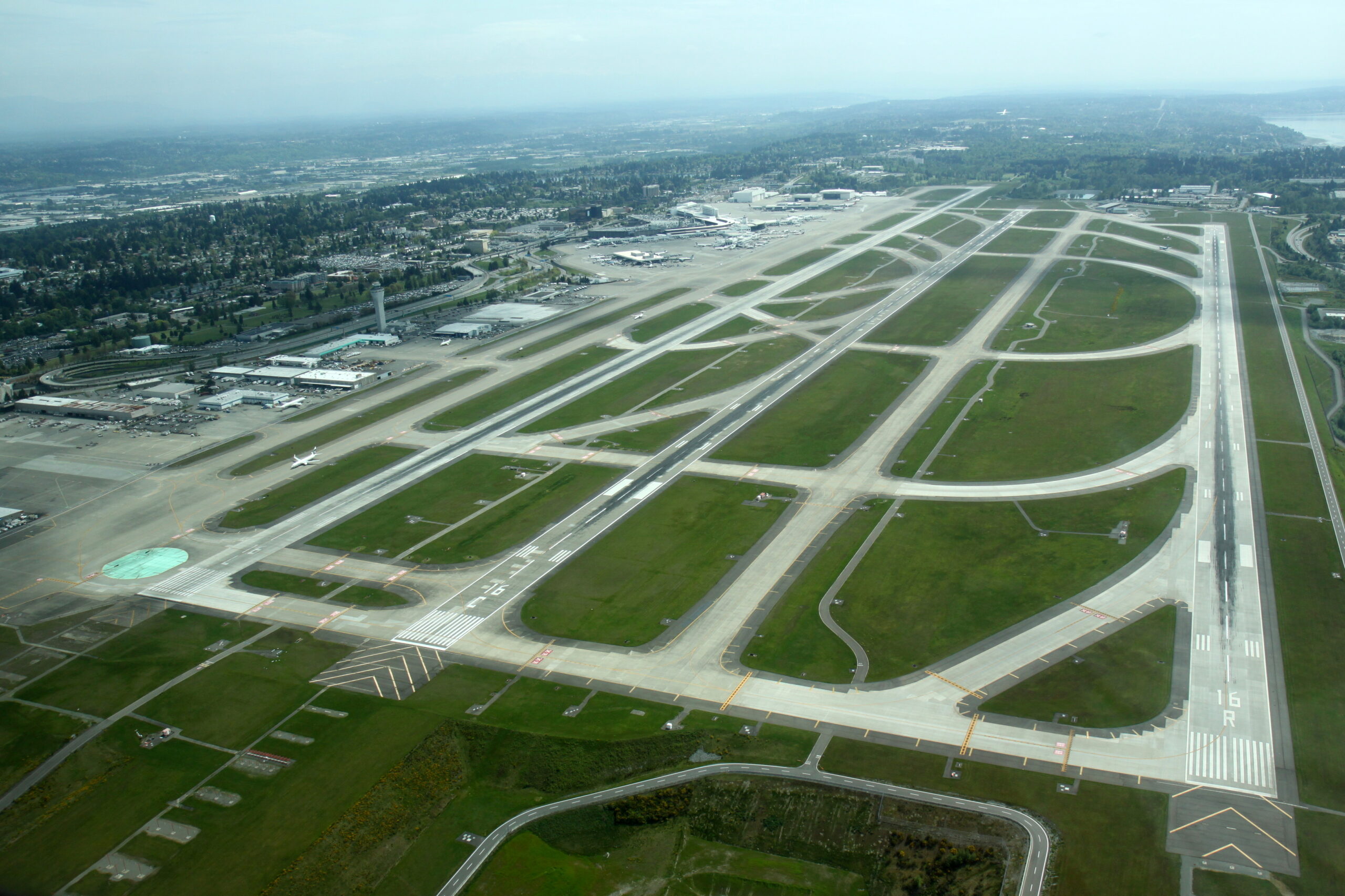
Sea-Tac Airport Aerial View of Parallel Runways, May 2012
Aerial photograph looking northward over Seattle-Tacoma International Airport showing the parallel runway complex. Runway designation '16R' is clearly visible in white paint on the rightmost runway threshold, consistent with SEA-TAC's three north-south parallel runways (16L/34R, 16C/34C, 16R/34L), with the main terminal and concourses visible in the upper left background. -
 2012-03-01
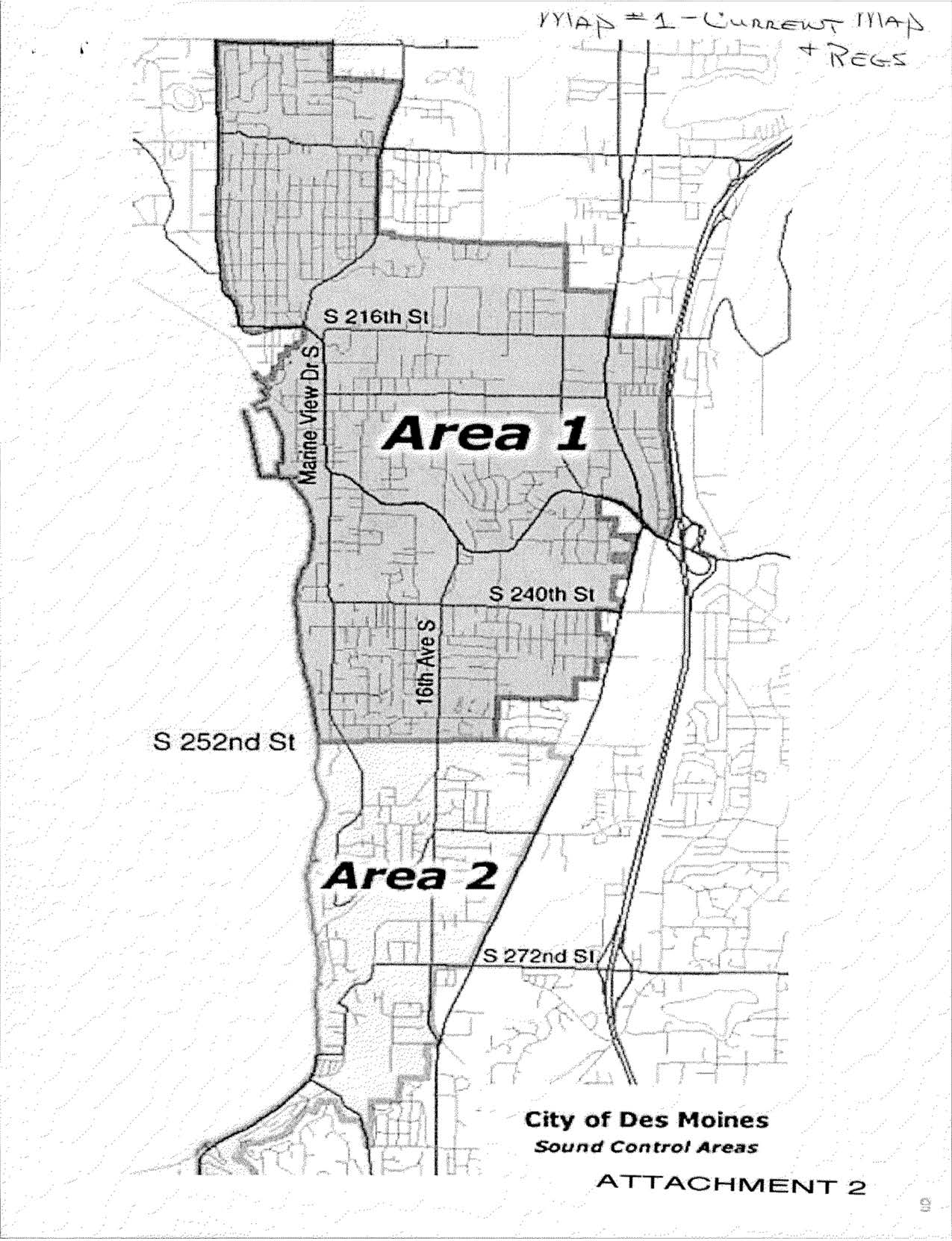
Des Moines Sound Control Areas Map — March 2012 Study Session
A map labeled 'City of Des Moines Sound Control Areas' (Attachment 2) depicting two designated sound control zones: Area 1, bounded approximately by S 216th St to the north and S 240th St to the south along Marine View Dr S and 16th Ave S, and Area 2, extending south to approximately S 272nd St. A handwritten note at the top reads 'MAP #1 – Current Map + Regs,' indicating this is part of a Sea-Tac Airport noise policy or regulatory archive. -
 2012-01-17
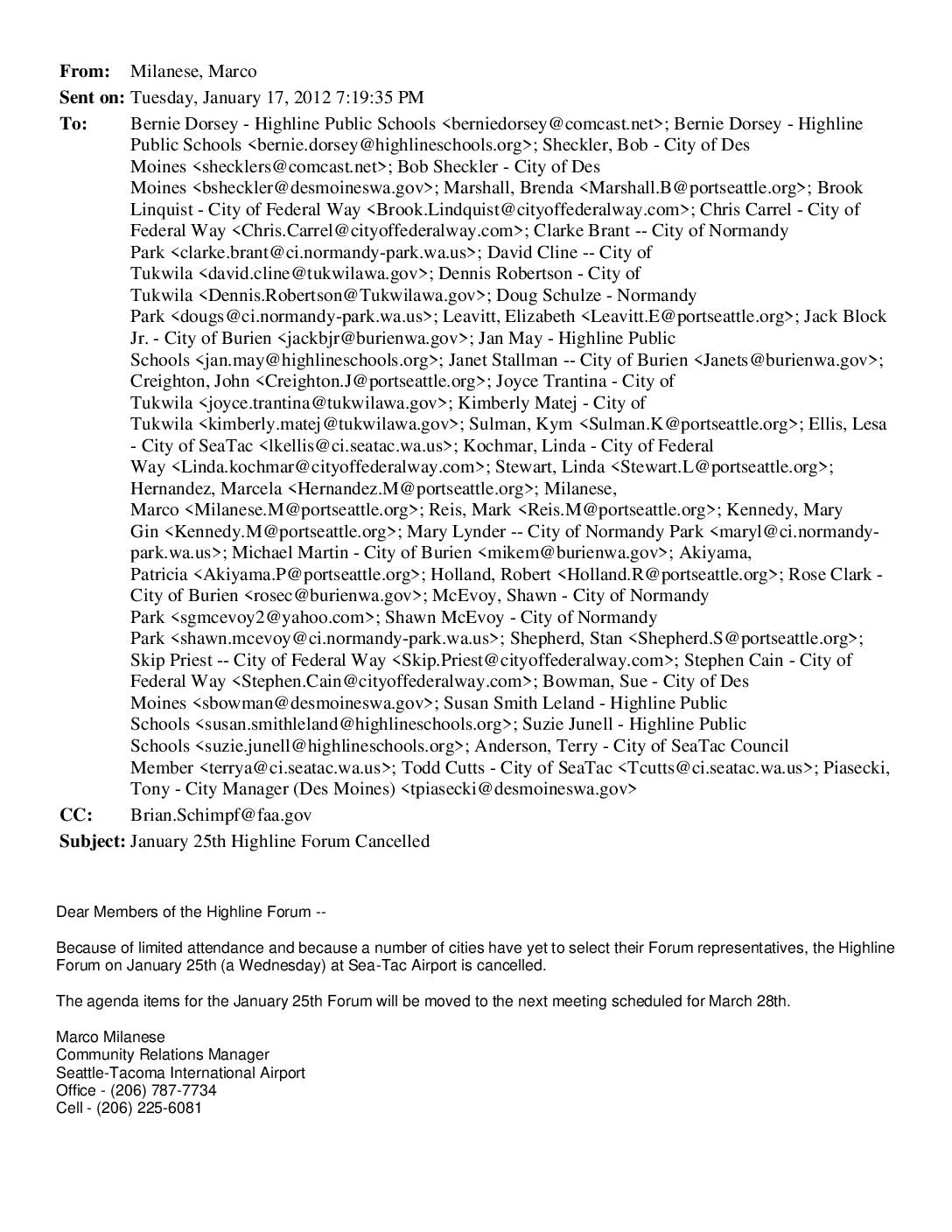
Highline Forum January 25, 2012 Meeting Cancellation Email
The Highline Forum meeting originally scheduled for January 25, 2012, at Sea-Tac Airport has been cancelled due to low expected attendance and several cities not yet having selected their Forum representatives. All agenda items planned for that meeting will be carried over to the next scheduled Forum on March 28, 2012. The cancellation notice was sent by Marco Milanese, Community Relations Manager at Seattle-Tacoma International Airport. -
 2011-09-12
Airline realignment program commission briefing for Sea-Tac
In September 2011, the Port of Seattle briefed commissioners on an Airline Realignment Program at Seattle-Tacoma International Airport, driven by major industry mergers such as Delta-Northwest, United-Continental, and Southwest-AirTran. The program involved relocating and consolidating multiple airlines—including Alaska Air Group, American, Virgin America, and others—across different terminals and satellites, with Alaska Air Group planning to consolidate at the North Satellite and Concourse C. The total estimated cost of the realignment program ranged from $122 million to $130 million, covering capital and expense projects. -
 2011-04-15
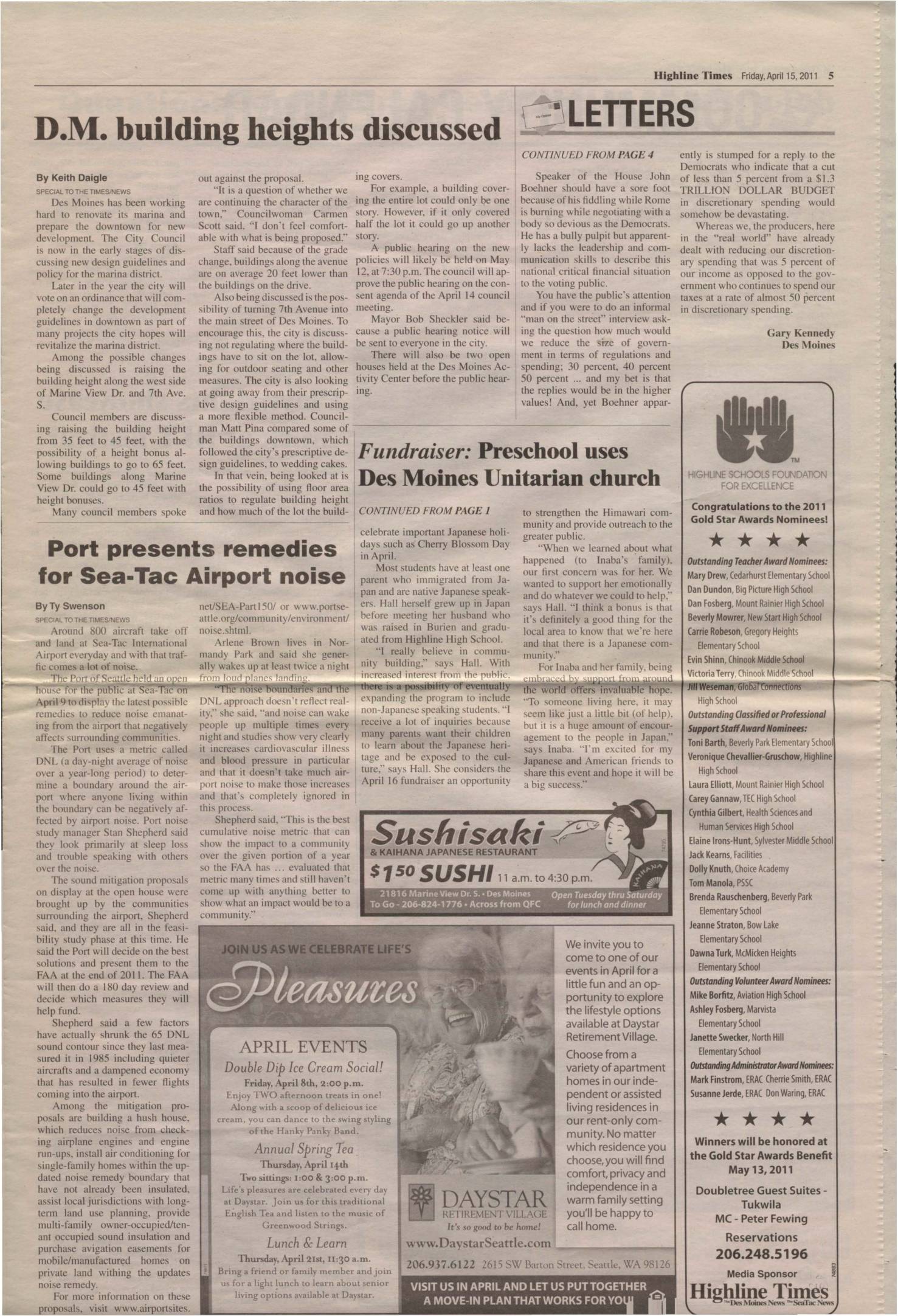
Port presents remedies for Sea-Tac Airport noise
The Port of Seattle held a public open house at Sea-Tac International Airport on April 9, 2011, to present feasibility-stage proposals for reducing airport noise affecting surrounding communities. Mitigation options under consideration included building a hush house to muffle engine run-ups, installing air conditioning in uninsulated single-family homes within the updated 65 DNL noise boundary, providing sound insulation for multi-family and mobile homes, and assisting local jurisdictions with long-term land-use planning. The Port planned to submit its recommended solutions to the FAA by the end of 2011, after which the FAA would conduct a 180-day review to determine which measures it would help fund. -
 2011-04-01
Periodic review: Continental Airlines Hydrant Fuel System, SeaTac International Airport
A periodic review by the Washington State Department of Ecology’s Toxics Cleanup Program of post-cleanup site conditions at the Continental Airlines Hydrant Fuel System located at SeaTac International Airport, Concourse C and North Satellite. The review evaluates whether cleanup actions conducted under the Model Toxics Control Act (MTCA) are protecting human health and the environment, -
 2011-01-01
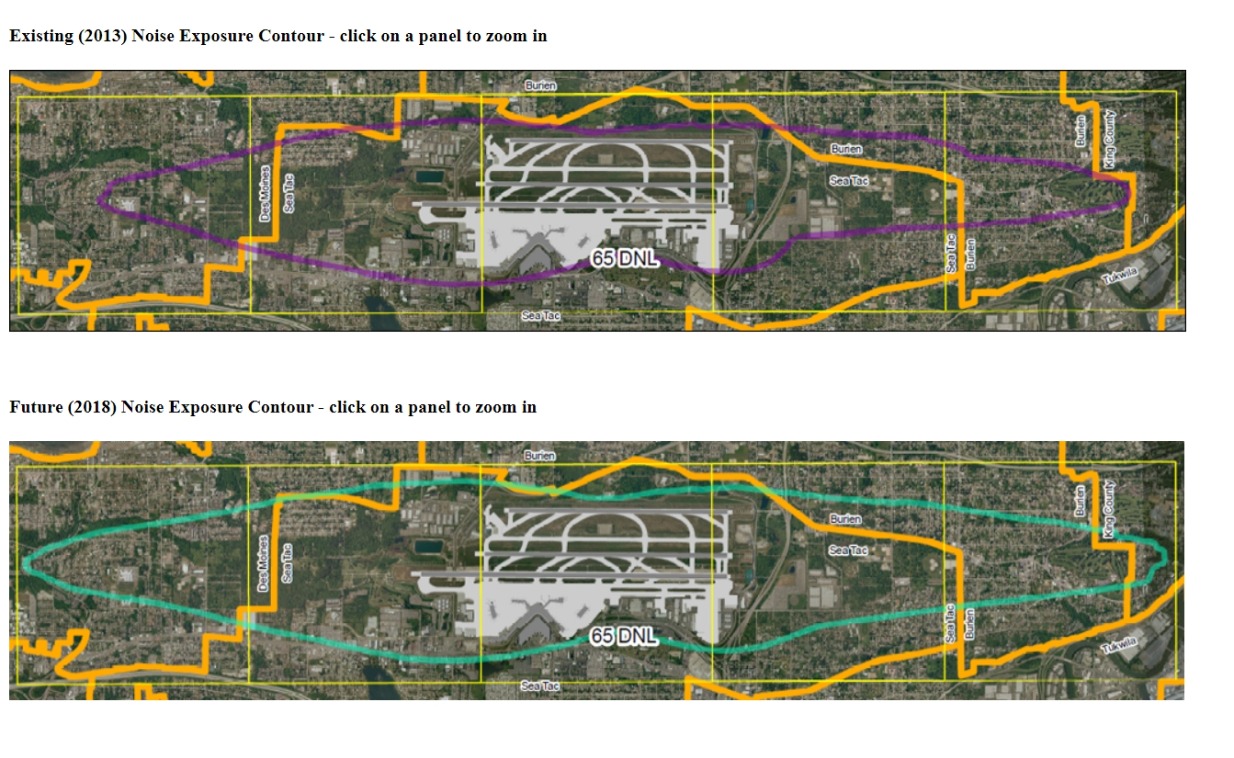
Sea-Tac Airport 65 DNL Noise Exposure Contour Maps: 2013 Existing vs. 2018 Future (Part 150 Study)
Two aerial noise exposure contour maps for Seattle-Tacoma International Airport showing the 65 DNL boundary for 2013 (existing, in purple) and 2018 (future, in teal/green), with an outer study area boundary in orange. The contours extend over surrounding communities including Burien, SeaTac, Des Moines, Tukwila, and unincorporated King County. -
 2010-12-06
Letter of agreement: Informal runway use program, Seattle-Tacoma International Airport
This document outlines the Runway Use Agreement between the FAA and the Port of Seattle at Seattle-Tacoma International Airport (Sea-Tac), effective December 6, 2010. It establishes preferred runway assignments for arrivals and departures under various weather and traffic conditions, while making clear that safety and air traffic management always take priority. The agreement does not change existing FAA practices but aims to provide consistency and transparency for the public regarding how runways are used.