TagNEPA(390)
-
 2025-05-29
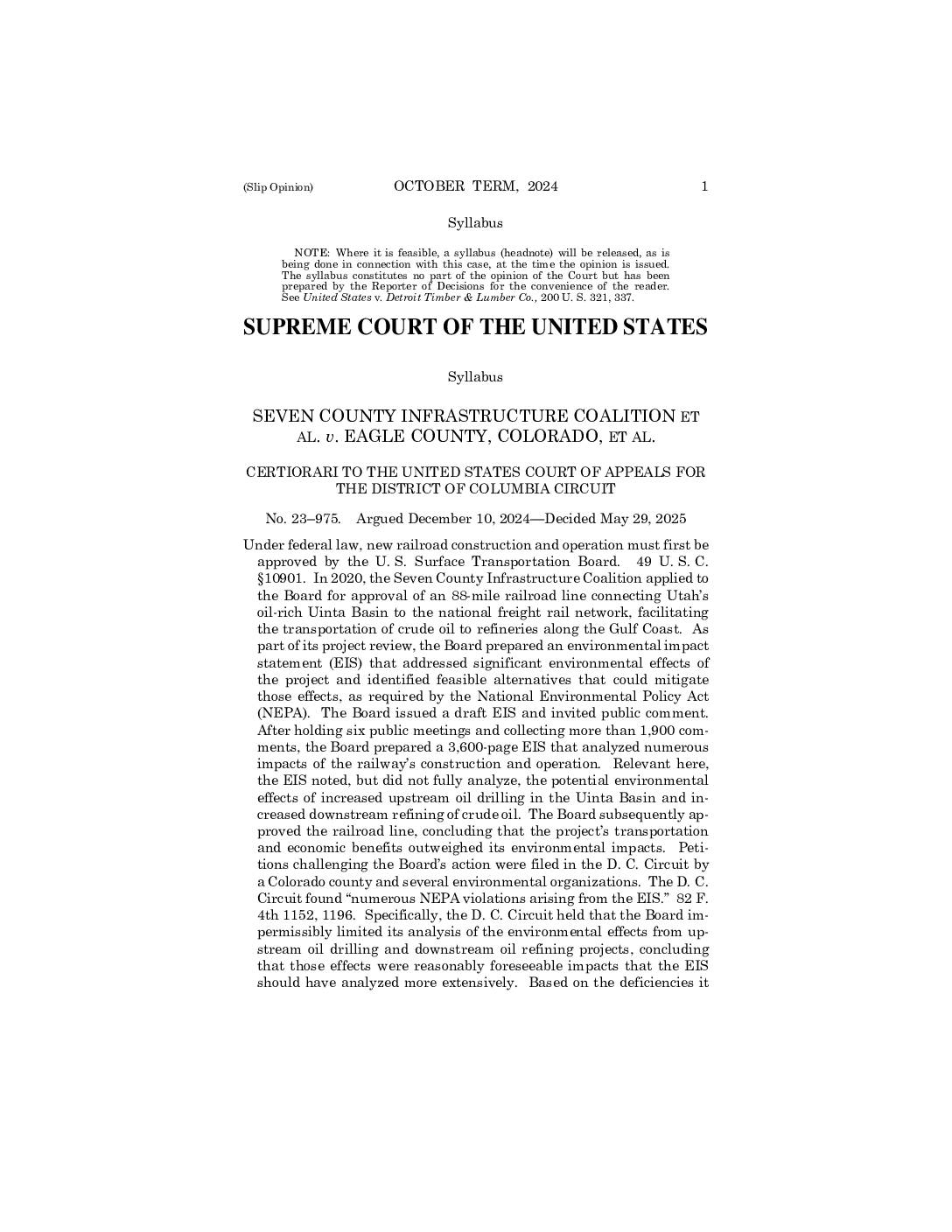
Seven County Infrastructure Coalition et al. v. Eagle County, Colorado, et al.
The U.S. Supreme Court ruled in May 2025 that federal agencies have broad discretion in determining the scope of environmental reviews required under the National Environmental Policy Act (NEPA). The case involved a proposed 88-mile railroad in Utah, where the Court held that agencies do not need to analyze the environmental effects of separate upstream or downstream projects — such as oil drilling or refining — when reviewing a specific infrastructure project. Courts must give substantial deference to agency decisions about what to include in environmental impact statements, rather than imposing their own judgment about what details are required. -
 2025-02-20
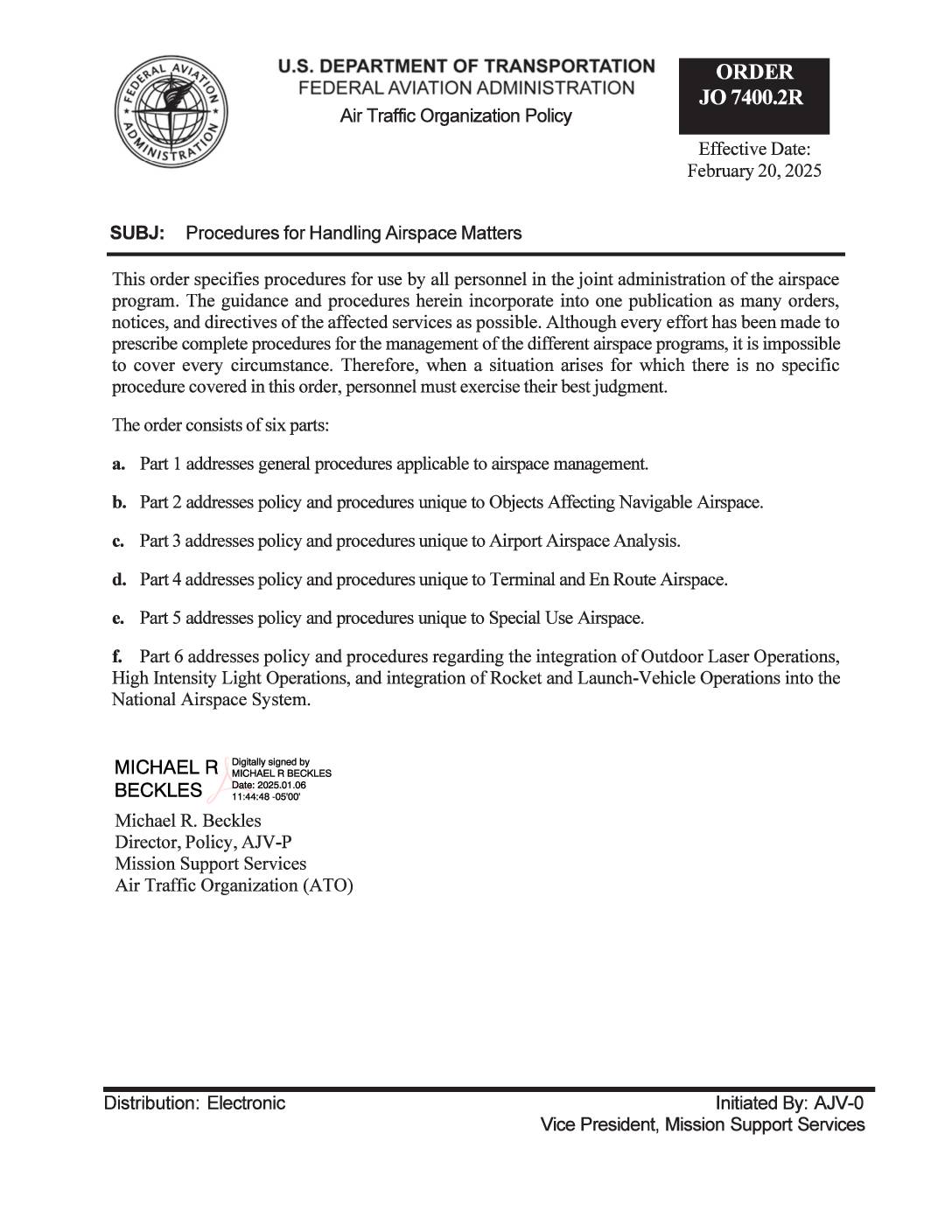
FAA JO7400.2R Handling Airspace Matters
FAA Order JO 7400.2R, effective February 20, 2025, sets out procedures for managing U.S. airspace, covering topics such as objects affecting navigable airspace, airport airspace analysis, terminal and en route airspace, special use airspace, and laser and rocket operations. The order updates policies related to surveillance facilities and airport proposals to reflect modern, contractor-supported National Airspace System technologies. Note that this document addresses broad national airspace management procedures and does not specifically cover Sea-Tac Airport noise policy. -
 2025-01-16
Sustainable Airport Master Plan: Near-Term Projects Environmental Review — Release of the FAA NEPA Draft Environmental Assessment and Public Comment Period
Jan 16 2025 presentation to PSRC by Dave Kaplan, Clare Gallagher. Port of Seattle presentation covering the Sustainable Airport Master Plan (SAMP) Near-Term Projects (NTPs) Environmental Review, released October–November 2024. Covers the FAA NEPA Draft Environmental Assessment (Draft EA) and public comment period for Sea-Tac Airport (SEA). Includes historical passenger growth data from 1949 (130,600 -
 2025-01-15
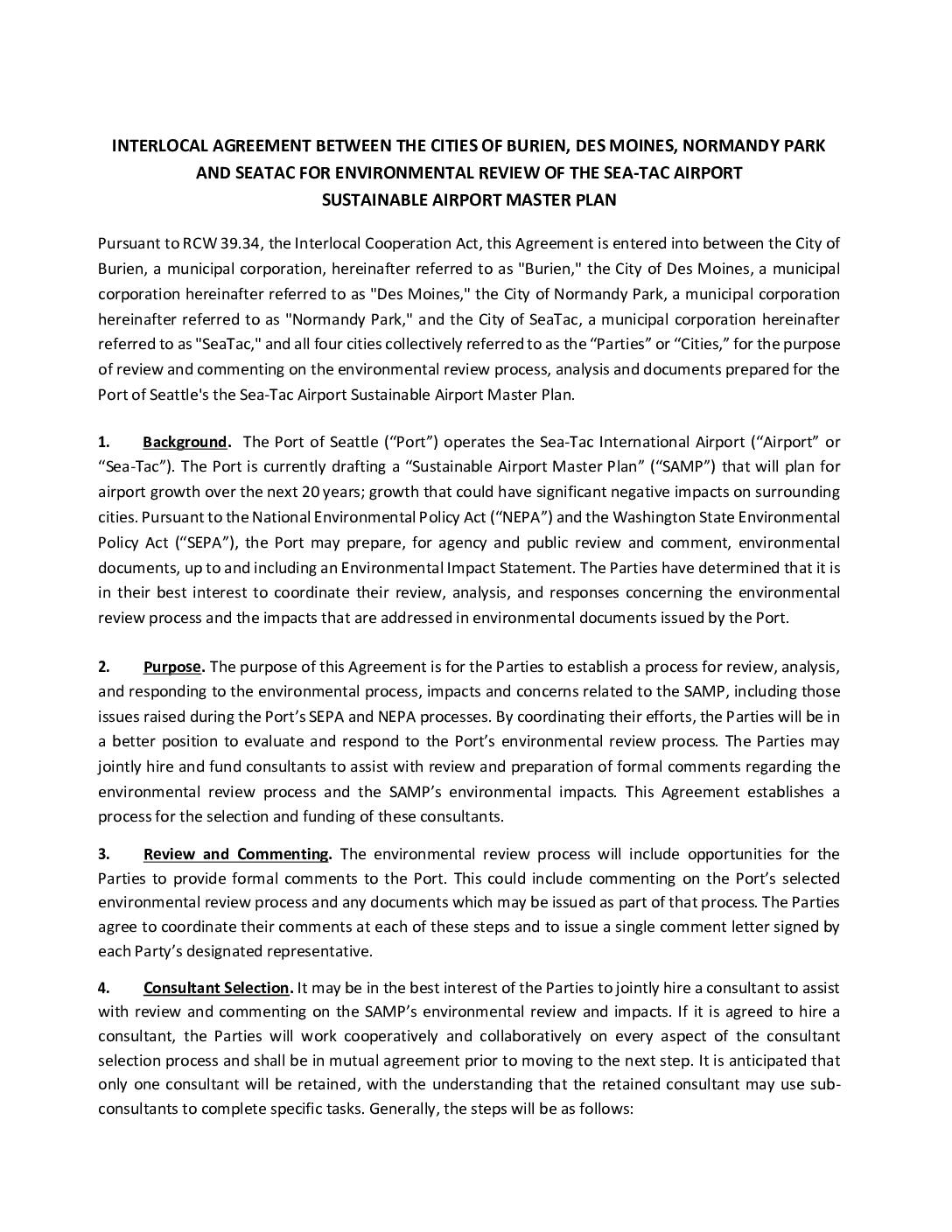
Interlocal agreement between the cities of Burien, Des Moines, Normandy Park and SeaTac for environmental review of the Sea-Tac Airport Sustainable Airport Master Plan
Four cities near Sea-Tac Airport — Burien, Des Moines, Normandy Park, and SeaTac — have joined together under a formal interlocal agreement to coordinate their review of the Port of Seattle's Sustainable Airport Master Plan (SAMP), which could bring significant noise and environmental impacts to surrounding communities over the next 20 years. The agreement establishes a shared process for hiring consultants, submitting joint public comments, and responding to environmental documents produced under federal (NEPA) and state (SEPA) law. The collaboration is set to run through December 31, 2027, with the City of Des Moines managing consultant contracts and the City of Burien overseeing fiscal matters. -
 2024-12-13
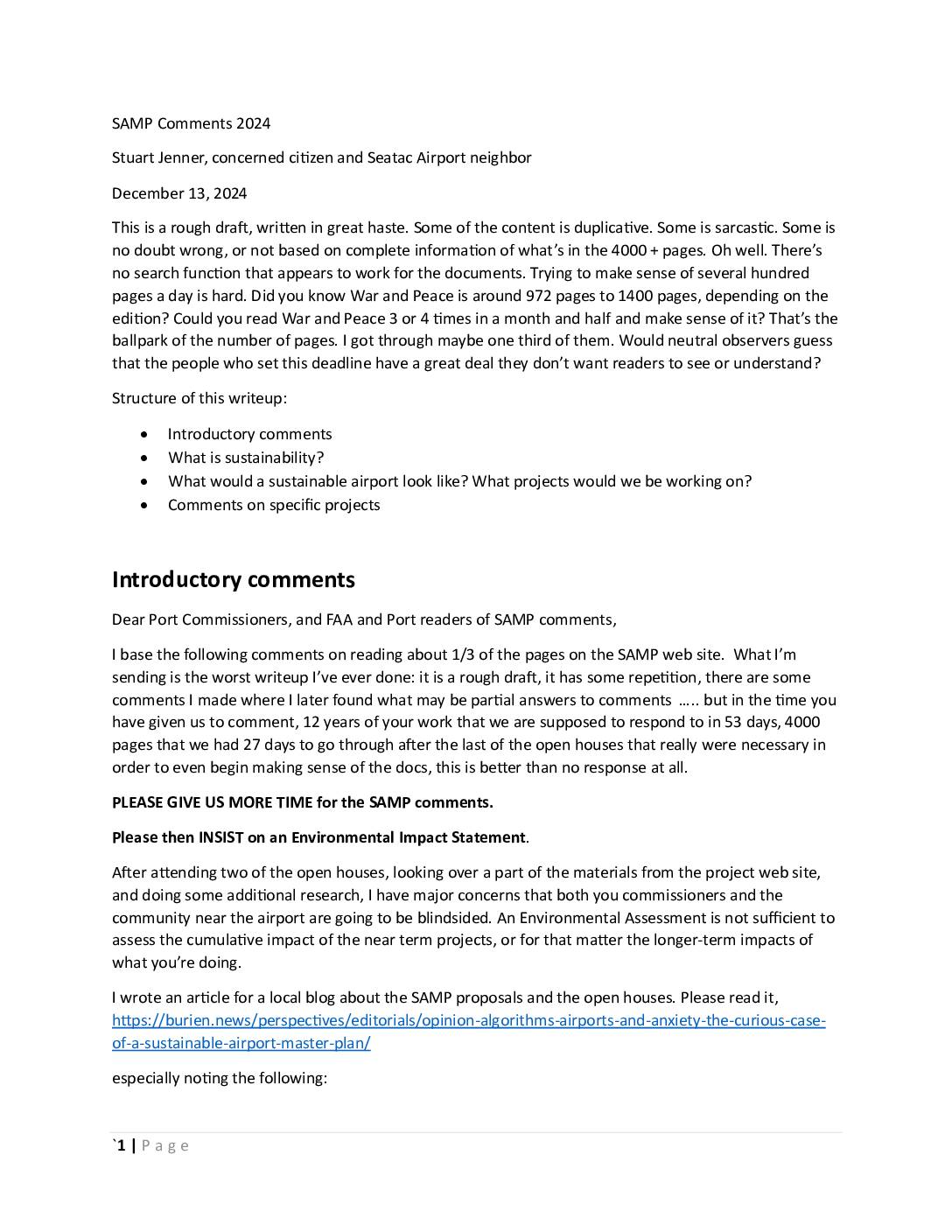
SAMP Comments: Stuart Jenner Public Comment on 2024 Draft Environmental Assessment
Seatac Airport neighbor Stuart Jenner submitted public comments in December 2024 criticizing the Port of Seattle's Sustainable Airport Master Plan (SAMP), arguing that citizens were given inadequate time to review over 4,000 pages of documents and that an Environmental Impact Statement—not merely an Environmental Assessment—is needed to properly evaluate the plan's effects on nearby residents. Jenner raises concerns about opaque computer models used to claim a nearly 50% increase in passenger traffic would have no environmental impact, shifting baseline comparisons that ignore past promises made during the third runway approval, and the absence of project cost information. He calls on Port Commissioners and the FAA to extend the public comment period and subject the plan to greater independent scrutiny. -
 2024-12-13
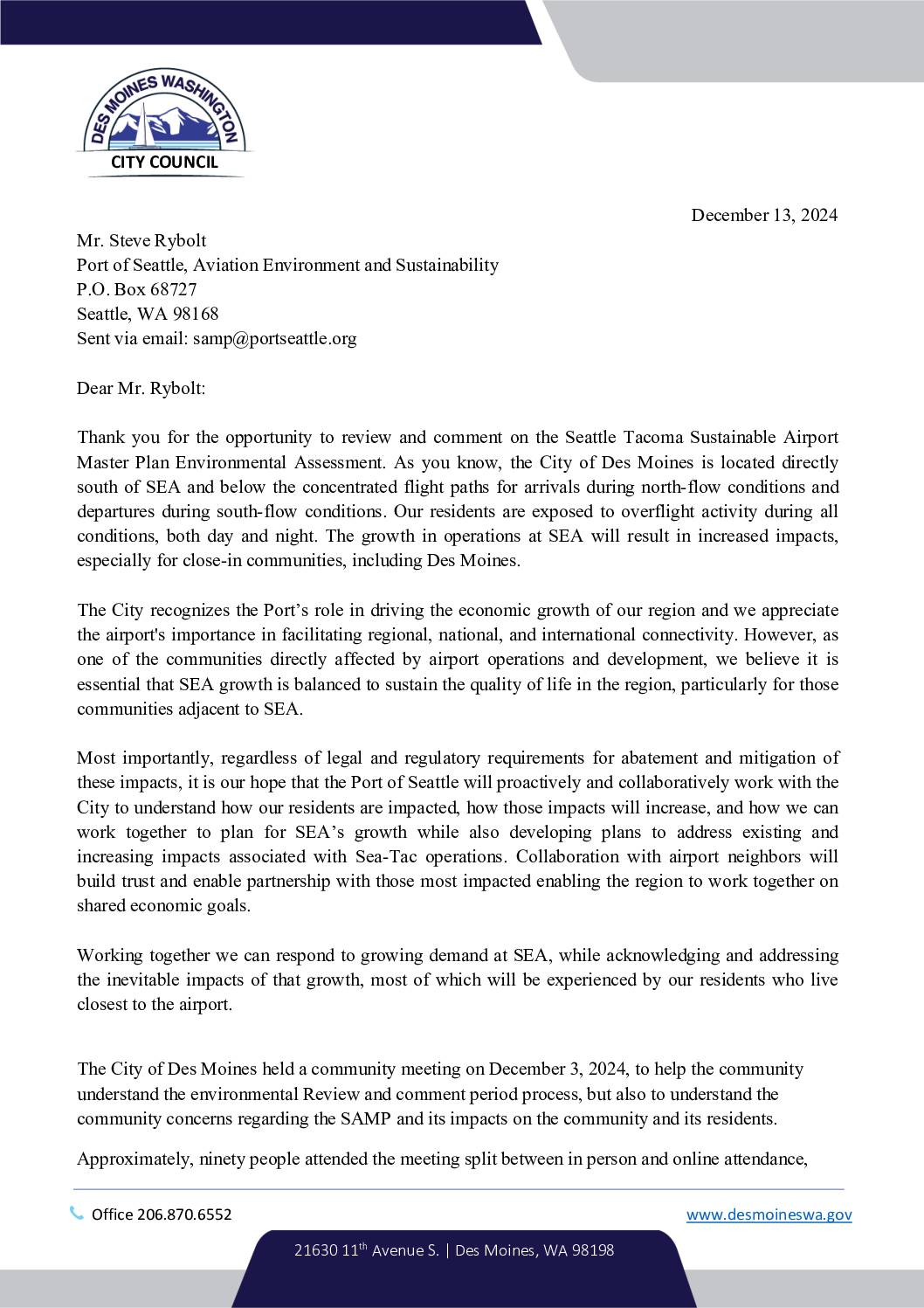
City of Des Moines Letter to Port Of Seattle: Comments on SAMP Draft Environmental Assessment
The City of Des Moines, Washington submitted formal comments to the Port of Seattle in December 2024, raising concerns about the environmental and health impacts of Seattle-Tacoma International Airport's planned growth. The city warns that by 2032, annual flight operations will increase by nearly 20%, expanding the noise exposure zone and raising the number of residents affected by significant aircraft noise from roughly 14,000 to nearly 22,000—with most of that burden falling on Des Moines residents. The letter calls on the Port and FAA to extend public comment periods, pursue meaningful noise mitigation measures such as sound insulation for homes and schools, and engage more collaboratively with impacted communities rather than treating public review as a formality. -
 2024-12-13
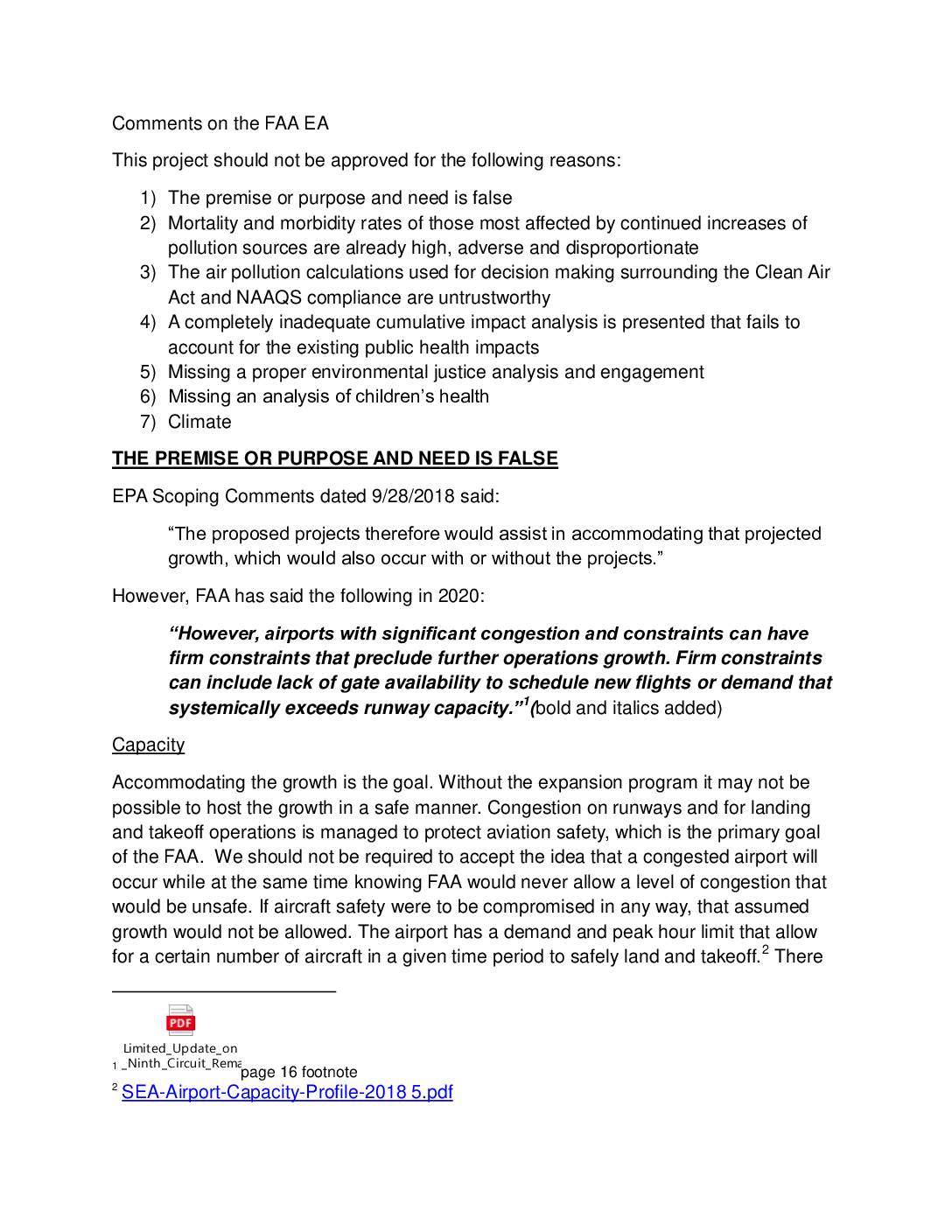
Comments on the FAA EA: SAMP Draft Environmental Assessment (Debi Wagner)
This document presents formal public comments opposing an FAA Environmental Assessment for expansion projects at Seattle-Tacoma International Airport. The author argues that the stated justification for expansion is misleading, contending that airport growth would not automatically occur without new gates and terminals since FAA safety rules already cap the number of aircraft operations. Additional concerns raised include disproportionate health burdens on nearby communities, unreliable air pollution modeling, inadequate environmental justice analysis, and failure to properly assess cumulative public health and climate impacts. -
 2024-12-13
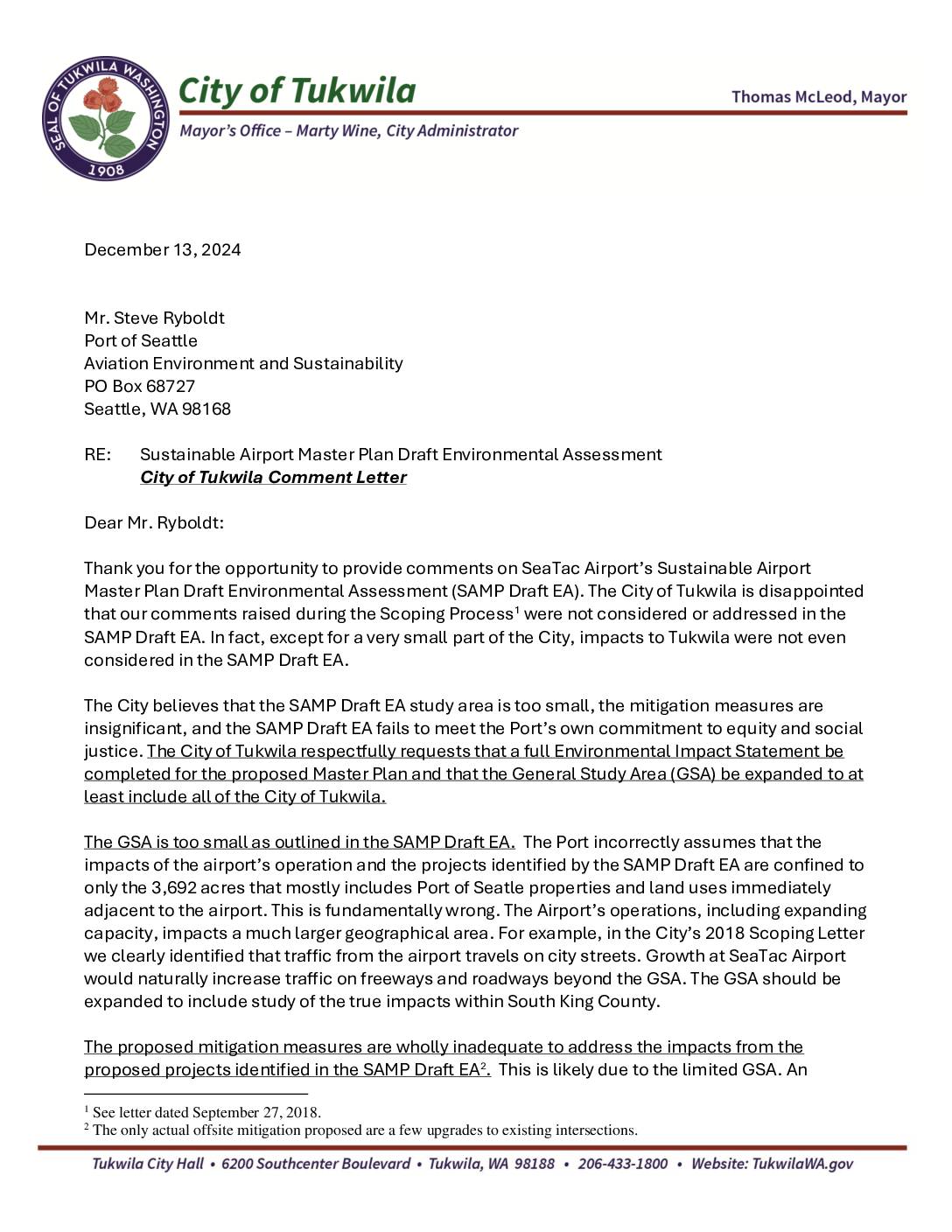
City of Tukwila Comment Letter on Sea-Tac Airport Sustainable Airport Master Plan Draft Environmental Assessment
The City of Tukwila submitted formal comments on December 13, 2024, objecting to SeaTac Airport's Sustainable Airport Master Plan Draft Environmental Assessment (SAMP Draft EA), arguing that the study area is too narrow, covering only 3,692 acres, and fails to account for broader impacts on surrounding communities including increased traffic, air quality degradation, and noise under flight paths. The city contends that proposed mitigation measures are inadequate and that the assessment ignores equity and social justice concerns affecting the low-income, diverse communities near the airport. Tukwila is calling for a full Environmental Impact Statement with an expanded General Study Area that includes the entire city and broader South King County region. -
 2024-12-12
Four-City Joint Comment Letter on Seattle-Tacoma International Airport SAMP Draft Environmental Assessment
Four cities near Seattle-Tacoma International Airport — Burien, Normandy Park, SeaTac, and Des Moines — submitted formal comments in December 2024 objecting to the airport's Sustainable Airport Master Plan Environmental Assessment. The cities warn that planned growth will increase annual flight operations by nearly 20% by 2032, expanding the noise impact zone and exposing an estimated 22,000 residents to significant aircraft noise, up from about 14,000 in 2022. They call on the Port of Seattle to extend public review periods, improve its sound insulation program, and take proactive steps to protect the low-income and minority communities most burdened by airport noise. -
 2024-12-12
City of Des Moines Comment Letter on Seattle-Tacoma SAMP Draft Environmental Assessment
The City of Des Moines submitted formal comments to the Port of Seattle in December 2024, expressing serious concerns about the Seattle-Tacoma International Airport's Sustainable Airport Master Plan and its projected growth in flight operations. The letter warns that by 2032, a nearly 20% increase in annual flights will significantly expand noise exposure for Des Moines residents, with the population affected by harmful noise levels rising by roughly 37% even without the proposed expansion. The city calls on the Port and FAA to extend public review periods, develop meaningful noise mitigation measures such as sound insulation programs, and collaborate more genuinely with neighboring communities rather than treating public input as a regulatory checkbox.