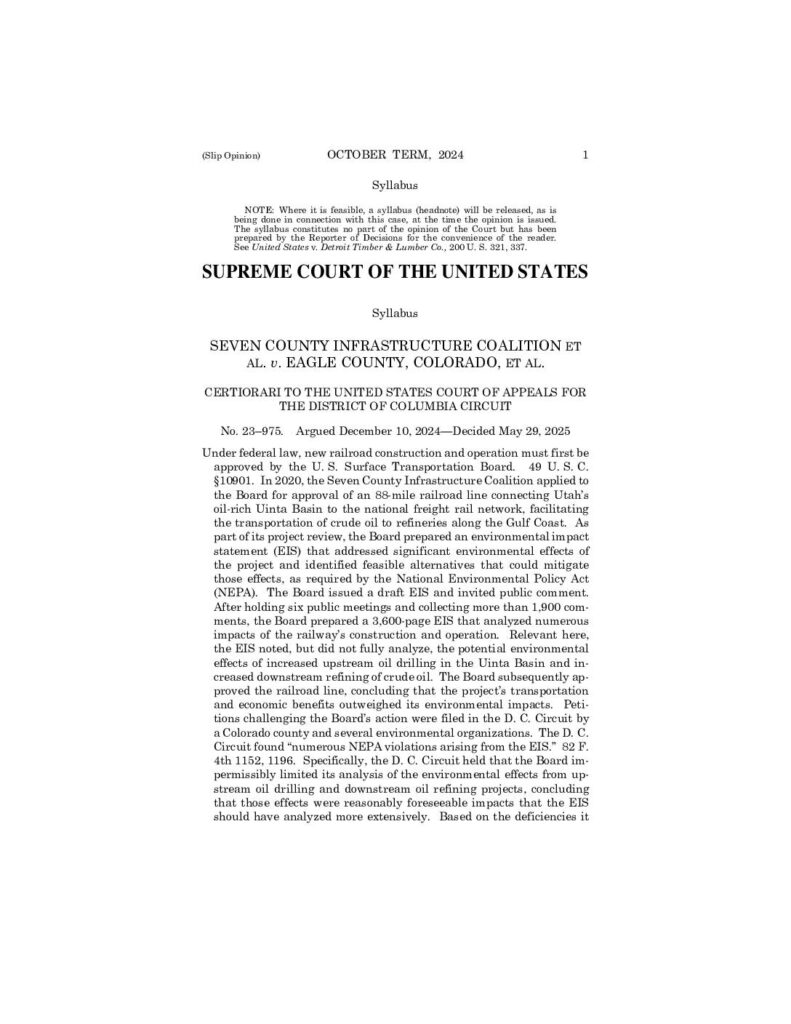
The U.S. Supreme Court ruled in May 2025 that federal agencies have broad discretion in determining the scope of environmental reviews required under the National Environmental Policy Act (NEPA). The case involved a proposed 88-mile railroad in Utah, where the Court held that agencies do not need to analyze the environmental effects of separate upstream or downstream projects — such as oil drilling or refining — when reviewing a specific infrastructure project. Courts must give substantial deference to agency decisions about what to include in environmental impact statements, rather than imposing their own judgment about what details are required.Open full document
Notes
Supreme Court slip opinion reversing the D.C. Circuit’s decision that found NEPA violations in the Surface Transportation Board’s environmental impact statement for the Uinta Basin Railway. The Court held that the D.C. Circuit failed to afford the Board substantial judicial deference and incorrectly interpreted NEPA to require analysis of upstream oil drilling and downstream refining projects separate from the proposed railroad. The opinion clarifies that NEPA’s textual focus is on the ‘proposed action’ and that courts should not micromanage agency EIS decisions falling within a broad zone of reasonableness.