TagNEPA(390)
-
 1997-01-01
Considering Cumulative Effects Under the National Environmental Policy Act
A handbook published by the Council on Environmental Quality providing guidance on analyzing cumulative effects under NEPA. The document covers scoping, describing affected environments, determining environmental consequences, and addressing cumulative impacts in environmental assessments. -
 1997-01-01
Considering Cumulative Effects Under NEPA (Executive Summary)
A handbook by the Council on Environmental Quality providing framework and methods for analyzing cumulative effects in environmental assessments and impact statements under NEPA. The document outlines principles, steps, and data sources for cumulative effects analysis but does not establish new legal requirements. -
 1996-12-01
EXH AR040251: JARPA Application for Proposed Master Plan Update Improvements at Seattle-Tacoma International Airport
JARPA (Joint Aquatic Resources Permit Application) and Section 404 application submitted by Port Of Seattle to the U.S. Army Corps of Engineers (Jack Kennedy, Seattle District Office) in December 1996, prepared by Parametrix, Inc. Requests authorization to place fill material into waters of the United States at Sea-Tac Airport associated with the Master Plan Update -
 1996-02-01
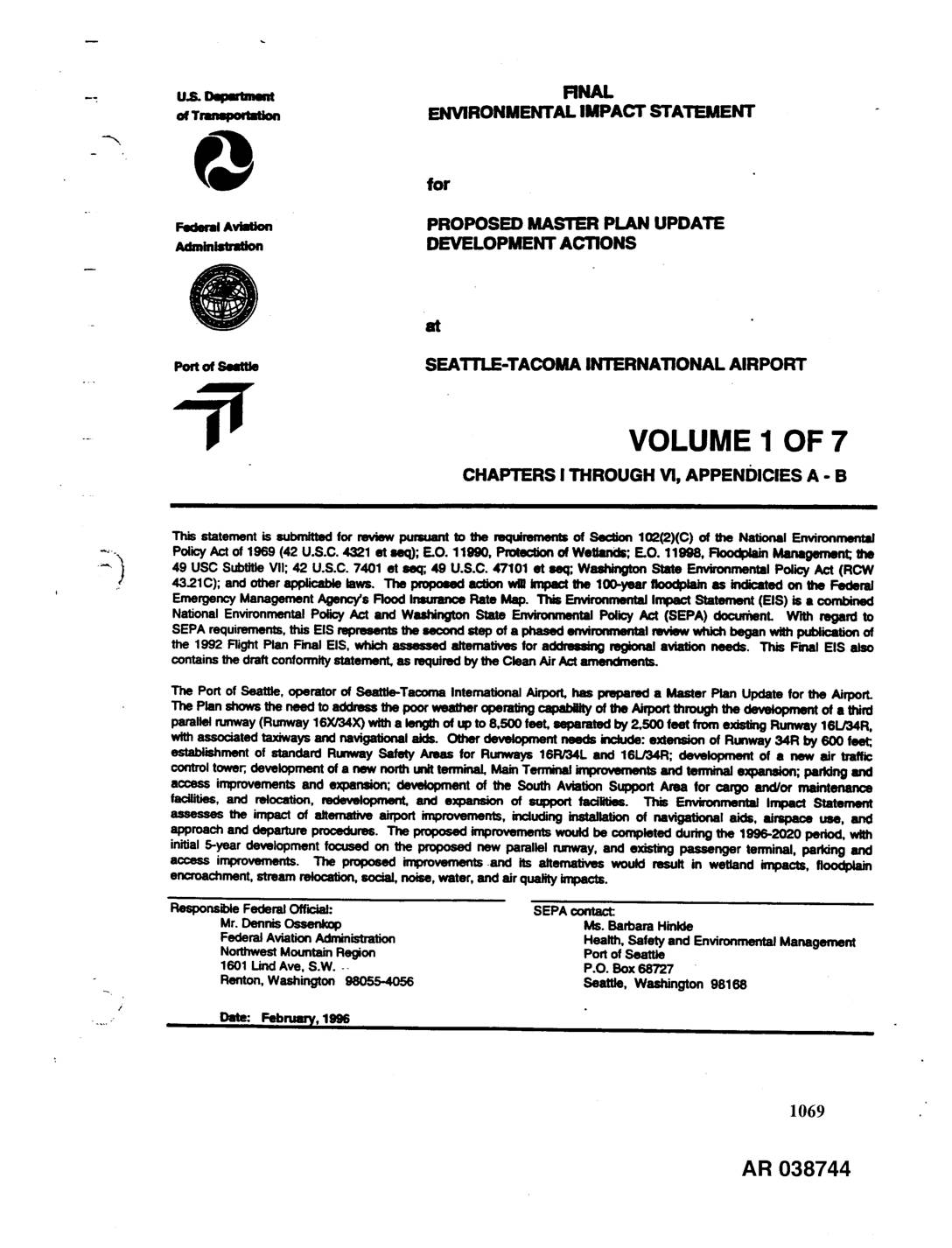
EXH AR038744: Final Environmental Impact Statement for Proposed Master Plan Update Development Actions at Seattle-Tacoma International Airport, Volume 1 of 7
Final Environmental Impact Statement (EIS) prepared jointly by the Federal Aviation Administration (FAA) Northwest Mountain Region and the Port of Seattle for the Seattle-Tacoma International Airport (Sea-Tac) Master Plan Update, dated February 1996, AR038744. Covers proposed development actions 1996-2020 including a new third parallel runway (Runway 16X/34X) up to 8,500 feet long separated 2,500 feet -
 1995-07-21
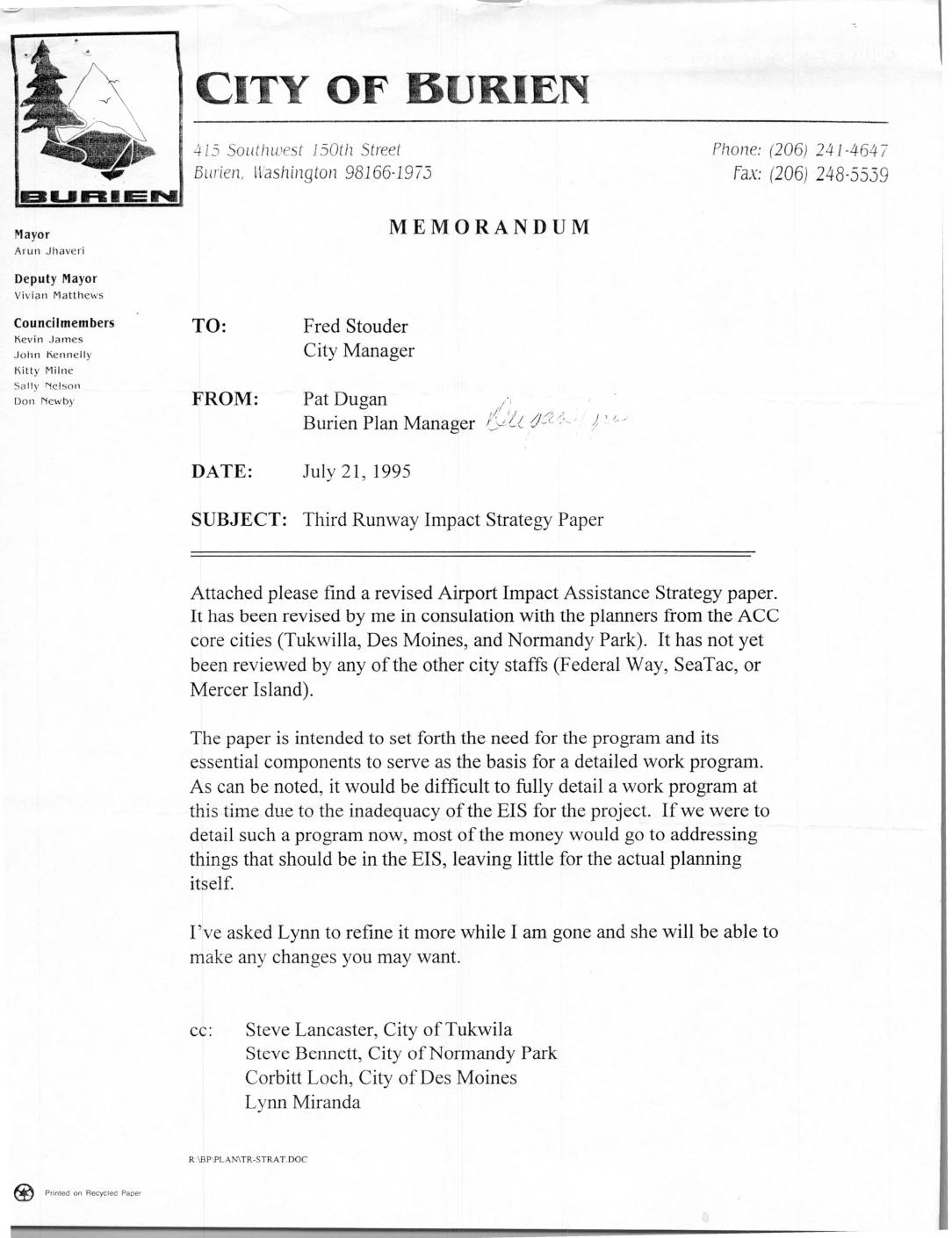
Airport Impact Assistance Strategy: Work Program Draft, City of Burien
A 1995 City of Burien memorandum and accompanying draft strategy paper outline concerns about the negative impacts of constructing a third runway at Seattle-Tacoma International Airport on surrounding communities, including increased noise, traffic, and neighborhood blight. The document warns that heavy truck traffic, expanded air traffic noise 'shadow,' and construction disruption could drive down property values, destabilize local businesses, and accelerate community deterioration. It calls for proactive planning and mitigation efforts, while criticizing the Environmental Impact Statement (EIS) for inadequately addressing these impacts. -
 1995-04-01
ACC Comments on the Proper Scope of the Environmental Impact Statement for a Proposed Development of Seattle-Tacoma International Airport
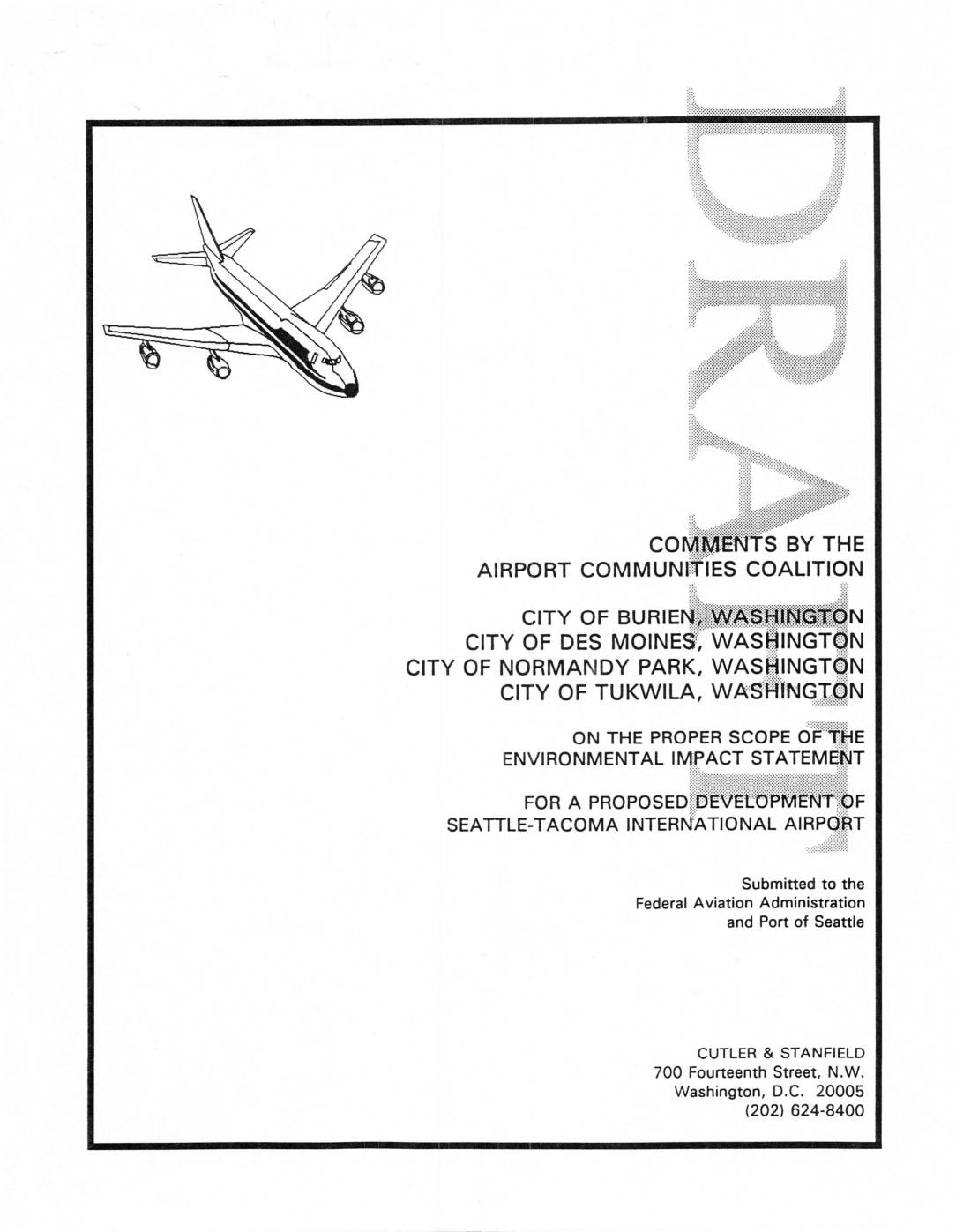
The Airport Communities Coalition, representing the cities of Burien, Des Moines, Normandy Park, and Tukwila, Washington, submitted formal scoping comments to the FAA and Port of Seattle regarding the proper scope of an Environmental Impact Statement for a proposed expansion of Seattle-Tacoma International Airport. The comments address key issues including the purpose and need for the project, the role of Puget Sound Regional Council planning, and the requirement for the FAA to independently fulfill its obligations under the National Environmental Policy Act. The document also calls for the EIS to account for connected and cumulative impacts, including planned land-side facility improvements and the Part 150 Noise Mitigation Program. -
 1992-04-09
Seattle Community Council Federation v. F.A.A., 961 F.2d 829 (9th Cir. 1992)
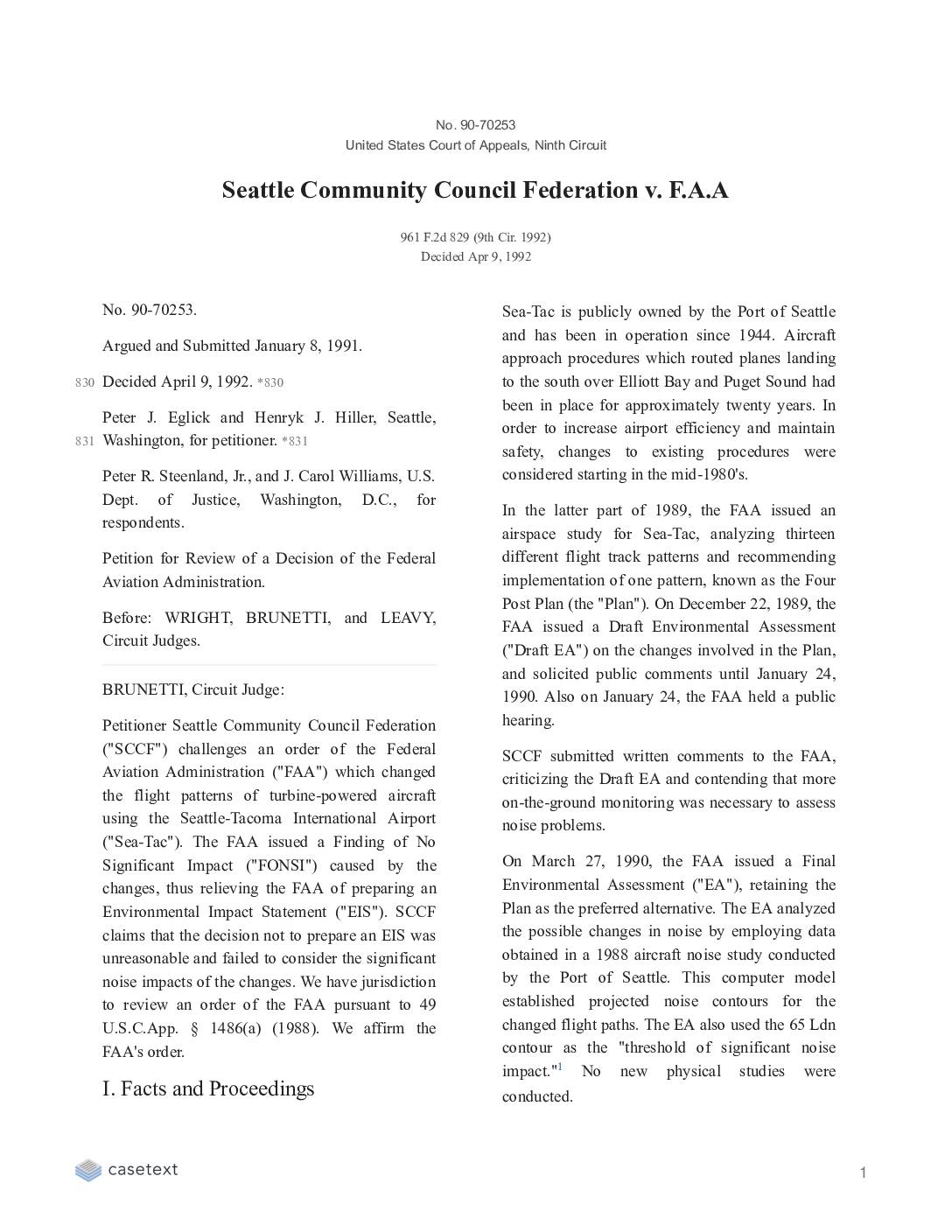
In 1992, the Ninth Circuit Court of Appeals upheld the FAA's decision to change flight patterns for turbine-powered aircraft at Seattle-Tacoma International Airport without preparing a full Environmental Impact Statement. The FAA had issued a Finding of No Significant Impact based on a computer noise model using the 65 decibel day-night sound level as the threshold for significant noise impact, which the court found to be a reasonable approach. The Seattle Community Council Federation had challenged the decision, arguing that the FAA failed to adequately assess the noise effects on surrounding communities. -
 1990-03-27
Final environmental assessment for proposed changes to air traffic arrival and departure routes at Seattle-Tacoma International Airport
This 1990 Final Environmental Assessment, prepared by the FAA's Air Traffic Division in Seattle, evaluates proposed changes to arrival and departure flight routes at Seattle-Tacoma International Airport. The document was signed by Air Traffic Division Manager Temple H. Johnson, Jr. on March 27, 1990, and examines the potential environmental impacts of rerouting aircraft traffic in and out of Sea-Tac. It serves as an official federal record relevant to noise and environmental policy affecting communities around the airport. -
 1990-01-01
Final environmental assessment: Proposed changes to air traffic arrival and departure routes at Seattle-Tacoma International Airport, Volume II
This 1990 Final Environmental Assessment, published by the U.S. Department of Transportation's Federal Aviation Administration, examines proposed changes to air traffic arrival and departure routes at Seattle-Tacoma International Airport. Volume II of the document compiles public comments received in response to the Draft Environmental Assessment, reflecting community input on how the proposed route changes could affect noise and other environmental conditions in the Seattle, Washington area. -
 1980-03-04
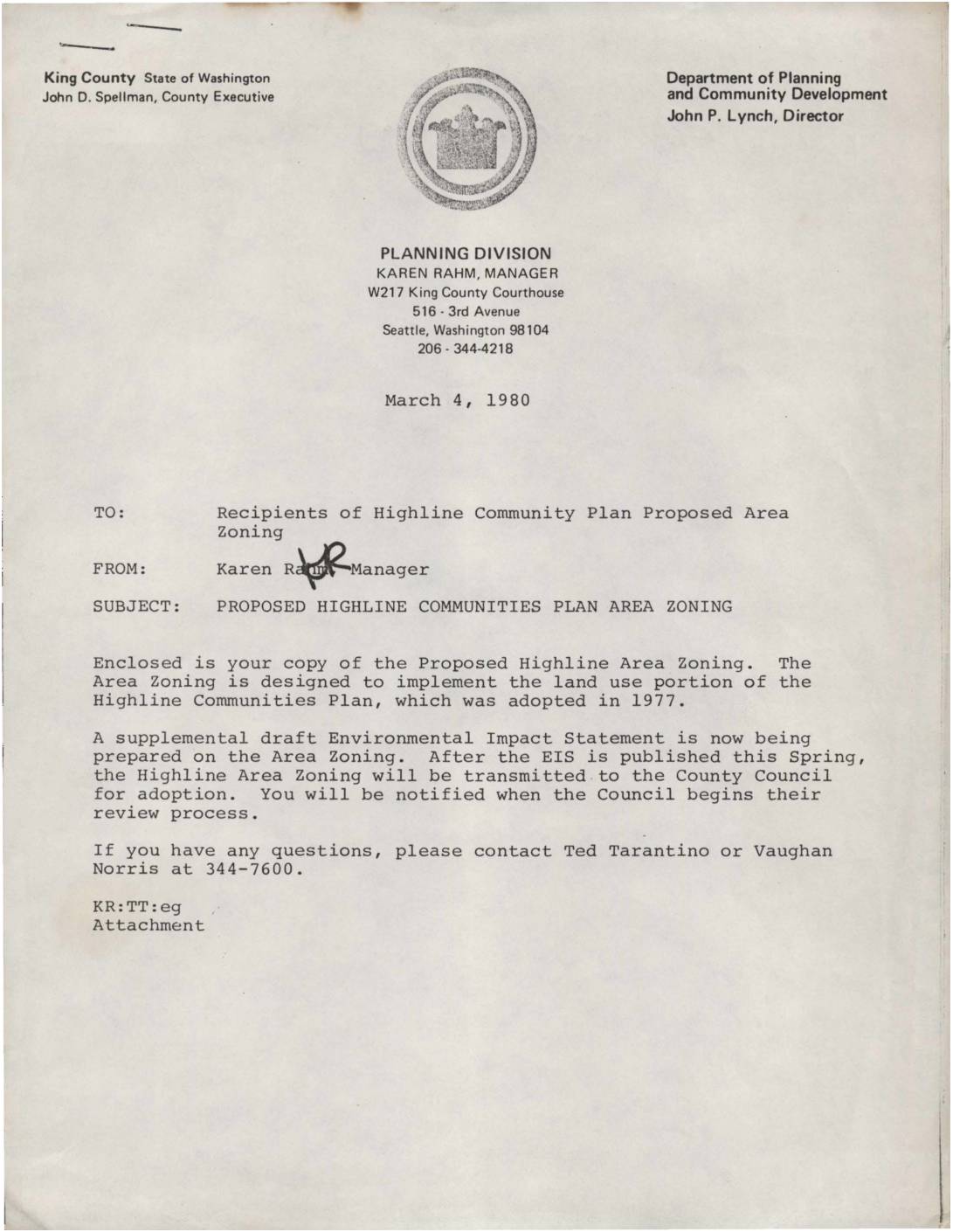
Proposed Highline Communities Plan Area Zoning: Transmittal Letter from King County Planning Division
A March 1980 memo from King County's Planning Division manager Karen Rahm notifies recipients about the Proposed Highline Communities Plan Area Zoning, a zoning framework designed to implement the land use guidelines of the 1977 Highline Communities Plan. The memo states that a supplemental draft Environmental Impact Statement was being prepared and would be published in Spring 1980, after which the zoning proposal would be sent to the County Council for adoption. Handwritten notes on the reverse reference page 56, suggesting a potential rezoning from SR to ML (Medium Light industrial) with consideration of buffer zones around ML areas.