TagSea-Tac Airport(1855)
-
 1993-04-21
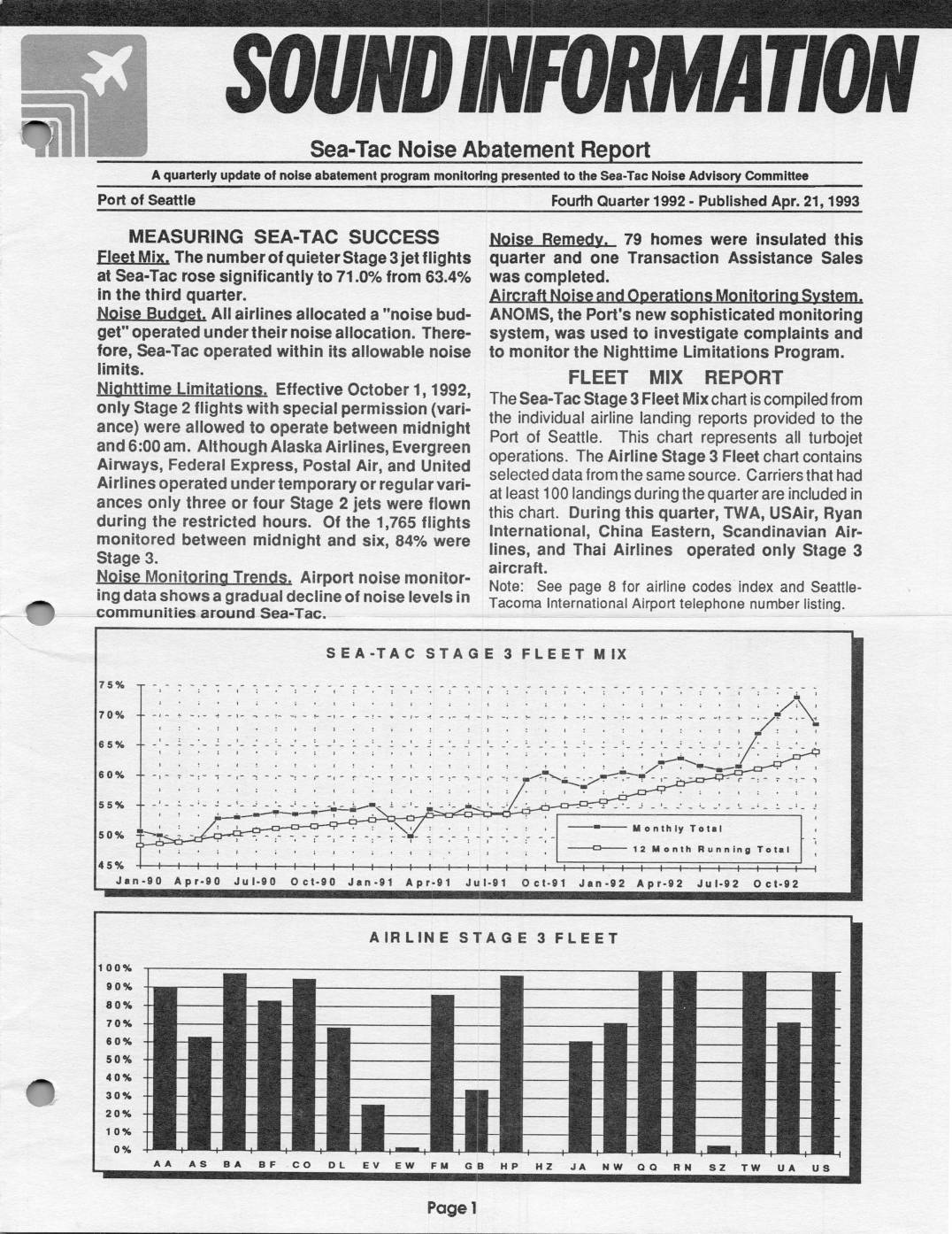
Sound Information: Sea-Tac Noise Abatement Report, Fourth Quarter 1992
This quarterly Sea-Tac Noise Abatement Report from the Port of Seattle (Q4 1992) tracks progress in reducing airport noise, highlighting that 71% of jet flights were operated by quieter Stage 3 aircraft, up from 63.4% the previous quarter. All airlines stayed within their allocated noise budgets, and new nighttime restrictions effective October 1, 1992 limited louder Stage 2 jets between midnight and 6:00 a.m. The report also outlines noise abatement flight procedures designed to route departing and arriving aircraft over industrial areas and water to minimize noise impacts on surrounding communities. -
 1993-04-15
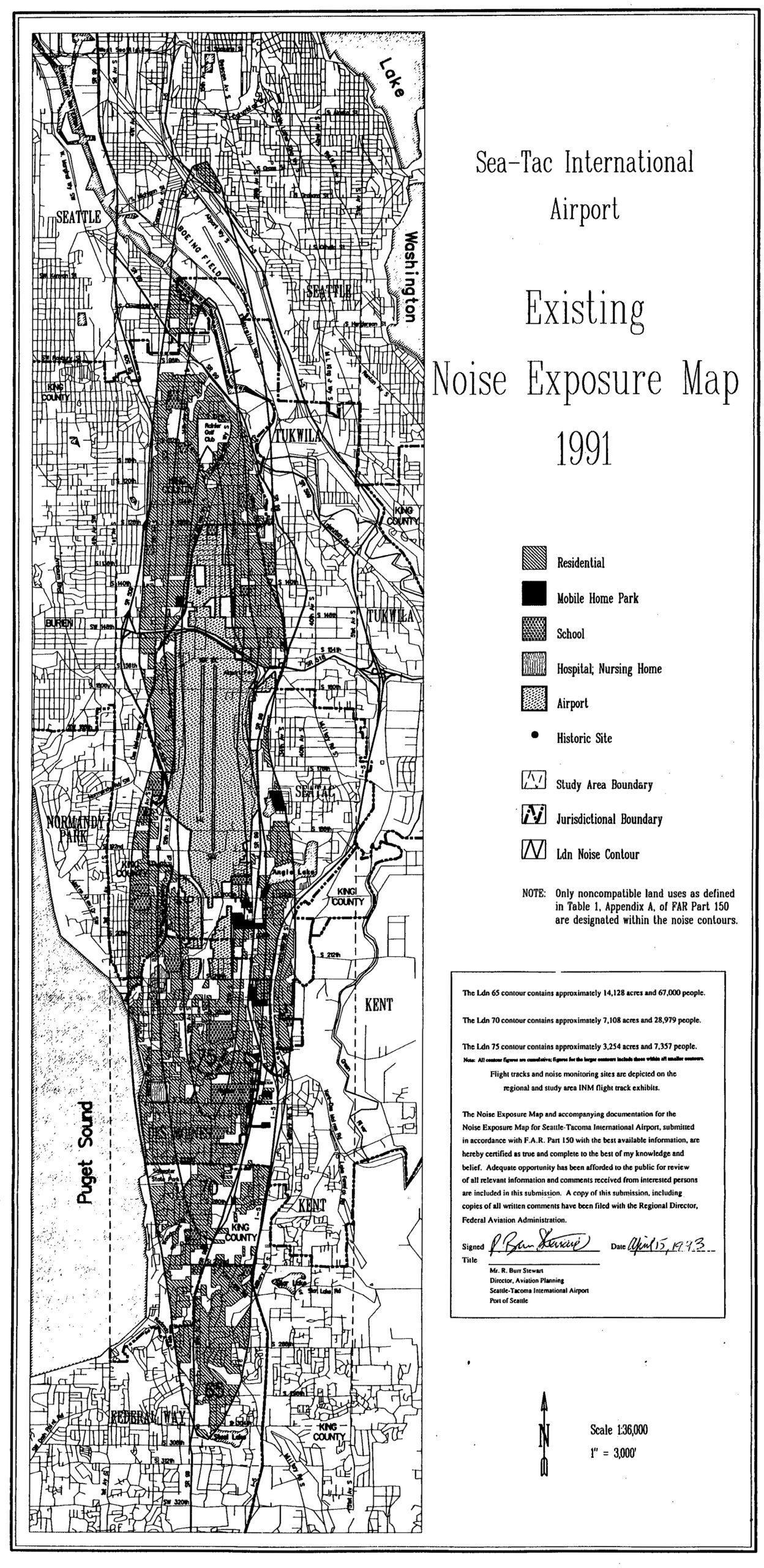
1991 Sea-Tac Part 150 Noise Exposure Map NEM
This is the official 1991 Existing Noise Exposure Map for Seattle-Tacoma International Airport, submitted in accordance with F.A.R. Part 150, signed by R. Bun Stewart, Director of Aviation Planning, Port of Seattle, on April 15, 1993. The map depicts Ldn noise contours (65, 70, and 75) over the surrounding communities including Seattle, Tukwila, SeaTac, Normandy Park, Burien, Kent, and Federal Way, with the Ldn 65 contour encompassing approximately 14,128 acres and 67,000 people. -
 1993-04-15
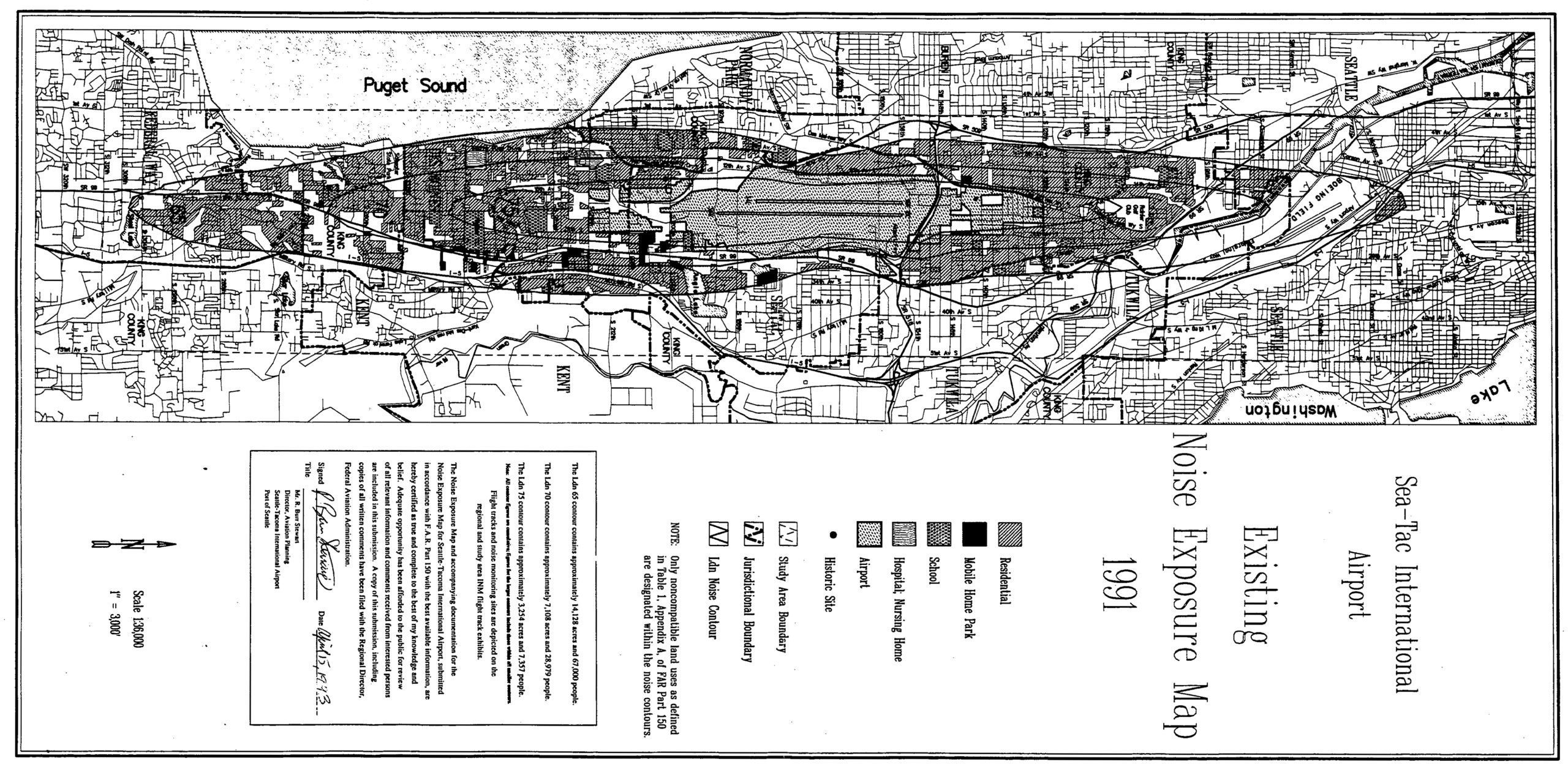
FAR Part 150 1991 Existing Noise Exposure Map (NEM) — Sea-Tac Airport
This is the official 1991 Existing Noise Exposure Map for Seattle-Tacoma International Airport, prepared in accordance with FAR Part 150. The map covers the Sea-Tac flight corridor from Puget Sound to Lake Washington, showing noise contours, jurisdictional boundaries across King County municipalities, and land use designations including residential, school, hospital/nursing home, mobile home park, and airport zones; it is signed by W.E. Bus-Street, Director of Aviation Planning, Seattle-Tacoma International Airport, and dated April 15, 1993. -
 1993-04-15
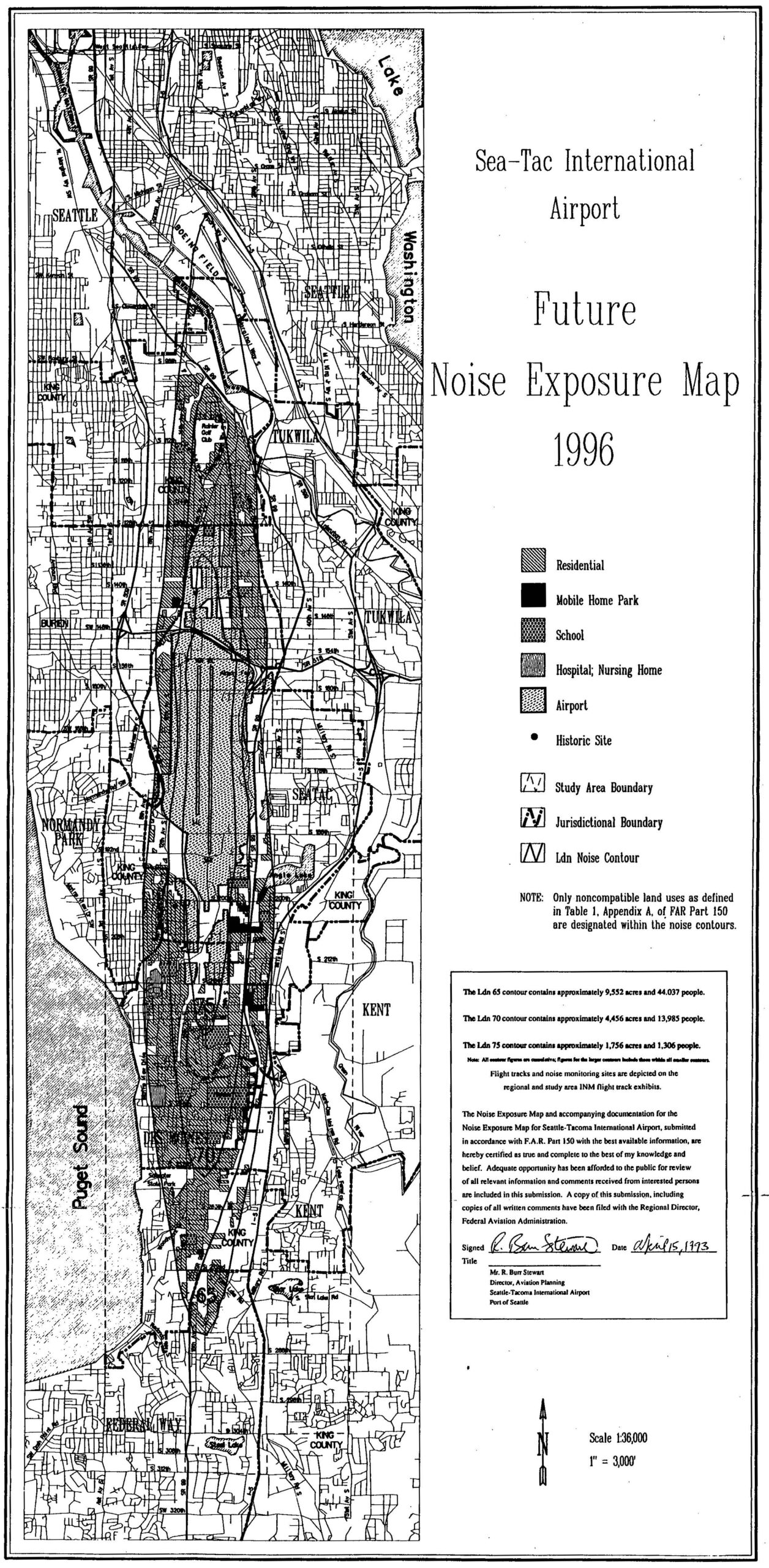
Noise Exposure Map NEM Future 1996 pg 210 from 1993 Part 150 Study
A Future Noise Exposure Map for Seattle-Tacoma International Airport projecting 1996 noise contours (Ldn 65, 70, and 75), showing affected land uses including residential, schools, and hospitals across the Sea-Tac area. Signed by R. Burr Stewart, Director of Aviation Planning, Port of Seattle, and dated April 15, 1993, at a scale of 1:36,000. -
 1993-03-31
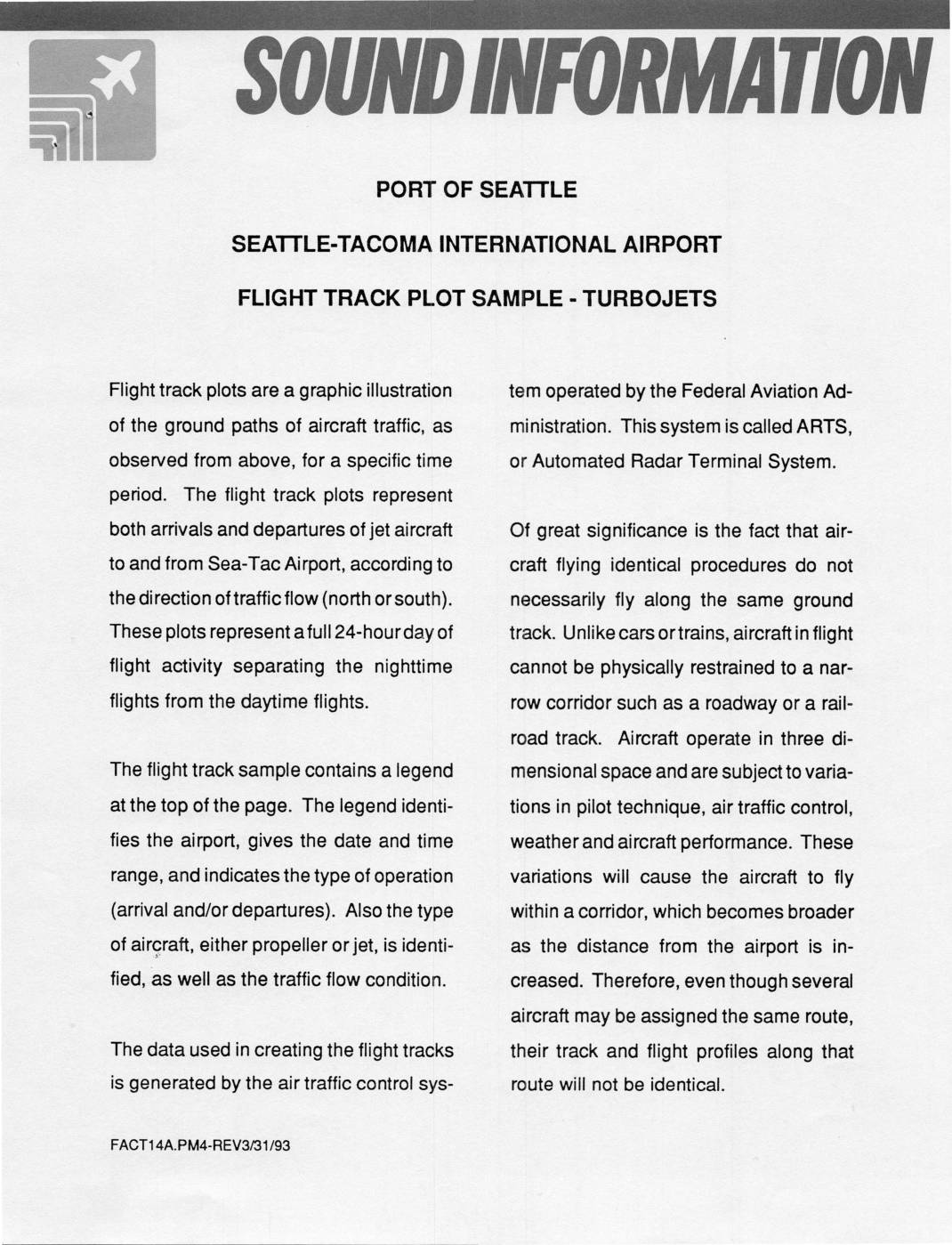
Port Of Seattle Sea-Tac Airport: Flight Track Plot Sample – Turbojets
This Port of Seattle document explains flight track plots for Seattle-Tacoma International Airport, which are overhead graphic illustrations showing the ground paths of arriving and departing jet aircraft over a 24-hour period, separated into daytime and nighttime operations for both north and south traffic flows. The data is sourced from the FAA's Automated Radar Terminal System (ARTS). Notably, the document emphasizes that even aircraft following identical routes will not fly the exact same path, as factors like pilot technique, air traffic control, weather, and aircraft performance cause flight corridors to widen with increasing distance from the airport. -
 1993-03-03
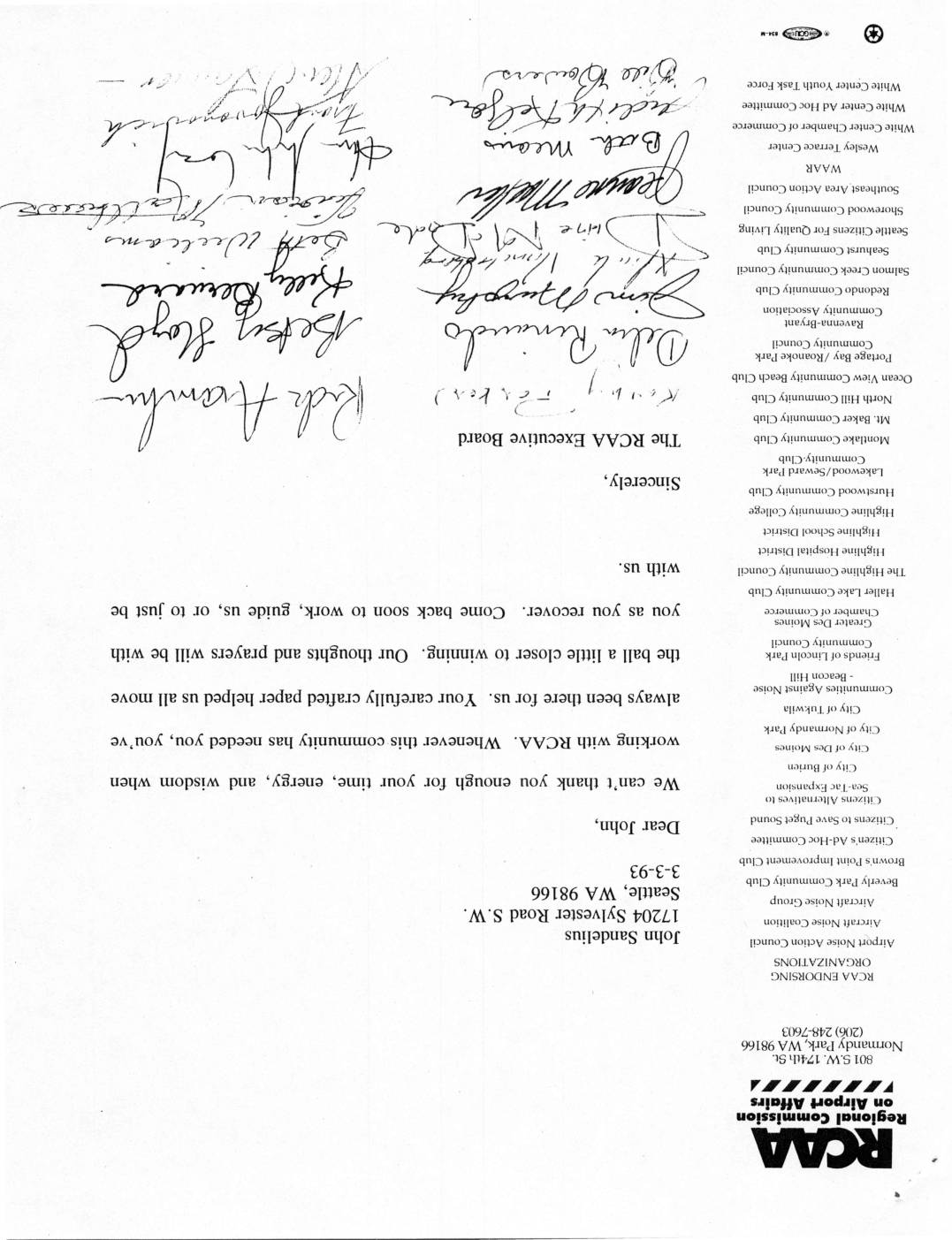
RCAA letter to John Sandelius
A March 1993 letter from the RCAA (Regional Commission on Airport Affairs) Executive Board addressed to John Sandelius of Seattle, thanking him for his time, energy, and wisdom contributed to the organization's efforts regarding Sea-Tac Airport noise issues. The letter expresses well-wishes for his recovery and notes that his work was valued whenever the community needed him. The document is endorsed by a wide coalition of over 50 community organizations, city governments, and civic groups from the greater Seattle and South King County area opposing airport noise expansion. -
 1993-02-02
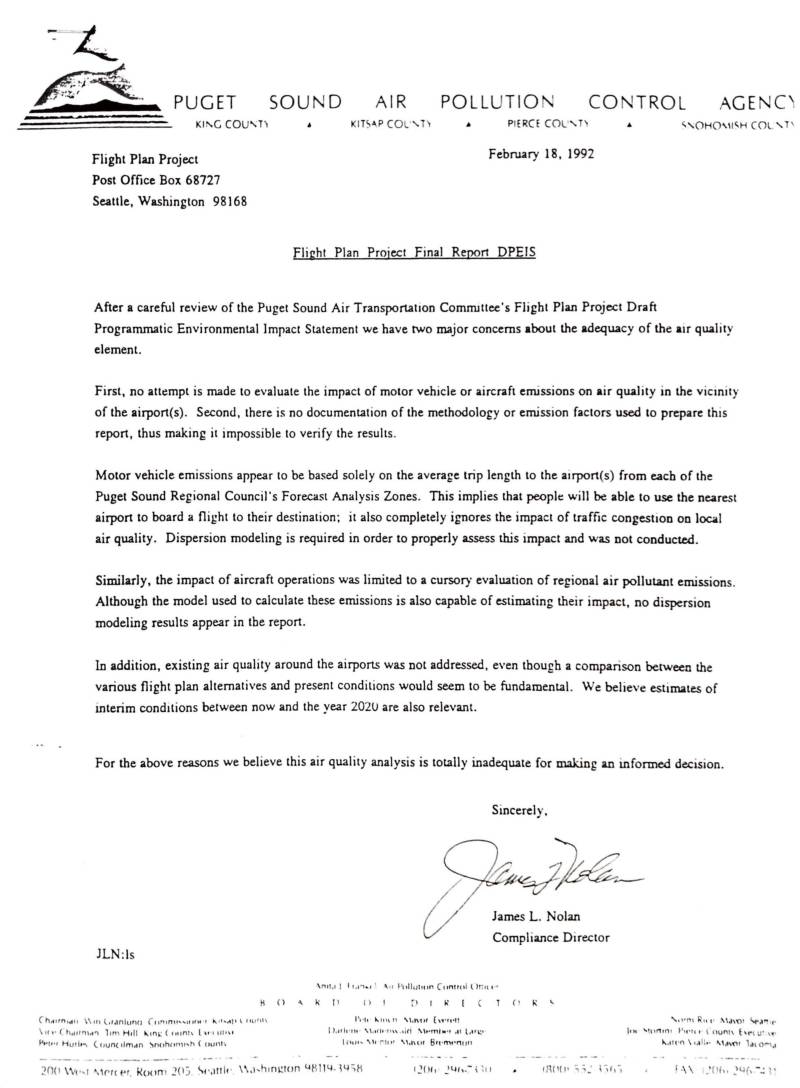
PSAPCA’s role regarding airport air quality
The Puget Sound Air Pollution Control Agency (PSAPCA) raised concerns in 1992 about inadequate air quality analysis in the Flight Plan Project's environmental impact statement, citing missing dispersion modeling for both vehicle and aircraft emissions near Sea-Tac Airport. A follow-up 1992 letter addressed the use of ethylene glycol as a de-icing agent at Sea-Tac, concluding it was unlikely to pose a significant air quality risk due to its low vapor pressure. A 1993 internal memo clarified PSAPCA's role in reviewing airport-related environmental impact statements and conducting annual inspections of registered equipment at airports within its jurisdiction. -
 1993-01-26
RCAA Regional Commission on Airport Affairs information packet
The Regional Commission on Airport Affairs (RCAA) was a coalition of cities and citizen groups in the Puget Sound region that opposed the proposed third dependent runway at Seattle-Tacoma International Airport in the early 1990s. The organization compiled expert research and white papers covering noise impacts, public health effects, environmental and social consequences, and economic costs associated with airport expansion. Their goal was to identify financially feasible and environmentally responsible alternatives to meet the region's air capacity needs without further expanding Sea-Tac. -
 1993-01-21
RCAA presentation materials on demand management, airport planning, and system alternatives
This January 1993 document from the Regional Commission on Airport Affairs (RCAA) presents materials to the Puget Sound Regional Council's Transportation Policy and Executive Board covering demand management, airport planning, and regional air capacity alternatives. The packet includes analysis of flight delays, airspace and runway capacity issues, and landside capacity concerns prepared by consultants J. Richard Aramburu and Gerald Bogan, along with alternative airport development ideas from locations such as Grays Harbor County, Toledo-Winlock, and Moses Lake. The RCAA, backed by dozens of community groups and several cities in the Sea-Tac area, sought to offer expert-driven solutions to address long-term aviation capacity needs while addressing aircraft noise concerns affecting surrounding neighborhoods. -
 1993-01-14
Regional Commission on Airport Affairs Book #1
This is Book #1 of materials compiled by the Regional Commission on Airport Affairs (RCAA), a coalition of community organizations and cities in the Puget Sound region, submitted to the Transportation Policy Board in January 1993. The packet presents expert reports on air traffic forecasting, economic impacts, noise, effects on children's education, public health, and air pollution—all focused on the proposed expansion of Seattle-Tacoma (Sea-Tac) International Airport. The RCAA argues against airport expansion on the grounds of quality of life, environmental harm, and equity for surrounding communities.