Skip to content
  • STNI
  • Statistics
    • Ops and Passengers
      • King County International Airport (Boeing Field) Annual Operations
    • Financials
    • Aviation fuel uplift in the State of Washington 2018 – 2025
      • Aviation Fuel Tax Revenue in the State of Washington 1983-2025
      • Aviation Fuel Uplift at Sea-Tac Airport
    • Air Quality Monitoring
    • Flight Tracking
      • Flow and Flight Tracks
      • Five Year Comparison
      • Busiest Hours and Days
    • SEL Noise Reports & Graphs
      • About The Permanent Noise Monitors
      • Minutes of Quiet by Noise Monitor
      • Noise Events mapped
      • Noise Events (SEL)
    • Runways
    • Employees
    • Real Estate
      • Port Properties and Trees mapped
    • Parking
  • Events
  • Protest
    • Regular Events
    • Policy
      • Legislative Agenda 2027
      • Airport mitigation for the twenty first century
      • Port Dracula
    • Complain about a particular flight
    • Advocacy Organizations
    • Media Outlets
    • People
    • The Port of Seattle
      • Commission Meetings
      • Public Records Requests
      • StART
      • Highline Forum
    • Contact Your Electeds
  • Resources
    • FAQs
      • FAA Occurrences/Accidents/Indents
    • The SAMP
      • SAMP Public Comment Template
        • Two versions of Appendix K: NEPA/SEPA 2018 vs 2023
      • SAMP NTP: 31 projects by the numbers
      • SEPA Draft EIS (2026)
      • SAMP Record of Decision/FONSI (2025)
      • SAMP Draft EA (October 2024)
      • 2018 Scoping
    • Port Packages
      • Port Package Property Costs
      • Port Packages mapped
      • The Port Package Explainer
      • So you want a (first-time) Port Package? Start here
      • Port Package Looker Upper
      • How do I determine if I have a Port Package or Avigation Easement?
      • Progress on Port Package Update legislation
      • Having a Port Package Problem?
      • Port Package Site Visit Follow-Up
    • Document Library
    • Explainers
      • The Airport Law Cheat Sheet
      • The Grant Explainer
    • External Articles
    • History
      • Timeline
      • The Sea-Tac Communities Plan
        • Sea-Tac Communities Plan – Planning Maps
      • PSRC Third Runway Decision Process
    • Studies
    • Videos
  • Stories
  • Mission
  • Subscribe
  • Contact
Scroll down to content

Get InformedStay Informedx

I understand that you will never share my information with anyone, you will only use it to keep me updated on relevant events and that I may unsubscribe at any time.

STNI

STNISea-Tac Noise.Info

  • Solve for Sea-Tac. Solve for every airport.
  • Since 2016, working to obtain justice for everyone living under the flight path.
  • Less Noise. Cleaner Air. Better Public Health. Compensation.
  • Everything you think you know about the airport is wrong.

TagSea-Tac Airport(1855)

Advanced Search Options

  • Dates
  • Media
    • External Articles
    • Images
    • PDFs
    • Video
    • Audio
  • Order By
  • 1992-07-01

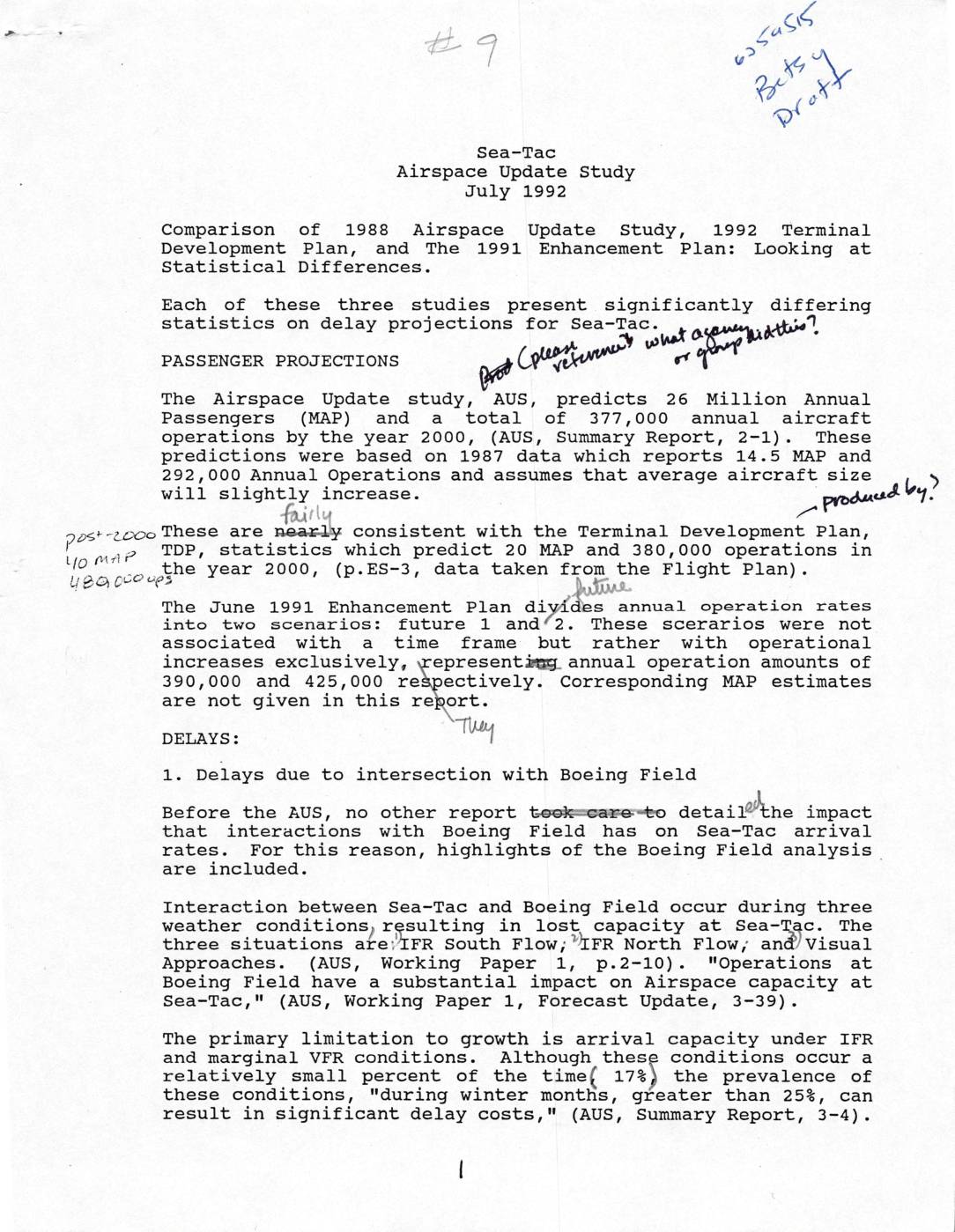
    Sea-Tac Airspace Update Study: Comparison of 1988 Airspace Update Study, 1992 Terminal Development Plan, and the 1991 Enhancement Plan

    This 1992 study compares three planning reports on Sea-Tac Airport's future capacity and delays: the 1988 Airspace Update Study, the 1992 Terminal Development Plan, and the 1991 Enhancement Plan. The reports differ significantly in their passenger and flight operation projections for the year 2000, and show striking discrepancies in delay estimates — with the Enhancement Plan projecting delay hours more than five times higher than the Airspace Update Study. The document also outlines proposed solutions to reduce delays, including new runway construction, airspace conflict resolution with nearby Boeing Field, and improved approach procedures.
    TagsAirspace Study, Boeing Field, Forecast, RCAA, Sea-Tac Airport, StatisticsFolderRCAA
  • 1992-06-27

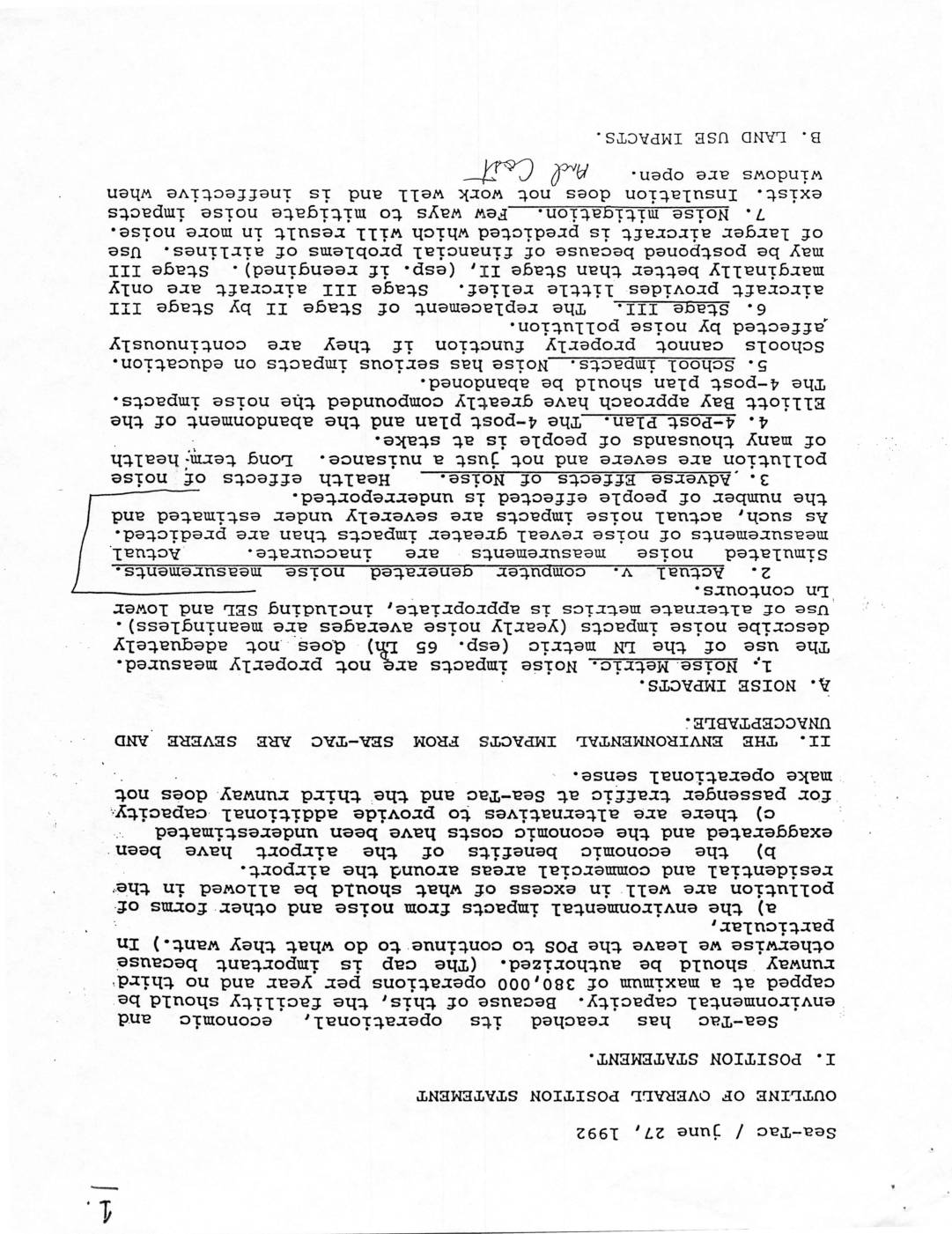
    Outline of overall position statement: Sea-Tac, June 27, 1992

    A 1992 position statement argues that Seattle-Tacoma International Airport (Sea-Tac) has reached its operational, economic, and environmental capacity and should be capped at a maximum of 380,000 operations per year with no third runway authorized. The document contends that noise impacts on surrounding communities are severely underestimated, that a third runway would make no operational or economic sense, and that alternatives such as demand management, use of existing regional airports, and improved transportation systems should be pursued instead.
    CategoriesCorrespondence TagsAirport Expansion, Environmental Impact Statement, Noise Pollution, RCAA, Sea-Tac Airport, Third RunwayFolderRCAA
  • 1992-03-11

    PORT OF SEATTLE ORDERS $75,000 AIR CARGO STUDY | Journal of Commerce

    John Davies | Mar 11, 1992, 7:00 PM EST A $75,000 study of the needs of the air cargo industry at Seattle-Tacoma International Airport was ordered Tuesday. Port of Seattle commissioners authorized a review of existing facilities, growth forecasts and a projection of what the airport should do to be prepared for emerging demands.The action follows the
    CategoriesFrom The Web TagsCargo, Daily Journal Of Commerce, Port Of Seattle Commission, Sea-Tac Airport
  • 1992-03-06

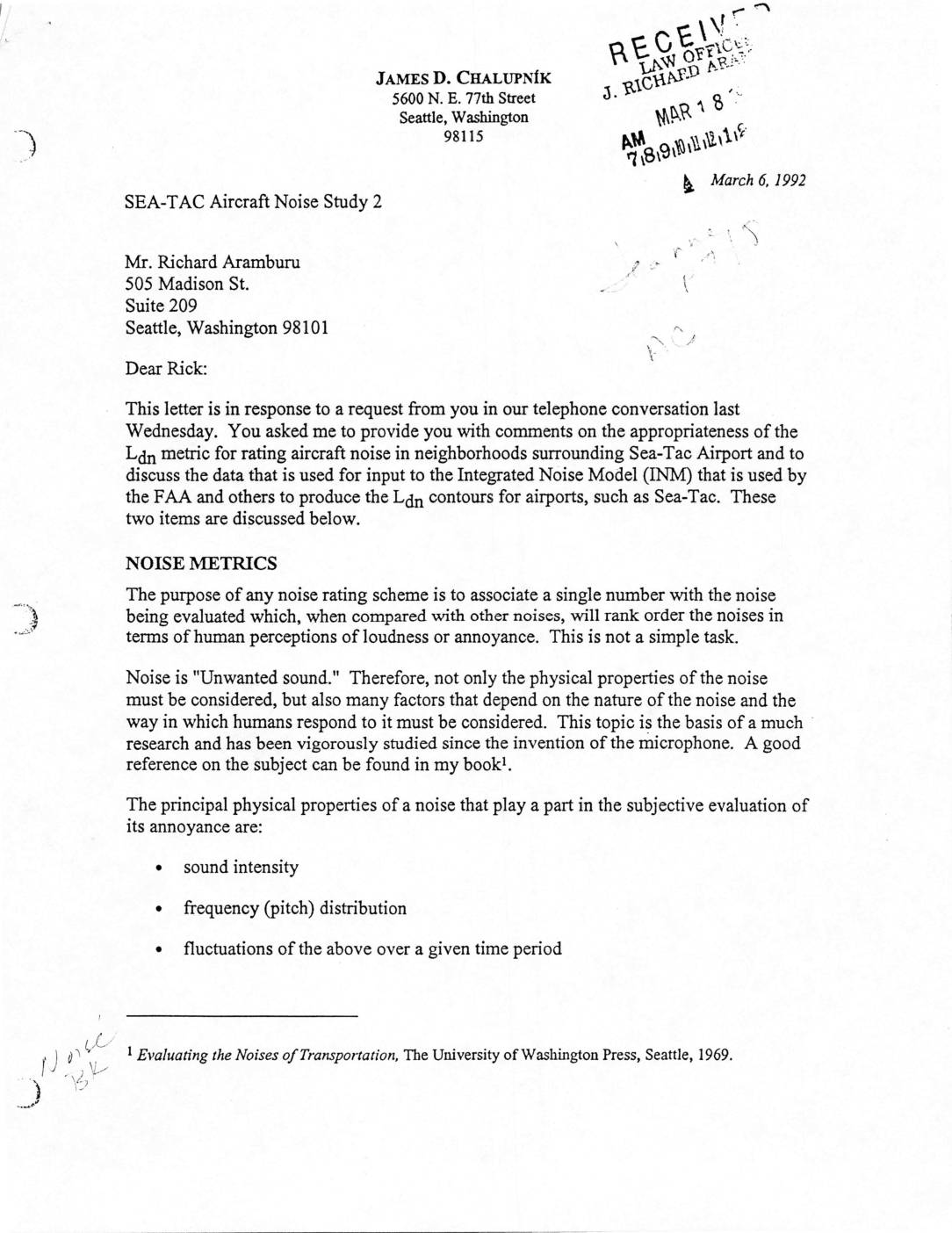
    Letter from James D. Chalupník to Richard Aramburu Regarding Sea-Tac Aircraft Noise Study 2: Ldн Metric and Integrated Noise Model

    In this 1992 letter, acoustics expert James D. Chalupník explains to attorney Richard Aramburu how aircraft noise near Seattle's Sea-Tac Airport is measured and rated, focusing on the appropriateness of the Ldn metric and the data used in the FAA's Integrated Noise Model (INM). He outlines the key physical properties of noise—intensity, frequency distribution, and fluctuation over time—and describes how various weighting schemes, particularly the A-weighting (dBA) scale, are used to approximate human perception of loudness and annoyance. The letter also notes the limitations of simpler metrics and introduces more sophisticated rating methods such as Stevens' Loudness Level and Perceived Noise Level for evaluating aircraft noise.
    CategoriesCorrespondence TagsFAA, INM, Noise, Part 150, Sea-Tac AirportFolder1993
  • 1992-02-13

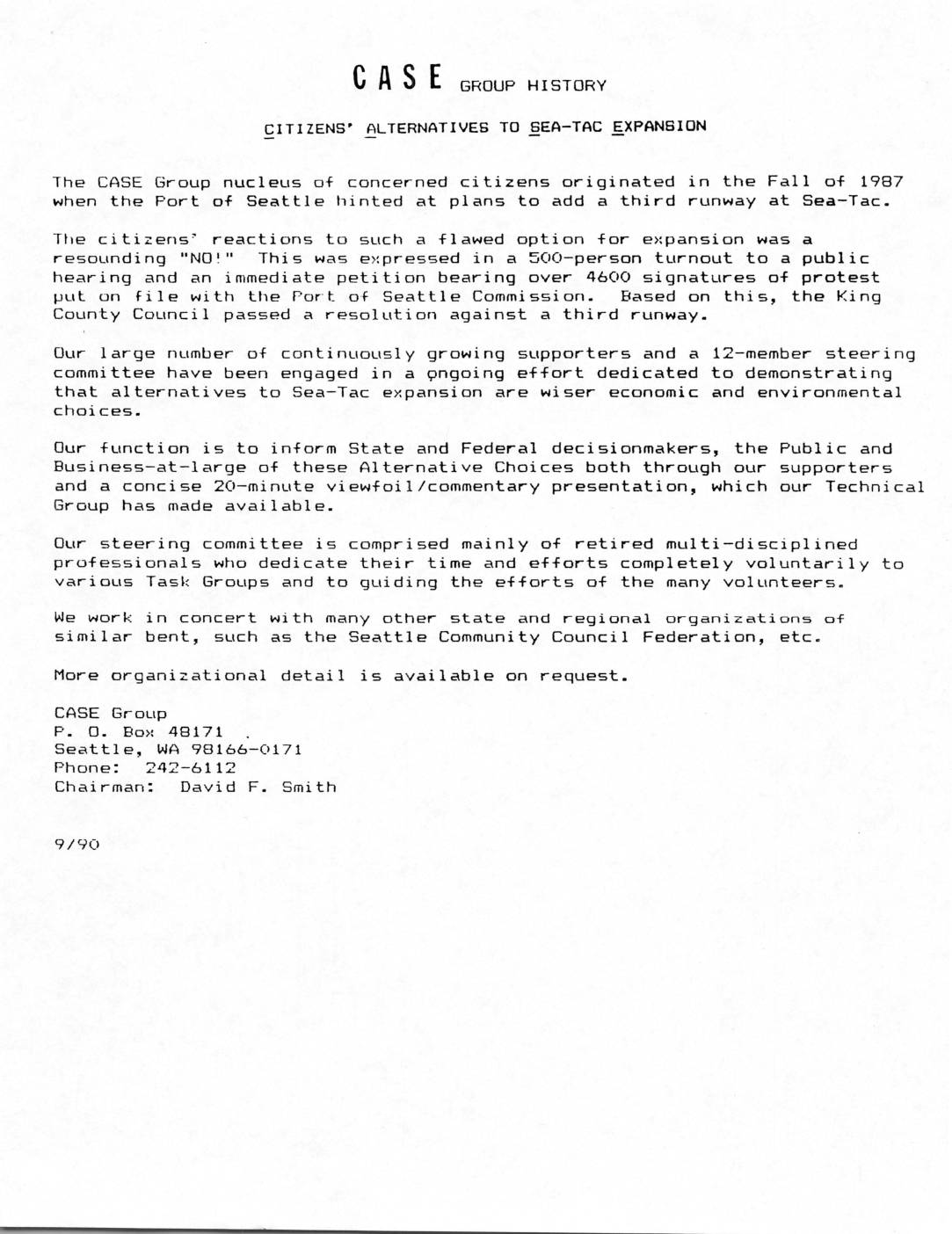
    CASE Group History and Third Runway Opposition Flyer and Petition

    The CASE Group (Citizens' Alternatives to Sea-Tac Expansion) was formed in 1987 to oppose the Port of Seattle's plans to add a third runway at Sea-Tac Airport, gathering over 4,600 protest signatures and prompting the King County Council to pass a resolution against the expansion. The coalition organized public hearings, lobbied Port Commissioners, and circulated petitions urging state officials to reject expansion recommendations in favor of building a new regional airport away from densely populated areas. Their core argument was that alternatives to Sea-Tac expansion represented sounder economic and environmental choices for the Central and South Puget Sound region.
    TagsCASE, Citizens Against Sea-Tac Expansion, Port Of Seattle, Sea-Tac Airport, Third RunwayFolderCASE
  • 1991-06-09

    Destination Unknown — Airport! The Controversy

    Destination Unknown — Airport! The Controversy Jun 9, 1991 Lance Dickie ONE word sums up the public’s reaction to expanding Sea-Tac airport or planning for more planes in the sky over Puget Sound: Don’t. Don’t expand the Seattle-Tacoma International Airport, don’t add runways to any existing regional airport and don’t replace Sea-Tac and start from
    CategoriesFrom The Web TagsAirport Expansion, Editorial, Port Of Seattle, Sea-Tac Airport, Seattle Times
  • 1991-03-31

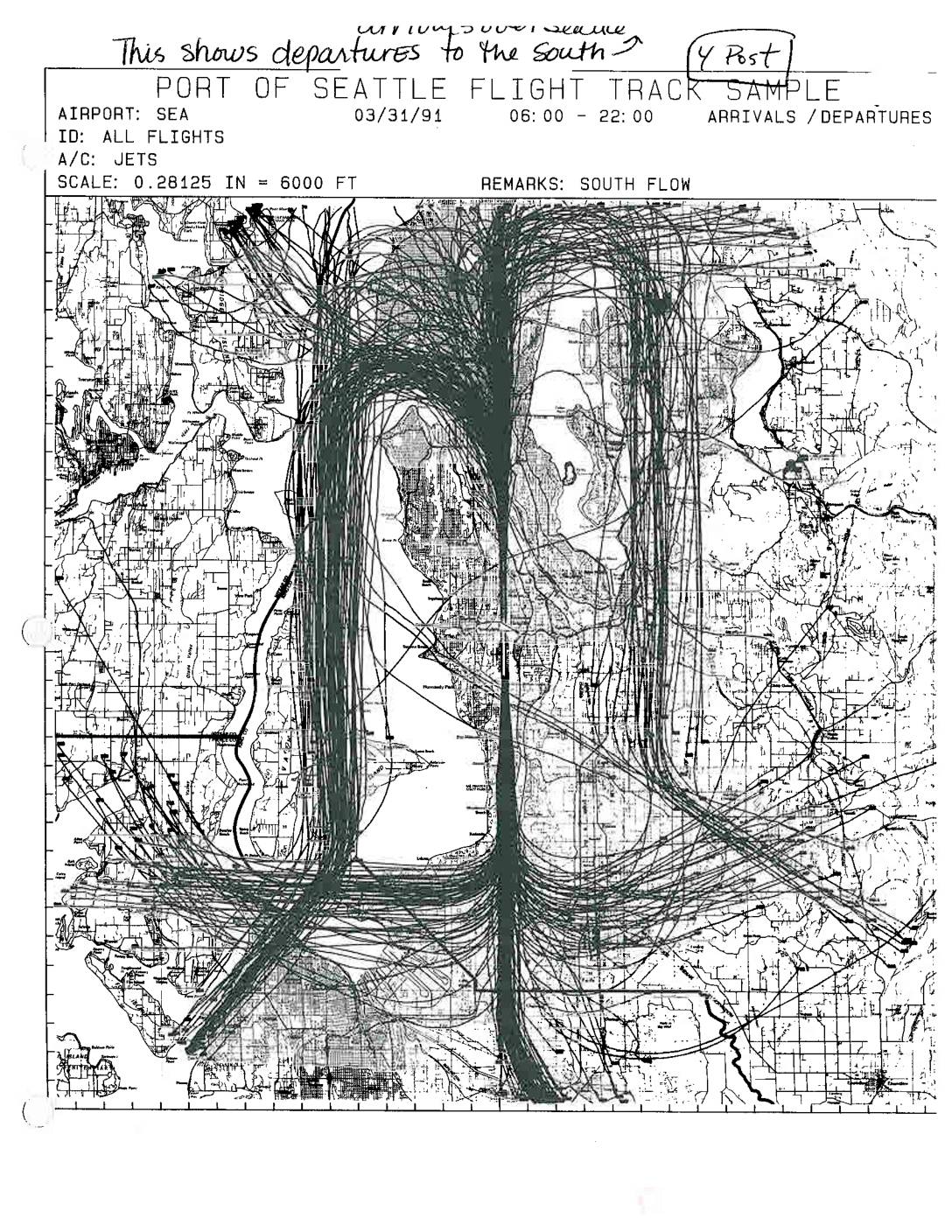
    Port Of Seattle Flight Track Sample: South Flow Arrivals/Departures — Pre- and Post-Four Post Plan Comparison Maps

    These two Port of Seattle Flight Track Sample maps compare jet aircraft arrival and departure patterns at Seattle-Tacoma International Airport (SEA) under south flow conditions, one from March 22, 1989 (pre-4 Post) and one from March 31, 1991 (4 Post). Both charts plot all jet flight tracks between approximately 4:30–24:00 and 6:00–22:00 respectively, showing how flight paths over the Seattle region shifted between the two periods. The maps are annotated to highlight southbound departures and arrivals over Seattle, serving as visual evidence for noise impact analysis related to airport runway and procedure policy changes.
    TagsFAA, Flight Tracks, Four Post Plan, Noise Abatement Procedures, Port Of Seattle, Sea-Tac AirportFolderFour Post Plan
  • 1991-01-01

    Part 150 Noise Exposure Map 1991 — Ldn 65 Contour Area and Population

    Text states that the Ldn 65 noise contour contains approximately 14,128 acres and 67,000 people. This figure relates to the noise impact area around Sea-Tac Airport as defined by the Day-Night Average Sound Level (Ldn) metric.
    TagsDNL65, Noise, Part 150, Sea-Tac AirportFolderPart 150
  • 1991-01-01

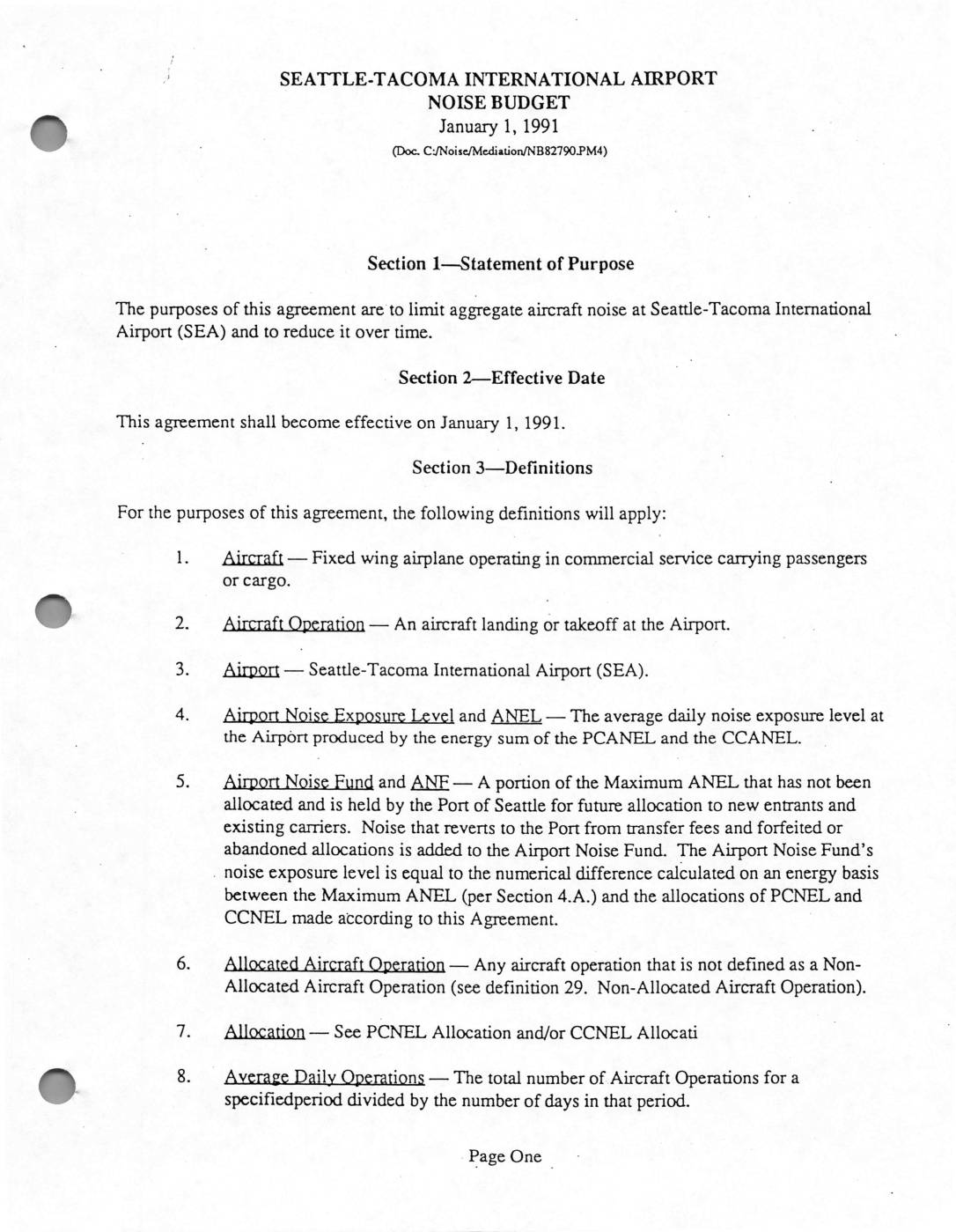
    Seattle-Tacoma International Airport Noise Budget, January 1, 1991

    The Seattle-Tacoma International Airport Noise Budget, effective January 1, 1991, is a formal agreement designed to limit and gradually reduce overall aircraft noise levels at Sea-Tac Airport. It establishes a system of noise allocations assigned to individual passenger and cargo carriers, measured through defined noise exposure levels, with limits enforced on both a quarterly and annual basis. The agreement outlines key definitions and rules governing how noise is measured, allocated, and managed, including provisions for new entrants, international carriers, and government aircraft.
    TagsNoise, Part 150, Port Of Seattle, Sea-Tac AirportFolder1993
  • 1991-01-01

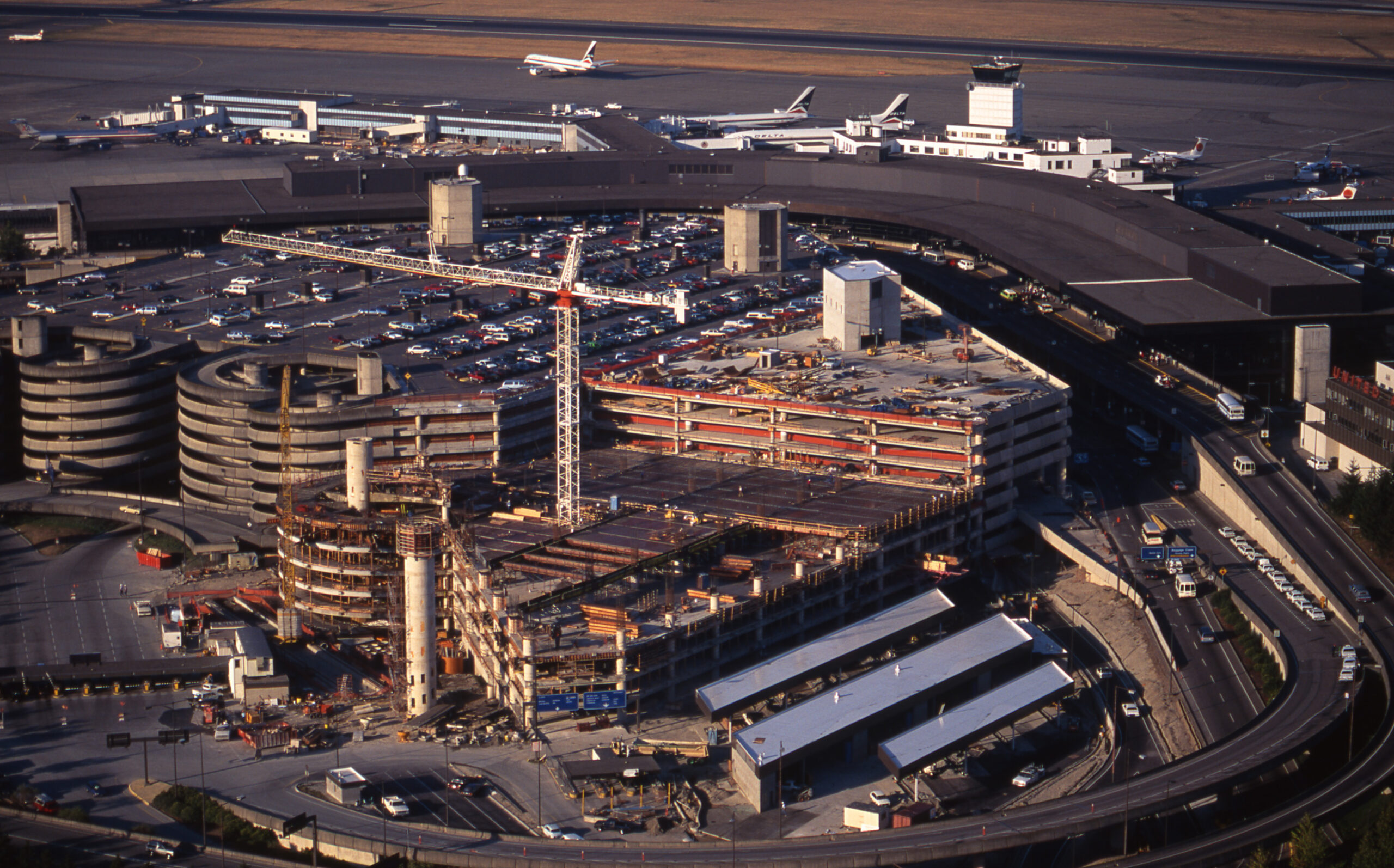
    Sea-Tac Airport Terminal and Parking Garage Construction, 1991

    An aerial photograph shows active construction of a multi-story parking garage and terminal expansion at Seattle-Tacoma International Airport, with a tower crane visible on site. The existing curved terminal building, a spiral parking structure, aircraft at gates, and the air traffic control tower are visible in the background.
    TagsAirport Expansion, Construction, Parking, Sea-Tac AirportFolderRunways

Posts pagination

Page 1 … Page 167 Page 168 Page 169 Page 170 Page 171 … Page 186
Sidebar On/Off

Upcoming Events

  • Part 150 NCP Workshop — Burien
    Add to CalendarMSaturday Oct 17: 10:00am

    Attend a Port of Seattle open house on the Part 150 Study Noise Compatibility Program (NCP). The Part 150 program determines the noise boundary around the airport and opportunities for noise mitigation such as sound insulation.

    [...]
  • Part 150 NCP Workshop — SeaTac
    Add to CalendarMMonday Oct 19: 6:00pm

    Attend a Port of Seattle open house on the Part 150 Study Noise Compatibility Program (NCP). The Part 150 program determines the noise boundary around the airport and opportunities for noise mitigation such as sound insulation.

    [...]
  • Part 150 NCP Workshop — Des Moines
    Add to CalendarMTuesday Oct 20: 6:00pm

    Attend a Port of Seattle open house on the Part 150 Study Noise Compatibility Program (NCP). The Part 150 program determines the noise boundary around the airport and opportunities for noise mitigation such as sound insulation.

    [...]

[See all...]


Issues

Sea-Tac Airport is currently undergoing the largest and longest expansion in its history, collectively known as the Sustainable Airport Master Plan (SAMP). Some of it you can already hear, but you’re probably not aware of what it all means. Here’s what you need to know.
read more...

Read This!

As the source for federal transportation grants, the Puget Sound Regional Council was charged with developing a system to meet the growing need for commercial aviation. When the search for a second airport failed, they authorized the Port of Seattle to build the Third Runway, with a mandate to develop a noise abatement and mitigation program. In their effort to stop the Third Runway, the ACC argued over every detail of the Port's efforts--including property buyouts and sound insulation. The dispute was meant to be settled by a three member Expert Arbitration Panel. This is their final report. It finds 2-1, that the Port's program was insufficient in several respects. Despite that, funding for the Third Runway was approved by the PSRC, and the 'Port Package' program, proceeded largely unchanged. Expert Arbitration Panel's final decision finding that the Port of Seattle had not shown sufficient reduction in real on-the-ground noise impacts to satisfy noise reduction conditions required for approval of a third runway at Sea-Tac International Airport. The majority decision concluded the Port's noise abatement programs were insufficient despite being impressive in scope.
continue...

  • Sea-Tac Noise.Info
  • Connect with STNI

    • Subscribe
    • Port Package Problem?
    • Donate
    • Podcast
    • Socials
      • Facebook
      • X (Twitter)
      • Bluesky
      • Instagram
  • Learn

    • Frequently Asked Questions
    • Explainers
    • Youtube
    • Research Requests
    • Complain about one flight
  • Goals

    Fulfill the promises of 1976:
    • Compensation
    • Reduced noise
    • Improved air quality
    • Environmental remediation
Login/Register
©2026•Data Privacy

Message

We use cookies to provide basic functionality. We also provide access to search engines in order to provide site analytics. We do not sell or share your data.
V V