TagFAA(687)
-
2016-09-20
Angry Burien citizens forming group to fight FAA over increases in airplane noise – The B-Town (Burien) Blog
Burien’s city council chambers were packed at Monday night’s meeting. Click image to view larger version.[/caption] By Jack Mayne Photos by Scott Schaefer The Burien City Council wants an October meeting between the city, the Port of Seattle and the regional office of the Federal Aviation Administration (FAA) to discuss the recent increase in airplane -
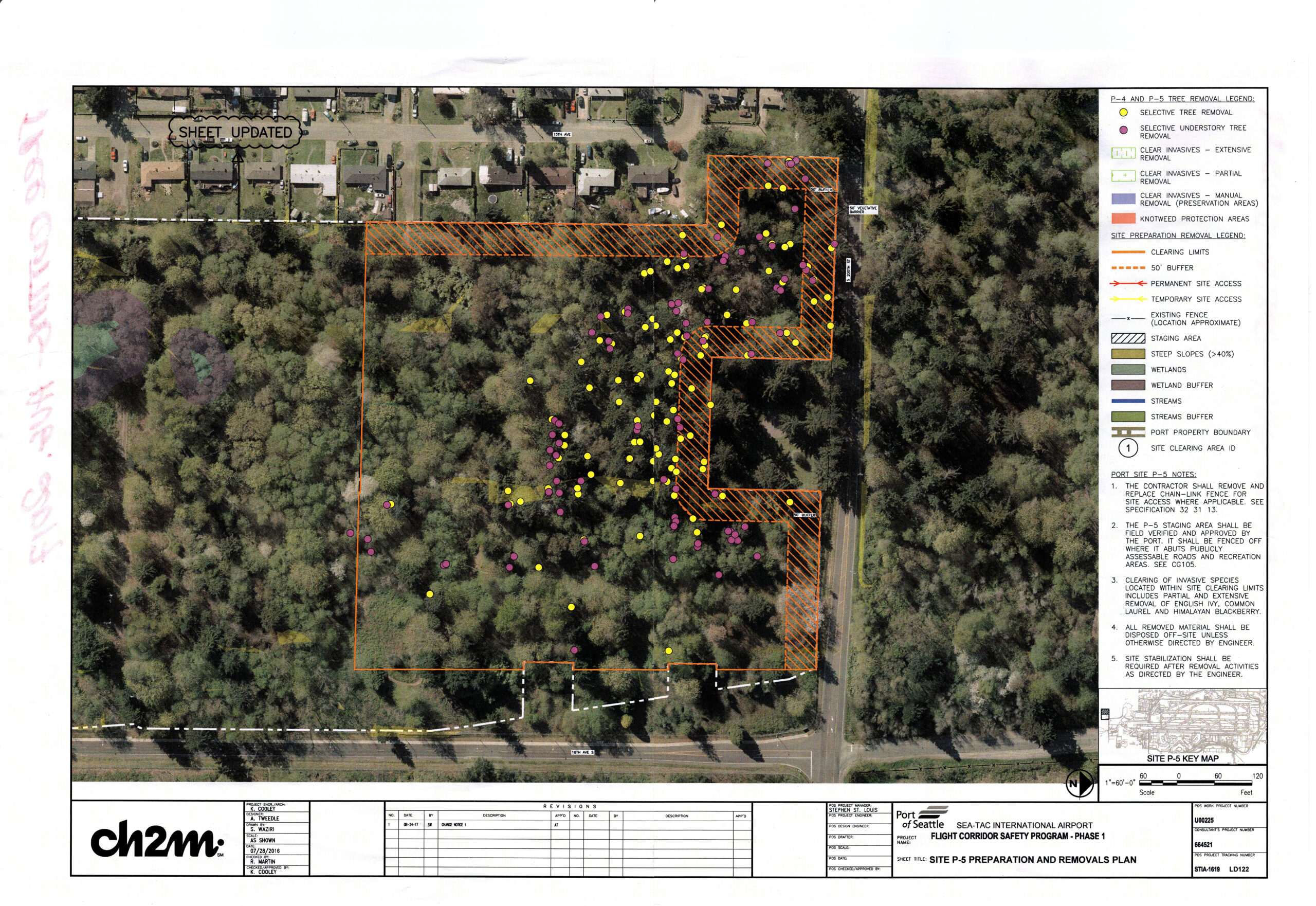
Flight Corridor Safety Program P5 Tree Cutting July 28, 2016
Engineering drawing prepared by CH2M for the Port of Seattle's Sea-Tac International Airport Flight Corridor Safety Program, Phase 1 (sheet LD122, project U00225/664521, dated 07/28/2016). The plan shows Site P-5 tree removal, invasive species clearing, staging areas, and site access routes overlaid on an aerial photograph, with a detailed legend distinguishing selective tree removal, knotweed protection areas, wetlands, and clearing limits. -
 2016-07-26
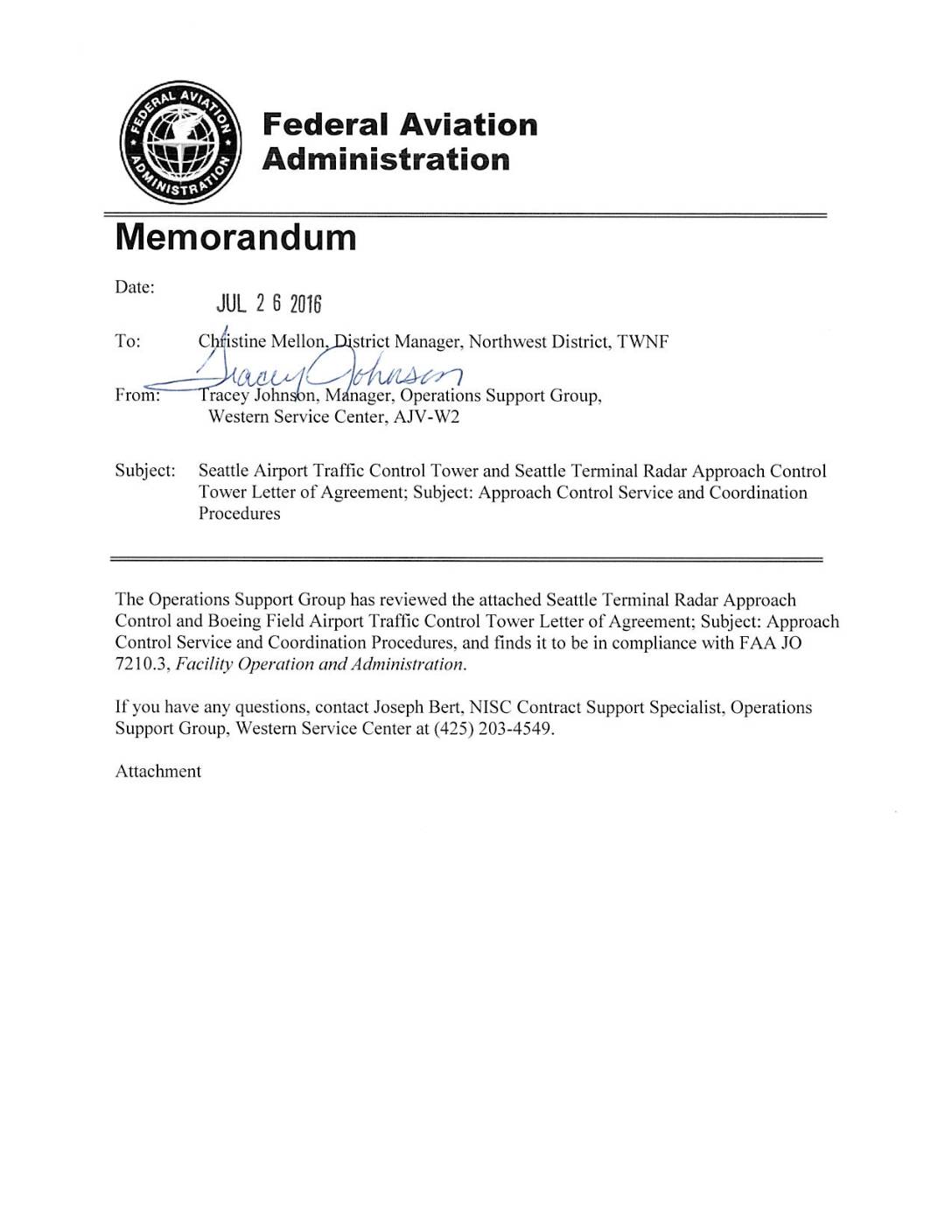
(LOA) 1-01 SEA-S46 LOA 7-26-16 (MASTER)
This July 2016 Federal Aviation Administration Letter of Agreement establishes coordination and control procedures between Seattle Terminal Radar Approach Control (TRACON) and Seattle Airport Traffic Control Tower, replacing a prior agreement from June 2013. It outlines responsibilities for managing air traffic, including pre-arranged coordination protocols, handling of Boeing Field arrivals and departures, and conditions under which those procedures may be suspended. The document governs how controllers at both facilities communicate and share airspace authority around the Seattle area. -
 2016-06-01
NextGen implementation plan 2016
★ 32The FAA's 2016 NextGen Implementation Plan outlines progress on six major air traffic modernization programs, including ADS-B surveillance, Data Communications, and automation upgrades, which are reshaping operations across the National Airspace System. Key milestones include Data Comm departure clearance services being rolled out to over 56 airports by end of 2016, three years ahead of schedule, and a doubling of ADS-B-equipped aircraft since 2014. While this plan focuses on nationwide airspace modernization rather than Sea-Tac-specific noise policy, the technologies described—such as more precise flight routing—can have implications for aircraft flight paths and noise impacts at airports like Sea-Tac. -
FAA: Shoot down a drone, go to jail (for up to 20 years!)
Daniel Howley Technology Editor Turns out that firing a gun into the air to shoot down your neighbor’s drone is illegal. In other news, water is wet. The Federal Aviation Administration confirmed to Forbes that — despite what some well-armed citizens may think — trying to shoot down a drone is, in fact, a felony punishable -
2016-03-17
Aviation roundtable members argue over structure at meeting – QNS
By Madina Toure Posted on March 17, 2016 By Madina Toure (clarifying the history of the roundtable structure) The highly anticipated New York Community Aviation Roundtable meeting was marked by tension last week as people spent nearly three hours debating everything from the roundtable’s structure to individuals directly affected by airplane noise. The March 10 -
 2016-03-04
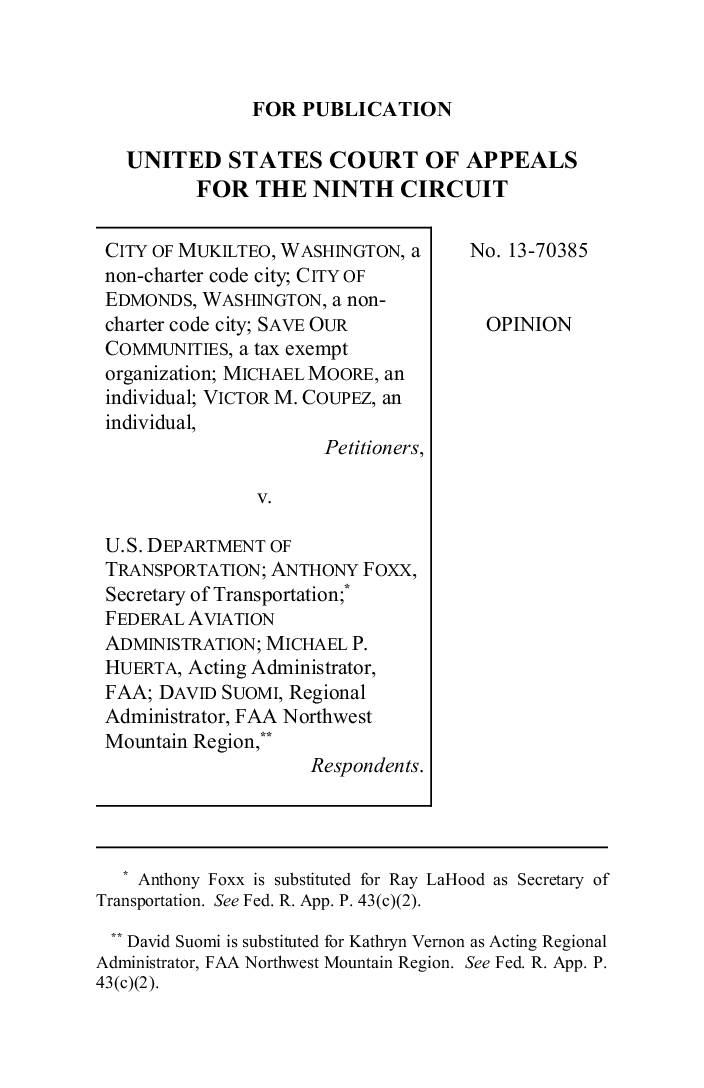
City of Mukilteo v. U.S. Department of Transportation: Ninth Circuit Opinion on FAA Environmental Review for Paine Field Commercial Service
A federal appeals court denied a challenge by the cities of Mukilteo and Edmonds, Washington, along with local residents and advocacy groups, to the FAA's decision to open Paine Field near Everett to commercial passenger service without requiring a full Environmental Impact Statement. The court ruled that the FAA's environmental review process was conducted in good faith and was not arbitrary or capricious, finding that the agency properly assessed foreseeable noise and environmental impacts under the National Environmental Policy Act. -
 2016-02-29
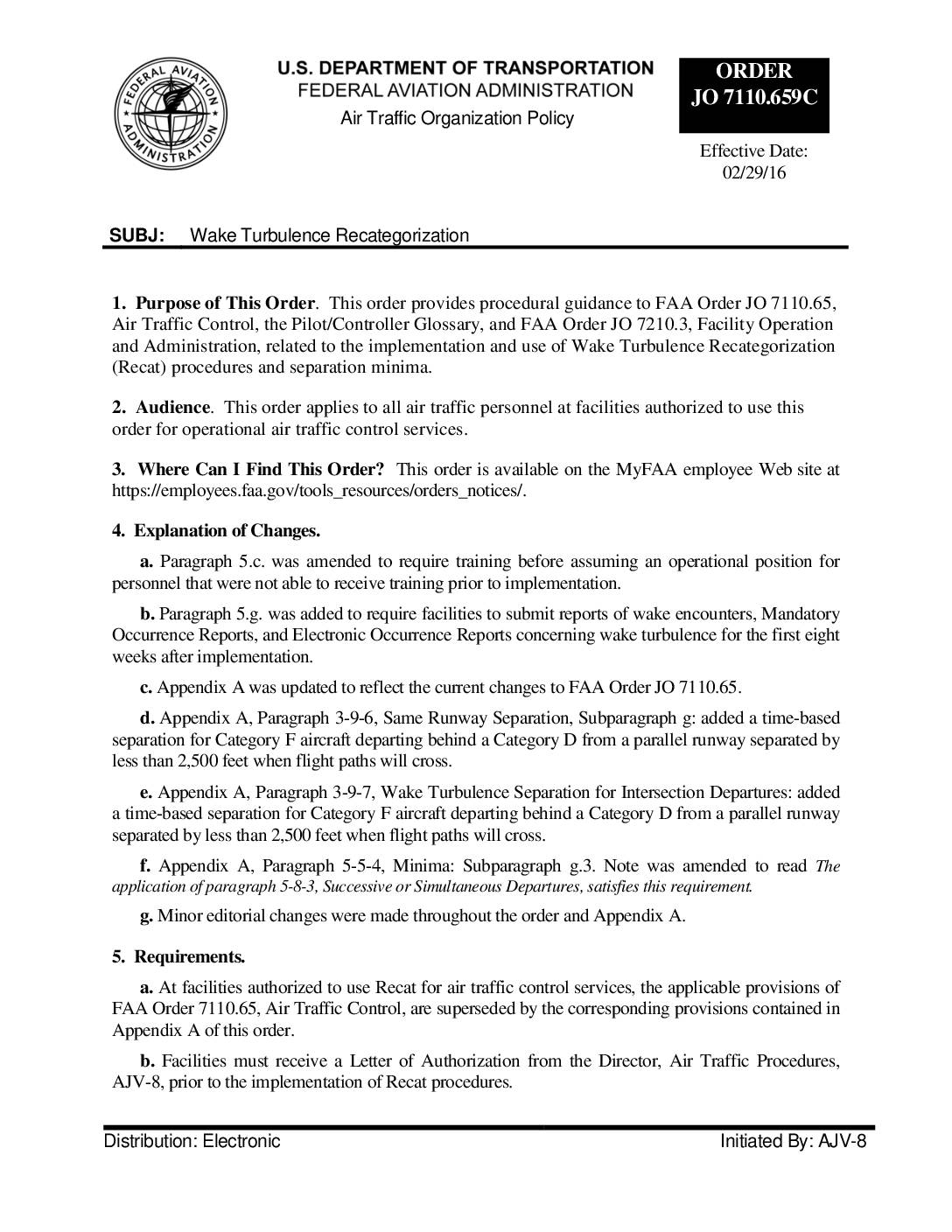
FAA Wake Recategorization JO7110659C
FAA Order JO 7110.659C, effective February 29, 2016, updates air traffic control procedures for Wake Turbulence Recategorization (Recat), which changes how aircraft are grouped for safe separation purposes. Instead of the traditional three weight classes (heavy, large, and small), Recat introduces six categories based on wingspan, takeoff weight, and an aircraft's ability to withstand wake turbulence, allowing for more precise separation distances and improved airport efficiency. Facilities must obtain authorization, train personnel, and submit weekly wake encounter reports for the first eight weeks after implementing these new procedures. -
 2016-02-01
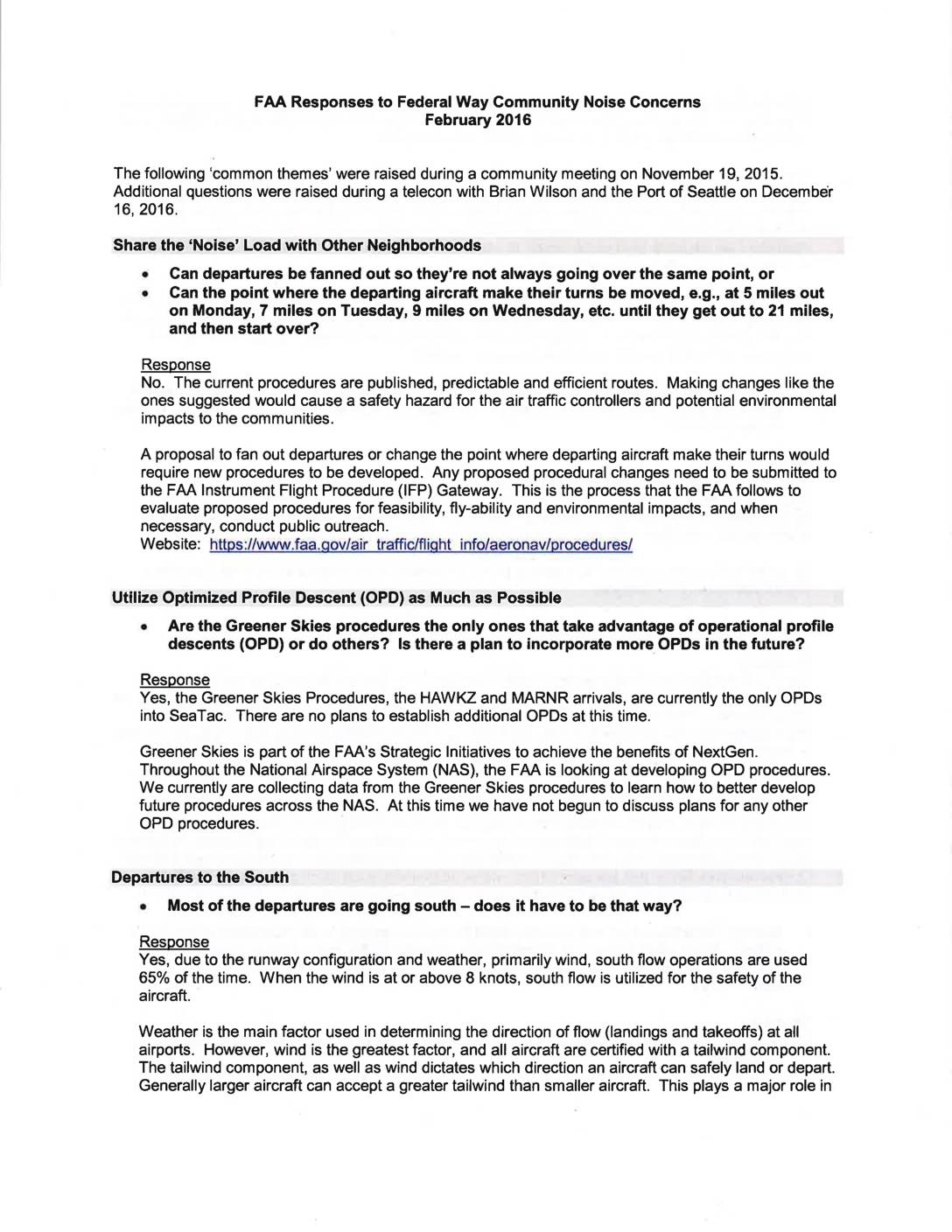
FAA Responses to Federal Way Community Noise Concerns
This February 2016 document contains FAA responses to noise complaints from Federal Way residents affected by Sea-Tac Airport flight operations. The FAA explains why departures are concentrated to the south 65% of the time due to wind and runway configuration, why flight paths cannot simply be rerouted or 'fanned out' to spread noise across neighborhoods, and why aircraft may appear lower than in the past despite following all published procedures. Any proposed changes to flight routes or procedures must be submitted through the FAA Instrument Flight Procedure (IFP) Gateway for safety, feasibility, and environmental review. -
 2016-01-30
FAA NextGen and the 2012 to 2015 ‘Optimization of Metroplex Airspace’
This 2016 report by Palo Alto resident Mark Shull examines how the FAA's NextGen 'Optimization of Airspace and Procedures in the Metroplex' (OAPM) program, implemented between 2012 and 2015, led to dramatically increased aircraft noise over residential communities by redesigning flight paths to be lower, straighter, and more concentrated. The author argues that while the program was publicly marketed as improving efficiency, reducing fuel use, and lowering environmental impact, its primary purpose was increasing airport capacity by reducing separation between aircraft and simplifying flight corridors. The report traces the legislative, regulatory, and industry decisions that shaped the program, concluding that communities were left worse off and that genuine air traffic modernization will be harder to achieve going forward.