TagFAA(687)
-
 2017-08-29
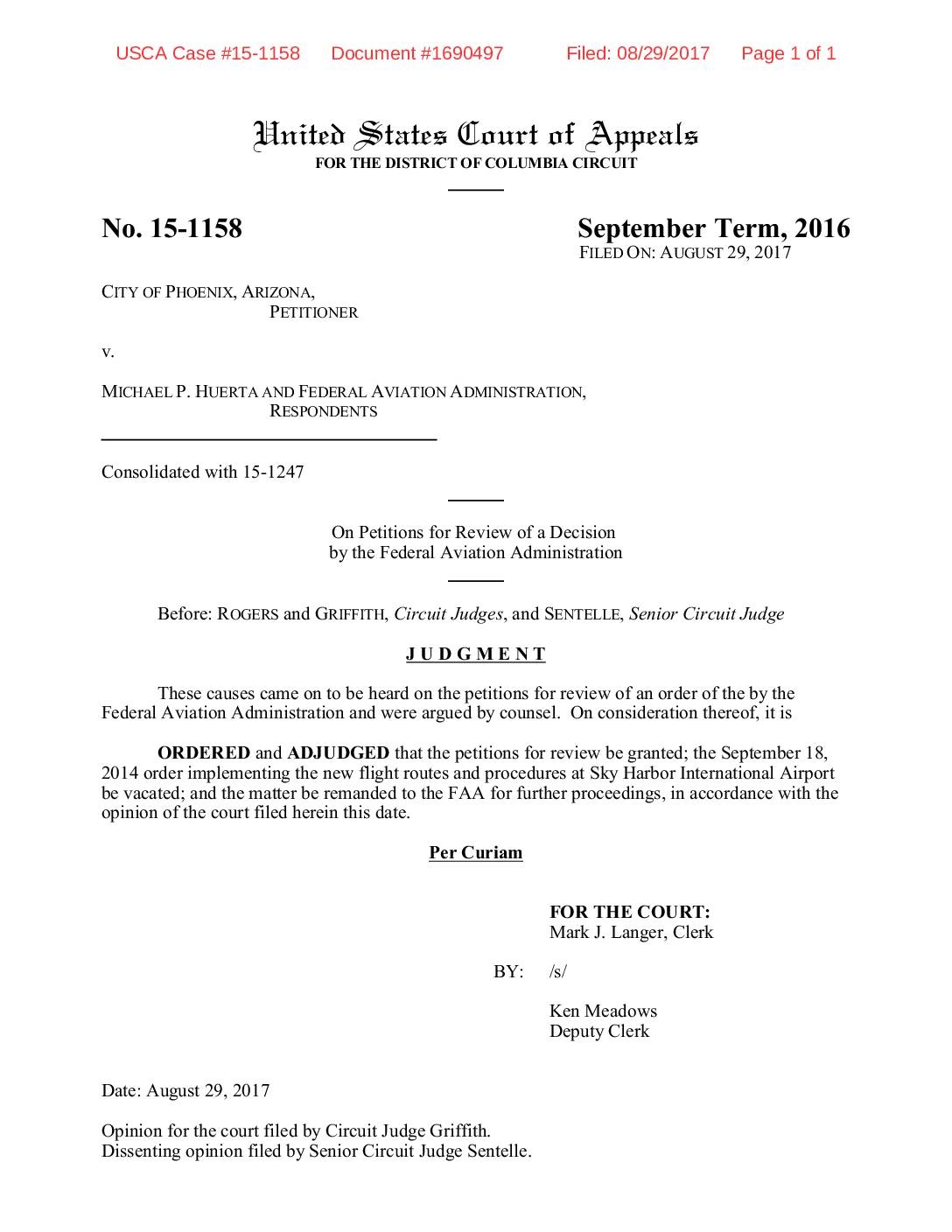
City of Phoenix, Arizona v. Michael P. Huerta and Federal Aviation Administration: Judgment of the U.S. Court of Appeals for the D.C. Circuit
A federal appeals court ruled in favor of the City of Phoenix, vacating a 2014 FAA order that had implemented new flight routes and procedures at Sky Harbor International Airport. The court found the FAA's order flawed and sent the matter back to the agency for further review. The case highlights how municipalities can successfully challenge FAA flight path decisions that impact communities near airports. -
 2017-08-29
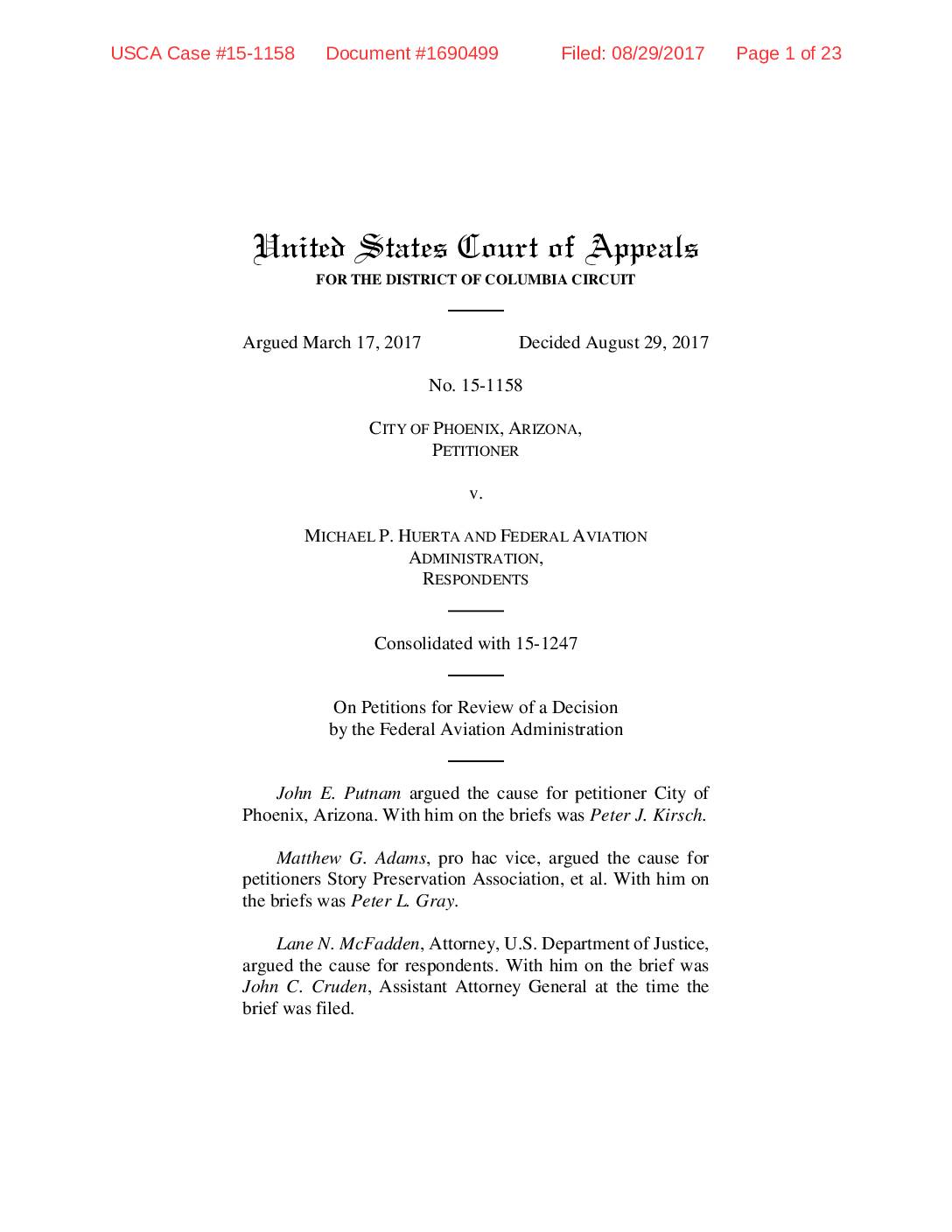
City of Phoenix v. Huerta and Federal Aviation Administration: U.S. Court of Appeals, D.C. Circuit Opinion (No. 15-1158)
A federal appeals court ruled in 2017 that the FAA acted arbitrarily when it changed flight routes at Phoenix Sky Harbor International Airport in 2014 without adequately consulting city officials or thoroughly reviewing environmental impacts. The new routes increased air traffic over historic neighborhoods and public parks by 300%, yet the FAA conducted consultations only with low-level employees who lacked the authority to speak on the city's behalf. The case highlights the legal obligations federal agencies have to meaningfully engage local governments and assess noise impacts before implementing major flight path changes. -
 2017-08-03
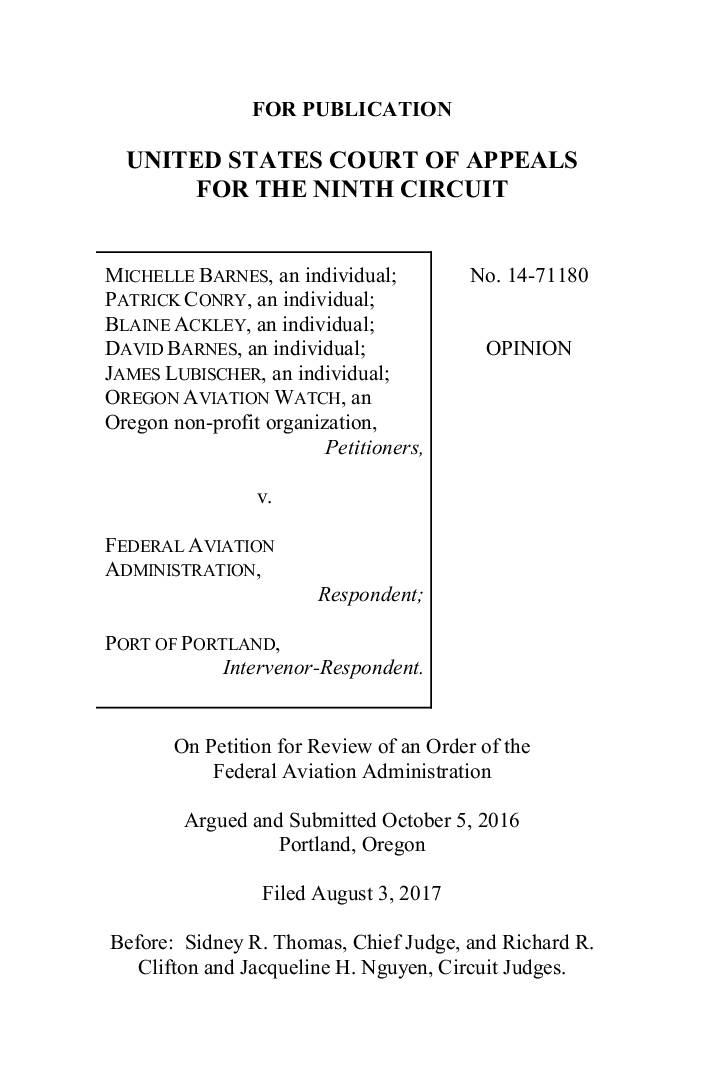
Barnes v. Federal Aviation Administration – Ninth Circuit Court Opinion
A federal appeals court denied a challenge by Oregon residents and an aviation watchdog group against a new runway project at Hillsboro Airport near Portland, Oregon. The court found that the Federal Aviation Administration acted properly in concluding the project would have no significant environmental impact, including only a minimal effect on air traffic and air quality. This case, a follow-up to a 2011 ruling, may be relevant to discussions of how environmental reviews are conducted for airport expansion projects in the Pacific Northwest. -
 2017-07-01
Washington Aviation System Plan (WASP): Executive Summary
The Washington Aviation System Plan (WASP), completed in July 2017 by the Washington State Department of Transportation (WSDOT), is a statewide assessment of Washington's public-use airports covering both commercial and general aviation facilities. The plan evaluates how individual airports perform and interact as a system, identifies needed improvements, and develops policy recommendations to support communities, economic activity, and emergency services across the state. Funding was provided by the Federal Aviation Administration (FAA), and the plan builds on the earlier 2009 Long-term Air Transportation Study (LATS). -
2017-06-08
FAA calls for comment on proposed use of Runway 34
for use by turboprop planes The Federal Aviation Administration (FAA) is conducting an analysis under the National Environmental Policy Act (NEPA) to determine the environmental effects of a westerly heading for turboprop aircraft departing from Runway 34 at Seattle-Tacoma International Airport (SEA). The heading would only be used when the airport is landing and departing -
 2017-06-02
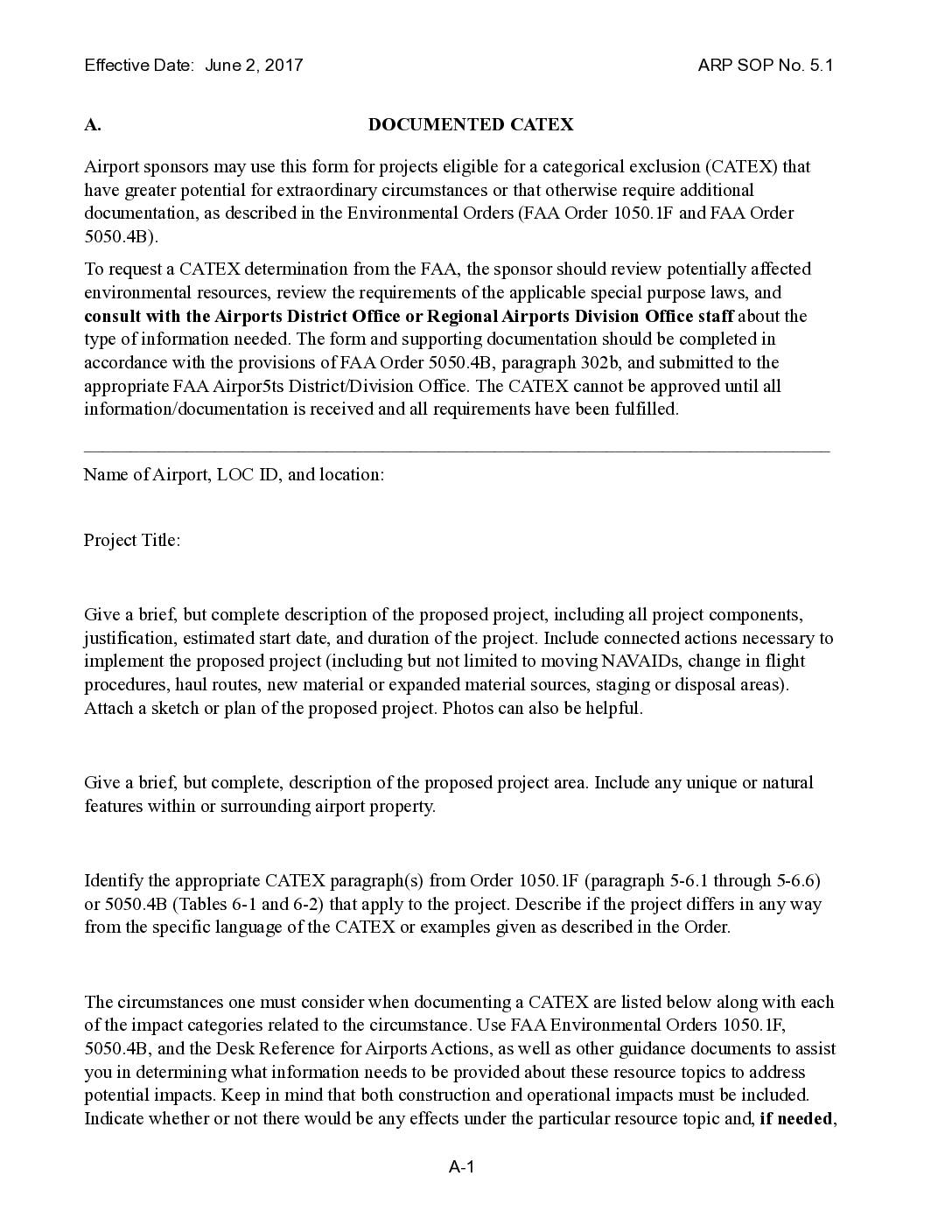
ARP SOP No. 5.1: Documented Categorical Exclusion (CATEX) Form
This FAA form (ARP SOP No. 5.1, effective June 2, 2017) guides airport sponsors through the process of requesting a Categorical Exclusion (CATEX) determination for projects that may have extraordinary environmental circumstances. It requires sponsors to document potential impacts across key resource areas, including historic and cultural resources under the National Historic Preservation Act and protected lands under Department of Transportation Act Sections 4(f) and 6(f). Sponsors must consult with their FAA Airports District or Regional Division Office and submit all required documentation before a CATEX can be approved. -
 2017-04-25
NextGen briefing
In April 2017, the Federal Aviation Administration (FAA) presented a NextGen briefing to the Port of Seattle Commission, outlining the agency's initiative to modernize the U.S. air traffic system. NextGen aims to improve safety, reduce flight delays, cut fuel consumption and emissions, and handle growing air travel demand. The briefing is relevant to Sea-Tac Airport stakeholders as these airspace changes can directly affect flight paths and noise impacts on surrounding communities. -
 2017-04-25
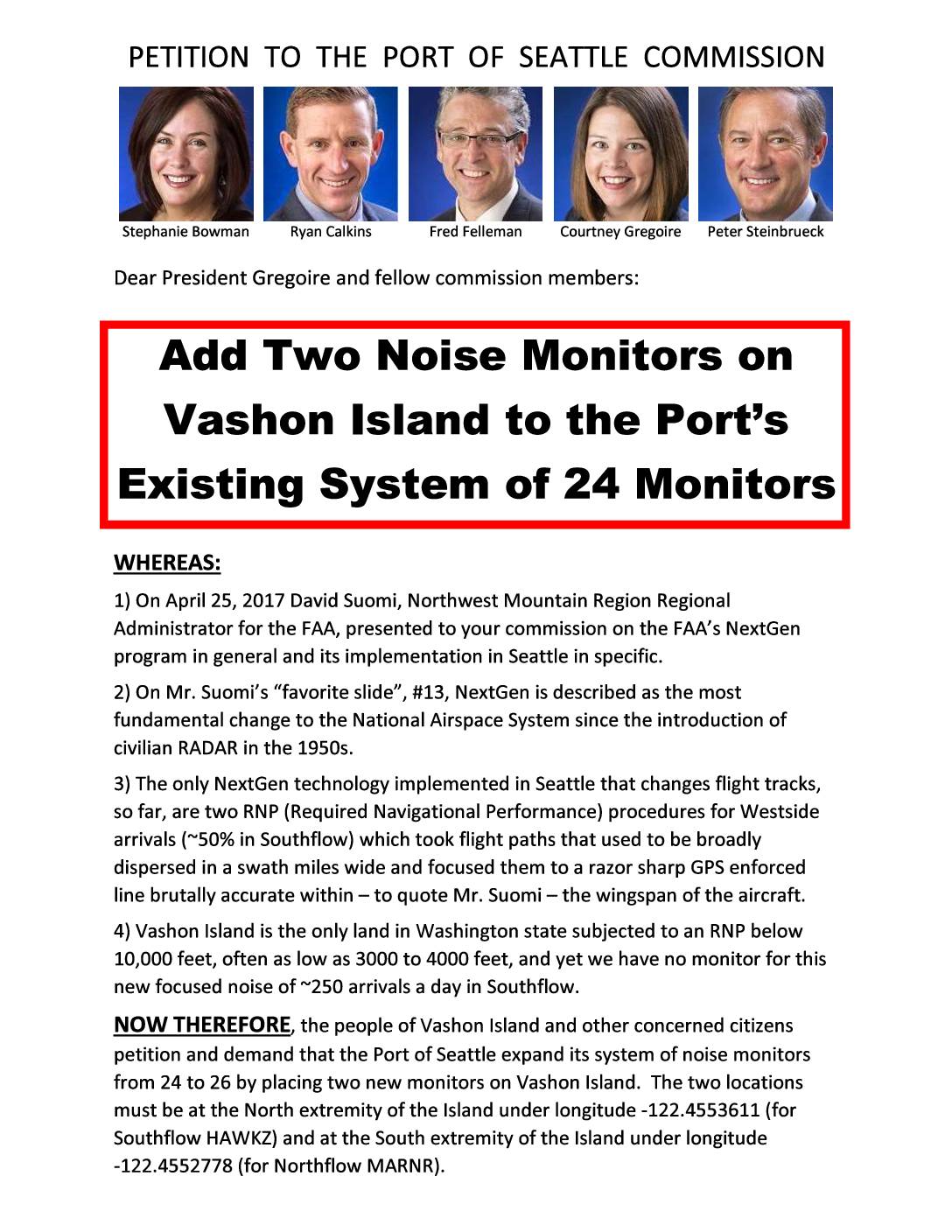
Petition to the Port of Seattle Commission – Add Two Noise Monitors on Vashon Island to the Port’s Existing System of 24 Monitors
A petition to the Port of Seattle Commission requesting the addition of two noise monitors on Vashon Island to monitor aircraft noise from new FAA NextGen flight procedures. The petition cites concerns about focused flight paths over Vashon Island at low altitudes affecting approximately 250 arrivals per day in Southflow operations. -
2017-04-16
FAA Responds to City of Burien’s Petition Regarding Turbo Prop Overflights
News from the City of Burien 04/16/2017 On April 13, 2017, the City of Burien received a letter from the Federal Aviation Agency (FAA) stating they would be ceasing the North Flow flight patterns over Burien. The North Flow flight corridor, also known as the “New Route,” has caused significant noise impacts to Burien parks, -
 2017-04-15
Inventory of U.S. greenhouse gas emissions and sinks: 1990–2015
This EPA report tracks U.S. greenhouse gas emissions and sinks from 1990 to 2015, covering sources such as transportation, agriculture, industry, and waste. It was published by the U.S. Environmental Protection Agency in 2017 and is available for download on the EPA website. Note: this document does not appear to contain information relevant to Sea-Tac Airport noise policy.