Skip to content
  • STNI
  • Statistics
    • Ops and Passengers
      • King County International Airport (Boeing Field) Annual Operations
    • Financials
    • Aviation fuel uplift in the State of Washington 2018 – 2025
      • Aviation Fuel Tax Revenue in the State of Washington 1983-2025
      • Aviation Fuel Uplift at Sea-Tac Airport
    • Air Quality Monitoring
    • Flight Tracking
      • Flow and Flight Tracks
      • Five Year Comparison
      • Busiest Hours and Days
    • SEL Noise Reports & Graphs
      • About The Permanent Noise Monitors
      • Minutes of Quiet by Noise Monitor
      • Noise Events mapped
      • Noise Events (SEL)
    • Runways
    • Employees
    • Real Estate
      • Port Properties and Trees mapped
    • Parking
  • Events
  • Protest
    • Regular Events
    • Legislation 2026
    • Complain about a particular flight
    • Advocacy Organizations
    • Media Outlets
    • People
    • The Port of Seattle
      • Commission Meetings
      • Public Records Requests
      • StART
      • Highline Forum
    • Contact Your Electeds
  • Resources
    • FAQs
      • FAA Occurrences/Accidents/Indents
    • The SAMP
      • SAMP Public Comment Template
        • Two versions of Appendix K: NEPA/SEPA 2018 vs 2023
      • SAMP NTP: 31 projects by the numbers
      • SEPA Draft EIS (2026)
      • SAMP Record of Decision/FONSI (2025)
      • SAMP Draft EA (October 2024)
      • 2018 Scoping
    • Port Packages
      • Port Package Property Costs
      • Port Packages mapped
      • The Port Package Explainer
      • So you want a (first-time) Port Package? Start here
      • Port Package Looker Upper
      • How do I determine if I have a Port Package or Avigation Easement?
      • Progress on Port Package Update legislation
      • Having a Port Package Problem?
      • Port Package Site Visit Follow-Up
    • Document Library
    • Explainers
      • The Airport Law Cheat Sheet
      • The Grant Explainer
    • External Articles
    • History
      • Timeline
      • The Sea-Tac Communities Plan
        • Sea-Tac Communities Plan – Planning Maps
      • PSRC Third Runway Decision Process
    • Studies
    • Videos
  • Stories
  • Mission
  • Subscribe
  • Contact
Scroll down to content

Get InformedStay Informedx

I understand that you will never share my information with anyone, you will only use it to keep me updated on relevant events and that I may unsubscribe at any time.

STNI

STNISea-Tac Noise.Info

  • Solve for Sea-Tac. Solve for every airport.
  • Since 2016, working to obtain justice for everyone living under the flight path.
  • Less Noise. Cleaner Air. Better Public Health. Compensation.
  • Everything you think you know about the airport is wrong.

TagFAA(684)

Advanced Search Options

  • Dates
  • Media
    • External Articles
    • Images
    • PDFs
    • Video
    • Audio
  • Order By
  • 2024-10-01

    Seattle-Tacoma International Airport Environmental Assessment for the Sustainable Airport Master Plan Near-Term Projects: Chapter 1, Introduction and Purpose & Need

    The Port of Seattle is preparing an Environmental Assessment for 31 near-term improvement projects at Seattle-Tacoma International Airport (SEA), covering upgrades to taxiways, runways, terminals, and support facilities. The projects, expected to be operational by 2032, aim to reduce crowding, long lines, and flight delays that have grown as passenger demand has increased. The Federal Aviation Administration (FAA) will review the findings to determine whether the projects will significantly impact the surrounding environment, potentially affecting noise levels for nearby communities.
    TagsFAA, Landrum & Brown, NEPA, SAMP, SAMP Draft EA, Sustainable Airport Master PlanFolder2024 Draft EA
  • 2024-10-01

    Airport Improvement Magazine, October 2024: Runway & Ramp Special Edition

    The October 2024 special edition of Airport Improvement magazine covers runway and ramp safety projects at airports across the United States, including Seattle-Tacoma International Airport's transition to PFAS-free firefighting foam. The Seattle-Tacoma article focuses on cleaning PFAS contamination from firefighting vehicles, reflecting broader efforts to eliminate hazardous fluorine-based chemicals from airport operations. Additional stories cover FAA technology deployments, taxiway reconstruction, and airfield safety improvements at airports nationwide.
    TagsAirport Improvement Magazine, FAA, PFAS, Sea-Tac AirportFolderAirport Improvement
  • 2024-10-01

    Draft Environmental Assessment for the Sustainable Airport Master Plan Near-Term Projects: Cover, Table of Contents, and Acronyms

    This October 2024 Draft Environmental Assessment, prepared by Landrum & Brown for the Port of Seattle and the FAA, evaluates the environmental impacts of near-term construction projects at Seattle-Tacoma International Airport as part of its Sustainable Airport Master Plan. The assessment covers a wide range of environmental topics—including noise and noise-compatible land use, air quality, water resources, and environmental justice—for proposed improvements to passenger terminals, cargo facilities, airfield design, taxiways, and fuel storage. It is intended to support FAA decision-making under the National Environmental Policy Act (NEPA) and addresses the airport's ability to accommodate a projected 56 million annual passengers.
    Tagsenvironmental assessment, FAA, NEPA, SAMP, Sea-Tac Airport, Sustainable Airport Master PlanFolder2024 Draft EA
  • 2024-09-24

    Appendix D: Biological Resources — Biological Evaluation and Section 7 Consultation Request, SEA SAMP Near-Term Projects

    The FAA submitted a Biological Evaluation to support an informal consultation under the Endangered Species Act for near-term construction projects at Seattle-Tacoma International Airport, all expected to be completed by 2032. The projects aim to expand passenger and cargo capacity, upgrade taxiway layouts, and increase fuel storage including sustainable aviation fuel. The evaluation assessed potential impacts on 14 species, determining that several—including Chinook salmon, bull trout, and killer whales—may be affected but not likely adversely, while the remaining species, such as the marbled murrelet and North American wolverine, would face no effect.
    TagsESA, FAA, NEPA, Salmon, SAMP, Sea-Tac Airport, Sustainable Airport Master PlanFolderAppendices
  • 2024-09-05

    HAWKZ Eight Arrival (RNAV) — Transition Routes, Seattle-Tacoma International Airport

    The HAWKZ Eight Arrival (HAWKZ8) is a standard terminal arrival route (STAR) used to guide aircraft into Seattle-Tacoma International Airport (SEA) from multiple directions, including transitions from waypoints such as Battle Ground, Klamath Falls, and Lakeview. The procedure requires RNAV 1 capability (DME/DME/IRU or GPS) and radar, and directs jet aircraft to descend via Mach number until intercepting 280 knots. Aircraft follow a series of waypoints and altitude restrictions, ultimately converging at the HAWKZ fix at 12,000 feet and 270 knots before continuing to the airport.
    TagsATC, FAA, Map, Sea-Tac AirportFolderFlight Tracks
  • 2024-09-01

    GAO 24-107001: FAA Actions Are Urgently Needed to Modernize Aging Systems

    A September 2024 U.S. Government Accountability Office report found that the FAA's air traffic control systems are critically outdated, with 37% rated unsustainable and 39% potentially unsustainable out of 138 total systems reviewed. The agency has been slow to modernize the most at-risk systems, with some upgrades not planned for completion until 2030–2035, and four critical systems lacking any modernization plans at all. The GAO made seven recommendations to improve FAA oversight and accelerate upgrades to protect the safety and efficiency of the national airspace.
    CategoriesFrom The Web TagsAir Traffic Control, ATC, Aviation International News, FAA, GAOFolderFAA
  • 2024-08-01

    Aviation Environmental Design Tool (AEDT) version 3g supplemental manual: Quick start tutorial

    The Aviation Environmental Design Tool (AEDT) Version 3g is a Federal Aviation Administration software system used to model aircraft operations and calculate their environmental impacts, including noise, emissions, and fuel consumption. This Quick Start Tutorial guides users through building basic noise and emissions studies, covering steps such as adding airports, creating flight tracks, setting up receptors, and running metric results. The tool is relevant to airport noise policy analysis, as it provides a structured method for quantifying and evaluating the environmental effects of aviation activity around airports like Sea-Tac.
    TagsAEDT, Aviation Emissions, FAA, Manual, NoiseFolderFAA
  • 2024-07-25

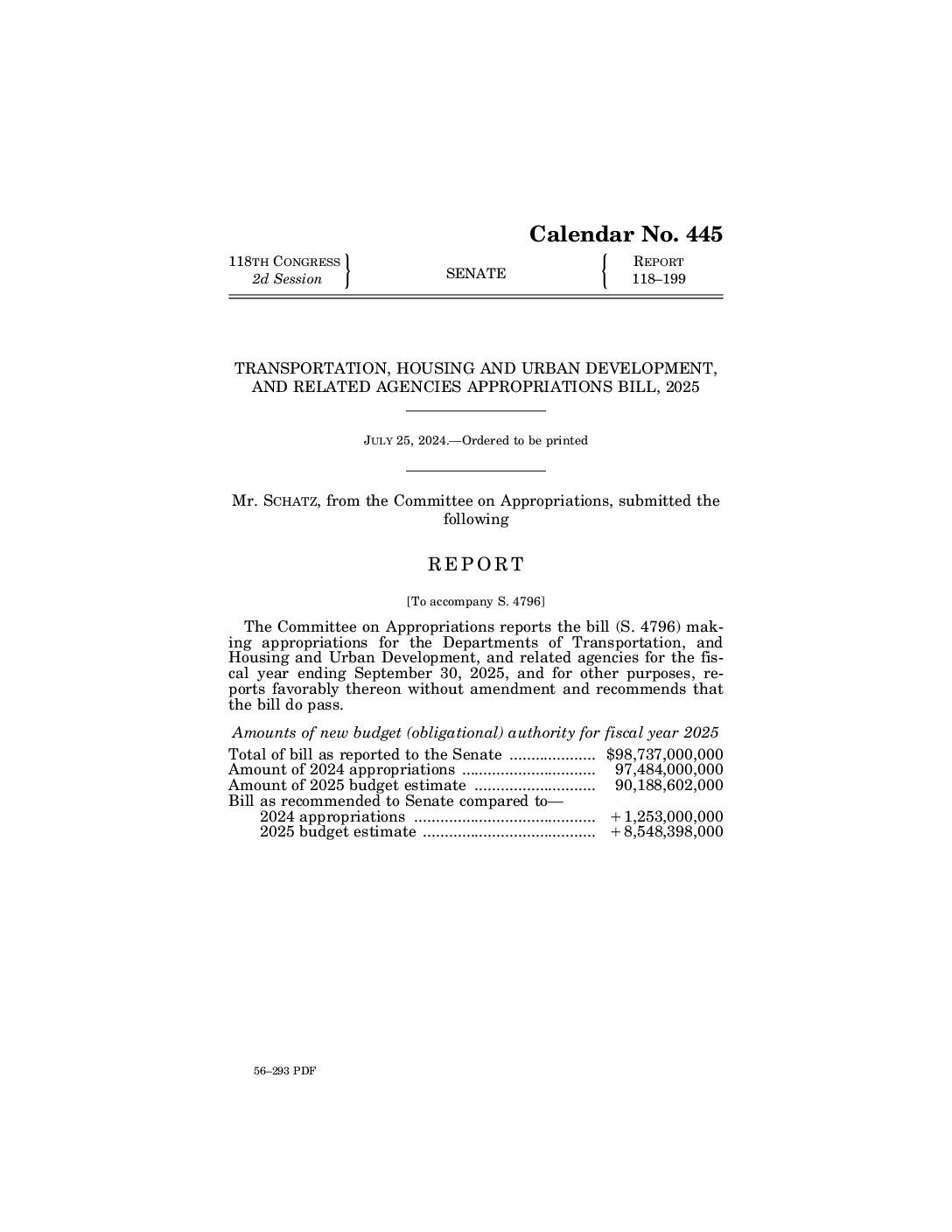
    Transportation, Housing and Urban Development, and Related Agencies Appropriations Bill, 2025

    This is a U.S. Senate Appropriations Committee report from July 2024 recommending passage of the Transportation, Housing and Urban Development, and Related Agencies Appropriations Bill for fiscal year 2025, totaling approximately $98.7 billion. The bill covers funding for federal agencies including the Federal Aviation Administration, Federal Highway Administration, Federal Transit Administration, and the Department of Housing and Urban Development, among others. It represents an increase of roughly $1.25 billion over 2024 appropriations levels.
    TagsBudget, Department Of Transportation, FAA, HUD, United States SenateFolderFederal
  • 2024-07-12

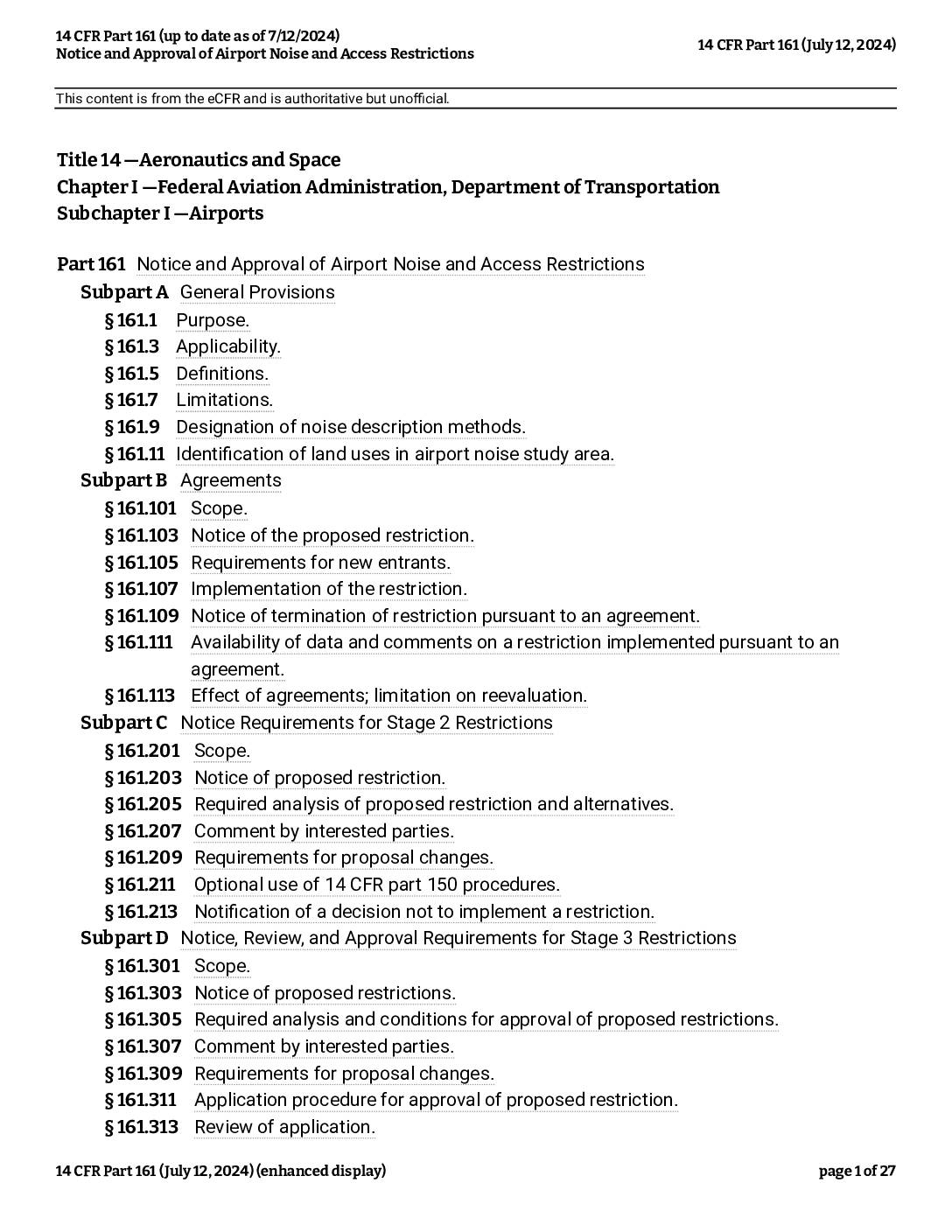
    14 CFR Part 161 — Notice and approval of airport noise and access restrictions

    14 CFR Part 161 sets out the federal rules governing how airports like Sea-Tac must notify the public and obtain FAA approval before imposing noise and access restrictions on aircraft operations. It covers different requirements depending on whether restrictions apply to older Stage 2 aircraft or newer Stage 3 aircraft, including mandatory analysis, public comment periods, and formal FAA review. Airports that fail to follow these procedures risk losing federal grant funds and passenger facility charges.
    TagsAirport Noise Law, CFR, FAA, Part 161FolderUSC & CFR
  • 2024-07-12

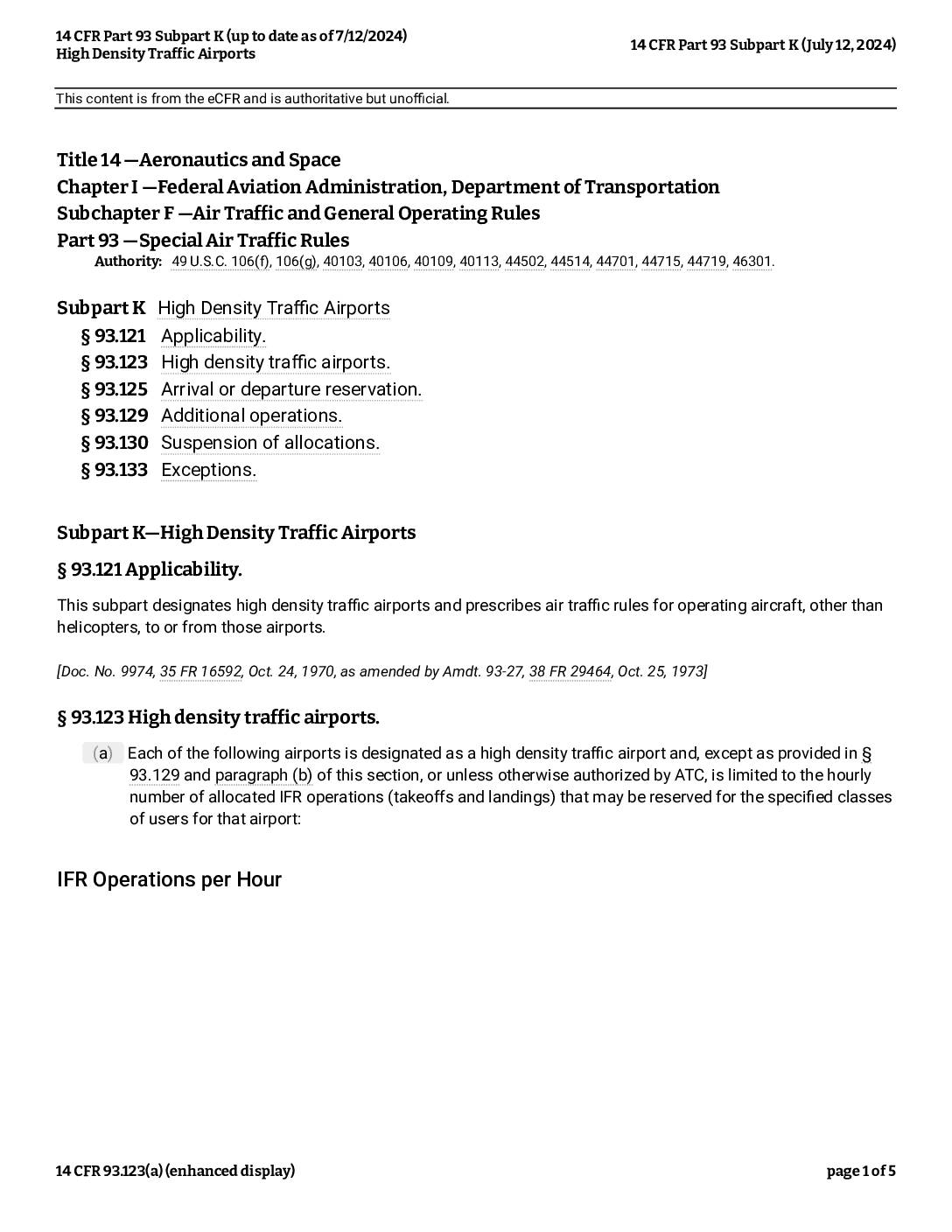
    14 CFR part 93 subpart K — High density traffic airports

    This federal regulation identifies certain U.S. airports as 'high density traffic airports' and sets hourly limits on the number of IFR (instrument flight rules) takeoffs and landings allowed there. The designated airports include LaGuardia, Newark, O'Hare, Ronald Reagan National, and John F. Kennedy, with specific caps assigned to air carriers, commuter airlines, and other users. Note that this regulation does not apply to Sea-Tac Airport and pertains to air traffic slot management rather than noise policy.
    TagsAir Traffic Control, CFR, FAA, Slots, Title 14FolderUSC & CFR

Posts pagination

Page 1 … Page 17 Page 18 Page 19 Page 20 Page 21 … Page 69
Sidebar On/Off

Upcoming Events

  • Stay Grounded Event: Night trains, not night planes!
    Add to CalendarMSunday Sep 13: 12:00am
    Ntnnp social media3

    For the past two years, more than 220 initiatives from 15 countries have declared September 13th as the International day for the ban of night flights at airports. In parallel, activists across Europe have been gathering for pyjama parties for night trains – coordinated in 2024 and 2025 by Back on Track and Stay Grounded.

    [...]
  • Burien Airport Committee Meeting September 15, 2026
    Add to CalendarMTuesday Sep 15: 6:00pm
    400 SW 152nd St, Burien, WA 98166
    Burien airport committee 15 sep 2026 agenda pdf pdf

    a) Part 150 Noise Study (Emily Inlow-Hood) — 15 minutes
    b) SAMP Update and Next Steps (Brian Davis and Sarah Moore) — 15 minutes
    c) Legislative Updates — 10 minutes
       • SCA (Sarah Moore)
       • Work with Sen. Orwall (Brian Davis)
    d) StART Reorganization (Jeff Harbaugh and Karen Veloria) — 10 minutes

    [...]

[See all...]


Help study childhood asthma. Get free HEPA filter!

read more...

Issues

Sea-Tac Airport is currently undergoing the largest and longest expansion in its history, collectively known as the Sustainable Airport Master Plan (SAMP). Some of it you can already hear, but you’re probably not aware of what it all means. Here’s what you need to know.
read more...

Read This!

As the source for federal transportation grants, the Puget Sound Regional Council was charged with developing a system to meet the growing need for commercial aviation. When the search for a second airport failed, they authorized the Port of Seattle to build the Third Runway, with a mandate to develop a noise abatement and mitigation program. In their effort to stop the Third Runway, the ACC argued over every detail of the Port's efforts--including property buyouts and sound insulation. The dispute was meant to be settled by a three member Expert Arbitration Panel. This is their final report. It finds 2-1, that the Port's program was insufficient in several respects. Despite that, funding for the Third Runway was approved by the PSRC, and the 'Port Package' program, proceeded largely unchanged. Expert Arbitration Panel's final decision finding that the Port of Seattle had not shown sufficient reduction in real on-the-ground noise impacts to satisfy noise reduction conditions required for approval of a third runway at Sea-Tac International Airport. The majority decision concluded the Port's noise abatement programs were insufficient despite being impressive in scope.
continue...

The Podcast!

Subscribe to the only podcast devoted to policies, politics, history, impacts for people living under the flight path everywhere. It’s definitely not just about noise!
  • Sea-Tac Noise.Info
  • Connect with STNI

    • Subscribe
    • Port Package Problem?
    • Donate
    • Podcast
    • Socials
      • Facebook
      • X (Twitter)
      • Bluesky
      • Instagram

    "Federal aviation noise and air quality legislation for StART Federal Working Group consideration" — , 2025

  • Learn

    • Frequently Asked Questions
    • Explainers
    • Youtube
    • Research Requests
    • Make a complaint
  • Goals

    Fulfill the promises of 1976:
    • Compensation
    • Reduced noise
    • Improved air quality
    • Environmental remediation
Login/Register
©2026•Data Privacy

Message

We use cookies to provide basic functionality. We also provide access to search engines in order to provide site analytics. We do not sell or share your data.
V V