TagFAA(687)
-
 2024-05-11
Community impacts from NextGen noise: Questions for community groups
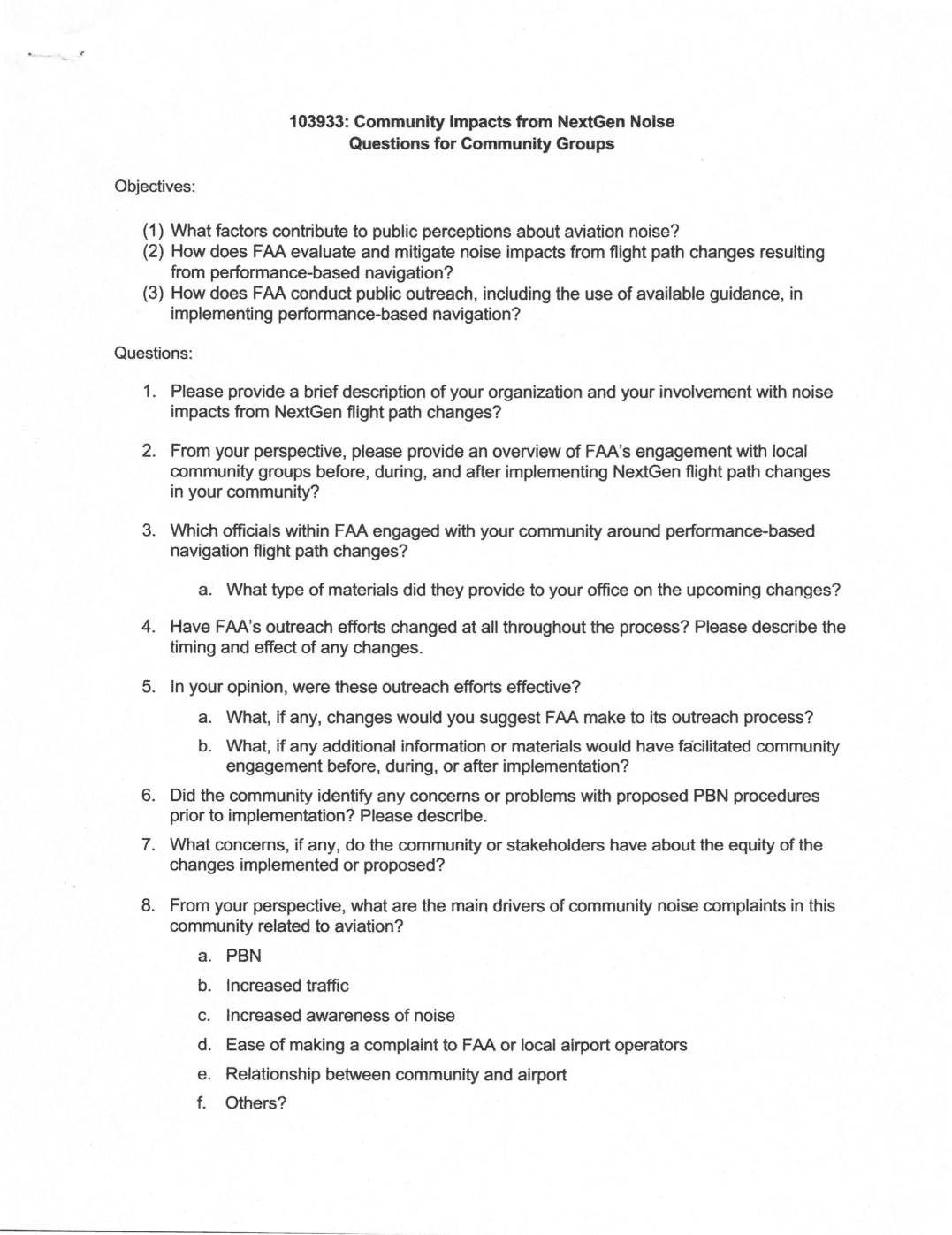
This document contains a structured set of interview questions developed for a GAO study (project 103933) examining how NextGen flight path changes have affected local communities through increased aviation noise. The questions are directed at community groups and cover topics including FAA outreach efforts before and after implementation, equity concerns, the drivers of noise complaints, and whether any flight path modifications were sought or made following implementation. It aims to assess how effectively the FAA communicated with and involved communities in performance-based navigation (PBN) decisions. -
 2024-05-11
NextGen effects on communities surrounding Sea-Tac Airport
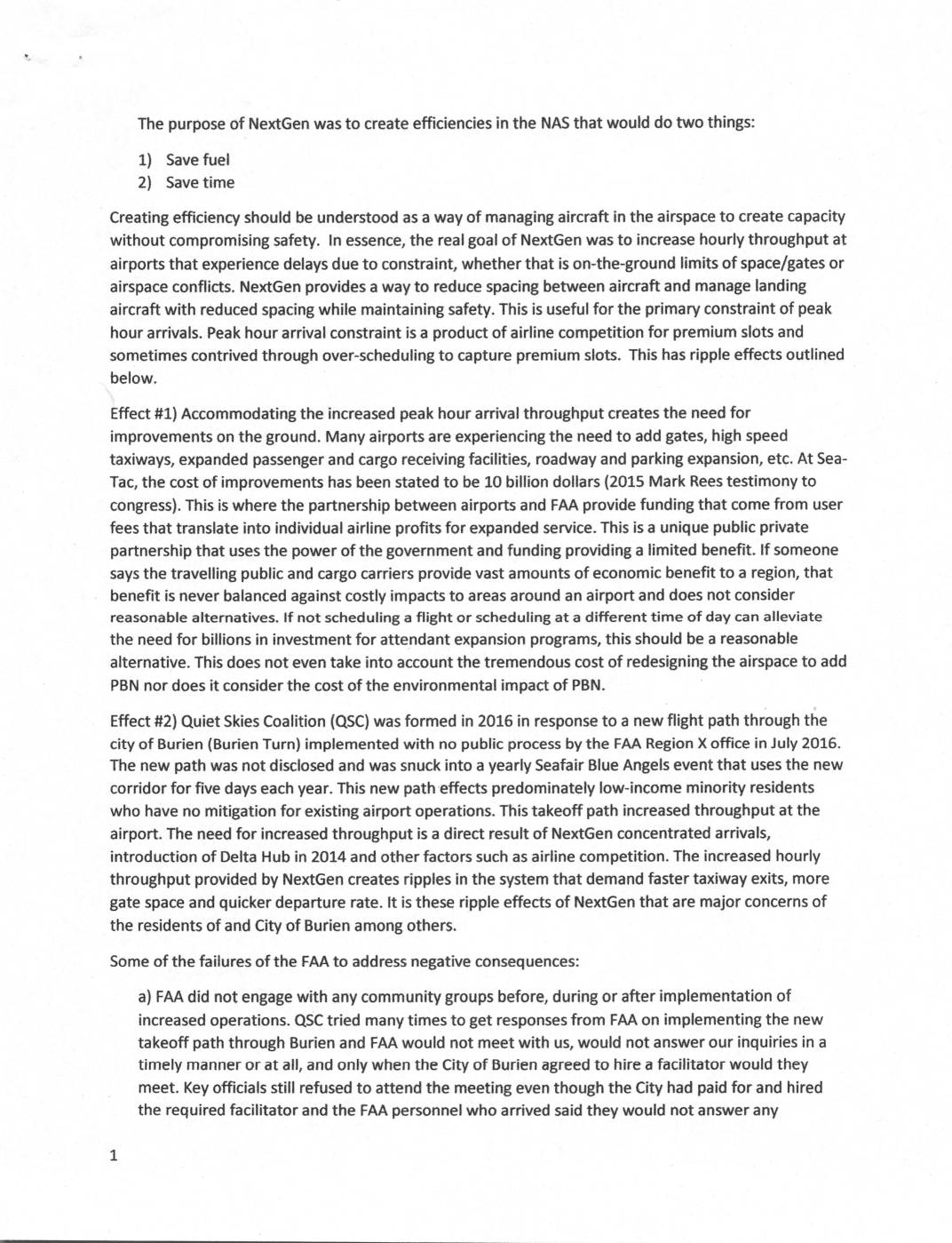
This document outlines concerns raised by the Quiet Skies Coalition about how the FAA's NextGen air traffic modernization program has increased flight operations at Seattle-Tacoma International Airport, creating concentrated flight paths over low-income and minority neighborhoods like Burien. It argues that the FAA failed to engage communities before implementing new flight routes, dismissed significant noise and air quality concerns, and has not analyzed the cumulative health impacts of aircraft noise and ultrafine particle emissions on nearby residents. The document also details a successful legal challenge by the City of Burien against the FAA in the 9th Circuit Court of Appeals, which the FAA has continued to ignore. -
 2024-05-11
Read this, to start understanding the ‘Greener Skies’ fraud
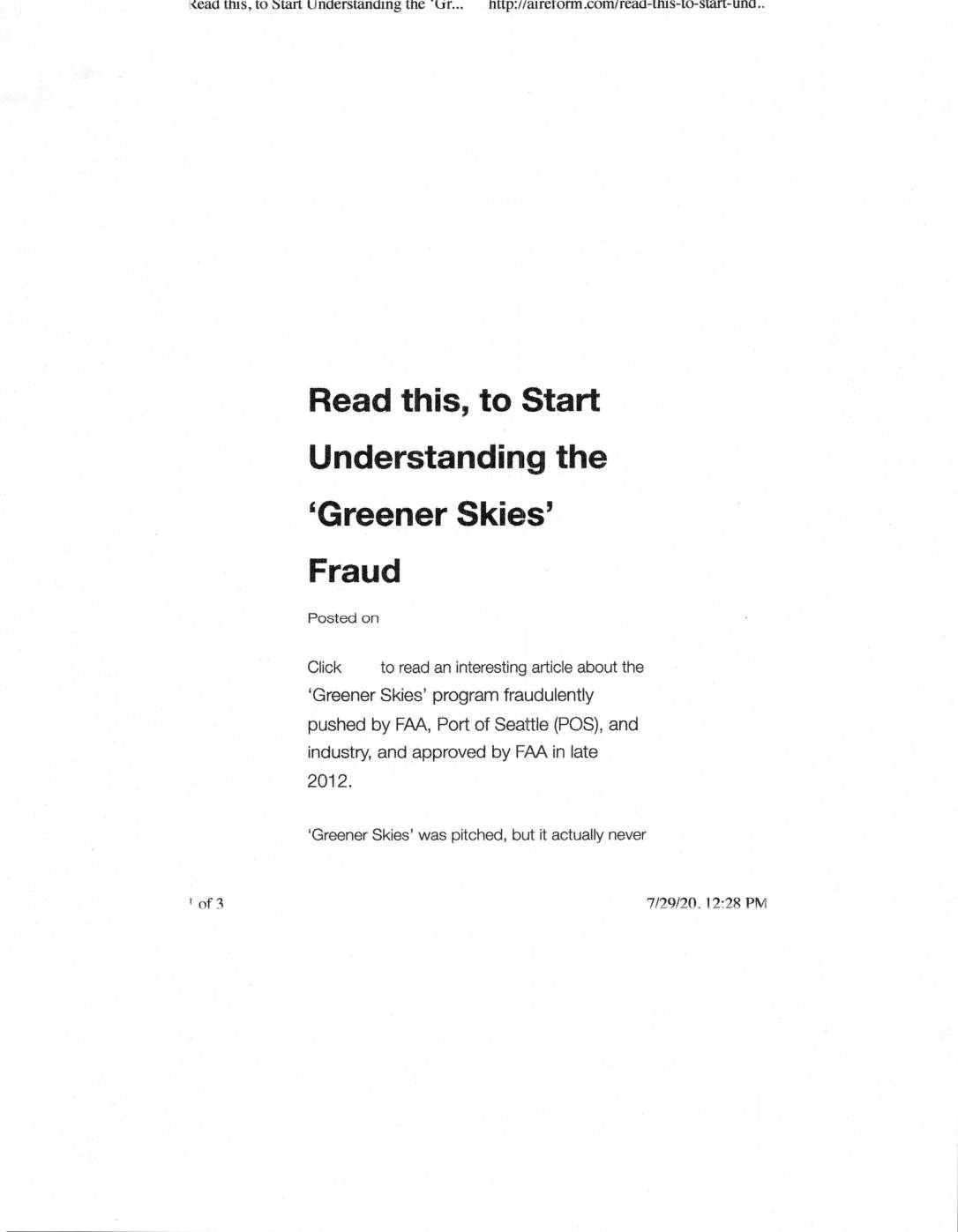
The 'Greener Skies' program, approved by the FAA in late 2012 and promoted by the FAA and Port of Seattle, promised to dramatically reduce aircraft noise near Sea-Tac Airport by routing more than half of all arrivals over Elliott Bay, far from residential areas. Critics argue the program was fundamentally flawed and never delivered on its promises, as air traffic controllers rarely use the Elliott Bay routes due to the need to merge east- and west-side arrival streams. FAA and industry's own data are cited as evidence that the program amounted to an environmental fraud, with concentrated flight paths continuing to impact west-side communities while east-side routes were never given equivalent precision procedures. -
 2024-05-07
The basics of noise metrics
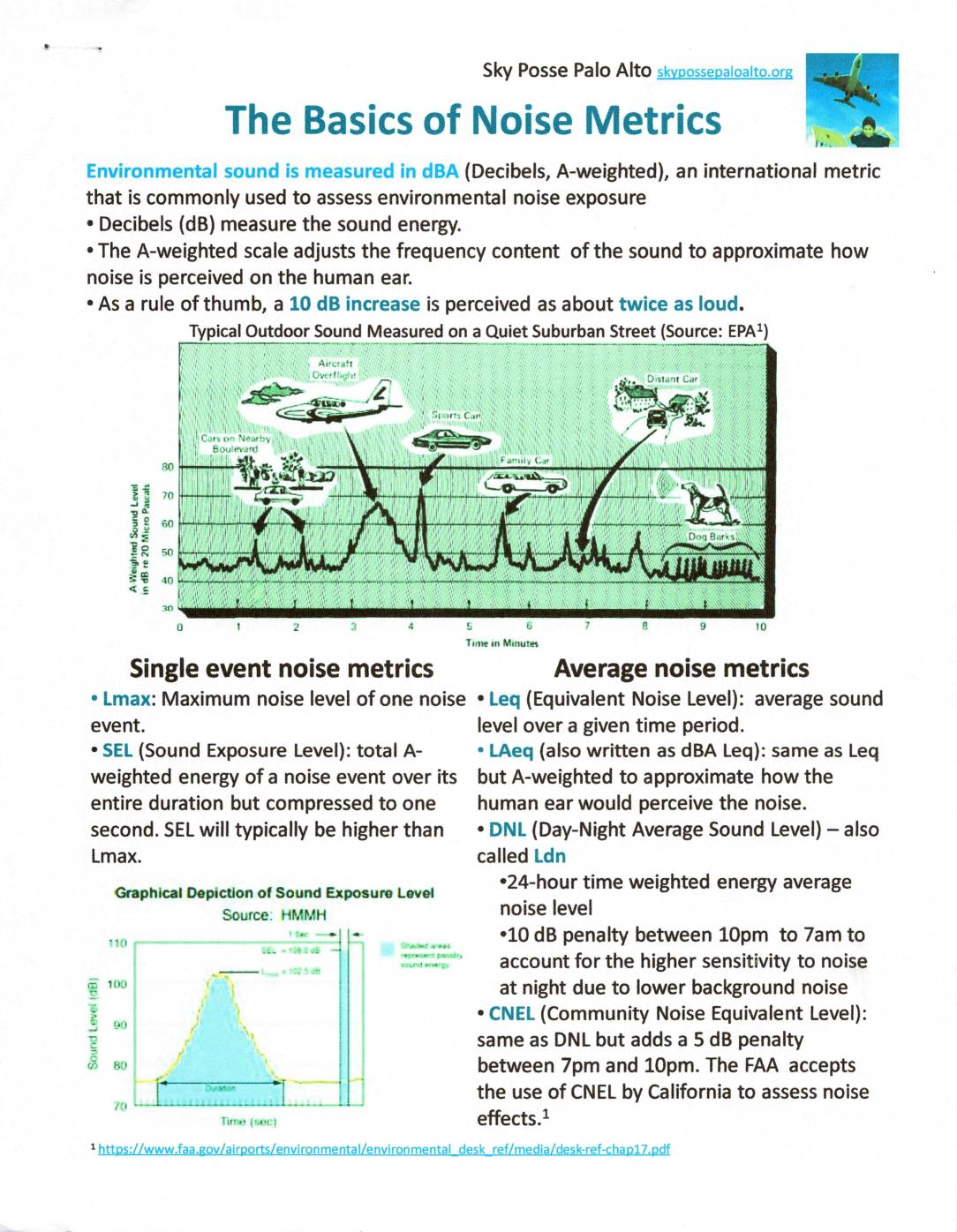
This document explains how aircraft noise is measured using decibel-based metrics such as DNL, CNEL, and SEL, and highlights that the FAA's accepted noise threshold of 65 dB exceeds the World Health Organization's recommended limits of 50–55 dB outdoors and 30–35 dB indoors. It also notes that standard metrics like SEL fail to capture the cumulative impact of repeated aircraft overflights. The international aviation body ICAO recommends a four-part 'Balanced Approach' to managing airport noise, encompassing noise reduction at the source, land-use planning, operational procedures, and operating restrictions. -
 2024-05-07
Consequences of parallel runway operations at Sea-Tac Airport
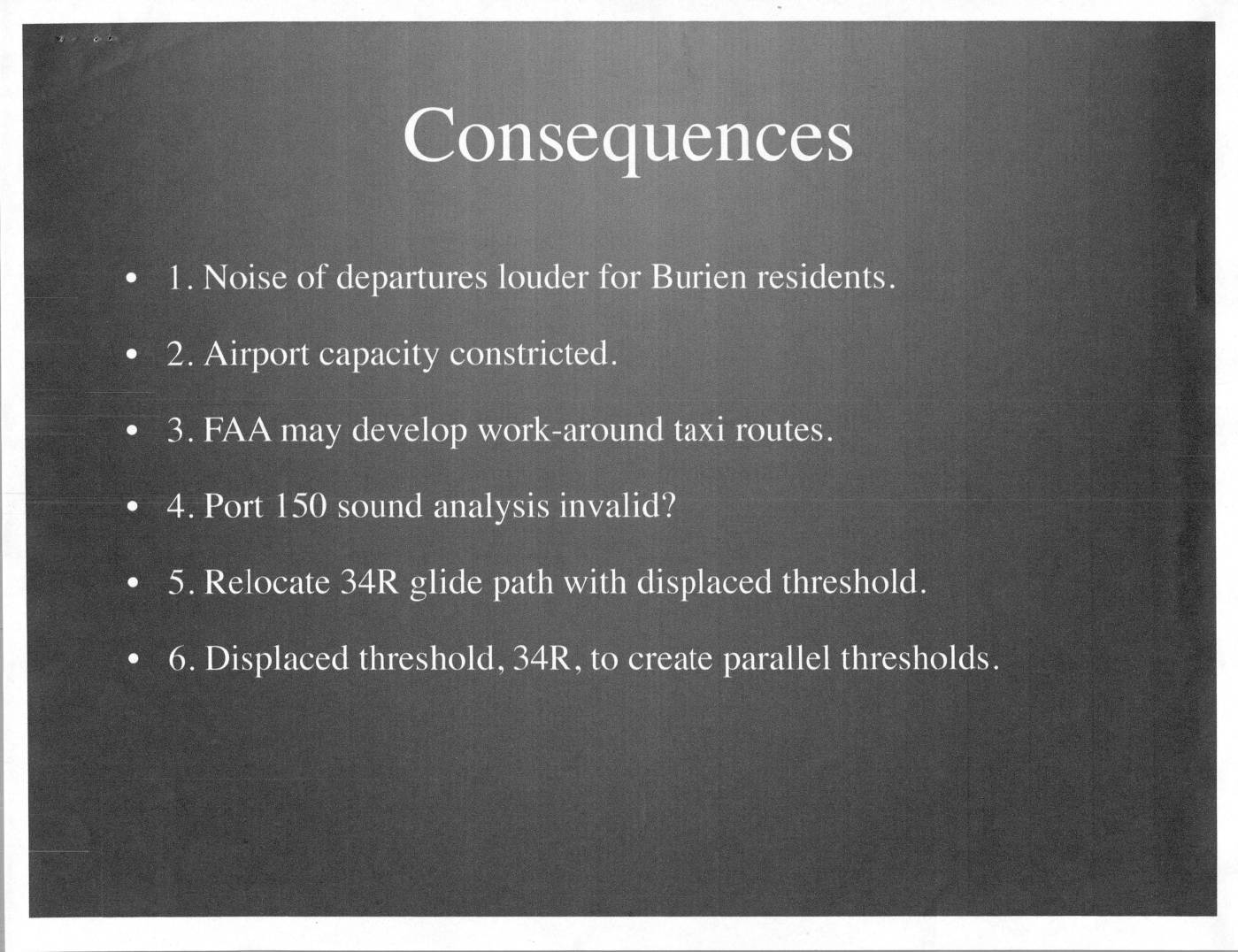
This presentation examines the consequences of runway configuration changes at Seattle-Tacoma International Airport (Sea-Tac), including louder departure noise for Burien residents, reduced airport capacity, and potential FAA workaround taxi routes. It references Seattle Air Traffic Control Tower standard operating procedures for opening and closing runways, and analyzes the feasibility of simultaneous parallel runway operations under FAA Order JO 7110.65. Key technical challenges identified include the need to relocate the Instrument Landing System, extreme ramp congestion, and the possibility of displacing the Runway 34R threshold by approximately 3,400 feet to achieve parallel threshold alignment. -
 2024-05-07
Requests for assessment of POS and FAA Part 150 compliance
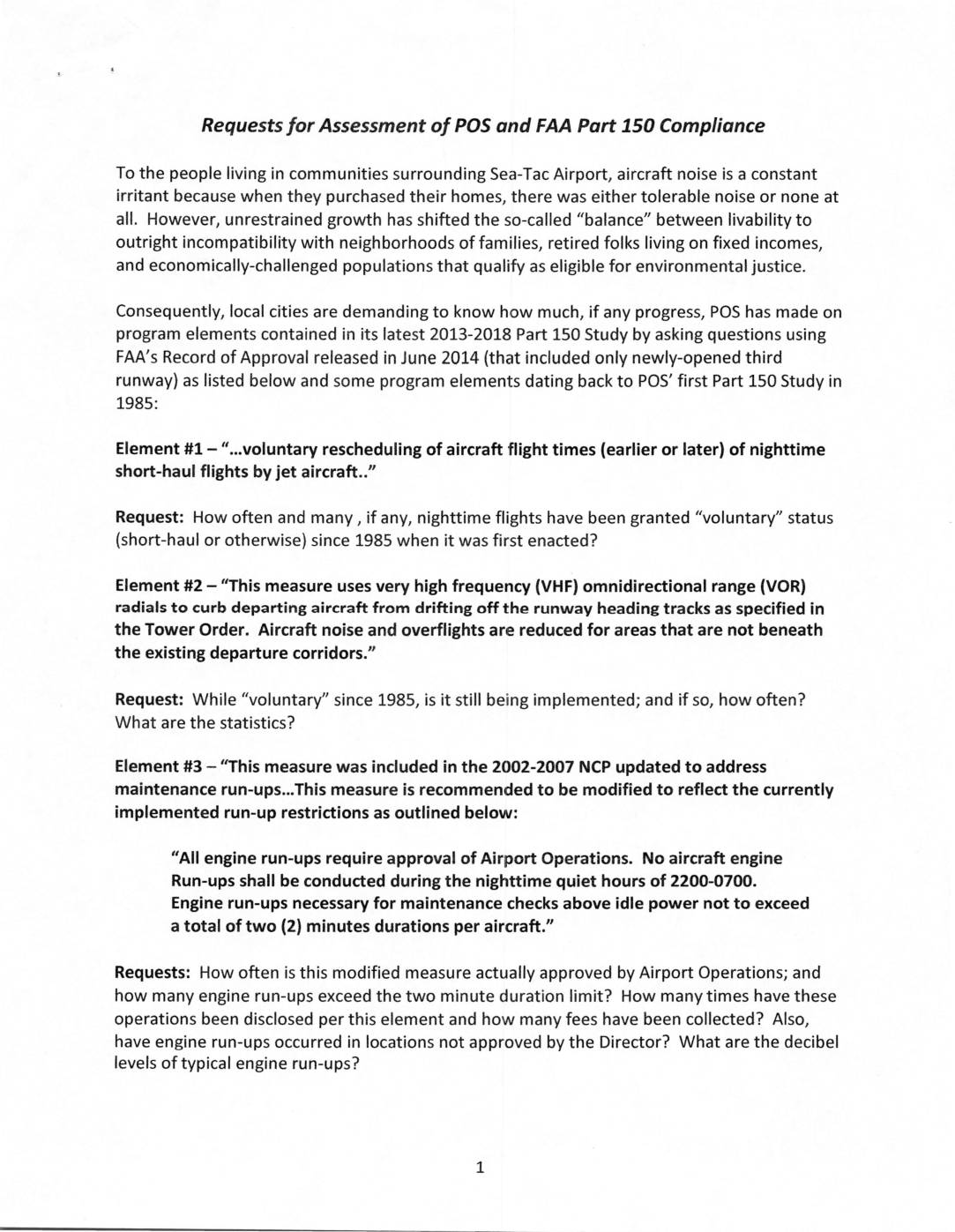
Local communities surrounding Seattle-Tacoma International Airport are demanding accountability from the Port of Seattle (POS) regarding its compliance with FAA Part 150 noise mitigation measures, some dating back to 1985. The document raises detailed questions about ten specific program elements — including voluntary flight rescheduling, engine run-up restrictions, noise abatement corridors, the Fly Quiet Program, and home sound insulation — asking for data on how consistently and effectively each measure has actually been implemented. Critics argue that despite decades of commitments, key noise reduction tools such as a Ground Run-Up Enclosure have been quietly dropped, while growing air traffic continues to harm residential neighborhoods and environmentally vulnerable populations. -
 2024-05-07
Handwritten notes on airport grant assurances and noise mitigation
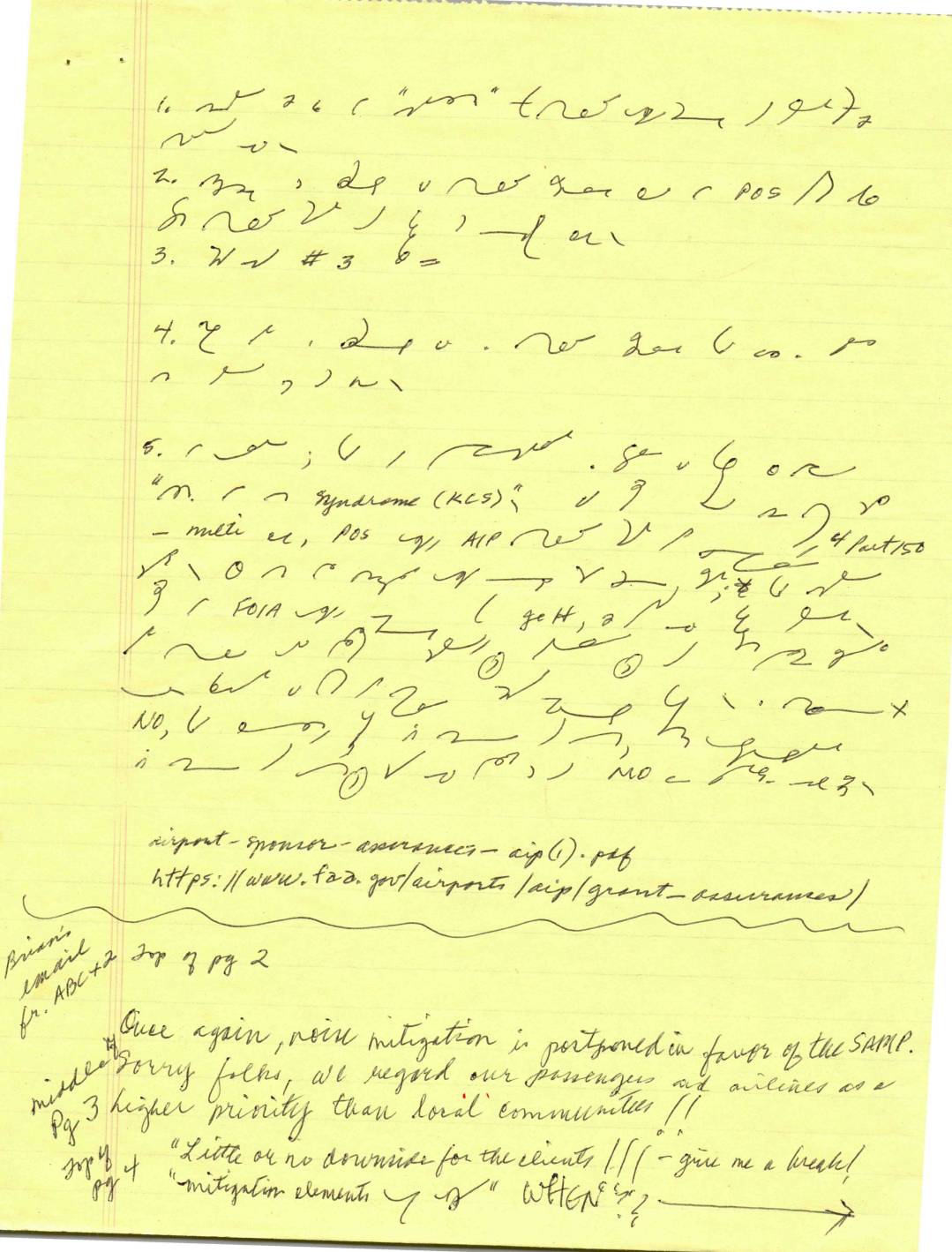
Handwritten notes reviewing an FAA document on airport grant assurances, referencing noise mitigation policy and Kandahar Corridor Syndrome (KCS). The notes criticize the postponement of noise mitigation efforts in favor of the SAMP (Sustainable Airport Master Plan), quoting language suggesting 'little or no downside for the clients' and expressing concern that passengers and airlines are being prioritized over local communities. A URL referencing FAA airport grant assurances (airport-sponsor-assurances-aip(1).pdf) is also included. -
 2024-05-06
Response to noise analyses by FAA contained in Section 5.2.7 noise and noise-compatible land use from CATEX on page 34
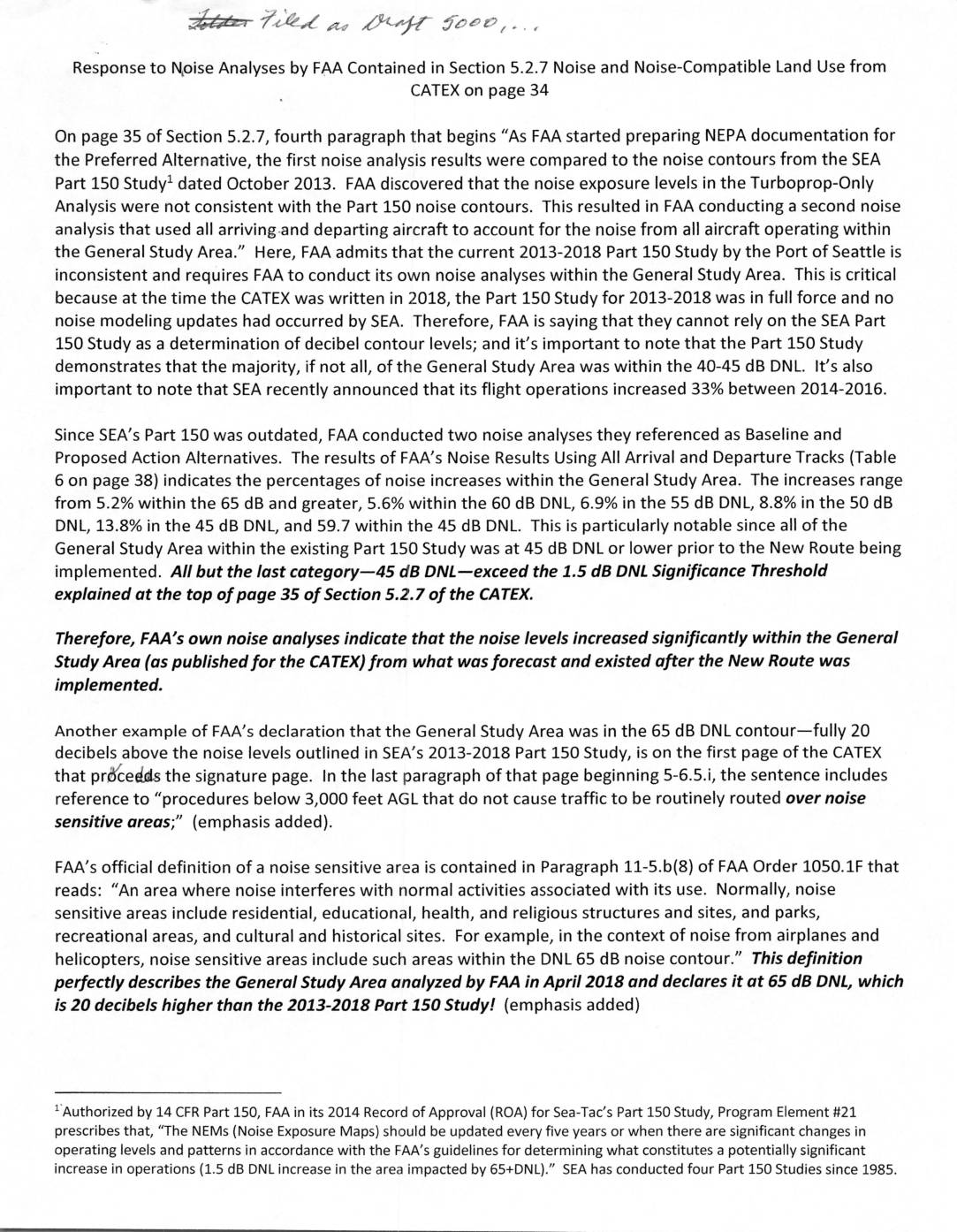
The Quiet Skies Coalition challenges the FAA's Categorical Exclusion (CATEX) for new turboprop flight routes over Burien, Washington, arguing that the FAA's own noise analyses show significant increases in noise levels that exceed the agency's 1.5 dB DNL significance threshold — contradicting the FAA's claim of no environmental impact. The coalition contends that the FAA's reliance on an outdated 2013-2018 Sea-Tac Part 150 noise study, which failed to account for a 51% increase in airport operations, led to inaccurate noise assessments and improper use of a categorical exclusion. Community members and the City of Burien are urged to join legal and political efforts to challenge the FAA and Port of Seattle's authority over flight path decisions affecting residents from Shoreline to Federal Way. -
 2024-05-06
Cumulative impact analysis of the Burien Turn and Sea-Tac Airport development actions under NEPA
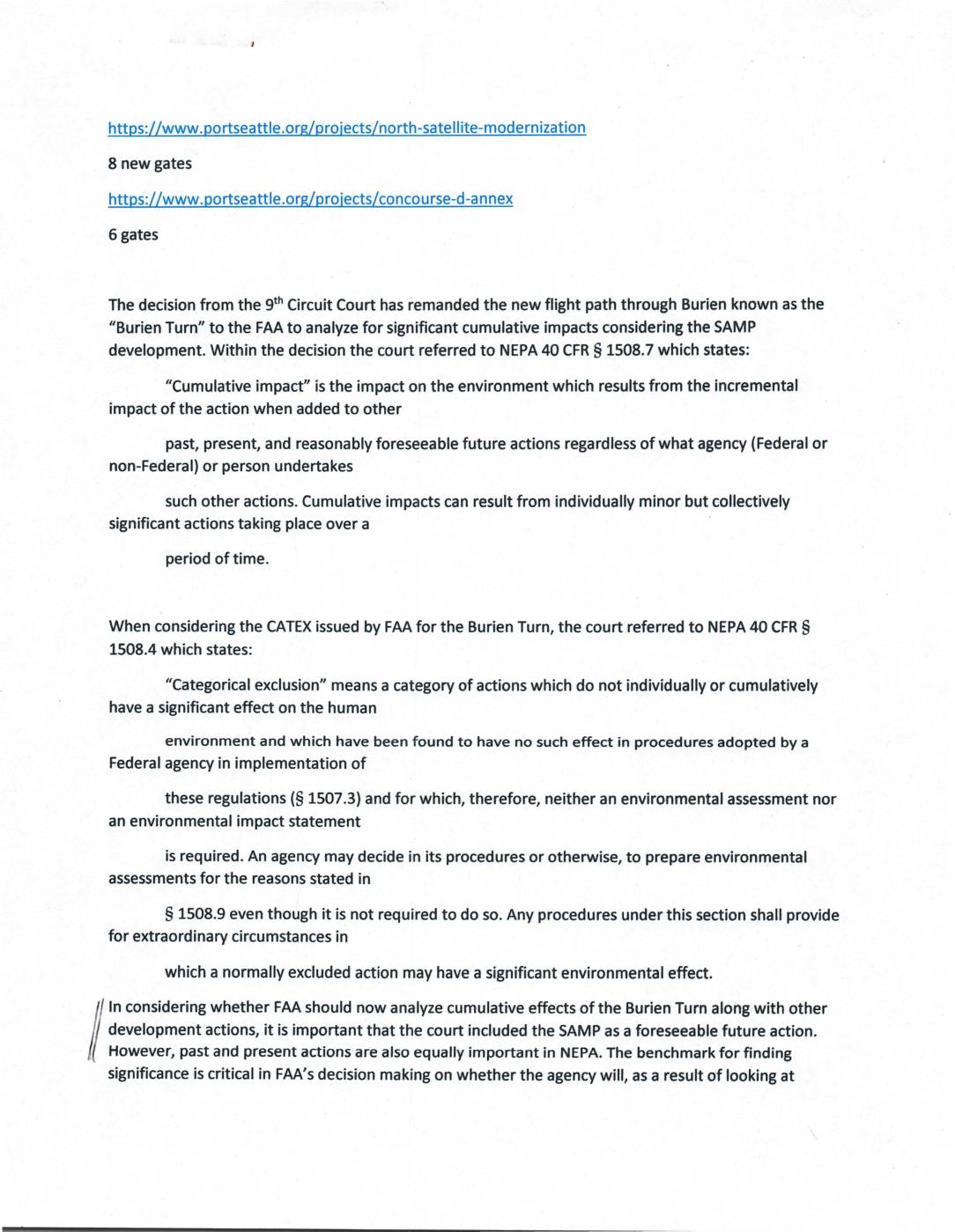
A legal and regulatory analysis arguing that the FAA must conduct a broader cumulative environmental impact review of Seattle-Tacoma International Airport expansion, following a 9th Circuit Court ruling that remanded the 'Burien Turn' flight path back to the FAA. The document contends that multiple airport expansion projects—including the addition of 14 new gates and the extension of Highway 509—were each approved individually under categorical exclusions (CATEXs) without properly accounting for their combined effects on noise, air quality, and environmental justice communities. The author argues that under NEPA regulations, the FAA is required to analyze these past, present, and future actions together to determine whether their collective impact is significant. -
 2024-05-06
Answer on ‘LIMITED Update’ from FAA
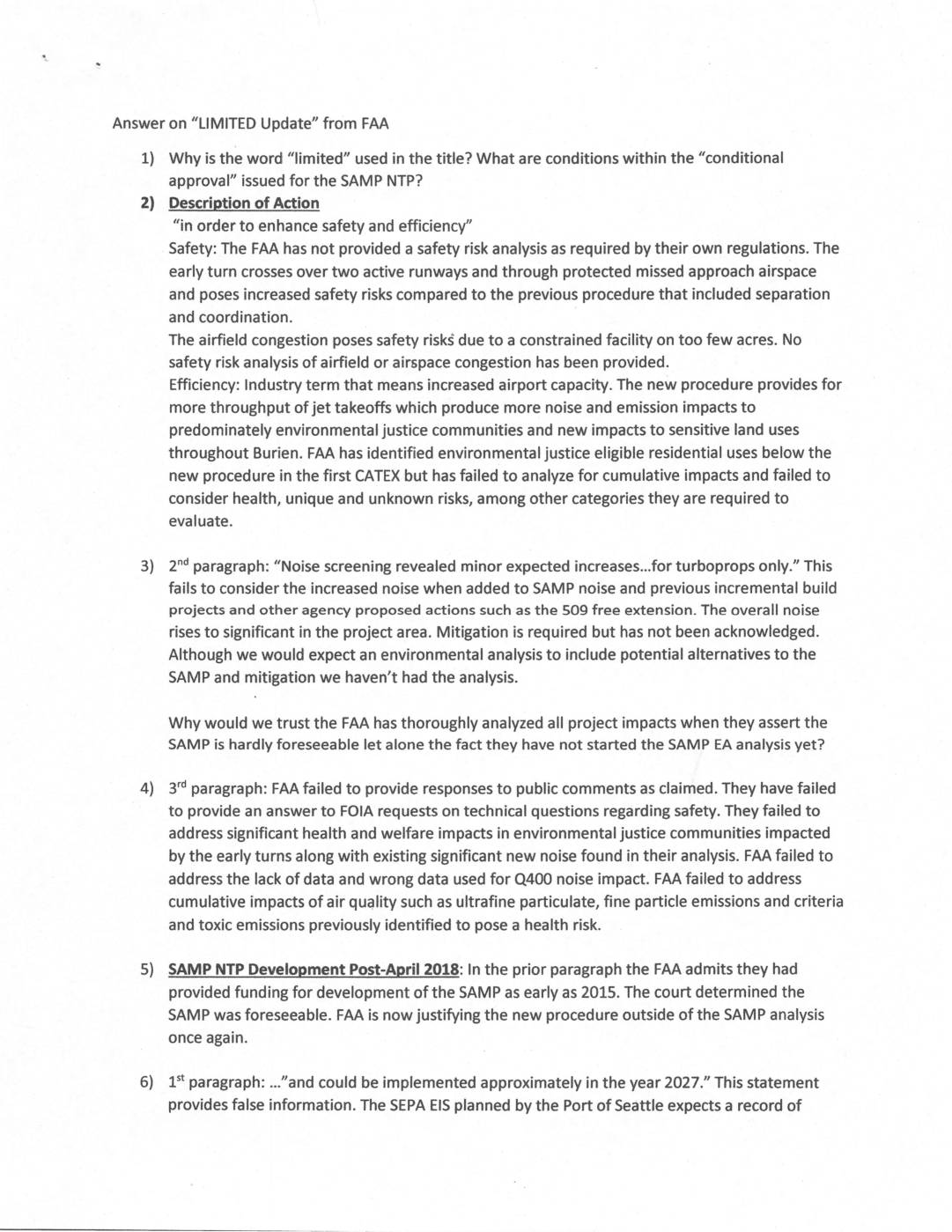
This document presents a point-by-point rebuttal to an FAA 'Limited Update' regarding a new flight departure procedure at Seattle-Tacoma International Airport, arguing that the FAA has failed to conduct required safety risk analyses, properly assess cumulative noise and air quality impacts on environmental justice communities, and comply with court-ordered environmental review under NEPA. The authors contend that the FAA is understating the scope and timeline of the Sea-Tac Airport Master Plan (SAMP) expansion while dismissing significant health, noise, and emissions impacts on nearby residents. The critique calls out procedural shortcuts, incomplete public comment responses, and what it characterizes as predetermined conclusions designed to avoid full environmental scrutiny.